An ISDA AI tool is software that reads a dealer's ISDA Schedule, credit support annexes and related agreements, extracts each negotiated term with the page it came from, compares it with the fund's playbook and with what the same dealer accepted before, and drafts the counter, the redline and the cover note for a lawyer. Used well, it removes the days of reading, searching and drafting that delay an ISDA negotiation. Used badly, it makes a credit decision nobody approved, or sends a redline nobody reviewed. The boundary between the two is the whole question a buyer should ask, and it is the one regulators ask too: FINRA lists "Autonomy" and "Scope and Authority" among the risks of AI agents. Botminds' ISDA Negotiation puts that boundary in the product: seven agents read, place, find precedent, draft, check and book; the lawyer decides every term, credit risk and treasury approve their terms, and only the deputy general counsel releases a turn.
The examples come from a fictional sample firm, Quillfield Capital, and a fictional dealer, Thornbury Bank N.A. Regulators' statements and research findings are linked where they are used.
An ISDA AI tool, bounded
6min
for the agents to read an 85-page, four-document dealer package and draft the redline, in the sample case
fictional sample
0
turns, concessions or approvals any agent can send or make on its own
product design
58%+
how often public chatbots hallucinated on legal questions in a peer-reviewed study
Journal of Legal Analysis, 2024
Can AI negotiate an ISDA?
AI can do most of the work of an ISDA negotiation, but it should not negotiate. Reading, comparing, finding precedent and drafting are tasks with checkable answers: a term is on page 6 or it is not; a dealer accepted 30% in 2024 or it did not. Deciding to concede is different. A NAV trigger, a cross default threshold or an eligible-collateral cap is a credit judgement that binds a fund to every future trade with that dealer, and it belongs to people who answer for the fund's risk.
The regulators' framing points the same way. In FINRA's definition an agent is a program able to complete a user's task without step-by-step direction, and the first risks the regulator lists are an agent acting with no person validating or approving it, and an agent reaching beyond the scope and authority its user meant to give it (FINRA, 2026 Annual Regulatory Oversight Report). An agent that conceded a term would be acting with authority no one gave it.
The agents may read, place, find precedent, draft and check. Conceding a term, accepting credit risk or releasing a turn to the dealer stays with a named person.
The answer is not to keep agents out of the work, but to give each a narrow task, a source for everything it says, and a limit it cannot cross. The figure below is how that looks across one first turn.
What can an AI tool do with a dealer's ISDA draft?
An AI tool can take a dealer's draft from the inbox to a checked redline: log and match it, extract every term, place each on the playbook, find precedent, draft the changes and check them blind. Each step has something it may never do. The people's steps follow, and nothing reaches the dealer until they are done.
One first turn, agent by agent, and where the people take over
Agent
Intake agentClassifies each document, matches it to a fund, dealer and negotiation by LEI, name and open trading requests, spots duplicates, and compares a new turn with the last, including changes the dealer did not mention.
Never: opens a negotiation for an unknown fund; below 90% match confidence an analyst confirms.
Agent
Reader agentExtracts every negotiated term, clause by clause, with document, clause and page; reads German, French and Japanese masters in the original.
Never: guesses a value; below 85% confidence it asks a person.
Agent
Playbook agentPlaces each term on the fund type’s scale from preferred to walk away and routes it: thresholds to credit risk, collateral to treasury, language to legal.
Never: edits the playbook, or treats “near the line” as approved.
Agent
Precedent agentFinds what this dealer accepted before across the firm’s funds, and what other dealers accepted for the same fund type.
Never: anchors on an agreement older than five years or one that was superseded.
Agent
Drafter agentWrites the counters and the redline in the firm’s clause language, with a cover note and an issues list.
Never: sends anything to a dealer.
Agent
Checker agentRe-reads the redline blind against the extracted terms, the playbook and the other documents, and reports inconsistent definitions and numbers.
Never: changes the redline itself.
A person decides
Negotiating lawyerDecides every term: accept the counter, edit it, or concede with a reason code.
A person decides
Credit risk and treasuryApprove thresholds, triggers and collateral terms, each with the clause and precedent beside it; a maker never approves their own decision.
A person decides
Deputy general counselApproves any concession beyond the playbook with the term owner, and releases the turn once every owner has decided.
In the sample case this took six minutes on a Friday afternoon: 23 terms extracted with the lowest confidence at 95%, seven placed off the playbook, six counters anchored on the dealer's 2024 agreement with another fund, 31 changes drafted, and two findings from the blind second read. One was a definition in Part 5(n) of the Schedule that still said 30% over three months after the counter in Part 1(h)(ii) had moved to 40%. Nothing was sent.
Can an AI tool send a redline to the dealer?
It can be built to, and it should not be. Sending a turn commits the fund's position to a counterparty; once a dealer has seen a concession, it is hard to withdraw. In ISDA Negotiation the Drafter agent "Never sends anything to a dealer", and the release of any turn belongs to the deputy general counsel, after every term is decided and every approval is in.
The same applies after signing. The Booking agent compares each signed collateral term with the collateral system and prepares the update, but nothing is written until treasury checks it. In a second sample agreement, it found one field that differed: a 96% valuation percentage for Treasuries over ten years in the signed CSA against 94% in the system, which had come from a template default. The agent proposed the fix; treasury made it.
FINRA's description of good practice for generative AI fits this design: log every prompt and every output, note which model version was running on which dates, and put a person between an output and its use (FINRA, 2026). A tool that can act on a dealer or a collateral system without that review fails the first test a compliance team will set.
Who approves a concession when AI drafts the counter?
The people who own the term, never the agent and never the person who made the decision. In the sample firm's routing, NAV triggers, cross default, independent amounts and NAV reporting go to credit risk; eligible collateral, minimum transfer, timing, interest and the custodian go to treasury; and any concession beyond the playbook's walk-away needs the term owner and the deputy general counsel.
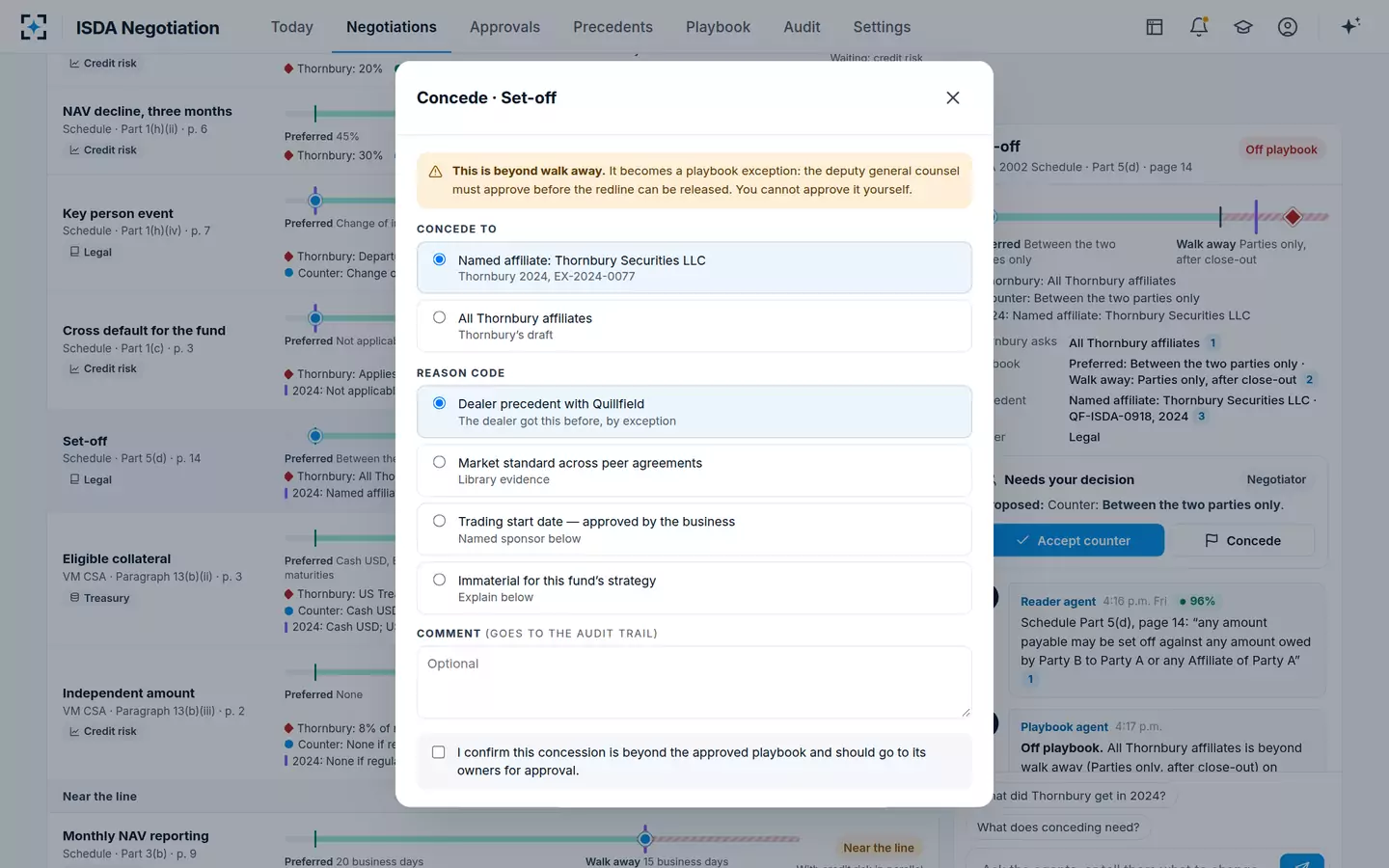
The concession screen makes the rule concrete. When the sample negotiator conceded set-off with one named dealer affiliate, as the dealer had won in 2024, the screen warned that this was beyond walk-away, would become a playbook exception, and that she could not approve it herself. She chose a reason code, "Dealer precedent with Quillfield", and the exception went to the deputy general counsel. Regulation expects exactly this kind of trail: EU and UK margin rules require counterparties' procedures to cover how exceptions to them are authorised and recorded (Delegated Regulation 2016/2251, Article 2(2)(e)).
Conceding in ISDA Negotiation: a reason, a comment and a second name
How is an AI tool's reading of an ISDA checked?
Every value the tool extracts should point to the dealer's own words, and the people who rely on it should be able to open that passage in one click. In ISDA Negotiation each term cites its document, clause and page; the Reader agent asks a person below 85% confidence; the Checker agent re-reads the redline blind; and opening a source is logged. A lawyer who doubts a reading checks it against the page, not against the tool.
Testing the tool before trusting it needs labelled examples. The research community learned this on contracts: the CUAD contract dataset took dozens of legal experts and more than 13,000 annotations to build, precisely because labelling contracts well needs experts and experts are expensive (Hendrycks et al., NeurIPS 2021; how to measure a legal search tool on ISDA clauses builds such a test step by step). The same method applies inside a fund: a set of the fund's own executed agreements, with each term's correct value agreed by its lawyers, against which the tool is scored. ISDA Negotiation's agents are evaluated on a golden set of 120 executed agreements, and any person can override a result with a reason code.
Four ways to check an ISDA AI tool’s reading, and what each catches
| Check | How it works | What it catches |
|---|---|---|
| Citation to the page | Every extracted value links to the passage in the dealer’s document; opening it is logged | Values the tool invented or took from the wrong document |
| Confidence floor | Below a set confidence, the agent asks a person instead of answering | Scans, unusual drafting, other languages |
| Blind second read | A separate agent re-reads the redline against the terms and the other documents without seeing the drafter’s reasoning | Definitions and cross references that undo a counter; numbers that differ between documents |
| Golden set | Scoring against the fund’s own executed agreements, with values agreed by its lawyers | Systematic errors before go-live, and drift after a model change |
How often do legal AI tools hallucinate?
Often enough that no legal AI output should be used without its source. A peer-reviewed study of public chatbots found large language models wrong on legal questions at least 58% of the time, poor at telling when they were wrong, and quick to accept a user's mistaken legal premise (Dahl et al., Journal of Legal Analysis, 2024). A later preregistered study of commercial legal research tools built on retrieval found fewer invented answers, but each tool tested still produced them on 17% to 33% of queries (Magesh et al., Journal of Empirical Legal Studies, 2025; how to test a cited answer covers both studies).
Legal AI still makes things up, and retrieval reduces it without removing it
Two lessons carry over to ISDAs. First, a tool should answer from the document in front of it, not from what it remembers about ISDAs in general; the questions that matter in a negotiation, what this dealer's draft says and what this dealer signed in 2024, have answers in the fund's own files. Second, an answer without a citation should be treated as a guess. The researchers' own conclusion was a warning against "the rapid and unsupervised integration of popular LLMs into legal tasks".
What do regulators say about AI agents?
US and EU regulators have said that their rules apply to AI as they apply to everything else, and that firms must supervise it. FINRA has said its rules and guidance are meant to apply whatever technology a firm uses (Regulatory Notice 24-09). ESMA expects a firm's management body to understand how AI is used inside the firm and to oversee it, and warns against relying on AI so heavily that human judgment is set aside (ESMA, May 2024).
FINRA's agent risks read like a design brief for an ISDA tool: reasoning spread over many steps can leave a result that nobody can trace or explain, and an agent working on sensitive data can keep, probe, disclose or misuse it without anyone meaning it to. An ISDA package is privileged and confidential, and every step an agent takes on it should be traceable to who asked, what it read and what it produced. In ISDA Negotiation every step, by people and agents, goes to an append-only trail with the reason and evidence, kept for ten years in the sample firm's setting.
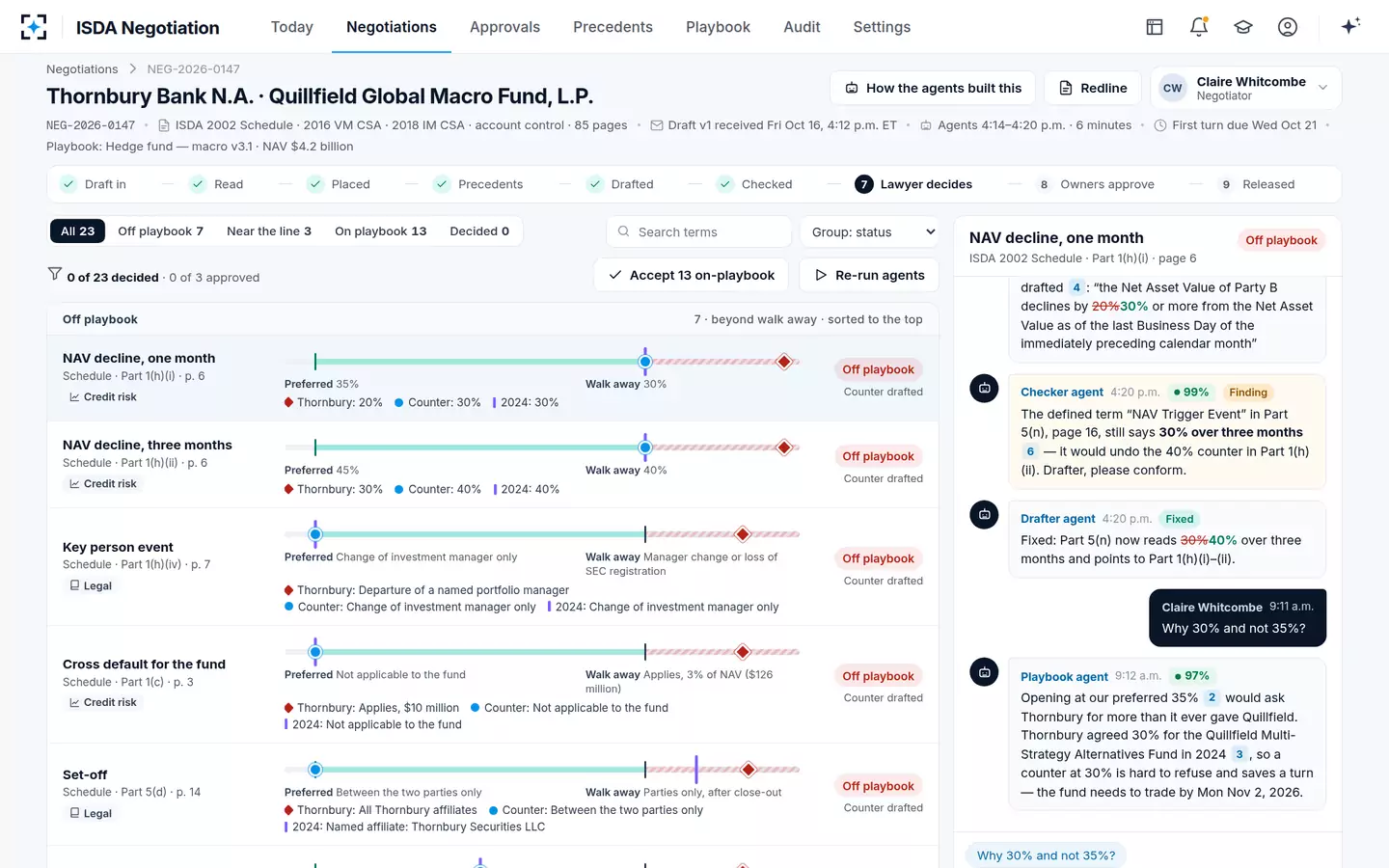
Asking the agents in ISDA Negotiation, with every answer cited
Buying an ISDA AI tool: five tests before a pilot
A fund evaluating an ISDA AI tool should test the boundary first and the accuracy second. A tool that reads well but can send, approve or edit the playbook is not one a general counsel can sign off. Five tests separate the two.
Ask the tool to send a redline: it should refuse, and say who can. Ask it to concede a term beyond the playbook: it should produce an exception that needs two named approvers, neither of them the maker. Pick ten values it extracted and open their sources: each should land on the dealer's words. Give it a package whose definitions disagree with its numbers: the second read should find the conflict. And ask for the trail of one decision: who, when, why, on what evidence, and which agent version. How lawyers come to trust such a tool once those tests pass is set out in ISDA negotiation software lawyers will actually use, and how to measure what it changes in the ISDA playbook guide. The seats that keep the decisions are described in who decides ISDA credit terms.
Questions people ask
Is there an AI tool for ISDA negotiation?
Yes. Botminds' ISDA Negotiation is one: its agents read a dealer's package, place every term on the fund's playbook, find precedent, draft and check the redline, and people decide, approve and release. Whatever tool a fund looks at, the test is where it stops.
Can AI read an ISDA Schedule in another language?
It can, and it should show the original beside any translation. In the sample firm, a German Rahmenvertrag with its Besicherungsanhang was read in German, with an English rendering beside each term, and four terms were placed off the fund's UCITS playbook.
Does an ISDA AI tool learn from our negotiations?
It should use the firm's executed agreements as precedent, and only those: in ISDA Negotiation only executed or approved positions count, and a concession that keeps recurring produces a proposed playbook change for the deputy general counsel and the term owner to approve, never an automatic one.
Is it safe to put privileged ISDA drafts into an AI tool?
Only into one built for it. FINRA lists data sensitivity among agent risks; a tool for ISDA work should keep data by entity, carry legal hold and privilege labels, limit outside counsel to the negotiations shared with them, and log every access.
How accurate is AI at extracting ISDA terms?
No regulator or independent study publishes a figure for ISDA documents. Measure it on your own executed agreements with values your lawyers agree, and keep the citation for every value so that errors are caught where they occur.