The difference between the 1992 and 2002 ISDA Master Agreements is mainly in close-out. Under the 1992 form the parties elect in the Schedule a payment measure, Market Quotation or Loss, and a payment method, First Method or Second Method; the 2002 form replaces all four with one measure, the Close-out Amount, and one two-way payment method, and it requires the valuation to be commercially reasonable by an objective standard. The 2002 form also shortens grace periods: a missed payment becomes an Event of Default after one Local Business Day's notice instead of three. Both forms are still signed and still litigated, which is why a fund's documentation team needs to know which one it is reading before it reads anything else. Botminds' ISDA Negotiation reads Schedules under either form, places each term on the fund's playbook and shows what the same dealer agreed under earlier agreements, whichever form they used.
Every statement about the forms on this page comes from an English court's reading of them, linked where it is used. The negotiation examples come from a fictional sample firm, Quillfield Capital.
The 2002 form in three changes
3→1
Local Business Days after notice to remedy a missed payment, 1992 form against 2002 form
Lomas, 2012; Macquarie, 2022
30→15
days to have an insolvency petition dismissed before it is an Event of Default
Court of Appeal, 2012
4→1
close-out elections (two measures, two methods) replaced by a single Close-out Amount paid both ways
Lomas, 2012; Grant, 2022
What is the difference between the 1992 and 2002 ISDA?
The 2002 ISDA keeps the 1992 structure and rewrites what happens when the relationship ends. The High Court put it in two sentences in 2022: the 1992 version "was the first version that was designed in a form applicable to derivatives other than just swaps", and the 2002 version "replicates most of the provisions of the 1992 version albeit with significant changes to provisions concerning the determination of amounts due on early termination" (Grant v FR Acquisitions, 2022, at [52]).
The Court of Appeal explained why the change came. "The terms as to the consequences of early termination were revised in 2002. The reason for this appears to have been that the provisions of the 1992 Master Agreement did not produce a closing out which met regulators' requirements with regard to the capital base of the market participants ... For the first time, the calculation of the liabilities due on closing out had to be carried out “in order to produce a commercially reasonable result”" (Arden LJ, Lehman Brothers International (Europe) v Lehman Brothers Finance, 2013, at [10]).
For a fund, close-out is not an abstraction. It decides how much is paid, and to whom, on the day a dealer or the fund defaults, and the size of that number is set by the side that does the valuing. Everything else in the comparison follows from that.
ISDA 1992 vs 2002, clause by clause
Six clauses account for most of the practical difference between the forms. The table sets each out as the courts have quoted or described it, and says what changes for a fund.
ISDA 1992 vs 2002: six clauses that changed, as the courts read them
Failure to payLomas [12]; Macquarie v Phelan [2022]
1992 formNot remedied on or before the third Local Business Day after notice.
2002 formNot remedied on or before the first Local Business Day after notice.
Why a fund caresTwo fewer business days for a fund’s operations to fix a missed payment before it is an Event of Default.
Insolvency petitionLomas [31]
1992 formAn Event of Default unless dismissed or stayed within 30 days.
2002 formShortened to 15 days.
Why a fund caresHalf the time to have a hostile petition struck out.
Close-out measureLomas [12]; National Power [13]–[15]
1992 formMarket Quotation or Loss, elected in the Schedule; Market Quotation if no election.
2002 formOne measure, the Close-out Amount.
Why a fund caresNo election to negotiate; the valuation standard moves into the definition.
Payment methodGrant v FR Acquisitions [2022], fn 19
1992 formFirst Method or Second Method, elected in the Schedule; Second Method if no election.
2002 formOne two-way method: whoever is in the money is paid.
Why a fund caresA defaulting fund that is in the money is paid; the 1992 First Method could leave it unpaid.
Standard for the valuationNational Power [74]–[81]
1992 formLoss is what a party "reasonably determines in good faith": a test of rationality.
2002 form"Commercially reasonable procedures in order to produce a commercially reasonable result": an objective test.
Why a fund caresA court can substitute its own figure if the dealer’s close-out is not objectively reasonable.
Calculation statementNational Power [13]
1992 formNot quoted in these judgments.
2002 formA statement "showing, in reasonable detail, such calculations (including any quotations, market data or information from internal sources used …)".
Why a fund caresThe fund can ask to see the inputs behind a dealer’s close-out number.
The list is deliberately short. Other provisions differ too; these six are the ones that move money or time in a default, and the ones a fund's playbook should take a position on before the first dealer draft arrives.
Which close-out method does each ISDA use?
The 1992 ISDA uses whichever of four combinations the Schedule elects; the 2002 ISDA uses one. Under the 1992 form, the Court of Appeal explained, "the parties are supposed ... to have elected in the Schedule to the Agreement a payment measure (either “Market Quotation” or “Loss”) and a payment method (either “First Method” or “Second Method”). If no election has been made, then “Market Quotation” is deemed to be the measure and “Second Method” is deemed to be the method" (Lomas, 2012, at [12]). In the Klaus Tschira case the Schedule's Part 1(f) elected "Loss and Second Method" ([2019] EWHC 379 (Ch)).
The payment method is the clause that most affects a fund. The High Court described the First Method plainly: under it, "the Non-defaulting Party could avoid making any payment to the Defaulting Party even if the Defaulting Party was “in the money”", and it is "almost never selected in practice". Under the 2002 form "The concept of the “First Method” does not exist", and the form "automatically proceeds on the basis that a payment is made to whichever party is “in the money”" (Grant v FR Acquisitions, footnote 19). A fund that holds an old 1992 agreement should check its Part 1(f) election for exactly this.
The 2002 measure, the Close-out Amount, is defined as "the amount of the losses or costs of the Determining Party that are or would be incurred under then prevailing circumstances (expressed as a positive number) or gains of the Determining Party that are or would be realised under then prevailing circumstances (expressed as a negative number) in replacing or in providing for" the economic equivalent of the terminated trades (quoted in Lehman Brothers Special Financing v National Power, 2018, at [15]). Gains and losses both count, which is the two-way principle written into the measure itself.
Good faith or commercially reasonable: the standard behind the number
The 2002 form changed the test a court applies to the valuing party's number from rationality to objective reasonableness. Under the 1992 form, Loss was "an amount that party reasonably determines in good faith to be its total losses and costs", a wording the High Court said "requires rationality". Under the 2002 form, the Determining Party must "act in good faith and use commercially reasonable procedures in order to produce a commercially reasonable result" (National Power, 2018, at [1], [74]–[75]).
The court's conclusion is the most important sentence for any fund comparing the forms: "the 2002 ISDA Master Agreement requires the Determining Party to use procedures that are, objectively, commercially reasonable in order to produce, objectively, a commercially reasonable result. If it does not do this the court or a tribunal will" (at [81]). The range in that case shows what is at stake: one side said it was owed $10,778,943 on a single terminated currency swap, the other that it was owed $12,826,887.
What each form lets the valuing party do on close-out
1992 form, Loss: "reasonably determines in good faith" — rationality: no determination "which no reasonable non-defaulting party could come to"
2002 form, Close-out Amount: "commercially reasonable procedures in order to produce a commercially reasonable result", judged objectively
1992 form, Loss: Any rational figure stands, even if a court would have chosen another
2002 form, Close-out Amount: A range of results may be reasonable, but the party cannot "simply take the result that suits it best at one end of the range"
1992 form, Loss: The determination is open to challenge as irrational
2002 form, Close-out Amount: "If it does not do this the court or a tribunal will"
1992 form, Loss: Not addressed in the passages the courts quoted
2002 form, Close-out Amount: A statement showing the calculations "in reasonable detail", including quotations and market data used
When a fund is the party whose trades are being valued, often against a dealer's larger and faster close-out machinery, an objective standard and the right to see the calculation are its protection: they bind the side holding the pen. That is the strongest reason a fund prefers the 2002 close-out terms, whichever form the rest of the agreement uses.
What changed in the 2002 ISDA grace periods?
The 2002 form shortened the grace periods for two of the commonest Events of Default. For failure to pay, the 1992 form allowed until "the 3 rd Local Business Day after notice of failure is given" (Lomas, at [12]); the 2002 form allows until "the first Local Business Day in the case of any such payment ... after ... notice of such failure is given to the party" (quoted in Macquarie Bank v Phelan Energy, 2022). For an insolvency petition, the Court of Appeal noted that the 1992 form's 30 days "is a comparatively short time ... Moreover in the 2002 ISDA Master Agreement the time is shortened to 15 days" (Lomas, at [31]).
The Macquarie case shows a one-day grace period working. Under a 2002 agreement, a counterparty failed to pay ZAR 117,780,488.64 due on 28 May 2021 on a currency swap whose strike price it disputed. The bank's notice said that failure to pay "on or before the first Local Business Day after this notice is given to you will constitute an Event of Default", and it later designated an Early Termination Date of 4 June 2021 ([2022] EWHC 2616 (Comm)).
For a fund, the lesson is operational. A one-day cure period means a payment held up by a dispute, a cut-off or a custodian error can become an Event of Default within two business days, with the right to terminate every trade behind it. A fund can negotiate a longer cure period for payment failures caused by administrative or operational error, and the place to do it is Part 5 of the Schedule.
Is the 1992 ISDA still used?
Yes. The High Court said in 2022 that both forms "share the same basic architecture" and both "continue to be used, depending on the parties' preference" (Grant v FR Acquisitions, at [53]). The same judgment shows how both end up in one relationship: one Lehman swap with a company in the Firth Rixson group stayed under the 1992 form, while a dollar swap "was novated ... pursuant to a novation confirmation which incorporated the 2002-form ISDA Master Agreement".
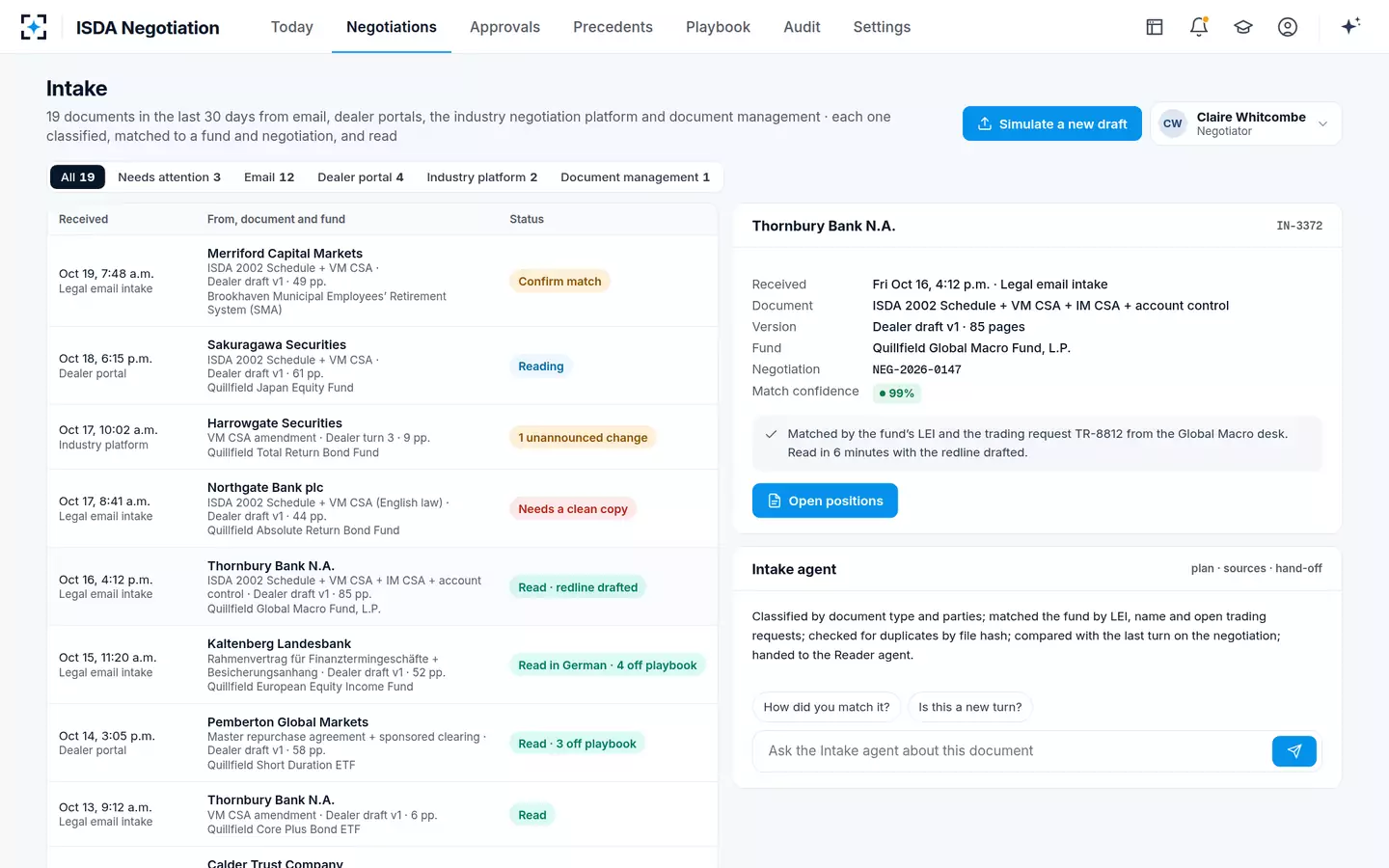
A fund family that has traded derivatives for long enough can easily hold agreements under both forms, plus agreements governed by local-law masters. In the sample firm's intake for one month, a dealer's German Rahmenvertrag arrived beside ISDA 2002 Schedules from four other dealers, each matched to a fund and read in the original language. The playbook has to say what the fund wants under each.
ISDA Negotiation’s intake: dealer drafts under different masters, matched to the right fund
Can you amend a 1992 ISDA to 2002 terms?
Yes, either by amending the agreement or by replacing it. Courts have seen both. In Lehman Brothers International (Europe) v Lehman Brothers Finance, the parties' agreement "followed the form of the 1992 version ... as modified to incorporate certain provisions of the 2002 version of the Master Agreement dealing with the consequences of termination" ([2013] EWCA Civ 188, at [1]). In Grant v FR Acquisitions, a swap was moved onto the 2002 form by novation.
A partial upgrade is the common case, and it needs care. A 1992 agreement amended to use Close-out Amount must also delete or override its Part 1(f) payment measure and method election, update the definitions that refer to Market Quotation, Loss and Settlement Amount, and check every cross-reference in the Schedule and the credit support annex that pointed to the old terms. The interaction is exactly the kind of inconsistency a blind second read is built to catch. For the Schedule's structure itself, see the ISDA Schedule guide.
Which ISDA master agreement should a fund sign?
For a new relationship, a fund is usually better served by the 2002 form, mainly because of its close-out terms. The objective valuation standard, the single two-way payment method and the right to a detailed calculation all protect the party that is not doing the valuing. The shorter grace periods cut the other way, and they are the point to negotiate rather than the reason to refuse the form.
Choosing between the forms, or upgrading an old agreement: six checks
- Find the payment method
On a 1992 agreement, read Part 1(f). First Method can leave a defaulting fund unpaid when it is in the money.
- Find the payment measure
Market Quotation depends on dealers’ quotations, which may be hard to obtain in a crisis; Loss and Close-out Amount do not.
- Price the grace periods
One Local Business Day under the 2002 form: negotiate a longer cure for operational errors in Part 5.
- Ask for the calculation statement
Under the 2002 form the valuing party must show its calculations in reasonable detail.
- Check every cross-reference when upgrading
Definitions, the CSA and Part 5 riders often still point to 1992 terms.
- Keep the threshold and trigger positions identical
Cross default thresholds and NAV triggers do not change with the form; neither should the playbook.
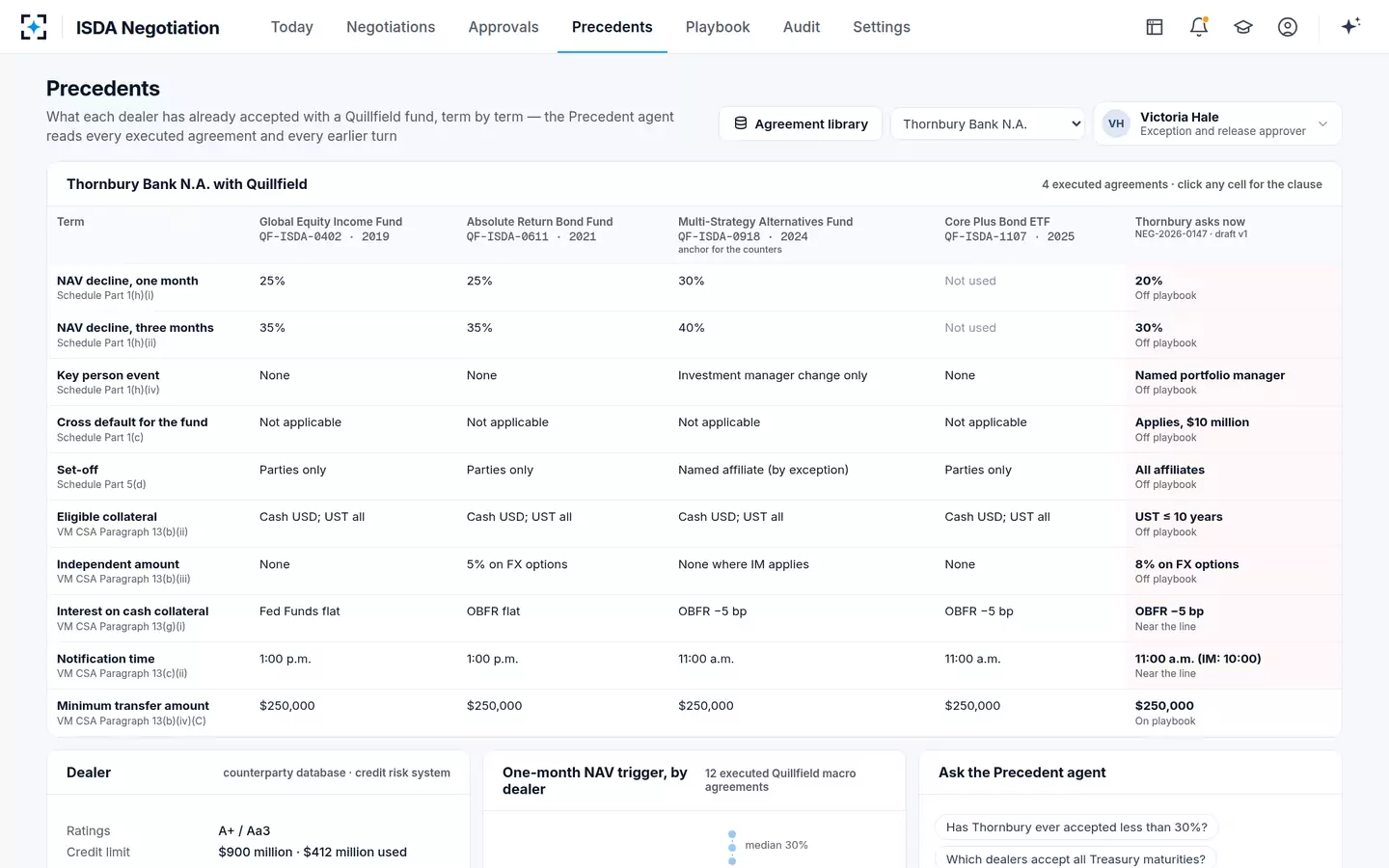
The credit terms do not care which form they sit in. A cross default threshold or a NAV trigger reads the same under 1992 and 2002, and a fund's playbook should set them once, for every form. That is how ISDA Negotiation organises the playbook: by fund type and term, with the master agreement's form recorded on each executed agreement so that the precedent the agents cite comes from a comparable document.
ISDA Negotiation compares one dealer’s terms across agreements signed under different forms and years
Questions people ask
Is the 2002 ISDA better for the dealer or the fund?
On close-out, the 2002 form generally protects the party being valued, because the Determining Party must reach an objectively commercially reasonable result and show its calculations. On grace periods it is stricter for everyone: one Local Business Day to remedy a missed payment instead of three.
What is Market Quotation?
A 1992 payment measure based on dealers' quotations for replacement trades; the Klaus Tschira judgment quotes it as "an amount determined on the basis of quotations from Reference Market-makers". Where using it would not, in the reasonable belief of the party making the determination, produce a commercially reasonable result, the 1992 Settlement Amount falls back to that party's Loss.
Does the 2002 ISDA allow walk-away clauses?
No. The 1992 First Method, sometimes called a walk-away clause, let the non-defaulting party avoid paying a defaulting party that was in the money; the High Court noted in 2022 that it "does not exist under the 2002 Form".
Do I need a new Schedule if I move from the 1992 to the 2002 form?
Yes, or a thorough amendment of the old one. Part 1 elections that exist only under the 1992 form, such as the payment measure and method, must go, and Part 5 riders written for 1992 definitions must be checked against the 2002 text.
Which form do US regulators require?
Neither. The CFTC requires written trading relationship documentation covering a list of terms, including how obligations are calculated and netted on termination, signed before or with the first swap (17 CFR 23.504); it does not prescribe a form. What a missed amendment does to the 2002 calculation is worked through in close-out amount under the ISDA.