A cross default threshold, called the Threshold Amount in an ISDA Schedule, is the minimum size of a party's other debt in default before that default also counts as an Event of Default under Section 5(a)(vi) of the ISDA Master Agreement, giving the other side the right to terminate every swap. It is set in Part 1 of the Schedule, for each party separately, either as a fixed amount or as a percentage of equity or net assets. Setting it is hard because it is a credit judgement wearing legal clothes: too low, and a small, unrelated default on a loan elsewhere ends a fund's hedges; too high, and a dealer's real distress goes unseen. Botminds' ISDA Negotiation reads the cross default election and its threshold in a dealer's Schedule, compares them with the fund's playbook and the dealer's earlier agreements, and sends the number to credit risk for approval.
The clause wording on this page is the 1992 form as quoted by the English High Court. The negotiation examples come from a fictional sample fund, Quillfield Global Macro Fund, L.P., with $4.2 billion of net assets, and a fictional dealer, Thornbury Bank N.A.
What one cross default number decides
£6.3m
early termination payment a bank claimed after a borrower’s loan default became a default under its swaps
High Court, 2017
0.24%
of the sample fund’s net assets: the $10 million threshold the dealer’s draft asked for
fictional sample
3%
of net assets, about $126 million: the sample fund’s walk-away level if cross default must apply
fictional sample
What is a cross default threshold?
A cross default threshold is the floor below which defaults on a party's other debt are ignored by the ISDA. The clause itself, as the High Court quoted it from the 1992 form, applies "If the "Cross Default" is specified in the Schedule as applying to the party", and catches a default "under one or more agreements or instruments relating to Specified Indebtedness of any of them (individually or collectively) in an aggregate amount of not less than the applicable Threshold Amount (as specified in the Schedule)" (Grant v WDW 3 Investments, 2017).
Two elections sit in the Schedule, not one. The first is whether Cross Default applies at all, and to which party: a fund and a dealer can elect it for one side only. The second is the Threshold Amount for each party to which it applies. Both are credit decisions. A lawyer can draft either answer; neither answer should be the lawyer's alone.
Cross default is an Event of Default, not a Termination Event. That puts it in the class of events that suspends the other party's payments: under Section 2(a)(iii), as the Court of Appeal held, a non-defaulting party's payment obligation is "suspended (rather than extinguished)" while an Event of Default continues (Lomas v JFB Firth Rixson, 2012). It also gives the right to end every transaction. A fund's NAV triggers, by contrast, are Termination Events, a distinction drawn in the guide to NAV triggers.
Reading the cross default clause limb by limb
The clause has two limbs, and each phrase in them is a separate negotiation point. The first limb catches debt that has become, or could be declared, due early; the second catches a failure to pay debt when due, after any grace period. Read together, they decide how early in another lender's process the ISDA counterparty may act.
The cross default clause, phrase by phrase, and what a fund negotiates in each
| Phrase in Section 5(a)(vi) | What it does | What a fund negotiates |
|---|---|---|
| "If the “Cross Default” is specified in the Schedule as applying to the party" | Makes the clause optional, party by party. | Not applicable to the fund; applicable to the dealer. |
| "Specified Indebtedness of any of them" | "Them" includes the party’s Credit Support Provider and Specified Entities, so other group members’ debt can count. | Which entities count, and what kinds of obligation are Specified Indebtedness. |
| "(individually or collectively) in an aggregate amount" | Small defaults on several instruments are added together. | Whether to aggregate; the size of the floor that applies to the total. |
| "which has resulted in such Specified Indebtedness becoming, or becoming capable at such time of being declared, due and payable" | Limb 1: the other lender need not have accelerated; a right to accelerate is enough. | Deleting "or becoming capable … of being declared", which turns cross default into cross acceleration. |
| "a default by such party… in making one or more payments on the due date thereof" | Limb 2: a payment default counts on its own, at or above the Threshold Amount. | Excluding amounts disputed in good faith; matching grace periods. |
| "(after giving effect to any applicable notice requirement or grace period)" | Limb 2 waits for the other agreement’s own grace period to run out. | Nothing, if the fund’s own facilities have reasonable grace periods. |
What is the difference between cross default and cross acceleration?
Cross default fires when another lender could accelerate; cross acceleration fires only when it has. The difference sits in four words of limb (1): the debt must have become "due and payable", or be "capable at such time of being declared" due and payable. Delete the second branch and the ISDA counterparty must wait for the other lender to act.
For a fund, the difference is a matter of who decides. Under cross default, a technical default under a fund's credit facility, which its lender might waive in a day, already lets the swap dealer terminate. Under cross acceleration, the ISDA follows the lender's actual decision. A fund with a subscription line or a NAV facility, whose lenders hold their own covenants and cure periods, has a strong case for cross acceleration at least; the difference between those facilities is set out in subscription line vs NAV facility.
Dealers resist because acceleration can come late. A lender that is negotiating a waiver will not accelerate, and the dealer is left exposed while it does. That is the trade: earlier rights for the dealer against fewer false alarms for the fund.
What is specified indebtedness in an ISDA?
Specified Indebtedness is the defined term that decides which of a party's obligations count for cross default, and it is negotiable in the Schedule. Narrowing it is often worth more to a fund than raising the threshold. A fund whose definition covers only borrowed money keeps its trading obligations, such as margin calls under other derivatives agreements, outside the clause; a fund whose definition covers its derivatives with other dealers lets a dispute with one dealer become a default with all of them.
The definition also decides whose debt counts. The clause reaches the Specified Indebtedness of the party, its Credit Support Provider and any Specified Entity, "of any of them (individually or collectively)". For a fund in a family of funds, the question is whether another fund managed by the same adviser could be a Specified Entity. If it could, a default in one fund's facility could reach the others' swaps.
The Grant v WDW 3 case shows how directly a loan reaches the swaps. A property company had a bank facility of more than £50 million and three interest rate swaps with the same bank. Its Schedule elected Cross Default in Part 1(c) and, in Part 5(f), substituted a "Default under Loan" for several standard Events of Default. When the loan fell due on 30 June 2014 and was not repaid, the bank's notice called it both a Part 5(f) Event of Default and "a Cross Default Event of Default under Section 5(a)(vi)"; the swaps were terminated with effect from 21 July 2014 and the bank claimed £6,324,214.50 ([2017] EWHC 2807 (Ch)).
How to determine the cross default threshold
Determine the cross default threshold from the size of the party's balance sheet and its debt, not from a round number in the dealer's form. The question is how large a default elsewhere must be to say something real about this party's ability to pay the swaps. A $10 million default is a crisis for a $50 million fund and noise for a $4.2 billion one, so the threshold should scale with the party.
There are two ways to make it scale. A fixed dollar amount, reviewed when the fund grows or shrinks. Or a percentage of shareholders' equity or net assets, which moves automatically. In the sample negotiation the dealer proposed a fixed $10 million for the fund; the fund's playbook preferred no cross default for the fund at all and set its walk-away at 3% of net assets; the fund's counter applied cross default to the dealer only, with a threshold of 3% of the dealer's shareholders' equity.
A fixed threshold and a percentage threshold through the same falling NAV
Fixed $10 million (the dealer’s ask): $10 million, 0.24% of NAV
3% of net assets (the fund’s walk-away): $126 million
Fixed $10 million (the dealer’s ask): $10 million, 0.30% of NAV
3% of net assets (the fund’s walk-away): $100.8 million
Fixed $10 million (the dealer’s ask): $10 million, 0.40% of NAV
3% of net assets (the fund’s walk-away): $75.6 million
Fixed $10 million (the dealer’s ask): The number stays put while the fund changes size: small for a large fund, proportionate only if the fund shrinks.
3% of net assets (the fund’s walk-away): The number falls with the fund: the clause tightens just as the fund weakens, which is what the dealer wants.
Fixed $10 million (the dealer’s ask): Fixed at signing; needs an amendment to move.
3% of net assets (the fund’s walk-away): At the latest NAV the fund has reported; needs a date in the definition.
Fixed $10 million (the dealer’s ask): A dealer’s threshold, where a fixed amount is easy to monitor.
3% of net assets (the fund’s walk-away): A fund’s threshold, because it stays proportionate as the fund grows.
Neither design is neutral. A percentage threshold falls as the fund loses money, which adds a second, quiet trigger beside the NAV triggers: at a 40% fall the fund's threshold has shrunk by $50 million. A fixed threshold avoids that but drifts out of proportion as the fund grows. A fund that accepts a percentage should ask for a floor, the higher of a fixed amount and a percentage, so the clause cannot shrink below a level the fund's credit team signed off.
For the dealer's side, a percentage of shareholders' equity is the natural measure, because a bank's equity is reported quarterly and moves slowly. The sample counter used exactly that: "“Threshold Amount” means, with respect to Party A, 3% of its shareholders' equity". The definition should say which equity, consolidated or the dealer entity's own, and as of which financial statements.
Does a fund need cross default in its ISDA?
A fund does not need cross default to apply to itself, and it can negotiate it away; it usually wants cross default to apply to the dealer. In the sample, the dealer's four executed agreements with the firm's other funds all had cross default "Not applicable" to the fund. The fund's case is that its borrowings are few, usually collateralised, and that its NAV triggers and reporting duties already give the dealer an earlier and better signal than another lender's default would.
Applying cross default to the dealer is a different question in the United States, because federal rules limit the default rights a fund may hold against a large banking group's dealer. A covered contract "may not permit the exercise of any default right with respect to the covered QFC that is related, directly or indirectly, to an affiliate of the direct party becoming subject to a receivership, insolvency, liquidation, resolution, or similar proceeding" (12 CFR 252.84). A fund's cross default against such a dealer still works for the dealer entity's own defaults; it cannot be written to fire on a parent's or affiliate's resolution, and the Schedule's cross default and Specified Entity language must be read with that rule.
The dealer's own rules push it the other way. A nonbank security-based swap dealer's margin rule requires procedures for "Obtaining and reviewing account documentation and financial information necessary for assessing the amount of current and potential future exposure to a given counterparty" (17 CFR 240.18a-3(e)). Cross default is one of the ways a dealer's credit team learns about a counterparty's distress, which is why it asks; the fund's answer is to offer the information directly.
How does the Threshold Amount differ from the CSA threshold?
The Threshold Amount in the Schedule is about other debt in default; the threshold in a credit support annex is about how much exposure may go uncollateralised. The two share a word and nothing else, and confusing them in a term sheet is a common source of drafting errors.
Two thresholds in one ISDA package, and the rules that bound each
| Threshold Amount (Schedule, cross default) | Threshold (credit support annex) | |
|---|---|---|
| What it measures | Defaults on the party’s other debt, in aggregate. | Exposure under the swaps that need not be collateralised. |
| What happens above it | An Event of Default: the other side may terminate every trade. | Collateral must be transferred. |
| Regulatory bound | None; the number is commercial. | Variation margin: "the full amount ... (ie a zero threshold)" for covered entities. Initial margin: up to $50 million between two US groups; €50 million in the global framework. |
| Who owns it at a fund | Credit risk. | Treasury and credit risk together. |
| Sample value | Dealer asked $10 million for the fund; counter: not applicable to the fund, 3% of equity for the dealer. | $6 million of initial margin threshold allocated to the fund in a signed sample IM CSA with another dealer. |
What happens when cross default is triggered?
When cross default is triggered, the non-defaulting party may designate an Early Termination Date for all outstanding transactions, and until it does, its own payments may be suspended. The Court of Appeal summarised the right in Lomas: the non-defaulting party may, "by giving not more than 20 days notice", designate an Early Termination Date "in respect of all outstanding Transactions", and that right is one "given to the Non-defaulting Party and it is not easy to see why there should be any limitation on the right" ([2012] EWCA Civ 419).
The suspension is the part funds forget. A dealer that is out of the money on the swaps may prefer not to terminate, and simply not pay while the default continues. The Court of Appeal held that the obligation is suspended and "will revive if the Event of Default is cured at any time before the outstanding Transactions are terminated". For a fund whose facility default was technical and quickly waived, the cure ends the suspension; for one whose default continues, its in-the-money swaps can sit unpaid.
The consequences are why the threshold belongs to the people who model them. A fund's credit team can say how large a default elsewhere would really signal trouble; its treasury can say what losing the hedges in a bad month would cost. The lawyer's job is to turn their answer into wording that cannot be read two ways.
Who should set the threshold, and how ISDA Negotiation routes it
Credit risk should set the threshold and approve every change to it, with legal drafting and the general counsel's office approving anything beyond the playbook. In ISDA Negotiation, cross default sits with NAV triggers, independent amounts and NAV reporting under one routing rule: the negotiating lawyer decides the counter, the credit risk officer approves it within one business day, and a concession beyond the playbook needs the term owner and the deputy general counsel.
ISDA Negotiation’s redline of the cross default election, with every owner’s decision checked before release
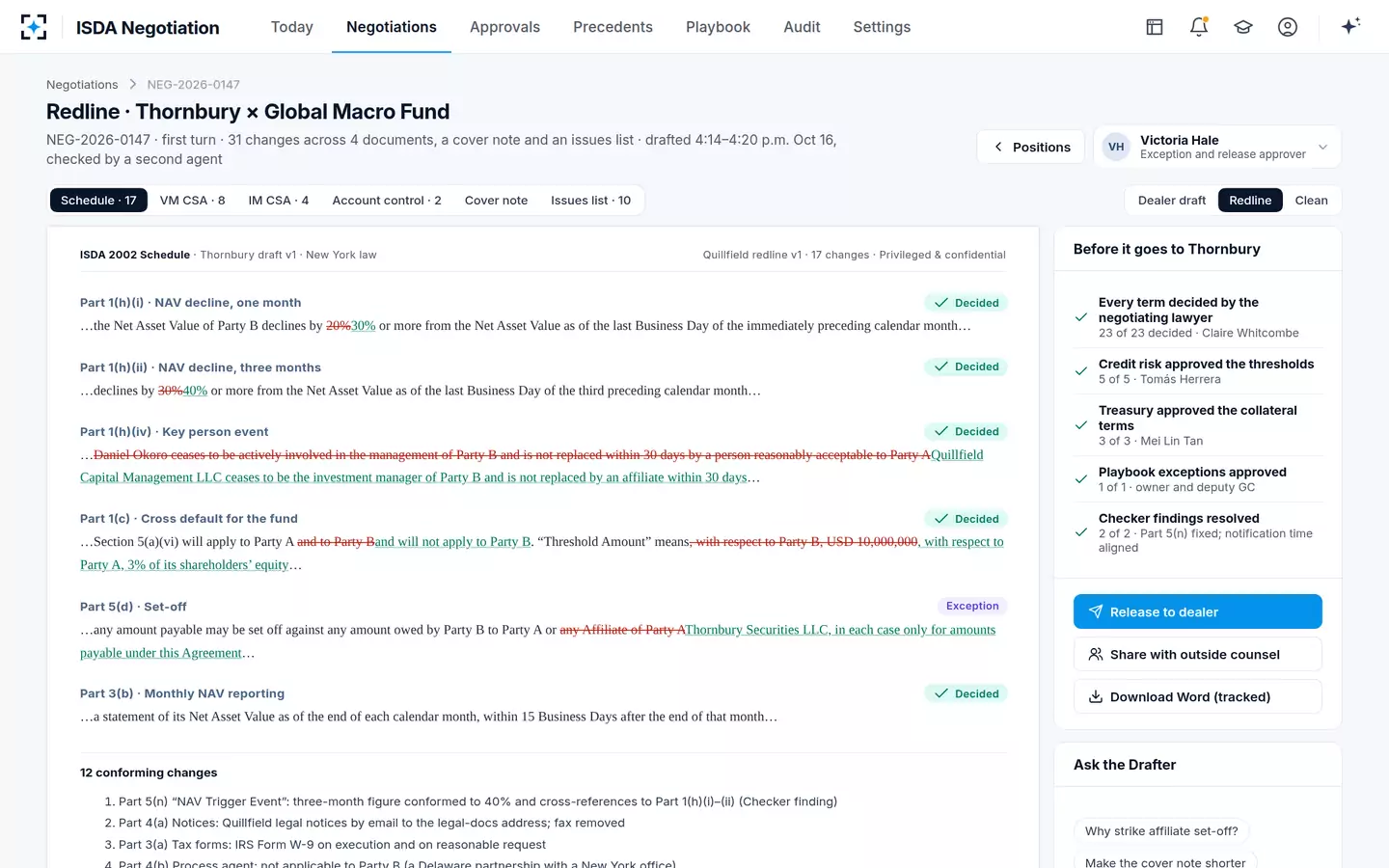
The approval screen puts the reasoning in one line. For the sample fund, the dealer's $10 million was "0.24% of the fund's $4.2 billion NAV — a small unrelated default could end every trade", and the dealer had agreed "Not applicable to the fund" in its 2024 agreement with a sister fund. The credit officer approved the counter with that evidence beside it, and the approval, its reason and its approver became part of the negotiation's audit trail.
Before you sign a cross default clause: six checks
- Decide applicability party by party
A fund can usually argue cross default away for itself; it should keep it for the dealer.
- Size each Threshold Amount to the party
Fixed for a dealer is easy to monitor; for a fund use the higher of a fixed floor and a percentage of net assets.
- Choose cross default or cross acceleration
Delete "or becoming capable at such time of being declared" if another lender’s technical default should not end the swaps.
- Narrow Specified Indebtedness
Borrowed money only keeps other derivatives disputes out of the clause.
- Check whose debt counts
Credit Support Providers and Specified Entities can bring in a parent or a sister fund.
- Read it with the resolution stay rules
Against a large US banking group’s dealer, default rights tied to an affiliate’s insolvency are restricted by 12 CFR 252.84.
Whatever the number, write down why it was accepted. A fund that signs a 1% threshold with one dealer under deadline will be asked for 1% by the next; measuring concessions against the playbook is how a general counsel sees that drift before it becomes the standard. The other Part 1 elections that sit around cross default are set out in the ISDA Schedule guide.
Questions people ask
What is a typical cross default threshold?
No regulator or independent study publishes market levels, and the right number depends on the party's size. Parties use either a fixed amount or a percentage of equity or net assets; in the sample, the fund's walk-away was 3% of net assets and the counter for the dealer was 3% of its shareholders' equity.
Is the cross default threshold the same for both parties?
It need not be. The clause refers to "the applicable Threshold Amount (as specified in the Schedule)", and the Schedule can set a different amount for each party, or apply Cross Default to one party only.
Does a margin call dispute count as a cross default?
Only if obligations under other derivatives agreements fall within Specified Indebtedness and the amount reaches the threshold. A fund can narrow the definition to borrowed money to keep trading disputes out, and add an exclusion for amounts disputed in good faith.
Can a cross default threshold be in a currency other than dollars?
Yes. The Threshold Amount is whatever the Schedule specifies. A party with debt in several currencies should also say how other currencies convert and on which date, so the comparison with the threshold cannot be argued.
Does cross default in the ISDA trigger cross default in a fund's loan agreements?
It can, if the loan agreement's own cross-default clause counts swap obligations. That is one reason funds keep NAV triggers as Termination Events rather than Events of Default: the ECB noted in 2007 that termination events generally do not trigger cross-defaults with third parties.