The difference between a subscription line and a NAV facility is what the lender is lending against. A subscription line looks to capital the fund's investors have committed but not yet paid in, so the credit question is who those investors are and whether they pay when called. A NAV facility looks to the net asset value of the portfolio the fund already owns, so the credit question is what those assets are worth and who says so. Everything else — tenor, pricing, early-warning levels, the week's monitoring — follows from that one difference. Botminds' Fund Finance Borrowing Base Monitoring tests both kinds on one screen, but it does not test them the same way: one is re-tested investor by investor against the credit agreement, the other mark by mark against a loan-to-value ladder.
The sample book on this page is fictional, inside the solution: sixteen facilities at an invented bank, including subscription lines, NAV facilities and back-leverage lines. Market figures come from the FDIC and the Financial Stability Board and are linked where they appear.
Where these facilities sit in bank lending to funds
$308.9bn
US bank loans to private equity funds, third quarter 2025 — most of it secured by capital call commitments
57%
of bank lending to non-bank financial firms goes to credit intermediaries instead
30%
the loan-to-value ceiling members reported as typical for NAV facilities
Two facilities, two different things lent against
Subscription lines are the common case. "Subscription lines are the most common form of bank financing to private credit funds," the FSB reports, describing them as "typically short-term bridge or working capital loans" with a tenor of one to three years and pricing of around 200 basis points over benchmark rates (FSB, May 2026). NAV financing, in the same survey, is a different instrument: "term loans and/or revolving facilities" of three to five years at around 200 to 400 basis points, where "cash flows and the value of the fund's underlying assets serve as collateral for the loan."
Translate that into a lender's week. On a subscription line, the thing that can go wrong is an investor: it pays late, it is downgraded, it sells out, it asserts an excuse right. Each of those is an event with a date and a document behind it, and each one is visible the morning it happens if the bank is looking. On a NAV facility, the thing that can go wrong is a valuation, and valuations do not happen on mornings.
Subscription line against NAV facility, row by row
Subscription line: Capital investors have committed to the fund and not yet paid in.
NAV facility: The net asset value of the portfolio the fund already owns.
Subscription line: Uncalled commitments, the right to call capital, and the account the called money is paid into.
NAV facility: Cash flows and the value of the underlying assets, usually through pledges over holding vehicles.
Subscription line: The investors. Credit risk is diversified across the investor list and each one’s own standing.
NAV facility: The portfolio companies, and the manager marking them. Risk is concentrated in the assets themselves.
Subscription line: A borrowing base: eligible uncalled capital × advance rate, after concentration limits.
NAV facility: A loan-to-value ratio against the reported net asset value, usually with eligibility and concentration tests on the pool.
Subscription line: Short-term, one to three years, around 200 basis points over benchmark rates.
NAV facility: Three to five years, around 200 to 400 basis points.
Subscription line: The same morning: a missed receipt, a ratings action, a transfer notice.
NAV facility: At the next valuation, which is usually quarterly.
Subscription line: Every investor against the agreement’s eligibility, rates and caps, as of the loan date.
NAV facility: Every mark against its source, the loan-to-value against its ladder, and the pool against its concentration tests.
Subscription line: Fundraising and the investment period, when uncalled capital is large.
NAV facility: Later, when uncalled capital is thin and the portfolio is substantial.
What secures a subscription line
Three things, and they are not one security interest. The fund's right to call capital from its limited partners; the general partner's power to make the call; and the pledged account the called money is paid into. The first two are contract rights perfected by filing a financing statement; the third is a deposit account, which under Article 9 can be perfected only by control. A lender that files once and considers the job finished is perfect on the promise and unperfected on the cash — the mechanics are worked through in what actually secures a subscription line.
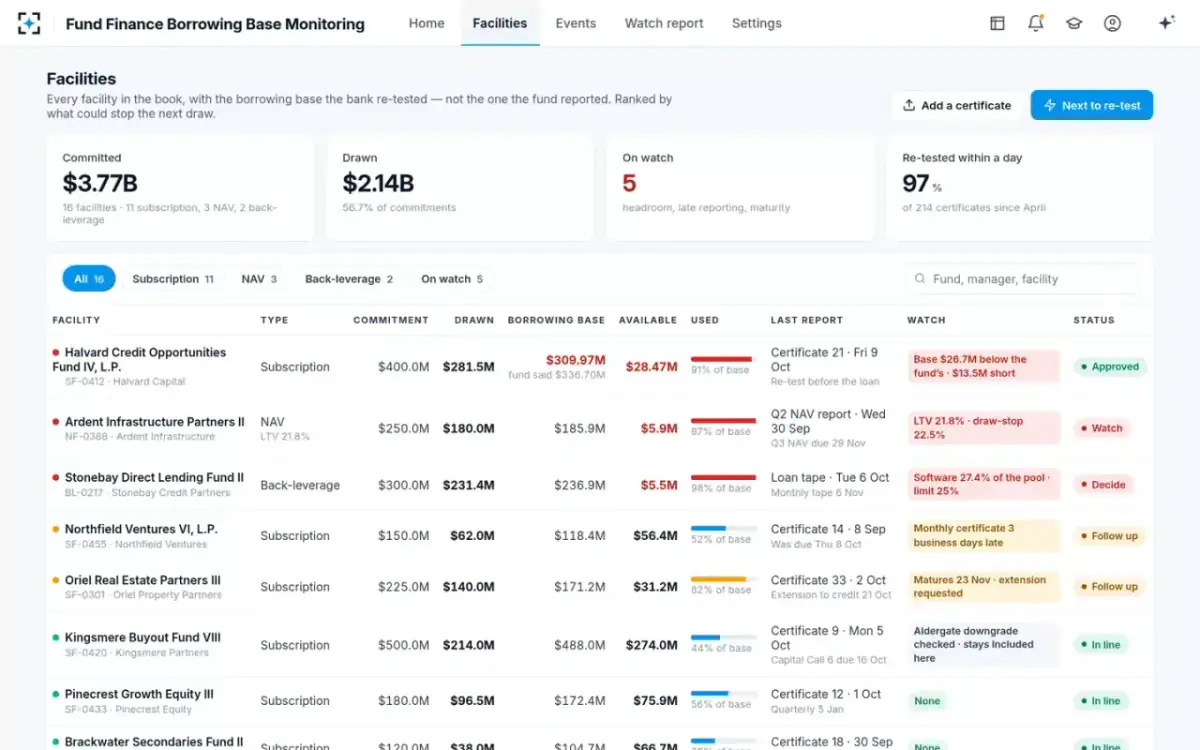
What the lender actually measures is narrower than what it holds. Only uncalled capital counts, only from investors the agreement makes eligible, only at that class's advance rate, and only within the concentration limits. On the sample $400,000,000 facility that produced a borrowing base of $309,974,600 once the bank re-tested it as of the loan date — $26,727,400 below the figure the fund itself had certified a fortnight earlier, because three investors had changed in between.
What secures a NAV facility
The portfolio, valued by the manager. The FSB describes NAV facilities as "typically term loans that enable funds to build leverage", where "the loans are collateralised against a fair value estimate of the fund's assets", and notes that "some member data suggests that loan-to-value ratios are generally limited to 30% and that this facility is more commonly used for lending to private equity or commercial real estate funds" (FSB, May 2026).
Read that sentence slowly, because it contains the whole difference. "A fair value estimate of the fund's assets" is not a balance; it is an opinion, produced by the borrower's own manager, usually quarterly, about assets that do not trade. A subscription line's collateral can be counted by reading an account statement. A NAV facility's collateral has to be believed.
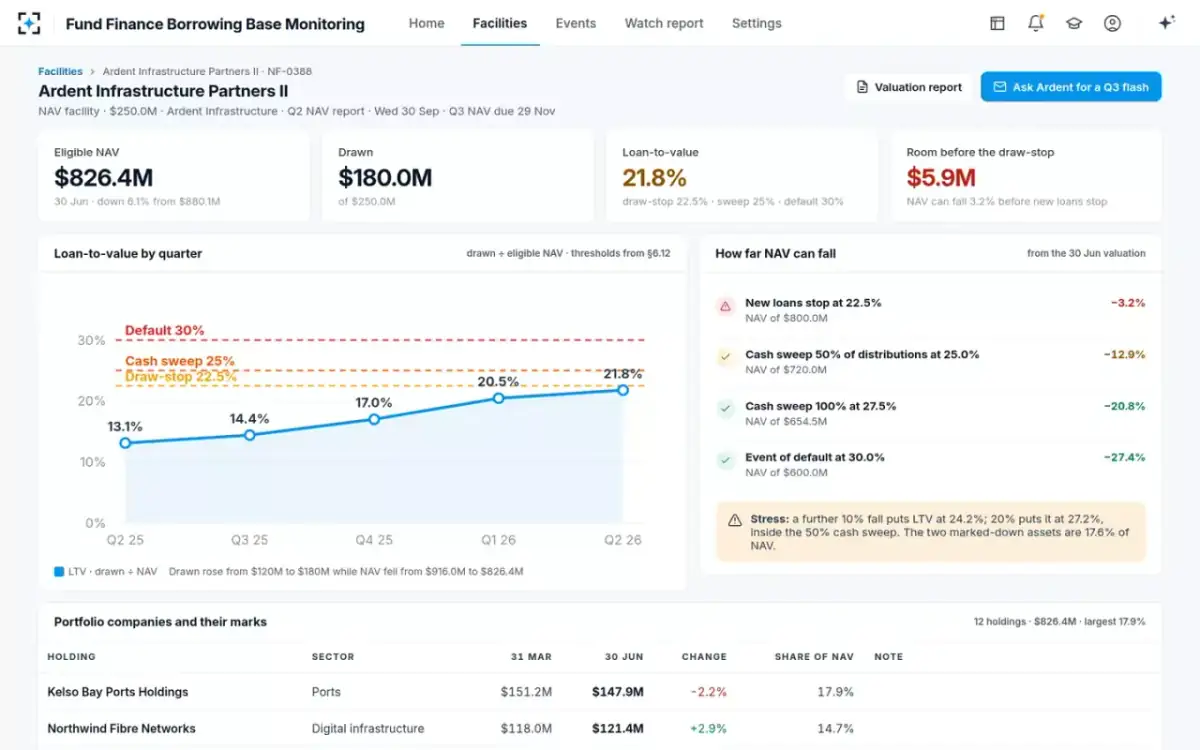
That is why a NAV facility's documents carry things a subscription line does not: eligibility criteria for what may be in the pool at all, concentration tests by obligor and by sector, a definition of which valuation may be used, and a ladder of consequences as the loan-to-value rises. In the solution the NAV and loan tape monitor reads each quarterly valuation, compares every mark with the prior quarter and runs the loan-to-value against the draw-stop, sweep and default levels with 10% and 20% valuation stresses. Its two hard limits say what it is for: it never adjusts a manager's mark, and it never accepts a mark without its valuation source.
A NAV facility, measured against its own ladder
What is the difference between a subscription line and a NAV facility?
In one sentence: a subscription line lends against money investors still owe the fund, and a NAV facility lends against the value of what the fund has already bought with money investors have paid.
In practice the difference shows up in four places. The collateral: commitments and a bank account, against portfolio assets and their cash flows. The credit risk: the investor list, against the portfolio and the manager's marks. The measurement: a borrowing base that can be recomputed exactly from documents, against a loan-to-value that depends on an estimate. And the speed of information: a subscription line's facts arrive daily, a NAV facility's arrive quarterly.
The fourth is the one that most changes a monitoring process. A weekly re-test of a subscription line is genuinely weekly — new facts have arrived. A weekly re-test of a NAV facility re-runs the same valuation against a changing loan balance and changing stress assumptions, which is useful but is not new information about the assets. Pretending otherwise produces a report that looks equally current on both and is not.
Why NAV facilities carry a different kind of risk
Not more risk necessarily — a NAV facility at 20% loan-to-value against a seasoned portfolio may be a better credit than a subscription line to a fund with a thin investor list. A different kind of risk, with a different shape. The FSB's account of how private credit funds value their own assets explains where it comes from, and a NAV lender's collateral is exactly those values.
Valuation frequency is the first part: "Valuations are updated infrequently, often on a quarterly basis, which may be adequate in normal market conditions but less so under stress." The second is the practical difficulty behind that: "the illiquidity of private credit assets, and the associated costs to make valuations, seem to make more frequent revaluations impractical." The third is incentive: the FSB notes that "perceived or actual stale valuations may create a first-mover incentive during stress events", for the fund's own investors, and that managers "may have potential incentives to manage valuations of their funds in a way that minimises the appearance of volatility, such as by delaying or spreading out the impact of negative shocks that could reduce asset values" (FSB, May 2026).
None of that is an accusation about any particular manager. It is a description of an estimate produced by an interested party, infrequently, about illiquid assets — which is exactly the kind of input a lender's monitoring should treat with a stress test rather than a reconciliation. On a subscription line the equivalent exercise would be pointless: you do not stress an account statement.
Draw-stops, sweeps and defaults: a NAV facility's early-warning ladder
Because the information arrives slowly, NAV facilities build their warnings into the loan-to-value itself. A typical ladder has three rungs. At the draw-stop, the lender stops advancing new money but nothing is in default. At the sweep level, distributions and realisation proceeds are applied to the loan instead of flowing to investors. At the default level, the facility's remedies open.
On the sample book, Ardent II sits at 21.8% against a 22.5% draw-stop, which is 0.7 points away and inside the bank's own 2.5-point early-warning setting, so the facility is on the week's watch list. The useful question for the committee is not where the ratio is but what would move it, and on a NAV facility only one thing really does.
One NAV facility's loan-to-value, and what a valuation fall would do to it
The stressed rows make the point a level cannot. The screen states the same thing the other way round: net asset value can fall 3.2% — from $826.4 million to $800.0 million — before new loans stop, and there is $5.9 million of further drawing before the same thing happens. A 10% fall, which on quarterly, estimate-based marks is not an extreme assumption, puts the facility past its draw-stop before anyone has done anything wrong. That is why the bank's early warning is set in points below the draw-stop rather than as an absolute figure, and why the stress is run on every valuation rather than annually.
The same week, two facilities, two completely different questions
| The subscription line (Halvard IV) | The NAV facility (Ardent II) | |
|---|---|---|
| What changed this week | Three investors: one unpaid capital call, one downgrade, one transfer with no investor letter yet. | Nothing. The last valuation is the one from the end of the quarter. |
| Where the bank learned it | A pledged-account statement, a ratings feed and a transfer agreement — three documents, three dates. | A quarterly valuation report, received once, read line by line against the prior quarter. |
| What the re-test produced | A borrowing base $26,727,400 below the fund’s own certificate, and a loan short by $13,525,400. | A loan-to-value of 21.8% against a 22.5% draw-stop, and two stressed figures either side of it. |
| What the committee decides | Whether to fund the re-tested availability now and hold the rest, or waive. | Whether 0.7 points of room is enough to keep advancing until the next valuation. |
| What would change the answer | Money landing in the pledged account, or an investor letter being approved. | A new valuation — which is three months away unless the manager produces one sooner. |
When a fund moves from one to the other
Not as a switch, but as the arithmetic of a fund's life. Early on there is a great deal of uncalled capital and almost no portfolio, so the subscription line is the only facility that has anything to lend against. As the fund calls capital, the uncalled pool shrinks and the portfolio grows. Late in the investment period a facility against assets becomes possible, and by the harvest period it is often the only one left.
Which facility a fund can use, and when, across its life
Fundraising and the first closes
Subscription line
Uncalled commitments are at their largest and the portfolio barely exists. The line bridges investments while capital is called.
The base is almost entirely uncalled capital; the risk is investor quality.
The investment period
Subscription line, at its largest
Drawn and repaid repeatedly as deals are done and calls settle. Commitments fall as capital is drawn down.
The base shrinks as the fund calls capital — the same investors, less uncalled.
Late investment period
Both, sometimes
Uncalled capital is thinning; the portfolio is substantial and marked. A facility against assets becomes possible.
Two bases, two tests, two sets of early-warning levels on one borrower.
Harvest and wind-down
NAV facility
Little uncalled capital is left. Borrowing is against the value of what the fund already owns, to manage distributions or support holdings.
The base moves with valuations rather than with investor behaviour.
For a lender, the interesting moment is the overlap. A fund in the late investment period can have a subscription line sized on a shrinking pool of uncalled capital and a NAV facility sized on a growing portfolio, both at the same bank, both drawn. The two bases are computed from different things and move in opposite directions, so a single exposure number across them hides exactly the trend that matters.
Can the same fund have both at once?
Yes, and plenty do. What matters is how the two are documented against each other, and most of the questions a credit committee should ask are about the seams rather than about either facility on its own.
Is the same collateral promised twice? Capital call proceeds that are swept to a NAV lender are not available to repay the subscription line, and an intercreditor arrangement should say so. Do the two facilities use the same definitions? An investor that is Designated under one agreement and Included under another is not an error — the facilities are separate contracts — but a bank whose monitoring applies one rule set will report one of them wrongly. Do the warning levels interact? A NAV facility sweeping distributions changes the fund's liquidity, which changes its ability to make the subscription line's payments.
On the sample book the two are shown on the same list, ranked against each other by what could stop the next draw, with each facility's own definitions applied to its own figures. What that weekly list should contain, and who has to own each row on it, is set out in what a fund finance watch report should tell your committee.
Sixteen facilities of three kinds, on one list
What to ask before treating a NAV facility like a subscription line
- What exactly is the collateral, and how is it perfected?
Commitments and a controlled account are not pledges over holding vehicles. The security opinions are different documents.
- Who produced the valuation, and when?
A manager’s quarterly fair value estimate. Ask for the source behind each mark, and the movement against the prior quarter.
- How far can the value fall before each rung of the ladder?
Not just today’s loan-to-value: the draw-stop, the sweep and the default level, each expressed as a percentage fall in net asset value.
- Does the monitoring stress the valuation, or only restate it?
Re-running the same quarterly mark weekly is not monitoring. A standing haircut — 10% and 20% on this book — is.
- Which eligibility and concentration tests apply to the pool?
A NAV facility’s pool has its own tests, by obligor and sector, that a subscription line does not have at all.
- If the fund has both, what sits between them?
Intercreditor terms, sweep waterfalls and whether capital call proceeds are promised in two places.
- Is one set of definitions being applied to two agreements?
Advance rates, eligibility floors and caps are per facility. A bank-wide rule set will misreport at least one of them.
The honest summary for a credit committee: a subscription line is a credit on a list of investors, tested from documents that arrive every day; a NAV facility is a credit on a portfolio, tested from an estimate that arrives every quarter. Both belong on the same book and the same report, and neither should be monitored the way the other one is. To see the subscription-line side worked end to end, read one borrowing base re-test, certificate to funding, or start from Fund Finance Borrowing Base Monitoring.
Questions people ask
What is the difference between a subscription line and a NAV facility?
A subscription line is secured by capital the fund's investors have committed and not yet paid in, plus the right to call it and the account it is paid into. A NAV facility is secured by the value of the portfolio the fund already owns and the cash flows from it. The first is measured by a borrowing base built from the investor list; the second by a loan-to-value against a valuation.
What secures a NAV facility?
The fund's underlying assets and their cash flows, usually through pledges over the vehicles that hold them. The FSB describes NAV loans as "collateralised against a fair value estimate of the fund's assets", and reports that member data puts typical loan-to-value ratios at no more than 30% (FSB, May 2026). Because the collateral is valued rather than counted, the facility's documents carry eligibility and concentration tests on the pool and a ladder of loan-to-value consequences.
Which is riskier, a subscription line or a NAV facility?
They carry different risks rather than ranking on one scale. A subscription line's risk sits with the investors and is visible daily, so a problem shows up the morning it happens. A NAV facility's risk sits in illiquid assets valued by the borrower's own manager, usually quarterly — so the exposure is better collateralised in a quiet market and slower to reveal itself in a stressed one.
When does a fund move from a subscription line to a NAV facility?
As its uncalled capital runs down and its portfolio builds up. During fundraising and the investment period there is plenty of uncalled capital to lend against; by the harvest period there is little left, and borrowing has to look to the assets instead. Many funds use both at once in the late investment period, and many never use a NAV facility at all.
What is a draw-stop on a NAV facility?
A level of loan-to-value at which the lender stops advancing new money, without anything being in default. It is the first rung of the ladder, above which usually sit a sweep level — where distributions and realisation proceeds repay the loan instead of going to investors — and a default level where the facility's remedies open. On the sample book one facility sits 0.7 points below its draw-stop, which a 10% fall in value would be enough to cross.
Can the same fund have both at once?
Yes. The questions to settle are at the seams: whether capital call proceeds are promised to both lenders, what the intercreditor terms say, whether each facility's own definitions are being applied to its own figures, and how a sweep under the NAV facility affects the fund's ability to service the subscription line.