A fund finance watch report is the weekly paper a credit committee relies on to decide what to do about a book of subscription lines, NAV facilities and back-leverage lines — and most of them are built the wrong way round. They list headroom per facility, largest first, which answers a question nobody is going to be wrong about. The question that decides the week is narrower: which facility is closest to something that stops its next draw, and what is that something? Before buying credit committee reporting software, or building the report in a spreadsheet, settle what it must rank and who has to own each row. Botminds' Fund Finance Borrowing Base Monitoring drafts the report from the re-tests themselves, and sends it only when someone presses Send.
The sample book on this page is fictional — sixteen facilities at an invented bank, inside the solution. The regulatory expectations are real and linked where they appear. Where a figure is the sample book's own, it says so.
Why a committee's attention is worth structuring: bank lending to funds, measured against capital
52.3%
loans to non-bank financial firms as a share of tier 1 capital and allowance, third quarter 2025 — 4.1% in 2010
68.1%
the same measure at banks with assets over $100 billion, from 5.7% in 2010
$987bn
undrawn commitments to non-bank financial firms — 42.9% of everything committed to them
The undrawn figure is the one that belongs on a fund finance committee's agenda. Most of what a bank commits to a fund is not lent yet: the FDIC puts undrawn commitments to non-bank financial firms at $987 billion, 42.9% of total commitments, and notes that "these loans tend to be revolving credit lines that could be drawn down in times of stress and could represent a potential stress on bank liquidity." A watch report about drawn balances is reporting the smaller half. The draw that has not happened yet is the exposure the committee can still do something about.
Why a list of headroom numbers isn't a watch report
Headroom is a good number and a poor ranking. It tells you the distance between a facility's borrowing base and its outstandings on the day the report was run, which is a fact about the past. It does not tell you how fast that distance can move, what would move it, or whether the base behind it has been tested at all.
Three facilities can show the same $20 million of headroom and be in completely different states. The first has a certificate three business days late, so the $20 million is last month's figure held over. The second has an investor rated one notch above the eligibility floor, where a downgrade moves $15 million of uncalled capital to a lower advance rate at a stroke. The third has 46 investors, all current, with the nearest concentration limit twelve points away. Ranked by headroom they are identical. Ranked by what could stop the next draw they are a problem, a watch item and a non-event.
The fix is not more numbers. It is to make the report state, for every facility, the single nearest thing that stops a draw, how far away it is in its own units, and the date it matters. Everything else on the page is supporting evidence.
What should a fund finance watch report contain?
Seven sections, in this order. The order matters as much as the content: a committee reads the first page properly and skims the rest, so the facilities on watch belong above the portfolio totals, not after them.
The anatomy of one week's facility watch report
1
The book in one line
How much is committed, how much is drawn, and what moved this week?
Commitments, outstandings and undrawn, with the change since the last report and the reason for each change.
2
The facilities on watch, worst first
What could stop the next draw, and when?
One row per facility: the trigger, today’s measure, the limit it is measured against, the date it bites and the person who owns it.
3
Every change to a borrowing base
Which bases moved, by how much, and on whose evidence?
Each movement with its amount, the document behind it and whether it is curable, so the committee argues about judgement and not about arithmetic.
4
Reporting that has not arrived
Which funds are late, and how late?
Certificates, valuations and loan tapes past their contractual date, with the days late and the last figure the bank actually tested.
5
Concentration against the bank’s own limits
Where is the book bunched, and against which limit?
Exposure by fund family, by sponsor, by strategy and against capital, each shown against the limit or sublimit it is governed by.
6
Maturities and renewals in the window
What has to be re-underwritten, and by when?
Facilities maturing inside the committee’s horizon, with the work already done and the decision date.
7
Decisions asked of the committee
What does this meeting have to decide?
Waivers, reinstatements, limit changes and exceptions, each with a recommendation, its evidence and the approver it needs.
Two of those sections are usually missing. Section 4, reporting that has not arrived, tends to be treated as an operations matter and kept off the committee paper — yet a fund whose quarter went badly has the most reason to be slow, and a base nobody has tested is the one most likely to be wrong. Section 7, the decisions asked for, is often replaced by a verbal "anything else?" at the end of the meeting, which is how a waiver gets granted without a written recommendation behind it.
Ranking a book of facilities by what could stop the next draw
Ranking across a mixed book is the part that looks impossible and is not. The triggers are in different units — days, rating notches, percentage points of a cap, points of loan-to-value — so they cannot be sorted on a single column. They can be sorted on the one thing they have in common: how far each is from the point where the lender's answer to a draw request changes.
In the sample book, five of sixteen facilities are on watch in the week shown. Each is on the list for a different reason, and each reason has a different owner.
Five facilities on watch, and the one thing that could stop each next draw
| Facility | What could stop the next draw | Where it stands | Who owns it |
|---|---|---|---|
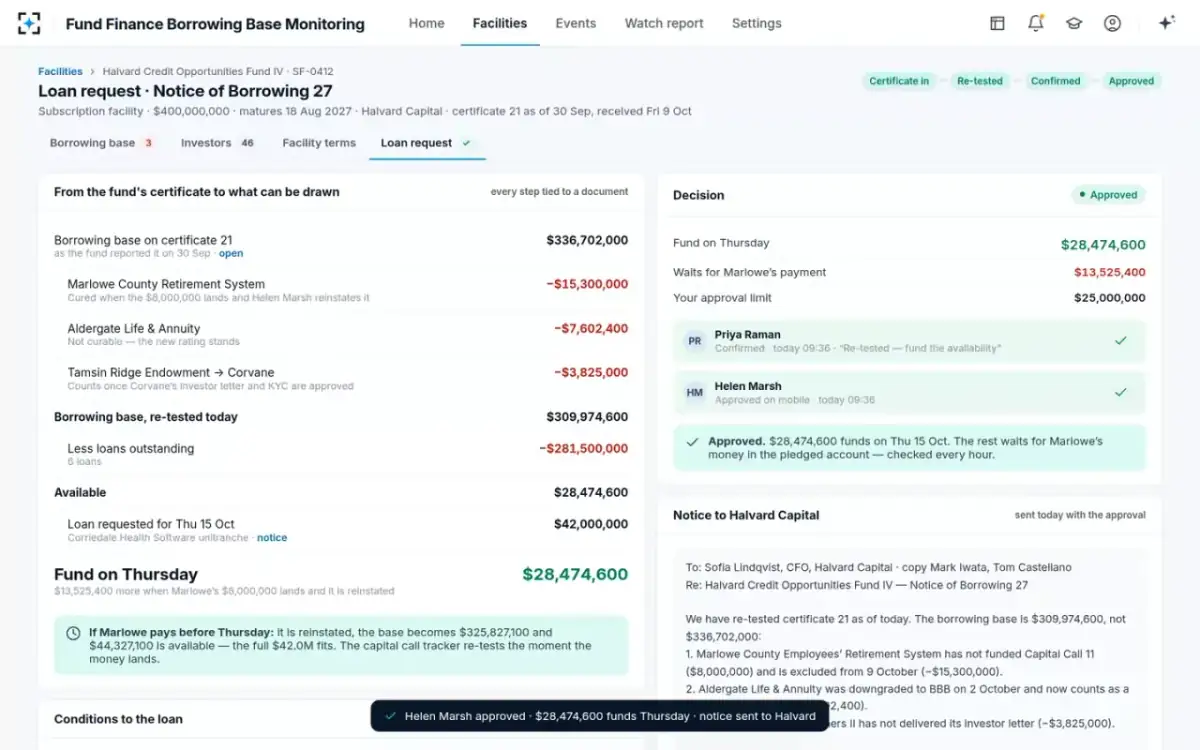
| Halvard Credit Opportunities Fund IV | A re-tested borrowing base below the loan requested: a missed capital call, a downgrade and an unapproved transfer, none of them on the fund’s certificate. | Re-tested as of the loan date; the loan funds in part, with the rest held until the late capital call lands in the pledged account. | Collateral analyst, with the credit officer approving |
| Ardent II | A loan-to-value approaching the facility’s draw-stop, where the lender stops advancing before any default is declared. | 21.8% against a 22.5% draw-stop — 0.7 points, inside the bank’s 2.5-point early warning. | Credit officer |
| Stonebay II | A concentration above the facility’s own limit, so the excess is disregarded in the base whatever the fund reports. | Software loans at 27.4% of the pool against a 25% limit. | Collateral analyst |
| Northfield VI | A certificate that has not arrived, so the last tested base is stale and the next draw would be priced on it. | Three business days late; the last base the bank tested is from the previous reporting period. | Relationship manager |
| Oriel III | A maturity inside the committee’s horizon, which turns a draw question into a renewal question. | Maturing 23 Nov, with the renewal credit not yet written. | Head of Fund Finance |
The whole book, sorted the way the report is — Fund Finance Borrowing Base Monitoring
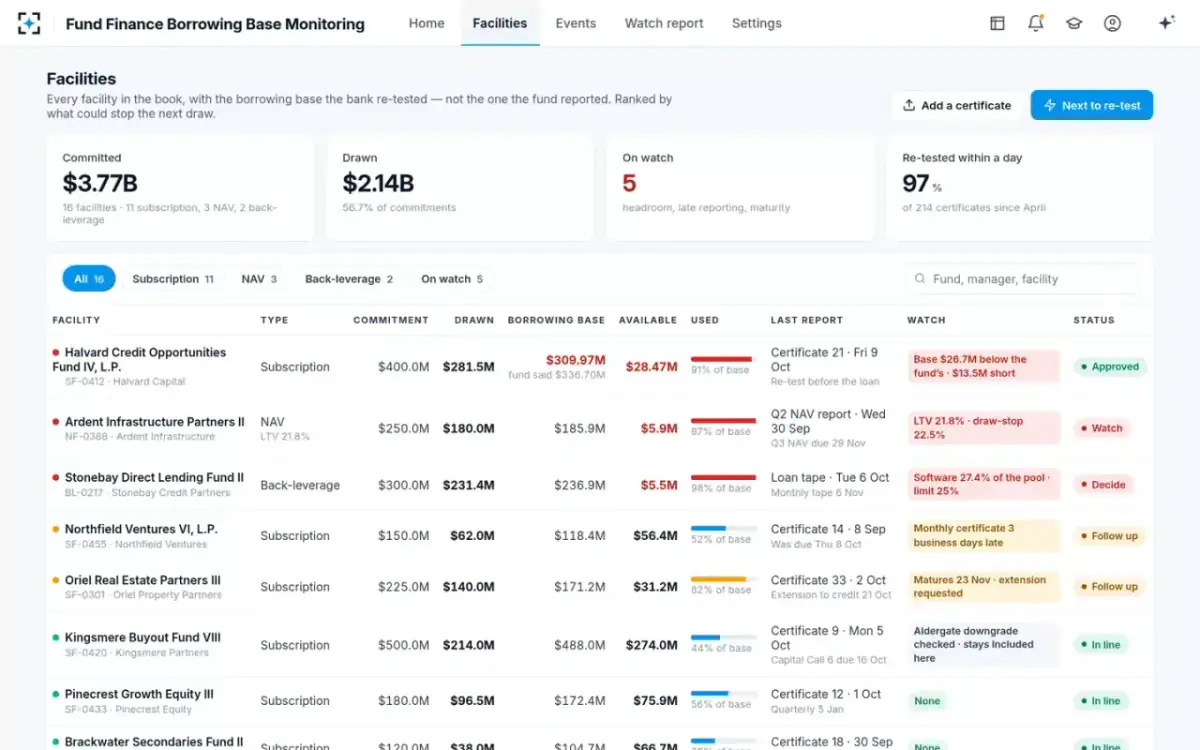
Read down the "who owns it" column and the report's second job appears. A watch list that does not name an owner per row produces a meeting in which everybody agrees the facility is a concern and nobody has an action. The owner is not always the relationship manager: a late certificate is a relationship call, a loan-to-value inside its early warning is a credit decision, and a re-tested base short of a loan request is an approval.
The week's watch report, drafted and not yet sent
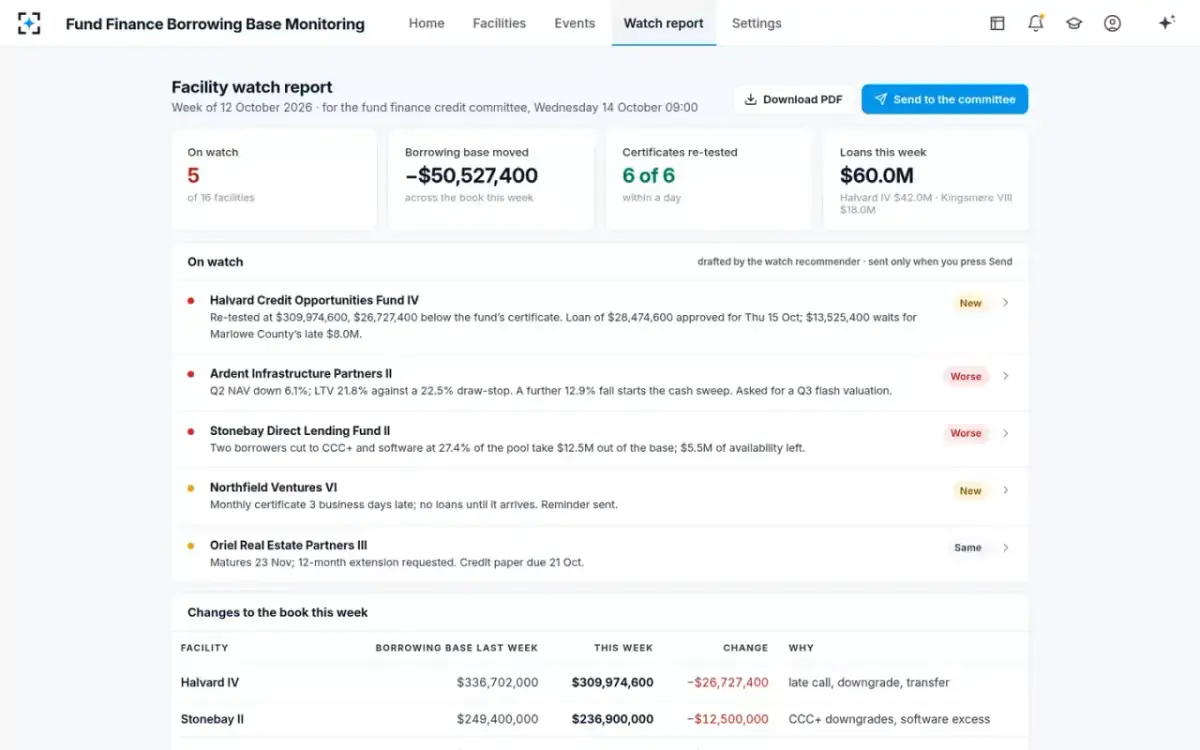
What triggers a facility going 'on watch'?
A facility goes on watch when a measurable thing crosses a line the bank set in advance, and comes off when it is cured. Written that way, the list is short and arguable at a policy meeting rather than at a committee meeting. The sample bank's settings are these: headroom under a tenth of the borrowing base; a capital call unpaid past the early-warning day; a loan-to-value within a set number of points of its draw-stop; any concentration at or above its facility's cap; a certificate, valuation or loan tape past its contractual date; and a maturity inside the renewal window.
All six are settings in the solution rather than code — the headroom warning runs from 5% to 25% in five-point steps, the late-call warning is one, three or five business days, and the loan-to-value early warning is one, two and a half or five points. That matters more than it sounds. The OCC's handbook on concentrations says bank limits "should be reasonable (e.g., not so high that they will likely never be approached nor so rigid that they are routinely exceeded)" (Concentrations of Credit, version 3.0). A threshold that fires on half the book every week trains a committee to ignore the report; one that never fires produces a clean report until the week it does not.
The handbook also expects the response to be written down in advance: banks' "policies or procedures typically delineate what actions should be taken if exposures are approaching or exceed concentration limits or thresholds." A watch report is the weekly instrument of that policy. If a row can appear on it with no defined next step, either the threshold or the procedure is missing.
How concentrated this lending has become against bank capital
What examiners expect a board report on concentration to show
Examiners do not prescribe a watch report, and no handbook names one. What they do is assess the reporting that exists. The OCC's examination procedures for concentrations of credit include, in terms, the instruction to "Assess the adequacy of management and board reports regarding concentrations of credit", and the scoping procedures tell an examiner to review those same reports alongside the policies and the risk tolerances (Concentrations of Credit, version 3.0). The report is evidence of the control, so a report that cannot be reconciled is a finding about the control.
The handbook is blunt about why the data underneath matters more than the layout: "Issues with data accuracy and timeliness hinder the usefulness of management and board reports. MIS that produce inaccurate reporting can provide a false sense of security and erroneously focus attention on lower-risk pools." It adds that "accurate reports support an active and timely dialogue with the board and senior management regarding concentration exposures."
For a fund finance book, "accurate and timely" has a specific meaning that a generic portfolio report misses. A borrowing base is only as current as the last certificate plus everything that has happened since it. A report that carries forward a fund's own last reported figure — without saying that it is the fund's figure, as of its own date, with three reports since — is exactly the false sense of security the handbook describes. This is the practical difference between a report built from re-tests and a report built from a data extract.
A headroom list against a watch report: the same book, two different meetings
A headroom list: Facilities by headroom, largest or smallest first.
A watch report: Facilities by the nearest thing that stops the next draw, worst first, whatever its unit.
A headroom list: The fund’s last certificate, as reported.
A watch report: The bank’s re-test as of today, with each change since the certificate and its source.
A headroom list: Shown as last period’s number, in the same colour as everyone else’s.
A watch report: Its own section: who is late, by how many days, and how old the last tested figure is.
A headroom list: A total exposure line, usually by fund.
A watch report: Exposure against the limit or sublimit that governs it, at facility level and across the book.
A headroom list: A memorandum column, if it appears at all.
A watch report: Ranked with the drawn book, because the undrawn half is what a stressed week actually calls on.
A headroom list: Notes it.
A watch report: Decides the waivers, reinstatements and limit changes listed in its last section, each with a recommendation and an approver.
Who drafts it, and who presses send
In the solution, the draw and watch recommender writes the report from the week's re-tests: every change to every borrowing base, with the amount, the document behind it and what cures it. It never approves anything and never sends anything. The head of fund finance reads it, edits it and presses Send, and the report goes out with his name on it — which is the point. A committee paper that nobody signed is a paper nobody has to defend.
That division of labour has a supervisory shape as well as a practical one. The interagency model risk guidance issued with SR 26-2 puts the responsibility squarely on the bank: "Each banking organization ultimately is responsible for adopting model risk management practices that are appropriate and effective for managing the specific risks the banking organization faces or is likely to face" (Revised Guidance on Model Risk Management, the attachment to SR 26-2). Whether a particular re-test is a model at all is a question with its own answer — is a borrowing base re-test a model under SR 26-2? takes it apart — but the ownership question does not depend on it. A drafting tool does not acquire responsibility for the committee paper by drafting it.
So the useful test of reporting software is not whether it produces a report. It is whether a named person can see, for every line, what it was built from, change it, and be accountable for the version that went out.
The approval the report has to be able to explain
How often should a credit committee see fund finance exposure?
Weekly for the watch list, monthly or quarterly for the full book, and immediately for anything that changes an answer to a draw request. The split matters because the three have different purposes. The weekly list is operational: it exists so the next draw is decided with today's facts. The periodic review is strategic: limits, sublimits, sponsor exposure, where the book is growing. The immediate notification is an exception: a borrowing base deficiency, a default, a sponsor event.
What sets the weekly cadence is not habit but the underlying rhythm. Funds send certificates monthly or quarterly, capital calls settle on their own dates, ratings move any morning, and a notice of borrowing can arrive on a Tuesday for a Thursday funding. A fortnightly committee simply cannot be the control over a Thursday draw. On the sample book the cadence is built around the Wednesday committee, with the re-tests in front of it and the actions behind it.
One week on a fund finance desk, built around the committee
- Reports arriveMon–Tue
- Re-tests and exceptionsTue–Wed
- Report draftedWed 08:00
- CommitteeWed
- Notices, waivers, chasingThu–Fri
- Ratings read every morning06:30 daily
- Pledged-account receipts matchedhourly while a call is open
- Re-test on any changeon arrival
What a watch report cannot replace
Three things, and a buyer should hear them from a vendor rather than discover them later.
It is not the credit judgement. The report ranks and evidences; it does not decide whether an investor should be reinstated, whether a fund's explanation for a late certificate is good, or whether a sponsor's behaviour this quarter changes the credit. Those are arguments, and a committee exists to have them.
It is not the annual review or the renewal credit. A weekly watch report is about what could stop the next draw. It says nothing about whether the facility should exist at the size it does, which is a different paper with a different depth of analysis.
And it is not a substitute for the terms themselves. Every threshold on the report traces back to a definition in a credit agreement — the eligibility floor, the advance rates, the concentration limits, the draw-stop — and those definitions differ facility by facility. A report that applies one bank-wide rule set to sixteen agreements is wrong in fifteen of them. What actually secures a subscription line sets out where those definitions sit in the security package.
What to ask of any fund finance watch report, bought or built
- Does it rank by what stops the next draw, or by headroom?
Ask to see a mixed book sorted. If the only sortable column is a dollar cushion, the ranking is decorative.
- Is every base on it the bank’s own re-test, or the fund’s last certificate?
If it is the fund’s figure, the report should say so, give its as-of date and list what has arrived since.
- Does each facility’s row use that facility’s own definitions?
Advance rates, eligibility floors, concentration caps and draw-stops are per agreement. One bank-wide rule set is wrong on most of the book.
- Can you open the evidence behind a line without leaving the report?
The account statement, the rating notice, the transfer agreement, the clause. A row you cannot open is a row you cannot defend to an examiner.
- Does it show late reporting as its own section?
With days late and the age of the last tested figure — not as last period’s number in the same colour as everyone else’s.
- Are undrawn commitments ranked alongside drawn balances?
Most of what is committed to funds is undrawn, and that is the half a stressed week calls on.
- Does every row name an owner and a next step?
A watch list with no owner produces a meeting with no action.
- Who can change a threshold, and is the change on the record?
Thresholds are policy. A setting that can be moved without a version and an audit trail is a control that cannot be examined.
- Who signs the version that goes out?
Drafting is a tool’s job. Sending is a person’s.
Where this solution fits is narrow and worth stating plainly. It re-tests borrowing bases against each facility's own credit agreement and writes the report from those re-tests; it does not underwrite, price, book a loan or move money, and the agents never approve anything. If a bank's problem is that its committee paper is late rather than wrong, a reporting tool over the existing data will be cheaper. If the problem is that the figures on the paper are the funds' own, the report is a symptom and the re-test is the fix. To see how one of those re-tests runs from certificate to funding, read one borrowing base re-test, certificate to funding, or start from Fund Finance Borrowing Base Monitoring.
Questions people ask
What should a fund finance watch report contain?
Seven things: the book in one line with the week's movement; the facilities on watch ranked by what could stop the next draw, each with an owner; every change to a borrowing base with its amount and evidence; reporting that has not arrived, with days late; concentration measured against the limit that governs it; maturities inside the renewal window; and the decisions the meeting has to take, each with a recommendation and an approver.
How often should a credit committee see fund finance exposure?
Weekly for the watch list, because a notice of borrowing can arrive on a Tuesday for a Thursday funding and a fortnightly meeting cannot be the control over it. Monthly or quarterly for the full book, limits and sponsor exposure. Immediately, outside the cycle, for a borrowing base deficiency, a default or a sponsor event.
What triggers a facility going on watch?
A measurable crossing of a line the bank set in advance. On the sample book: headroom under a tenth of the base, a capital call unpaid past the early-warning day, a loan-to-value within a set number of points of its draw-stop, any concentration at or above its facility's cap, reporting past its contractual date, and a maturity inside the renewal window. Each is a versioned setting, and each has a defined next step.
What does a board need to see about concentration risk?
Enough to tell whether exposure is inside the limits it approved, and whether the numbers can be trusted. The OCC's examination procedures direct examiners to "assess the adequacy of management and board reports regarding concentrations of credit", and the handbook warns that inaccurate reporting "can provide a false sense of security and erroneously focus attention on lower-risk pools" (Concentrations of Credit, version 3.0). Exposure against the governing limit, the trend, and the evidence behind both.
Who should draft the watch report, and who sends it?
Drafting can be automated from the week's re-tests; sending should not be. In this solution the recommender assembles every change with its source and its cure, and the head of fund finance edits and presses Send. The responsibility for the paper stays with the person whose name is on it.
Is a watch report the same as a response to an examination?
No. A watch report is a weekly management instrument about what could stop the next draw. An examination response is a one-off answer to a specific supervisory question, usually with a remediation plan attached. A good watch report makes the second one easier to write, because the evidence is already attached to each line.