An excluded investor in a subscription facility is a limited partner whose uncalled capital the credit agreement no longer lets the lender count — usually because it has not paid a capital call, has fallen below the facility's eligibility floor, or has sold its interest to someone the bank has not approved. The three cases look alike on a borrowing base summary, where each one simply makes a number smaller. They are not alike at all: one is cured by money arriving, one cannot be cured by anyone at the bank or the fund, and one is cured by paperwork. Botminds' Fund Finance Borrowing Base Monitoring applies each clause separately as of the loan date, says which of the three happened, and says what would reverse it.
The facility on this page is fictional sample data inside the solution: Halvard Credit Opportunities Fund IV, a $400,000,000 subscription facility behind which 46 investors sit. The investors, the fund and the people are invented, and so is every dollar figure. The thresholds quoted are that agreement's own definitions and the sample bank's own settings — no regulator sets them.
Three different problems, three different clauses
Eligibility is a matter of contract, not of law. The Financial Stability Board, surveying how banks lend to private credit funds, describes the pattern: the loans "may have covenants, such as specifying investor eligibility (e.g. minimum credit rating), requirements to notify bank lenders of capital calls or changes to commitments, and a minimum capital coverage ratio" (FSB, May 2026). Each of those covenants is negotiated facility by facility, which is why a bank with sixteen facilities has sixteen slightly different answers to the same investor's bad week.
Three ways an investor stops counting, and what each one actually does
A capital call goes unpaid
What signals it
The pledged account statement, matched call by call
Which clause
The exclusion-event definition, counted in the facility’s own business days
What it does to the base
The investor stops counting altogether — its whole uncalled commitment leaves the base
What cures it
The money lands in the pledged account and the credit officer reinstates the investor
An investor is downgraded
What signals it
The ratings read each morning, against this facility’s own eligibility floor
Which clause
The Included and Designated Investor definitions, with their advance rates and caps
What it does to the base
The investor keeps counting, at a lower advance rate and inside a tighter concentration cap
What cures it
Nothing the bank or the fund can do — only a ratings action reverses it
A commitment is transferred
What signals it
The transfer agreement, and the absence of an investor letter for the buyer
Which clause
The transfer clause and the eligibility schedules the buyer is not yet on
What it does to the base
The uncalled part of what was sold stops counting until the buyer is approved
What cures it
The buyer’s investor letter and checks are approved and it is added to the schedule
Why the distinction earns its keep: the cure determines who the bank talks to next. A missed call is a conversation with the fund's controller about a wire. A downgrade is a conversation with nobody — it is a fact to be applied. An unapproved transfer is a conversation with the buyer's compliance team about an investor letter. A desk that treats all three as "an excluded investor" starts every one of them by emailing the fund.
What is an excluded investor in a subscription facility?
It is an investor whose uncalled commitment the credit agreement removes from the borrowing base on the happening of a defined event, usually listed in the definitions clause. The typical list is short: failure to fund a capital call within a stated number of days; insolvency; a rating below the stated floor where the facility uses ratings for eligibility; a transfer to a party that is not an approved investor; and a dispute in which the investor asserts it is excused from funding.
Two things follow from that definition and are worth stating early, because they are what most summaries get wrong. First, exclusion is about the lender's collateral, not about the investor's standing in the fund. An excluded investor is still a limited partner with the same obligations to the fund; it is simply capital the lender has agreed not to lend against. Second, exclusion is rarely all-or-nothing across the whole document. A facility that uses ratings will often move an investor into a lower class rather than out of the base, which is a different clause with a different arithmetic.
On the sample facility, the base fell by $26,727,400 between the fund's certificate and the loan date, across three investors and three separate clauses.
What each of the three changes took out of one borrowing base
The order of size is instructive and runs the opposite way to the order of alarm. The unpaid call is the largest and the most curable. The downgrade is smaller and permanent until a rating agency says otherwise. The transfer is the smallest of the three and the one a few days of paperwork fixes.
A late capital call: counting the business days
A capital call becomes an exclusion event when the money has not reached the pledged collection account within the number of days the credit agreement allows, counted the way that agreement counts days. Two facilities can describe the same investor differently on the same morning because one counts business days from the call notice and the other counts calendar days from the due date.
On the sample facility, Marlowe County Employees' Retirement System has not paid $8,000,000 of Capital Call 11, which puts it twelve business days late. That is past the exclusion threshold in the agreement's definitions clause, so the whole of its $17,000,000 of uncalled capital stops counting and $15,300,000 leaves the base at a stroke. Availability falls to $39,902,000, which is $2,098,000 short of the $42,000,000 the fund asked for — a shortfall produced entirely by a payment, not by a credit judgement.
An account statement applied: one investor stops counting
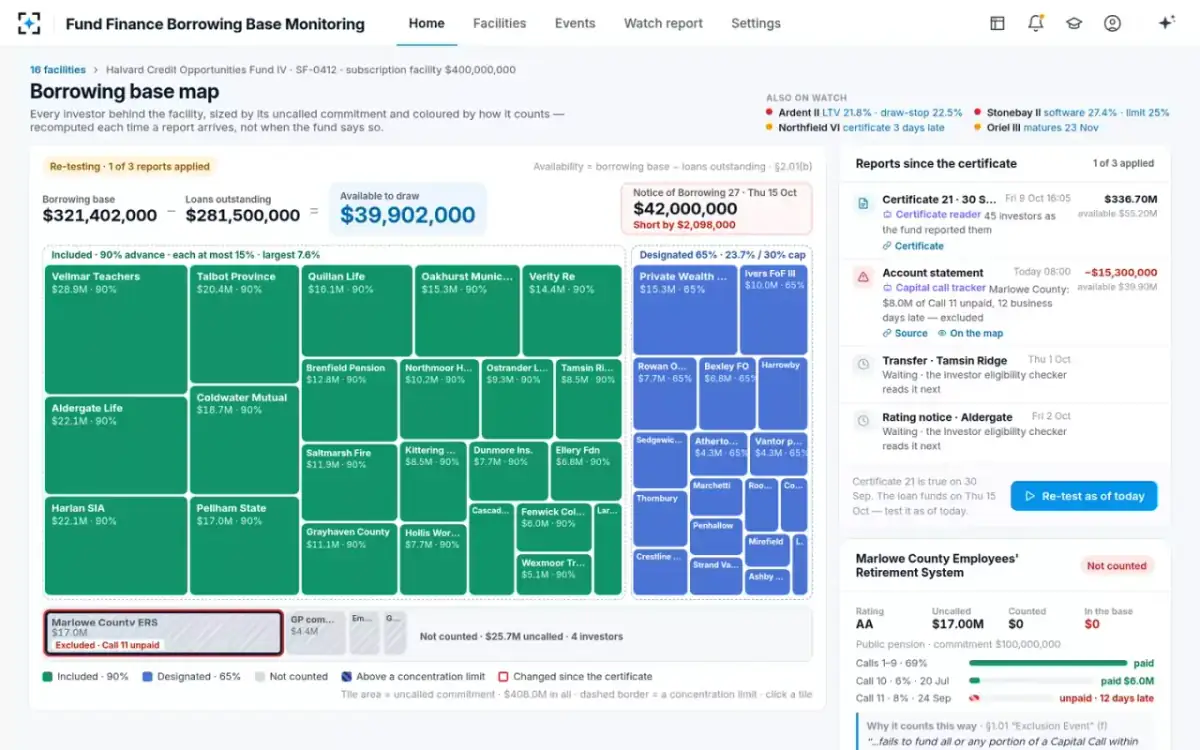
Note where the bank's own settings sit against the agreement's. The agreement sets the day on which the exclusion bites; the bank separately sets the day on which it wants to hear about it. In the sample bank that early warning is three business days by default, adjustable to one or five, which gives the relationship manager a window to ask the fund's controller what has happened before the collateral consequence arrives. The warning is housekeeping. The exclusion is the contract.
It is also worth being clear about what the agent does and does not do here. The capital call tracker matches each call notice to the receipts in the pledged account and counts days late per investor. It never contacts the investor, and it never tells an investor it is in default — that is a conversation between the fund and its own limited partner, and a bank that starts it has stepped into the fund's relationship.
A ratings downgrade: Included to Designated, and the cap that comes with it
Where a facility uses ratings for eligibility, a downgrade usually moves an investor down a class rather than out of the base. On the sample facility an Included Investor's uncalled capital counts at a 90% advance rate; a Designated Investor's counts at 65%, no single Designated Investor may be more than 5% of the base, and all of them together may not exceed 30%.
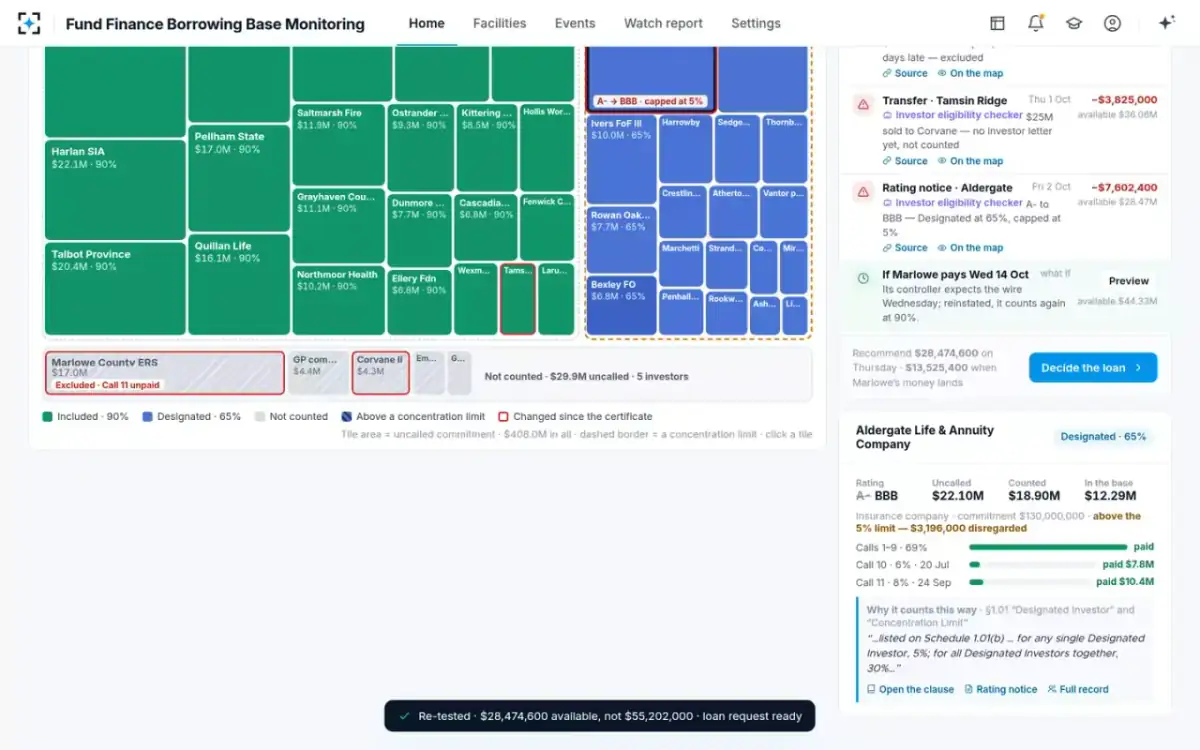
Aldergate Life & Annuity was cut from A- to BBB, which puts it below the Included floor. It moves into the Designated group, picks up the lower advance rate and the 5% single-investor cap, and $7,602,400 leaves the base. The whole Designated group then sits at 29.0% of its 30% limit, which is close enough that the next downgrade is a different kind of problem — one that would push capital out of the base even for investors whose own ratings never moved.
Two points a credit officer should take from this. First, a class change is not a judgement about the insurer's solvency; it is the application of a schedule. Second, concentration caps make downgrades interact. The arithmetic for one investor is simple; the arithmetic for the fourth downgrade in a group approaching its cap is not, and it is the kind of calculation that a spreadsheet rebuilt by hand each month tends to get wrong in the fund's favour.
The ratings that matter here are the investors' own: usually a public issuer rating or, for an insurer, a financial strength rating, and a facility's schedule may name more than one scale and more than one agency. A downgrade on any scale the agreement names can move the class. That is why the solution reads all three scales the sample bank watches every morning at 06:30, against each facility's own floor, rather than waiting for the fund's next certificate to mention it.
"The loans may have covenants, such as specifying investor eligibility (e.g. minimum credit rating), requirements to notify bank lenders of capital calls or changes to commitments, and a minimum capital coverage ratio"
Financial Stability Board, on the covenants in bank lending to private credit funds, May 2026
A transfer nobody approved yet
An investor that sells part of its commitment changes who owes the money. Until the buyer has signed an investor letter and cleared the bank's own checks, the lender holds a promise from a party it has never agreed to lend against, and the transferred portion stops counting.
On the sample facility, Tamsin Ridge Endowment sold $25,000,000 of its $50,000,000 commitment to Corvane Secondary Partners II, which has no investor letter yet. The base falls by $3,825,000 — much less than the headline $25,000,000, because only the uncalled part of a commitment ever counts in a borrowing base, and most of Tamsin Ridge's had already been drawn. At the facility's 90% advance rate, $3,825,000 of base corresponds to $4,250,000 of uncalled capital changing hands; that last step is our arithmetic from the facility's own advance rate, not a figure the fund reported.
This is the clause most often missed between certificates, for a simple reason: nothing arrives. A missed call shows up as an absence in an account statement that the bank already receives. A downgrade arrives on a ratings feed. A transfer is a document between two investors, and the bank learns of it when the fund tells it, which the notification covenant requires but does not guarantee. It is the clause where a monthly re-read of the investor schedule earns its cost.
What cures each exclusion event, and what never does
Put the three side by side with their cures, and the week's work plans itself.
Three clauses, three cures, and who has to act
| The event | What it takes out of the base | What cures it | Who has to act |
|---|---|---|---|
| Capital call unpaid past the agreement’s day count | The investor’s whole uncalled commitment, at its advance rate. On the sample facility: $15,300,000. | The money reaching the pledged collection account, then a reinstatement approved by the credit officer. | The investor pays, the fund chases, the bank verifies the receipt and reinstates. |
| Rating cut below the facility’s eligibility floor | The difference between the two advance rates, plus anything above the lower class’s concentration cap. On the sample facility: $7,602,400. | Nothing within anyone’s control. Only a ratings action restores the class; a waiver can change the treatment, with a reason, but not the rating. | Nobody, until a rating agency moves. The bank decides whether to seek a waiver. |
| Transfer to an investor the bank has not approved | The uncalled portion of the transferred commitment, at its advance rate. On the sample facility: $3,825,000. | The buyer’s investor letter and the bank’s own checks approved, and the buyer added to the eligibility schedule. | The buyer signs, the fund delivers the documents, the bank approves and the schedule is amended. |
| Investor asserts an excuse right for a particular investment | That investor’s capital, for the purpose of that draw only, where the agreement provides for it. | The purpose of the draw changing, or the investor withdrawing the assertion. | The fund and the investor; the bank checks each draw’s purpose against the excuse rights it holds. |
One thing never cures an exclusion event: the fund restating its certificate. A certificate is the fund's own representation on its own as-of date, and re-issuing it with a higher number changes nothing about what the bank can count. The agents in the solution recompute the fund's arithmetic and report the difference; they never alter a reported figure, in either direction.
Detected, removed, cured: who does what between a report arriving and an investor counting again
Agent
Capital call trackerMatches every capital call to the receipts in the pledged account and counts business days late per investor, on the facility’s own day count.
Never: contacts an investor, or tells one it is in default
Agent
Investor eligibility checkerReads ratings each morning and checks transfers, sanctions, side letters and the facility’s schedules investor by investor.
Never: adds an investor to a schedule
Agent
Facility terms readerSupplies the clause that governs the event, with its section, and applies the latest amendment where a term has changed.
Never: applies a superseded version of a term
Agent
Borrowing base calculatorRe-applies advance rates and concentration limits as of the loan date and reconciles line by line with the certificate.
Never: rounds in the fund’s favour
A person decides
Collateral analystConfirms the re-test with the meaning of her signature, and approves loans up to her own limit.
Never: approves a loan above that limit, or any waiver
A person decides
Credit officerApproves larger loans, any waiver of an exclusion and every reinstatement, with a reason on the record.
Never: delegates a reinstatement to the agents
How many business days late before a capital call is an exclusion event?
It depends entirely on the credit agreement, and the honest answer to anyone quoting a market standard is to ask which agreement they mean. On the sample facility the investor in question is twelve business days late, well past the threshold in the definitions clause; the bank's own early warning fires at three business days, and can be set to one or five. Neither number comes from a regulator, and no supervisory guidance sets a day count for capital calls.
What varies between agreements is not only the number but what it is counted from and how. Business days or calendar days; from the call notice, from the due date or from a notice of non-payment; whether a cure period runs before the exclusion or instead of it; and whether a partial payment stops the clock. A monitoring process that applies one day count across a book will be wrong on most facilities, which is why each facility's own count is read from its own agreement and shown with the section it came from.
One investor, the clause that governs it, and the history behind it
What evidence a credit officer needs before reinstating an investor
Reinstatement is the decision with the most room for a mistake, because it puts capital back into the base and therefore makes a larger loan possible. The bar should be higher than the bar for exclusion, and in the solution it is a credit officer's decision rather than an analyst's.
The evidence is specific to the event. For a late capital call it is the receipt in the pledged collection account — not the fund's statement that a wire has been sent, not the controller's email, the credit of the money into the account the lender has control over. For a transfer it is the buyer's executed investor letter, its completed checks and the amended schedule. For a downgrade there is nothing to produce: the rating either moved or it did not, and anything else is a waiver, which is a different decision with its own reason written down.
This is the kind of decision supervisors expect a person to own. The OCC, describing how banks are deploying newer forms of automation, observes that they are "taking a measured approach to the adoption of generative AI (genAI) and agentic AI, with usage generally limited to specific use cases with guardrails and human-in-the-loop accountability to manage risk" (OCC, Semiannual Risk Perspective, Spring 2026). The division used here is deliberately plain: the agents detect, cite and recompute; the analyst confirms; the credit officer decides anything that increases what the bank will lend.
The evidence an exclusion event needs, before and after
- The clause, with its section and its effective amendment
Which definition was applied, in the version in force on the test date, not the version at closing.
- The document that triggered it
The account statement, the rating notice or the transfer agreement — the page and line, not a summary of it.
- The day count the agreement uses
Business or calendar, from the notice or the due date, with the dates it was run on.
- The arithmetic, line by line
Uncalled commitment, advance rate, concentration cap and the amount disregarded, so the figure can be rebuilt without the tool.
- What would cure it, stated at the time
Written when the exclusion is applied, not reconstructed later when someone asks why the loan was short.
- For a reinstatement: the receipt, not the promise
Money credited to the pledged account, an executed investor letter, or an approved waiver with its reason.
- The approver, and the limit they approved under
Analyst or credit officer, with the signature, the time and the version of the rule applied.
What happens when the money arrives after all
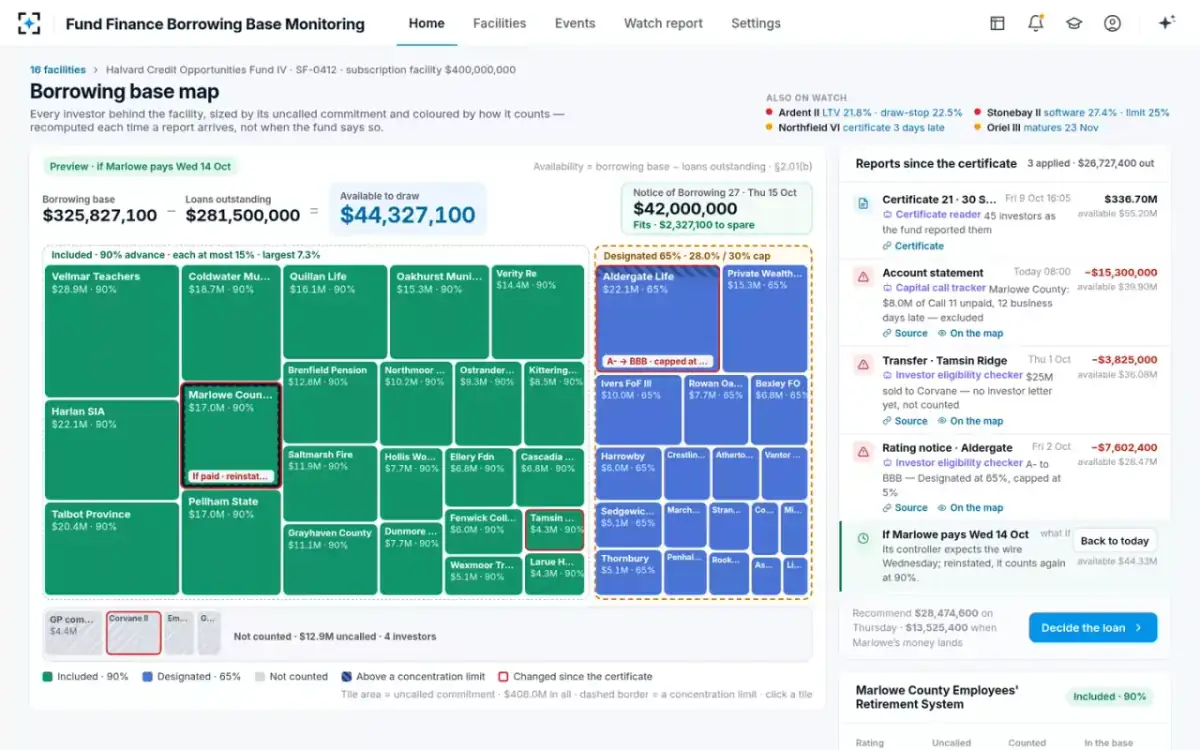
The most common ending to an exclusion event is the dullest. The fund's controller says the wire will go on Wednesday, and the question for Tuesday afternoon is what the loan looks like if it does. In the solution that is a preview rather than a change: the investor's tile turns green, the base rises to $325,827,100 and $44,327,100 becomes available, enough for the full $42,000,000 with $2,327,100 to spare.
Nothing about the preview moves the real figure. The base changes when the money is in the pledged account and the credit officer reinstates the investor, and not before — which is the whole point of separating the two. A preview is how a relationship manager tells a fund what Thursday will look like; a reinstatement is how the bank changes what it will lend.
A preview, not a change: what Wednesday's wire would be worth
Where an exclusion cannot be cured, the loan funds at the re-tested availability and the rest waits, with the notice to the fund saying which of the three events held back which amount and what would release it. How that notice, the approval and the signature fit together is worked through end to end in one borrowing base re-test, certificate to funding, and the collateral behind the whole arrangement — why the pledged account matters so much to a reinstatement — is in what actually secures a subscription line. To see the three clauses applied to a live book, start from Fund Finance Borrowing Base Monitoring.
Questions people ask
What is an excluded investor in a subscription facility?
A limited partner whose uncalled commitment the credit agreement no longer lets the lender include in the borrowing base, on the happening of a defined event — most often an unpaid capital call, insolvency, a rating below the eligibility floor, or a transfer to a party the bank has not approved. The investor remains a partner in the fund with the same obligations; it is the lender's collateral calculation that changes.
What happens if an investor misses a capital call?
Once it is past the number of days the agreement allows, the investor's whole uncalled commitment leaves the borrowing base at its advance rate, and availability falls by that amount. On the sample facility that was $15,300,000, enough to make a requested $42,000,000 loan short by $2,098,000. The fund's own remedies against the defaulting partner are a separate matter under the partnership agreement.
Does a ratings downgrade remove an investor from the borrowing base?
Usually it moves the investor to a lower class rather than removing it. On the sample facility an Included Investor counts at a 90% advance rate and a Designated Investor at 65%, with a 5% cap on any single Designated Investor and 30% on the group. A downgrade below the floor therefore costs the difference between the rates plus anything above the cap — and the group cap means one investor's downgrade can affect investors whose own ratings never moved.
Can an investor sell its stake without the bank's approval?
It can sell its interest in the fund, subject to the partnership agreement; what it cannot do is make the buyer count in the lender's borrowing base. Until the buyer has signed an investor letter and cleared the bank's checks, the uncalled portion transferred stops counting. The agreement's notification covenant obliges the fund to tell the lender; the lender's own re-read of the investor schedule is what catches it when the fund does not.
What cures an exclusion event?
It depends which one. A late capital call is cured by the money reaching the pledged collection account, followed by a reinstatement approved by the credit officer. An unapproved transfer is cured by the buyer's investor letter and checks being approved. A downgrade is not curable by anyone at the bank or the fund — only a ratings action reverses it, though a waiver can change the treatment if the credit officer records a reason.
Does a Designated Investor still count at all?
Yes, at the lower advance rate the agreement sets for the class, and only up to the concentration caps. On the sample facility that is 65% rather than 90%, no more than 5% of the base for any single Designated Investor, and no more than 30% for all of them together; anything above a cap is disregarded rather than removed, and the disregarded amount is shown separately so it can be checked.