AI agents for fund finance borrowing base monitoring work the way a well-run desk already works: by division of labour, with a person at every decision. In Fund Finance Borrowing Base Monitoring the re-test is split across seven specialist roles — a certificate reader, a facility terms reader, a capital call tracker, an investor eligibility checker, a borrowing base calculator, a NAV and loan tape monitor, and a draw and watch recommender — and not one of them may approve a loan, move money, contact an investor or alter a figure the fund reported. What they produce is a re-tested borrowing base with its working shown; what happens to it is a human decision.
This guide walks the seven roles across one sample run: a $42,000,000 notice of borrowing against a $400,000,000 subscription facility with 46 investors behind it. The fund, the bank and the investors are fictional characters in the solution's own sample data. The supervisory material quoted is the agencies' current text, linked where it appears.
One re-test of the sample facility, start to finish
50s
for the agents to re-test the sample facility end to end, certificate to drafted recommendation
46
investors checked against capital calls, ratings, transfers, side letters and sanctions screening
3
changes found since the fund’s certificate, none of them on the certificate
0
decisions the seven roles are permitted to make
Seven roles, one re-test
The reason to split the work at all is that a borrowing base re-test is four unrelated skills wearing one name. Reading a fund's spreadsheet is a document problem. Reading a credit agreement is a legal-interpretation problem. Counting business days between a capital call and a receipt is a reconciliation problem. Applying advance rates and concentration limits in the right order is arithmetic that has to be shown. A single general-purpose assistant asked to do all four at once produces one answer and no audit trail, which is exactly what a credit function cannot use.
Dividing it also makes each role small enough to constrain. A role that only reads certificates can be forbidden to change a number. A role that only applies rules can be required to cite a section for every rule it applies. Those constraints are the product. The division of labour is how they become enforceable rather than aspirational.
The seven roles, in the order the re-test uses them, and the person who decides after
Agent
Certificate readerReads the fund’s borrowing base certificate, investor list and notice of borrowing in whatever format the fund sends, and recomputes the fund’s own arithmetic.
Never: Never alters a reported figure — reports the difference
Agent
Facility terms readerTurns the credit agreement into the rules the re-test applies: eligibility, advance rates, concentration limits, exclusion events, transfers, reporting.
Never: A term it cannot read goes to the analyst
Agent
Capital call trackerMatches every capital call notice to the receipts in the pledged collateral account and counts business days late, per investor, on the facility’s own day count.
Never: Never contacts an investor or tells one it is in default
Agent
Investor eligibility checkerChecks all 46 investors each morning against today’s ratings, transfers, sanctions screening, side letters and KYC, under this facility’s definitions.
Never: Never adds an investor to a schedule
Agent
Borrowing base calculatorRecomputes the base, the concentration limits and availability as of the loan date, and reconciles line by line with the fund’s certificate.
Never: Never rounds in the fund’s favour
Agent
NAV and loan tape monitorReads quarterly valuations and monthly loan tapes, runs loan-to-value against draw-stop, sweep and default levels with 10% and 20% stresses.
Never: Never adjusts a manager’s mark
Agent
Draw and watch recommenderTurns the re-test into a loan recommendation with its conditions, drafts the notice to the fund and writes the week’s report for the credit committee.
Never: Never approves or moves money
A person decides
Collateral analyst, then credit officerConfirms the re-test and signs for it; above the analyst’s limit, or for any waiver or reinstatement, the credit officer approves.
Never: The signature is never delegated
The certificate reader: never alters a reported figure
Funds do not report in a common format. One sends a spreadsheet with the investor schedule on a second tab; another sends a signed PDF with the uncalled commitments in a table that spans three pages; a third sends both, disagreeing with itself. The certificate reader's job is to take whichever arrived and produce the fund's own numbers in a structure the rest of the re-test can use — investor by investor, with page and cell cited for every value.
Its single most important limit is that it may not improve what it reads. If the fund's schedule adds to a total that is $14,000 away from the total on its cover page, the reader does not quietly adopt the arithmetic that looks right; it reports the difference and leaves both figures standing. That sounds pedantic until you consider what the alternative does to an audit. A reader that silently corrects a fund's certificate has destroyed the only clean record of what the fund actually asserted — and the fund's assertion is the document the bank lent against.
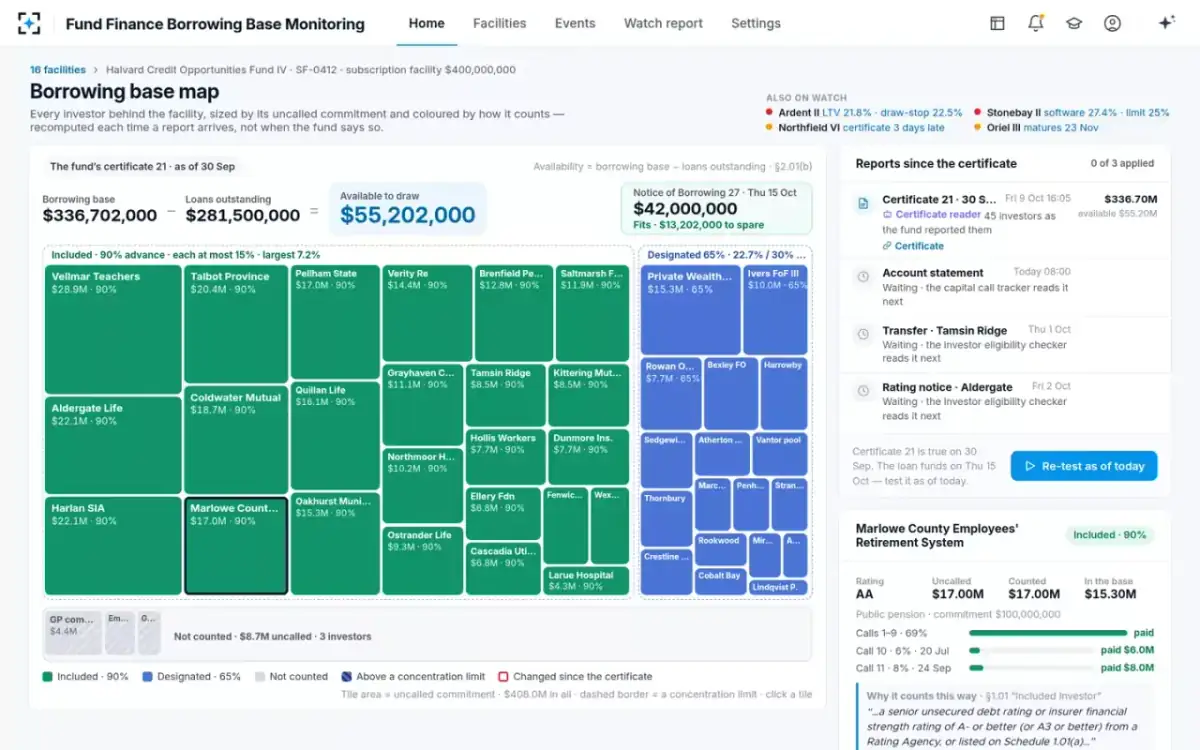
The same rule explains why the solution's starting screen draws the fund's figures rather than the bank's. On the sample facility, certificate 21 claims a borrowing base of $336,702,000 against loans outstanding of $281,500,000, leaving $55,202,000 available and the $42,000,000 request fitting with room to spare. That is the fund's case, drawn honestly, before a single rule is applied to it.
The fund's own certificate, before the bank's rules touch it
The facility terms reader: every rule cites its section
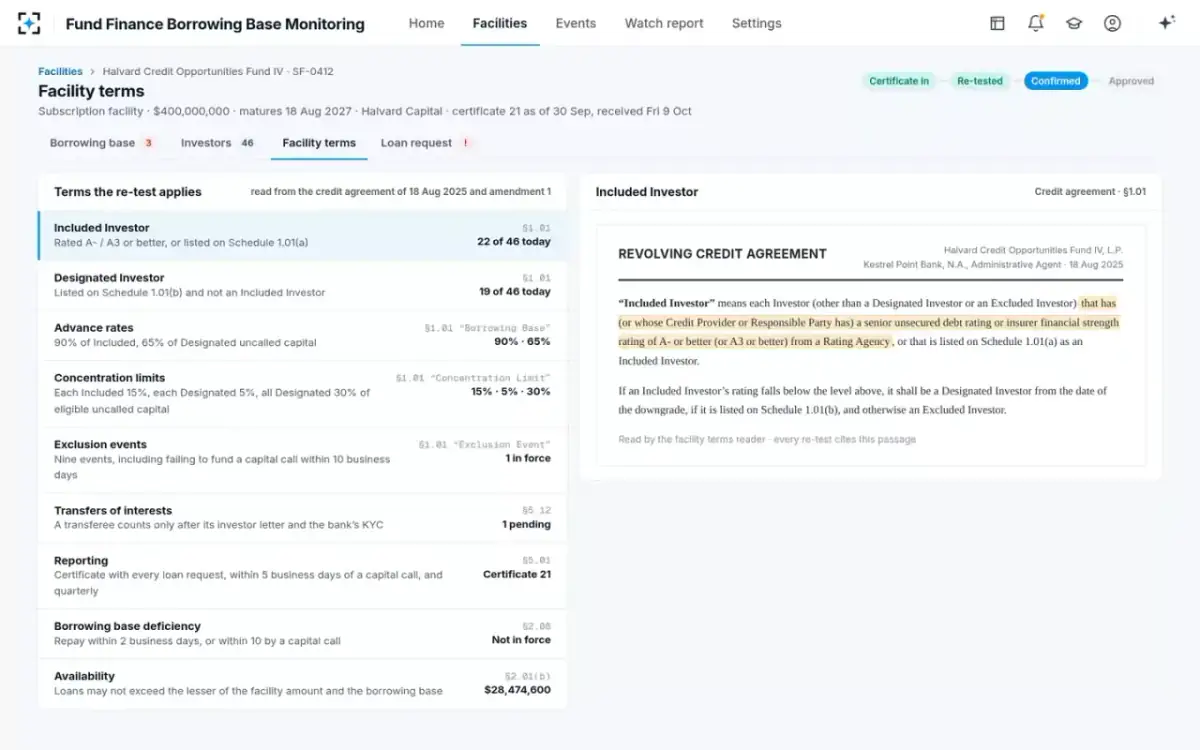
The second role reads the credit agreement and every amendment to it, and turns the parts that govern the base into rules with addresses. On this facility that means the definitions of Included Investor and Designated Investor, advance rates of 90% and 65%, concentration limits of 15% for a single Included Investor, 5% for a single Designated Investor and 30% for the Designated group together, the exclusion events, the treatment of transfers under §5.12, borrowing base deficiency under §2.08 and availability under §2.01(b).
Two constraints make this role usable rather than merely clever. The first is that every rule carries its section, so any figure in the final re-test can be traced back to the clause that produced it and the clause can be read with the passage highlighted. The second is that a term it cannot read confidently is escalated to the analyst rather than guessed. A credit agreement that defines eligibility by reference to a side letter the bank has not been given is not a problem to be solved by inference; it is a question for a person.
Rules with addresses: each term, its section, and today's value
The capital call tracker and the investor eligibility checker: two different clocks
These two roles are often collapsed into one by people describing this work, and they run on genuinely different clocks. The capital call tracker is a reconciliation that runs whenever money moves: it matches each capital call notice to the receipts in the pledged collateral account and counts business days late for each investor, using the day count the facility itself defines rather than a convention. The investor eligibility checker is a surveillance task that runs every morning: today's ratings across the rating scales the bank has chosen to watch, any transfer of an interest, sanctions screening, side letters, KYC status.
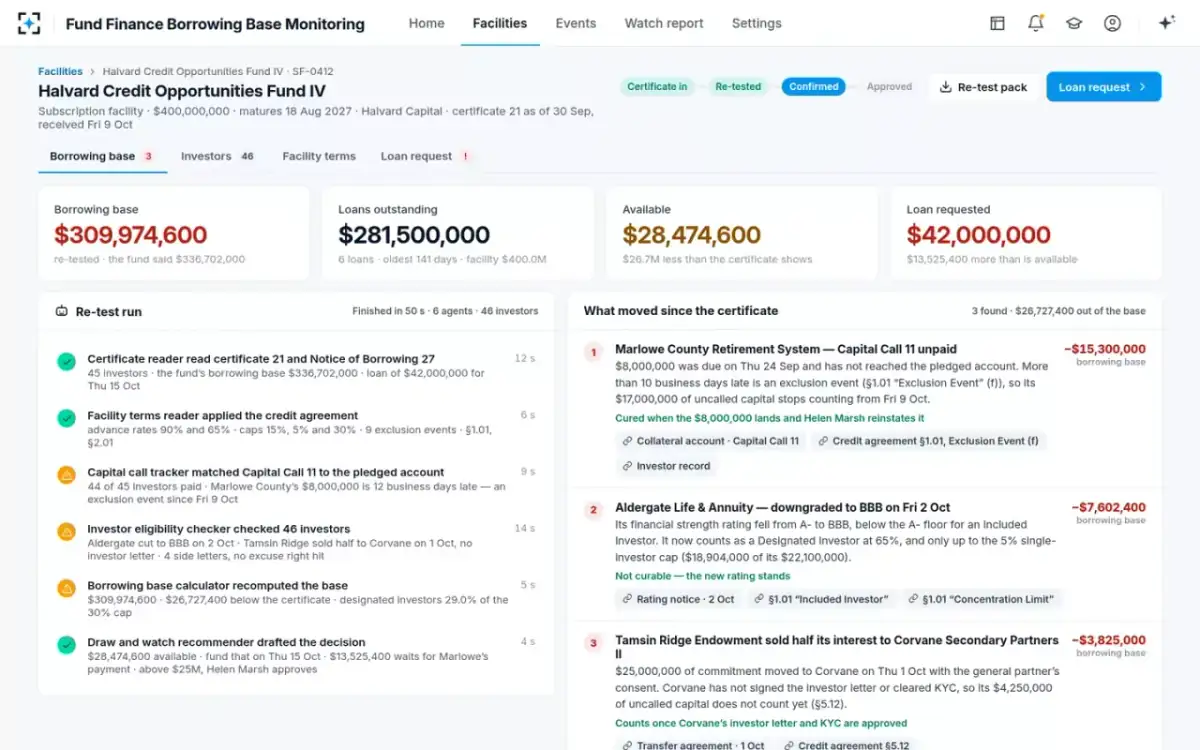
Both produced a change on the sample run, and neither change was on the certificate. Marlowe County Employees' Retirement System had not paid $8,000,000 of Capital Call 11 and was twelve business days late — an exclusion event under the agreement's own definition — removing $15,300,000 from the base. Aldergate Life & Annuity had been cut from A- to BBB, which moves it out of the Included group into the Designated group at a 65% advance rate and under the 5% single-investor cap: $7,602,400. A third change came from the transfer side: Tamsin Ridge Endowment sold half of its $50M commitment to Corvane Secondary Partners II, which has no approved investor letter yet, so $3,825,000 stops counting until it does.
The eligibility checker's hardest limit is also its least obvious: it applies each facility's own definitions, which means the same investor can remain Included in one facility and turn Designated in another on the same morning, and the checker may never reconcile that difference. Consistency across facilities would be a bug, not a feature, because the facilities are different contracts. What counts as an exclusion event, and what cures it, works through the categories one by one.
The borrowing base calculator: showing its working for every line
The calculator is the role with the least interpretive freedom and the most exacting output requirement. It recomputes the base as of the borrowing date rather than the certificate date, applies each investor's advance rate, then applies the concentration limits in the order the agreement sets, and reconciles the result line by line against what the fund said. Three limits govern it: use the borrowing date, show the working for every line, and never round in the fund's favour.
The third is the one that would be easiest to break invisibly. Rounding conventions inside a concentration test can move hundreds of thousands of dollars on a facility of this size, and a tool that resolves ties towards the borrower will be right almost every time and catastrophically wrong on the occasion that matters. On the sample facility the re-tested base came to $309,974,600 with $28,474,600 available — $13,525,400 short of the $42,000,000 request, with the Designated group sitting at 29.0% against its 30% cap, close enough that the next downgrade would bind.
The run, step by step, with every change and what would cure it
The NAV and loan tape monitor: stress, not just a snapshot
The sixth role exists because a fund finance book is not all subscription lines. NAV facilities lend against the value of the fund's investments, and back-leverage lines against a tape of underlying loans, and neither is tested by counting uncalled capital. For a NAV facility the monitor reads the quarterly valuation report, compares every mark with the prior quarter, and runs loan-to-value against the draw-stop, cash sweep and default levels with 10% and 20% valuation haircuts applied. For a back-leverage line it applies the facility's eligibility and concentration tests to each monthly loan tape.
Its two limits are about valuation integrity: it never adjusts a manager's mark, and it never accepts a mark without its valuation source. That is a deliberately conservative posture, and the current supervisory commentary supports it. The OCC's Spring 2026 Semiannual Risk Perspective records that bank "exposures to private credit funds are generally performing according to the terms agreed with borrowers" while adding that "there are signs that credit quality for some vintages, borrower types, and sectors of the private credit markets is weakening" (OCC, Semiannual Risk Perspective, Spring 2026). A monitor that could quietly re-mark a position would be able to smooth exactly the signal a lender most needs to see. Subscription line versus NAV facility sets out why the two are tested so differently.
Can an AI agent approve a fund finance loan?
No. In this solution the agents cannot approve a loan, and that is a design rule rather than a setting that can be relaxed. The draw and watch recommender turns a re-test into a recommendation — fund $28,474,600 on Thursday, with $13,525,400 waiting on Marlowe's payment — and drafts the notice to the fund's CFO. The analyst confirms, signing with the meaning of the signature; loans above her $25,000,000 limit go to the credit officer, as do waivers and reinstatements. The notice to the fund is sent only once the loan is approved.
There is a supervisory reason to be explicit about this as well as a commercial one. The agencies' revised model risk guidance, SR 26-2, which replaced SR 11-7 on 17 April 2026, says plainly in its attachment that "generative AI and agentic AI models are novel and rapidly evolving. As such, they are not within the scope of this guidance" (Revised Guidance on Model Risk Management, attachment to SR 26-2). Being outside a validation framework is not a licence; it is a reason to keep the decision rights with people and to make the tool's working legible enough that a bank's own controls can carry the weight the guidance does not. The letter itself is addressed principally to large institutions: it "is expected to be most relevant to banking organizations with over $30 billion in total assets regulated by the Federal Reserve" (SR 26-2). Whether a borrowing base re-test is a model at all takes that question apart.
Generative AI and agentic AI models are novel and rapidly evolving. As such, they are not within the scope of this guidance.
Revised Guidance on Model Risk Management, attachment to SR 26-2, 17 April 2026
What a role recommends, and what a person decides
The agents produce: A re-tested base of $309,974,600 with every line reconciled against certificate 21 and each difference sourced.
A person decides: The analyst confirms it, or sends a term back as unreadable and resolves it against the agreement herself.
The agents produce: Marlowe is twelve business days late on $8,000,000 of Capital Call 11; under the definition that is an exclusion event.
A person decides: The credit officer may waive it, with a reason recorded, and may reinstate the investor once the money lands.
The agents produce: A recommendation to fund $28,474,600 on Thursday, with the conditions that would release the rest.
A person decides: The analyst approves up to $25,000,000; above that, the credit officer approves — or waives and funds more.
The agents produce: A drafted notice to the fund’s CFO giving the re-tested base, the three reasons and what releases the balance.
A person decides: It is sent only when the loan is approved, by the person who approved it.
The agents produce: A weekly report of the facilities on watch and every change to the book, with reasons.
A person decides: The Head of Fund Finance reads it and presses Send, or does not.
What none of the seven may ever do
The limits are easier to audit as a matrix than as prose, because the useful question in a credit review is not "what can this tool do" but "what is it structurally unable to do". Six prohibitions apply across the whole set, and each role carries its own on top.
The prohibitions, role by role
| Role | What it may never do |
|---|---|
| Certificate reader | Alter any figure the fund reported. A difference is reported, with page and cell cited, never corrected into agreement. |
| Facility terms reader | Apply a term it cannot read. Where an amendment changes a term it applies the latest and keeps the history; an unreadable term goes to the analyst. |
| Capital call tracker | Contact an investor, or tell one that it is in default. It tells the bank, using the facility’s own day count. |
| Investor eligibility checker | Add an investor to a schedule, or carry a conclusion from one facility to another. |
| Borrowing base calculator | Round in the fund’s favour, use the certificate date instead of the borrowing date, or produce a line without its working. |
| NAV and loan tape monitor | Adjust a manager’s mark, or accept a mark with no valuation source behind it. |
| Draw and watch recommender | Approve anything, move money, or send the notice to the fund before a person has approved the loan. |
| All seven | Decide. Every re-test is confirmed by the analyst; loans above her limit, every waiver and every reinstatement are the credit officer’s. |
Two further controls sit around the seven rather than inside any of them. Each amount that leaves the base links to the account statement, rating notice or transfer agreement it came from, so a figure can always be walked back to a document. And every report read, every re-test, every signature and every change to the bank's own thresholds is written to the audit trail with who, what and when, with threshold changes versioned. A bank that cannot show an examiner why a loan funded at $28,474,600 rather than $42,000,000 has not automated its monitoring; it has outsourced it.
It is worth being clear about what this does not settle. Nothing here certifies the tool against any supervisory standard, and no agency has published one for agentic tools in fund finance. What the division of labour buys is a narrower claim: each step is small, each step cites its source, and the steps that could lose a bank money are the ones a person still performs. Against a backdrop the OCC describes as needing "careful monitoring of borrower performance and refinancing risk" as lending to private credit funds grows (OCC, Spring 2026), that is the right shape for the claim to take. To see the roles running on one facility, start from Fund Finance Borrowing Base Monitoring.
Questions people ask
How does AI borrowing base monitoring actually work?
It reads, it re-derives and it reconciles. One role reads the fund's certificate and notice of borrowing in the fund's own format; another turns the credit agreement into rules with section references; others match capital-call receipts in the pledged account and check every investor's rating, transfers, side letters and sanctions screening as of today. A calculator then rebuilds the base as of the loan date and reconciles it line by line against the certificate, showing its working.
Can an AI agent approve a fund finance loan?
Not in this solution. The agents produce a recommendation, its conditions and a drafted notice; the collateral analyst confirms and signs, and loans above her delegated limit go to the credit officer, as do every waiver of an exclusion event and every reinstatement of an investor that has cured. The notice to the fund is sent only after approval, by a person.
What is the difference between the certificate reader and the borrowing base calculator?
The certificate reader establishes what the fund said; the calculator establishes what the credit agreement makes of it today. The reader may not change a reported figure, so the fund's assertion survives intact as a document. The calculator starts from that assertion and re-derives the base as of the borrowing date, applying advance rates and concentration limits in the agreement's order and reconciling every line.
Can agents change a fund's reported figures?
No. If the fund's schedule and cover page disagree, both stand and the difference is reported with page and cell cited. The re-tested base is produced alongside the certificate, never over it, which is what allows a reviewer to see exactly where the bank and the fund part company — on this facility, three changes worth $26.7 million, each with the document behind it.
Does an agent ever contact an investor directly?
No. The capital call tracker counts business days late against the pledged collateral account and reports to the bank; it never tells an investor that it is late or in default, and the eligibility checker never writes to an investor to chase a side letter or KYC. Communication with investors belongs to the fund and its general partner, not to the fund's lender's monitoring tool.
What happens when a credit agreement term the agent can't read appears?
It goes to the collateral analyst. The facility terms reader is required to cite a section for every rule it applies, so a term it cannot resolve — a definition that turns on a side letter the bank has not been given, say — cannot be applied at all. The analyst reads the clause and decides, and the decision is recorded with the rest of the re-test.