The clearest borrowing base certificate example is one with something wrong in it — not an error, but a gap between what the fund reported and what the bank can lend against fifteen days later. Halvard Credit Opportunities Fund IV certifies a borrowing base of $336,702,000 as of 30 September and asks for $42,000,000 to fund on Thursday 15 October. The certificate is correct. By the funding date three investors have changed, $26,727,400 has left the base, and the loan is short. This page follows the file through Botminds' Fund Finance Borrowing Base Monitoring from the certificate arriving to the notice going back to the fund, screen by screen.
Every figure, name and document on this page is fictional sample data inside the solution. The fund, the bank, the investors and the four people are invented. What is not invented is the shape of the problem: a certificate is true on its as-of date, a notice of borrowing arrives days later, and nothing in between has been re-applied.
It is also a shape that regulators have recently made easier to see. Since the December 2024 reporting changes, US banks above $10 billion in assets report their lending to non-bank financial firms in five separate subcategories "including reporting of unused commitments in each of those subcategories", and all banks report performance data on those loans (FDIC, February 2026). The exposure has its own line now. The figure on that line should be the bank's, not the borrower's.
One certificate, one notice of borrowing, three days
The facility is a $400,000,000 subscription line — the ordinary kind. The FSB describes these as "typically short-term bridge or working capital loans that private credit funds use to originate loans prior to calling capital from their investors" (FSB, May 2026), which is exactly what this draw is for. The fund has a deal to close; it draws now and calls capital later.
The working week runs from Tuesday to Thursday, and almost all of it is the bank's own work rather than waiting on anyone.
Certificate to funding: one accurate statement, and the fifteen days after it
- Accurateon 30 Sep
- Three changes, none applied to itthe next 15 days
- Re-read and re-testedTue, 50 seconds
- Signed, then approvedTue, on mobile
- Funded in partThu 15 Oct
What does a borrowing base certificate look like?
A borrowing base certificate is a short document with a long attachment. The document itself is a signed statement by an officer of the fund that, as of a stated date, the borrowing base was a stated amount and the fund was in compliance. The attachment is the investor schedule that produces the number, and it is where everything interesting lives. Nine parts, in roughly this order.
The nine parts of a borrowing base certificate, and what this fund's say
1
The header
The fund, the facility, the certificate number and — the line that matters most — the as-of date. Certificate 21 on this facility is as of 30 September.
2
The investor schedule
One row per limited partner: its class under the agreement, its total commitment, the capital called from it so far, and the uncalled balance that is left. Forty-six rows on this facility.
3
The advance rates applied
The rate for each class, taken from the credit agreement. Here, 90% for an Included Investor and 65% for a Designated Investor.
4
The concentration tests
Each cap, the amount tested against it, and the excess disregarded. Here: 15% for any single investor, 5% for any single Designated Investor, 30% for all Designated Investors together.
5
The borrowing base total
Eligible uncalled capital at its advance rates, less everything disregarded. The fund certified $336,702,000.
6
Loans outstanding
Drawn under the facility, plus any letters of credit counted against it. $281,500,000 here.
7
Availability
The base less the outstandings: $55,202,000 on the fund’s own figures.
8
The certification
An officer of the fund signing that the above is true as of the as-of date. It is a representation about one day, and it is accurate.
9
The notice of borrowing
Usually a separate document: how much the fund wants and the day it wants it. Here, $42,000,000 to fund on Thursday 15 October.
Two things about that list are worth saying plainly to anyone searching for a template. First, there is no standard form: each fund sends its own spreadsheet in its own layout, with its own column names and its own rounding, which is why a collateral analyst's first hour on a certificate is usually spent re-keying rather than checking. Second, nothing in the certificate is wrong. Part 8 is a representation about part 1's date, and the fund's officer signed it correctly. The bank's problem is not accuracy; it is currency.
The certificate, drawn as a map of the facility
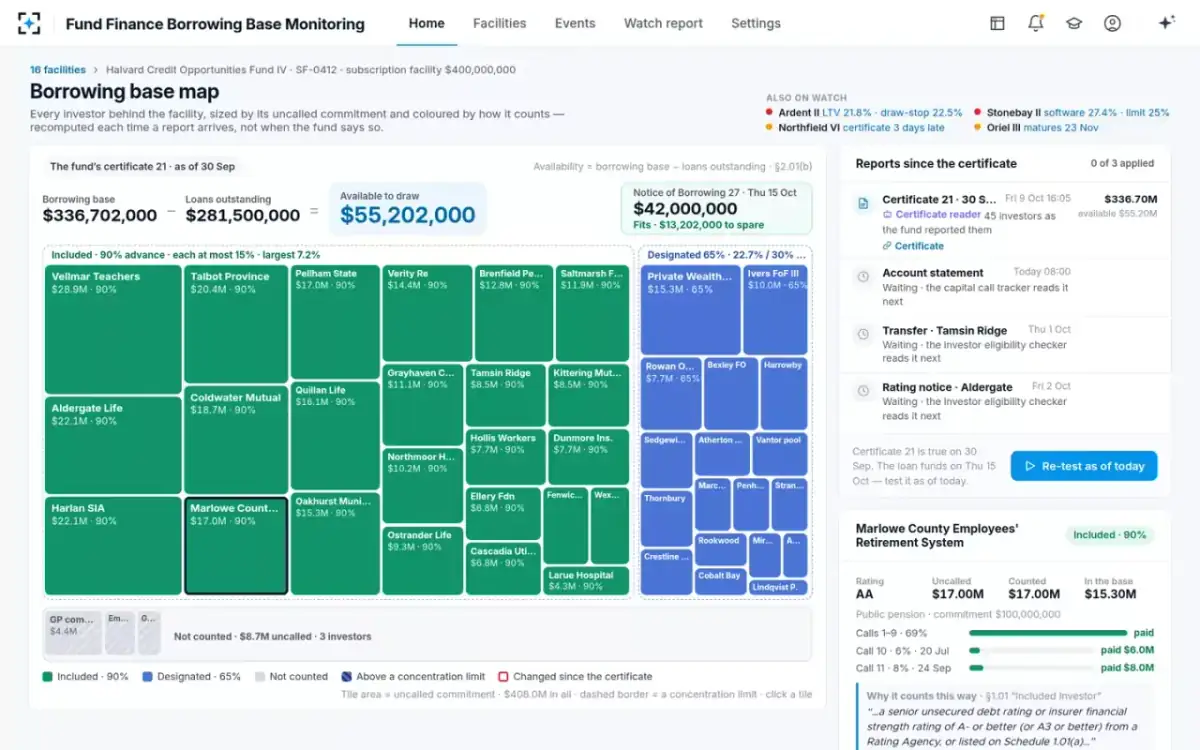
The first change: a capital call paid late
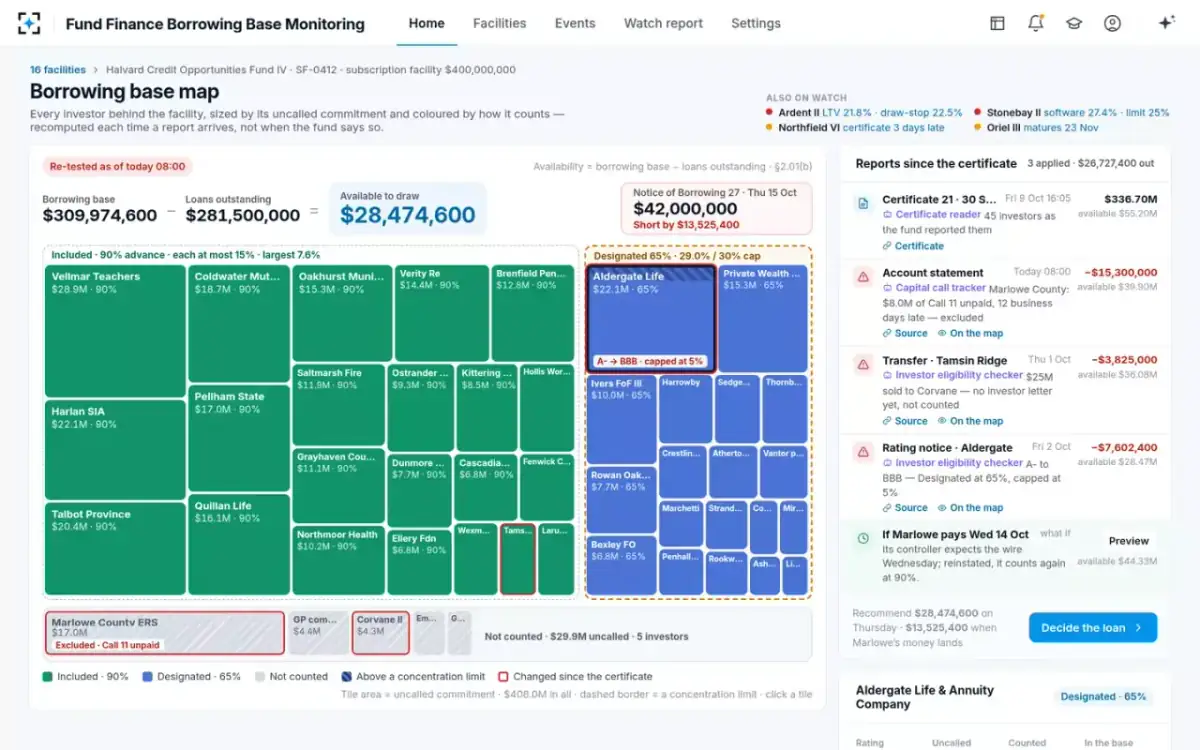
At 08:00 on the Tuesday the pledged collection account's statement arrives, and one line is missing from it. Marlowe County Employees' Retirement System has not paid its $8,000,000 share of Capital Call 11, which makes it twelve business days late — past the threshold in the agreement's definitions clause.
The consequence is not proportionate to the missed payment, and that surprises people the first time they see it. The $8,000,000 is not what leaves the base. The investor stops counting altogether, so its entire $17,000,000 of uncalled capital goes, and at the 90% advance rate the base falls by $15,300,000. Availability drops to $39,902,000 and the $42,000,000 request is short by $2,098,000 — on one unpaid wire.
The evidence for the exclusion is a credit that is not in an account. That is worth pausing on, because it is the only one of the three changes that is proved by a document the bank already controls. The collection account is pledged, and when it is held at the lending bank itself, Article 9 gives the lender control because "the secured party is the bank with which the deposit account is maintained" (§9-104(a)(1)). The statement that proves the default is then the lender's own record rather than something the borrower reports. Where the account sits at another bank, control comes instead from an authenticated three-party agreement under §9-104(a)(2), and the statement arrives from that bank.
The second and third changes: a downgrade and a transfer
The other two arrived in the ordinary post of a credit file. Aldergate Life & Annuity was cut from A- to BBB on 2 October, which puts it below the facility's Included floor: it moves to the Designated class at a 65% advance rate with a 5% single-investor cap, and $7,602,400 leaves the base. Tamsin Ridge Endowment sold half of its $50,000,000 commitment to Corvane Secondary Partners II, which has no investor letter yet, so the uncalled portion of what was sold stops counting and another $3,825,000 goes.
Each is a different clause with a different cure, and what happens when an investor is late, downgraded or sells out takes the three apart in detail. What matters here is the arithmetic of applying them together, and the fact that the Designated group ends up at 29.0% of its 30% cap — close enough that the next downgrade would cost capital belonging to investors whose own ratings never moved.
Three changes, traced from the document that proves each one to the dollars it moved
| What changed | The document behind it | What the clause does | Out of the base |
|---|---|---|---|
| A capital call unpaid, twelve business days late | The pledged collection account’s statement, matched against Capital Call 11 | The investor stops counting: its whole $17,000,000 of uncalled capital leaves at the 90% advance rate | −$15,300,000 |
| A rating cut from A- to BBB on 2 October | The rating notice, read on the morning it was published | Included becomes Designated: a 65% advance rate and a 5% single-investor cap | −$7,602,400 |
| Half a commitment sold to a new buyer | The transfer agreement, and the absence of an investor letter for the buyer | The uncalled part of what was sold stops counting until the buyer is approved and scheduled | −$3,825,000 |
| Everything else: 42 of 46 investors | No change since the certificate | Counts exactly as the fund certified it | — |
How does a bank re-test a borrowing base certificate?
By rebuilding it from the sources rather than correcting it from the top. The sequence is the same every time: read the certificate and the notice; read the credit agreement for the rules in force on the test date; match each capital call against the receipts in the pledged account; check every investor against today's ratings, transfers, side letters and schedules; recompute the base and the concentration tests as of the loan date; reconcile line by line with what the fund reported.
On this facility that run takes 50 seconds across 46 investors and six agents — the certificate reader, the facility terms reader, the capital call tracker, the investor eligibility checker, the borrowing base calculator and the draw and watch recommender. The seventh agent in the solution, the NAV and loan tape monitor, has nothing to do here: there is no portfolio valuation in a subscription line, which is the difference set out in subscription line against NAV facility.
The arithmetic itself is not complicated. It is just long, and every term in it is defined somewhere other than the spreadsheet.
The availability the bank will actually lend against, term by term
Eligible uncalled capital, at its class rate
Σ (investor uncalled × advance rate)
Only investors the agreement makes eligible, only the part not yet called, each at its own class rate — 90% Included, 65% Designated on this facility.
Rebuilt from the investor schedule, the ratings and the transfers; every line shown
Less what sits above a concentration cap
− disregarded excess
15% for any single investor, 5% for any single Designated Investor and 30% for all of them together. The excess is disregarded, not removed from the investor.
Caps read from the credit agreement, with their sections
Less loans outstanding
− $281,500,000
Drawn under the facility, plus any letters of credit counted against it. Unchanged since the certificate.
The bank’s own loan records
Availability on the loan date
= $28,474,600
Against a $42,000,000 request. On the fund’s certificate the same line read $55,202,000.
Re-tested as of 15 October, not 30 September
The fund's certificate against the bank's re-test, line for line
Certificate 21, as of 30 Sep: $336,702,000
Re-tested as of the loan date: $309,974,600 — $26,727,400 lower
Certificate 21, as of 30 Sep: $281,500,000
Re-tested as of the loan date: $281,500,000 — unchanged
Certificate 21, as of 30 Sep: $55,202,000
Re-tested as of the loan date: $28,474,600
Certificate 21, as of 30 Sep: Fits, with $13,202,000 to spare
Re-tested as of the loan date: Short by $13,525,400
Certificate 21, as of 30 Sep: 46, as scheduled
Re-tested as of the loan date: 42 unchanged, one excluded, one reclassified, one partly transferred
Certificate 21, as of 30 Sep: One day: 30 September, certified by an officer of the fund.
Re-tested as of the loan date: The day the money moves: 15 October, with each change evidenced.
Re-tested as of today, with every change priced
What happens when the loan is short
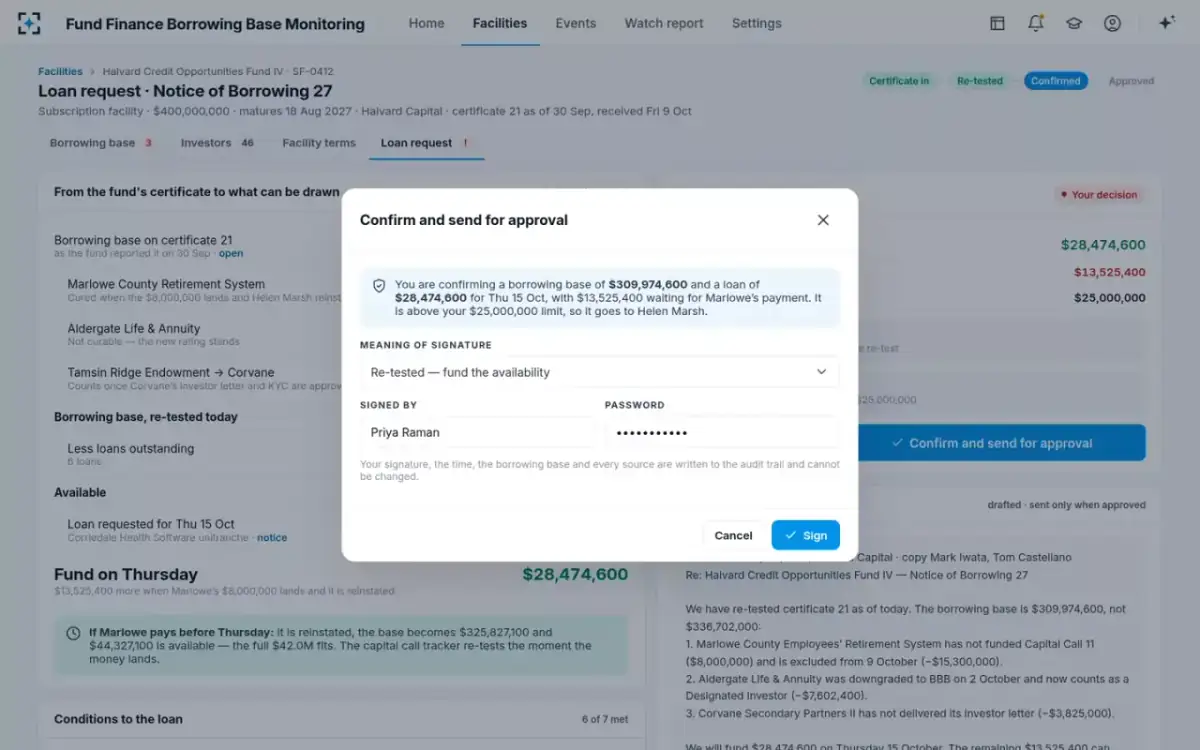
The facility does not simply refuse. The recommendation is split: fund what the re-tested base supports, and hold the rest against a condition. Here that is $28,474,600 on Thursday, with $13,525,400 waiting for the late capital call to land in the pledged account.
Funding the whole $42,000,000 would put the facility into a borrowing base deficiency — the clause that requires the fund to repay the excess — so it is not a matter of appetite. It needs a waiver from the credit officer, with a reason, and the waiver goes on the week's watch report. That is the honest version of "can part of a loan still fund": yes, the part the base supports, and the rest when the condition is met or someone senior accepts the deficiency in writing.
The analyst signs for the re-test with the meaning of her signature attached rather than a tick — "Re-tested — fund the availability" — and her password. The amount is above her $25,000,000 limit, so the decision itself belongs to the credit officer.
Confirming, with the meaning of the signature
"…listed on Schedule 1.01(b) … for any single Designated Investor, 5%; for all Designated Investors together, 30%…"
The clause the re-test applied, quoted from the sample facility's credit agreement
Every figure in the re-test traces to a passage like that one. The facility terms reader quotes the clause with the passage highlighted, which is what lets a disagreement be settled by reading the agreement rather than by comparing two spreadsheets.
What if the money arrives first
The fund's controller says the late wire will go on Wednesday, which changes Thursday's answer if it is true. The analyst previews it: the excluded investor counts again, the base rises to $325,827,100, and $44,327,100 is available — enough for the full $42,000,000 with $2,327,100 to spare.
The preview changes nothing. The base moves when the money is credited to the pledged collection account and the credit officer reinstates the investor, in that order, and the capital call tracker re-tests on the hour the receipt appears. A preview is how the relationship manager tells the fund what Thursday looks like either way; it is not a figure the bank will lend against.
This is also where a sceptical reader should push on any system of this kind. The dangerous version is one that quietly treats an expected payment as a received one, because the fund's controller is credible and the deal is Thursday. Keeping the preview visibly separate from the re-test, and making reinstatement a named person's decision with evidence attached, is the part that has to be true for the rest to be worth anything.
What the fund is told, and when
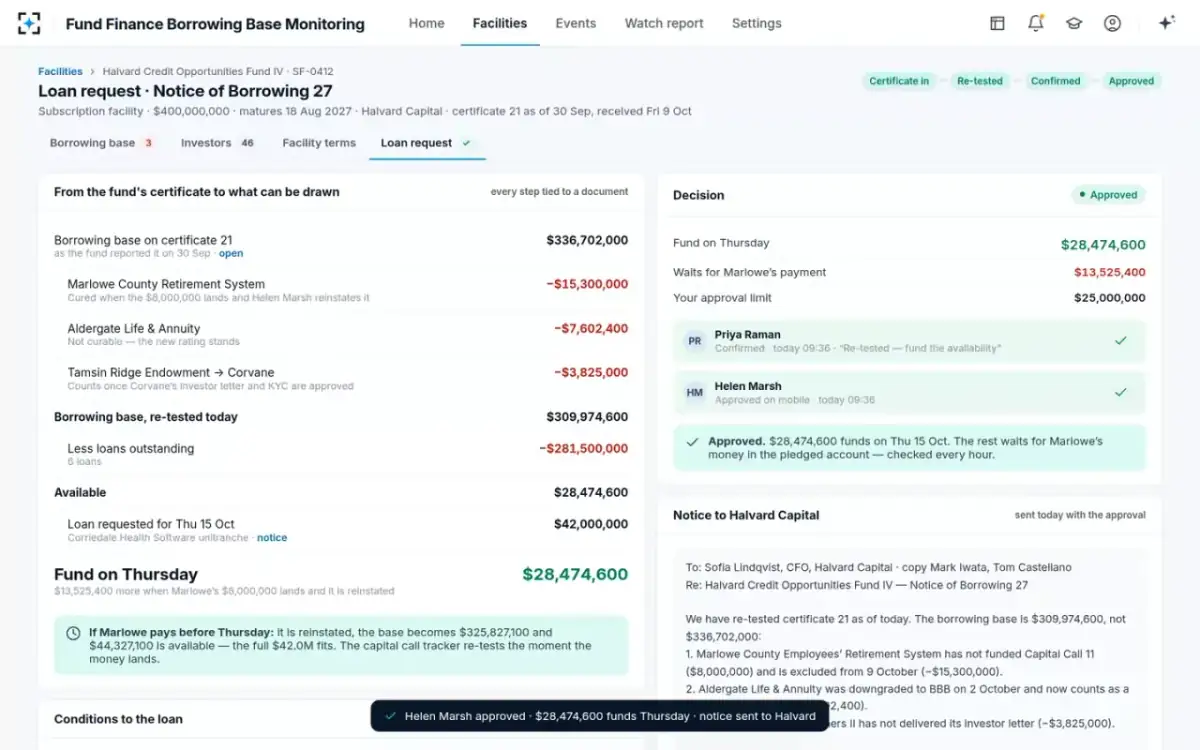
With the approval, not before it. The credit officer approves on her phone, and the notice goes to the fund's chief financial officer with the approval attached: the re-tested base, the three reasons with their sources, the $28,474,600 that funds on Thursday, and what releases the other $13,525,400. The fund's relationship manager and the controller are copied.
The timing is deliberate. A notice sent before approval is a negotiation; a notice sent with the approval is a decision. And the content is deliberate too: a fund told only that its loan is short will argue about the total, while a fund told which three investors changed, on which documents and under which clauses, can act on the one it can actually fix — the wire.
Approved, and the notice sent with it
The week ends on the committee paper. The facility appears on the watch report with the re-test, the amount held back and the condition that would release it, alongside the other facilities on watch that week. What that report should contain, and who should own each row, is set out in what a fund finance watch report should tell your committee.
What to check on the next certificate you receive
Most of this file could have been caught by hand. It would have taken a day rather than a minute, and it would have been caught after the deal team had already promised the fund a number — which is the real cost. The checks themselves are not exotic.
A certificate checklist for a fund finance desk
- Read the as-of date before the total
Everything below it is a statement about that day. The number of days between it and the funding date is the size of your exposure to things you have not applied.
- Match every open capital call to the pledged account
Investor by investor, on the facility’s own day count. An absence in a statement is evidence; a fund’s assurance is not.
- Re-read the ratings on the morning of the test
Not the ratings on the certificate. A downgrade moves a class, and a class moves an advance rate and a cap.
- Check the investor schedule against transfers
A buyer with no investor letter does not count, however good its name. This is the change that arrives by no feed at all.
- Re-apply the caps after every change, not before
Concentration tests interact: removing one investor changes the percentages for all the others, including groups near their limit.
- Recompute the fund’s own arithmetic, and report the difference
Never alter a reported figure. Show the fund’s number, your number, and each line between them.
- Test as of the borrowing date, not the certificate date
If the agreement tests availability on the day of the draw, that is the day to compute it for.
- Write down what would cure each shortfall, at the time
Not later, when someone asks why the loan was short. The cure is what the notice to the fund has to say.
One certificate, three changes, $26,727,400, and a loan that funded in part on the day it was asked for. To see what the bank actually holds behind all of it, read what actually secures a subscription line, or start from Fund Finance Borrowing Base Monitoring.
Questions people ask
What does a borrowing base certificate look like?
A signed statement by an officer of the fund that, as of a stated date, the borrowing base was a stated amount — with an investor schedule attached that produces the number: each limited partner's class, commitment, capital called and uncalled balance, then the advance rates, the concentration tests and the amounts disregarded, the base, the loans outstanding and the availability. There is no standard form; each fund sends its own spreadsheet.
How does a bank re-test a borrowing base certificate?
By rebuilding it from the sources as of the borrowing date: the credit agreement's rules in force that day, the capital calls matched against receipts in the pledged account, every investor checked against today's ratings, transfers, side letters and schedules, then the base and the concentration tests recomputed and reconciled line by line with what the fund reported. On the sample facility that takes 50 seconds across 46 investors and produces a figure $26,727,400 below the certificate.
What happens if the loan is short against the borrowing base?
The part the re-tested base supports can fund; the rest waits for a condition or needs a waiver. Funding past the base would put the facility into a borrowing base deficiency, which the agreement requires the fund to repay, so on this facility anything above the re-tested availability needs the credit officer's waiver with a written reason, and goes on the week's watch report.
Can part of a loan fund if the borrowing base is short?
Yes, where the facility allows a partial draw — and it is usually the right answer, because it gives the fund the money the collateral supports today without waiving anything. On this file $28,474,600 funded on the requested day and $13,525,400 was held against a late capital call reaching the pledged collection account.
What changes between a certificate and a loan date?
Anything that touches an investor. On this file: a capital call left unpaid past the agreement's day count, a rating cut below the eligibility floor, and half a commitment sold to a buyer with no investor letter. None of the three appeared on the certificate, because the certificate was an accurate statement about 30 September and all three happened afterwards.
What does the bank tell the fund when the base falls?
With the approval, and in specifics: the re-tested base, which investors changed, the document behind each change and the clause applied, the amount that funds on the requested day, and exactly what would release the rest. A fund told only that its loan is short will argue about the total; a fund told which wire is missing can send it.