A borrowing base certificate is reviewed by the lending bank's fund finance desk, and in practice that means four seats: a collateral analyst re-tests the fund's arithmetic against the credit agreement, a credit officer approves anything above the analyst's limit or any waiver, a relationship manager carries the answer back to the fund, and a Head of Fund Finance owns the book and any examiner's finding on it. The fund's own certificate is the input, never the conclusion. Fund Finance Borrowing Base Monitoring rebuilds that base as of the loan date — investor by investor, rule by rule, with each change sourced — so each of the four seats spends its hours on the decision rather than on the spreadsheet underneath it.
The desk in this guide is a fictional sample bank lending to Halvard Credit Opportunities Fund IV against a $400,000,000 subscription facility with 46 investors behind it. The people, funds and investors are characters in the solution's sample data; the wage and market figures come from the agencies that publish them, linked where they appear.
The desk exists because this is where the money went
24%
of large US banks’ loans to non-bank financial firms are loans to private equity funds, most of them secured by capital call commitments
46
investors behind one subscription facility in the sample bank — each with its own rating, transfers and capital-call history
$42.0M
the loan request this guide follows, against a certificate dated fifteen days earlier
The four seats behind one loan request
Fund finance lending is unusual in that the borrower does the first calculation. A fund sends a borrowing base certificate: its investor list, the advance rate it applied to each investor class, the concentration limits it believes bind, and a total. The certificate is honest and it is true on its as-of date. The notice of borrowing arrives days later, and by then investors have paid late, been downgraded, or sold their interests to someone the bank has never approved.
Every bank arranges the response slightly differently, but the four jobs below are always done, and almost always by four different people. They are not four reviews of the same thing. Each seat asks a different question, and each is accountable for a different failure.
One certificate, four seats, four different questions
Today
Rebuilds a spreadsheet for each fund’s own format and re-reads each credit agreement to check a certificate.
With agents
Starts from a base already rebuilt as of the loan date, every change carrying the document it came from.
Still theirs: Asks: is the fund’s number still right today?
Today
Approves loans above $25M on a reconciliation she has to take on trust.
With agents
Sees what stopped counting, why, and what would cure it, then approves from her phone.
Still theirs: Asks: may this loan fund, and on what conditions?
Today
Talks to his funds with the fund’s own figure, not the bank’s.
With agents
Sees every facility ranked by what could stop the next draw, before the notice goes out.
Still theirs: Asks: what do I tell the CFO, and when?
Today
Owns the book, the committee and any audit finding on it.
With agents
Gets a weekly watch report across sixteen facilities: headroom, late reporting, loan-to-value and maturities.
Still theirs: Asks: is the whole book still inside policy?
The collateral analyst: from rebuilding a spreadsheet to confirming a re-test
The collateral analyst is the first and longest seat. The job is not to re-add the fund's column; it is to test whether the fund's base is still the bank's base on the day the money leaves. That means four separate checks, each against a different document.
First, the certificate itself: the investor schedule, the uncalled commitment attributed to each investor, and the arithmetic. Second, the pledged collateral account: has each investor actually paid the capital call the fund says it answered, and how many business days late, counted the facility's own way? Third, the outside world: today's ratings, any transfer of an interest, any side letter or excuse right that changes how an investor counts. Fourth, the credit agreement: which investors are Included and which Designated, what advance rate each class carries, and which concentration limits bite once the first three checks have moved the figures.
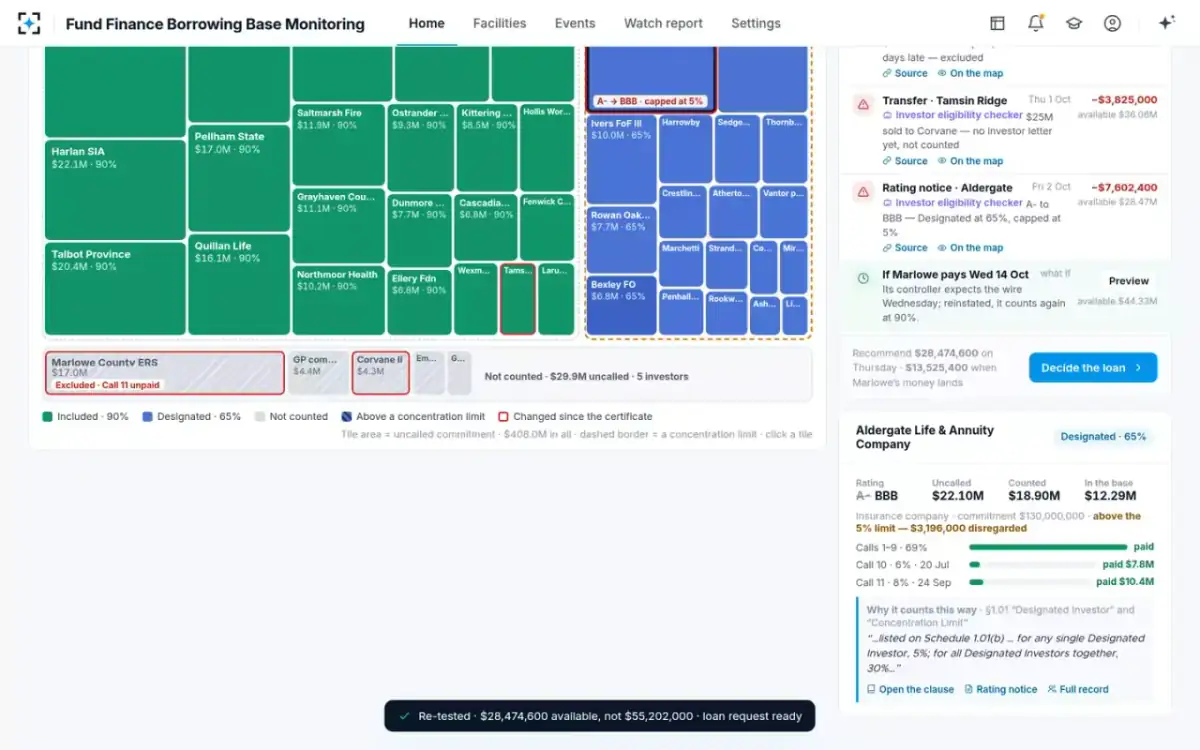
On the sample facility, those four checks moved the base by $26.7 million. Marlowe County Employees' Retirement System had not paid $8,000,000 of Capital Call 11 and was twelve business days late, an exclusion event, taking $15,300,000 of uncalled capital out at the 90% advance rate. Aldergate Life & Annuity had been cut from A- to BBB, dropping it from the Included group to the Designated group at 65% and under a 5% single-investor cap: $7,602,400. Tamsin Ridge Endowment had sold half its commitment to Corvane Secondary Partners II, which has no investor letter yet: $3,825,000. Nothing in that list is an error by the fund. It is simply a later date.
Where the analyst now starts: the base already rebuilt, every change sourced
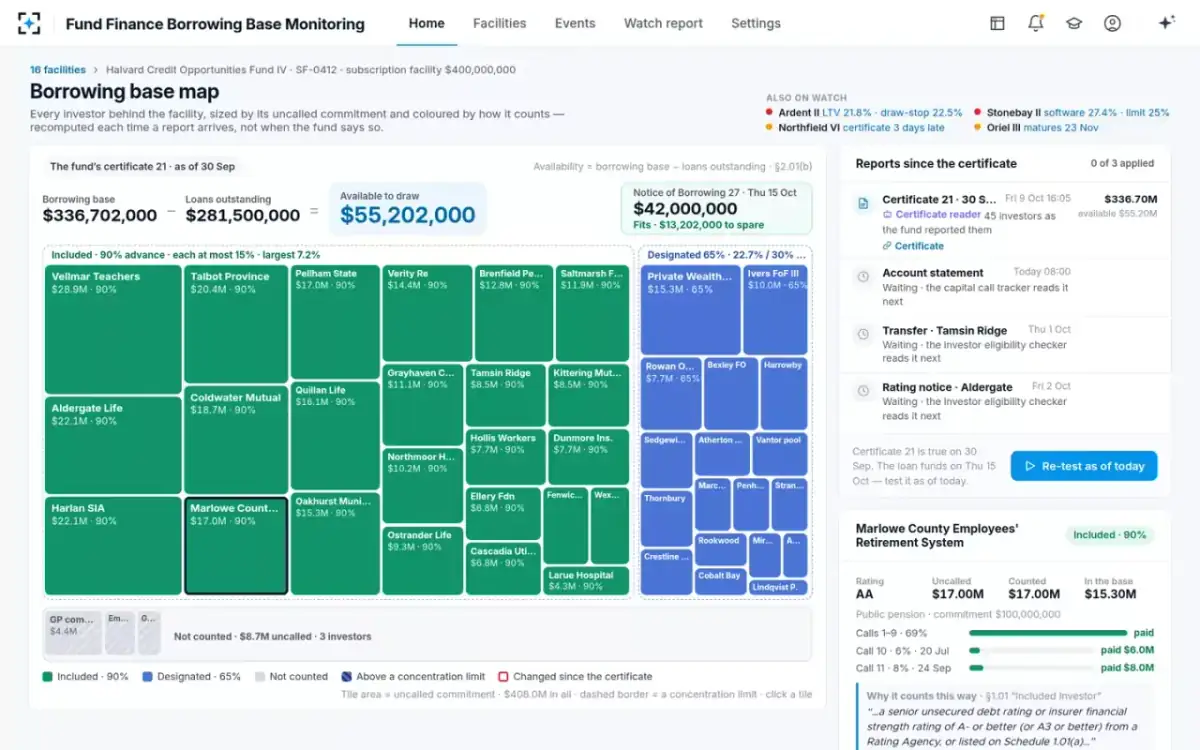
The change in the seat is narrower than it looks, and that is the point. The analyst still decides. What has gone is the rebuilding — the re-keying of a certificate into whatever template the bank uses for that fund, the manual tie-out of capital-call receipts, the page-by-page re-reading of a credit agreement that has not changed since last quarter. What remains is the part that needs a person: reading the three changes, deciding whether each is really an exclusion event under this agreement's words, and signing for the answer.
What does a credit officer actually decide?
The credit officer decides whether a loan may fund, and at what size, once the analyst has produced a re-tested base. At the sample bank the analyst's own limit is $25,000,000; the credit officer approves anything above it, every waiver of an exclusion event, and every reinstatement of an investor that has cured. Those three powers are the ones that cannot be delegated downward, because each of them is a decision to lend against collateral the bank's own rules have just questioned.
On this request the arithmetic made the decision for her in one direction and left it open in another. Re-tested, the base was $309,974,600 and availability $28,474,600 against a $42,000,000 request — short by $13,525,400. She could approve the availability, which she did. She could also have waived the Marlowe exclusion and funded the full amount, with a reason on the record and a line on the watch report. The distinction matters: a bank that cannot fund past its own re-tested base has a control; a bank that can, but only deliberately and in writing, has a control and a business.
One loan request across four seats, and who hands it to whom
Agent
Certificate and notice readReads certificate 21 and Notice of Borrowing 27 in the fund’s own format and recomputes its arithmetic.
Never: Never alters a figure the fund reported
Agent
Credit agreement appliedTurns eligibility, advance rates, concentration limits and exclusion events into the rules for this facility.
Never: A term it cannot read goes to the analyst
Agent
Investors re-tested as of the loan dateMatches capital calls to the pledged account and checks all 46 investors against ratings, transfers and side letters.
Never: Never contacts an investor
A person decides
Collateral analyst confirmsReads the three changes, tests each against the agreement’s words, signs with the meaning of the signature.
Never: Cannot approve above $25,000,000
A person decides
Credit officer approvesApproves the $28,474,600 that funds, or waives an exclusion with a reason.
Never: Approval, waiver and reinstatement stay with the person
A person decides
Relationship manager carries itTakes the re-tested base and the three reasons to the fund’s CFO before the funding date.
Never: Does not set the base or the conditions
A person decides
Head of Fund Finance reviews the bookTakes the week’s facilities on watch to the credit committee with every change and its reason.
Never: Owns the finding if a loan funds past the base
The relationship manager's seat: last to know, first to be asked
The relationship manager is the seat the process traditionally treats worst. He owns the conversation with the fund's CFO and controller, he is measured on the relationship, and under the old sequence he learns that a draw will be short at roughly the same moment the fund does — because the analyst finished the spreadsheet that afternoon and the notice goes out tomorrow. There is no version of that conversation in which the bank looks well organised.
The fix is not a better notice; it is an earlier one. If every facility is re-tested the day its certificate lands rather than the day before its draw, the relationship manager can see which of his funds is at risk of a short draw while there is still a week to do something about it — in this case, to tell Halvard's controller that Marlowe's wire is the difference between $28.5 million and the full $42 million. He moves from delivering a decision to shaping one. What counts as an exclusion event, and what cures it, is the detail he needs to carry that conversation.
The US Bureau of Labor Statistics publishes no occupation called "relationship manager, fund finance", so there is no median wage to quote for the seat. The closest published category is Loan Officers, whose median pay was $76,690 a year, or $36.87 an hour, in May 2025 (BLS, Occupational Outlook Handbook). It is a proxy for the shape of the job, not a measurement of this one: a fund finance relationship manager at a large bank typically covers fewer and much larger relationships than a mortgage or consumer loan officer.
The Head of Fund Finance: owning the whole book, not one loan
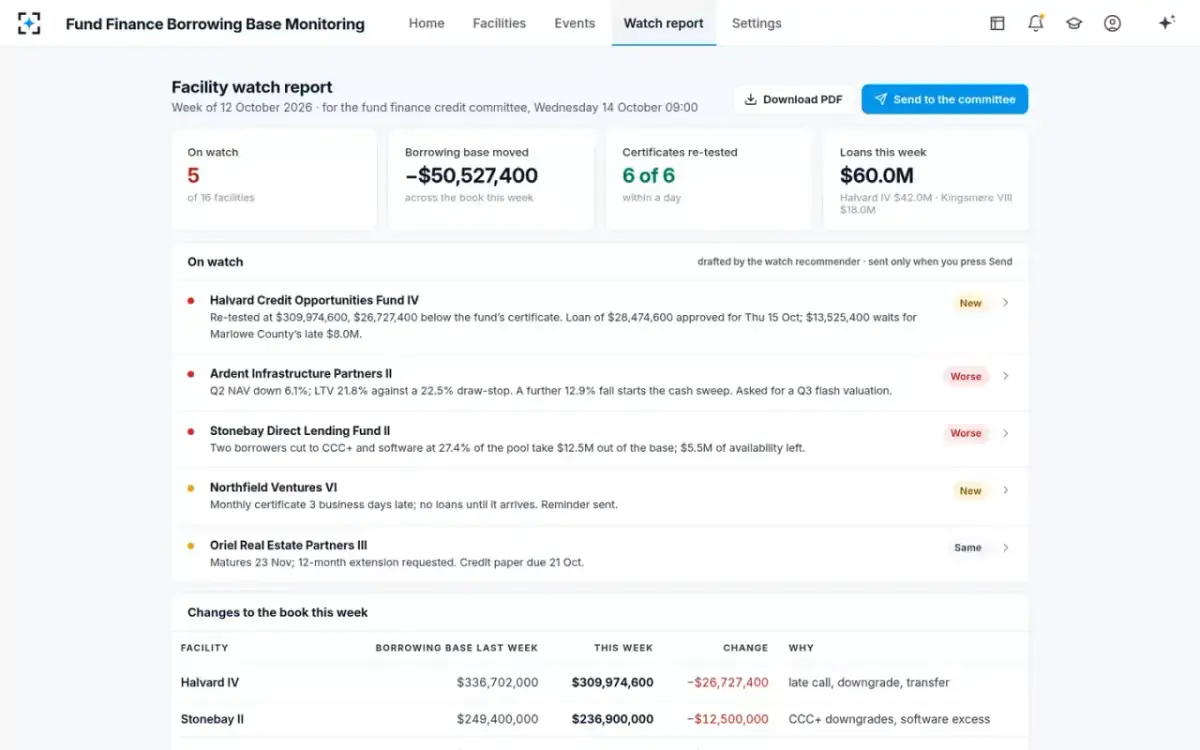
The fourth seat is the only one that never looks at a single loan request in isolation. The Head of Fund Finance owns sixteen facilities at the sample bank — subscription lines, NAV facilities and back-leverage lines — and is accountable to the credit committee and to the examiner for all of them. The question in this seat is not "may this draw fund" but "is anything in the book drifting, and would we know".
That is a reporting problem rather than a calculation problem, and it is the one most desks solve worst, because a weekly book-level view can only be assembled from re-tests that have actually happened. Five of the sample bank's sixteen facilities were on watch in the week this guide follows: Halvard IV re-tested and short, Ardent II's loan-to-value at 21.8% against a 22.5% draw-stop, Stonebay II's software loans at 27.4% of the pool against a 25% limit, Northfield VI's certificate three business days late, and Oriel III maturing on 23 November. Four of those five are not loan requests at all. They are conditions that will become loan requests.
The seat that reads sixteen facilities, not one
Pay for this seat does have a published category. Financial Managers had a median wage of $166,570 a year, or $80.08 an hour, in May 2025, and employment in the occupation is projected to grow 10 percent from 2025 to 2035 (BLS, Occupational Outlook Handbook). A Head of Fund Finance at a large bank is likely to sit above that national median, which is one more reason committee time is the most expensive input in the whole sequence.
Who reviews a fund's borrowing base certificate, start to finish?
Put end to end, the review of one certificate at a bank that lends to funds runs like this. The fund's finance team prepares and signs the certificate. It arrives at the bank, usually by email, in the fund's own format. The collateral analyst re-keys or imports it, ties the investor schedule to the facility's own schedules, and re-applies the credit agreement's definitions as of the date the loan will fund. Anything that has changed since the as-of date is tested as a possible exclusion event, transfer or ratings move. The analyst produces a re-tested base and availability, and signs for it.
If the requested loan is inside the analyst's limit and inside availability, it can fund on that signature. If it is above the limit, or if it needs a waiver, the credit officer approves — with the reason recorded where an examiner can read it. The relationship manager takes the result to the fund. The Head of Fund Finance sees it in the week's watch report alongside every other facility. Nowhere in that sequence does the fund's own total become the bank's answer without someone at the bank having re-derived it.
What the analyst opens when a figure has to be defended
Where the week's hours actually go, seat by seat
The table below attributes the hours of one subscription-line certificate and loan request to the seat that carries them. The hours are the solution's own estimates for a facility of this size, not a measurement at a named bank; the attribution to seats is ours, and a desk that splits the work differently should re-cut it.
One certificate and one loan request: estimated hours by step, and the seat that carries them
| Step | Seat | By hand | With agents |
|---|---|---|---|
| Re-keying the fund’s certificate and investor schedule | Collateral analyst | 4.0 hours | 0.25 hours |
| Matching capital-call receipts in the pledged account | Collateral analyst | 3.0 hours | 0.25 hours |
| Checking ratings, transfers and side letters investor by investor | Collateral analyst | 4.0 hours | 0.5 hours |
| Re-applying advance rates and concentration limits from the credit agreement | Collateral analyst | 3.0 hours | 0.5 hours |
| Credit approval and the notice to the fund | Credit officer and relationship manager | 2.0 hours | 1.0 hours |
| Total for one certificate | The desk | 16.0 hours | 2.5 hours |
Fourteen of the sixteen hours sit in one seat, and thirteen of those fourteen are mechanical. That is the shape of the opportunity and also its limit: the automatable share of this desk is large, and it is almost entirely inside the analyst's week. The credit officer's two hours barely move, because approving a loan is not a clerical task. What a borrowing base re-test really costs, hour by hour turns these hours into a rate and a method you can re-run with your own numbers.
What changes when the re-test takes a day, not a week
Three things change, and only one of them is time saved.
The first is sequence. When a re-test takes most of a week, it necessarily happens close to the funding date, which means the relationship manager learns of a problem too late to fix it and the credit officer reviews under time pressure. When it takes a day, the re-test can run when the certificate lands, and the week between certificate and draw becomes usable: time to chase a late wire, approve a transferee's investor letter, or tell a fund to size its notice differently.
The second is coverage. A desk that spends fourteen analyst-hours per certificate re-tests when it must. A desk that spends two can re-test every facility whenever anything moves — a ratings change at 06:30, a receipt landing in the pledged account at noon — which turns borrowing base monitoring from an event into a condition. That is what makes the Head of Fund Finance's weekly report possible at all.
The third is what a disagreement means. When the bank's figure is produced by hand, a difference from the fund's certificate starts an argument about arithmetic. When it is produced line by line with the clause and the document behind each change, the conversation starts at the three reasons — and the fund's controller can answer them one at a time. On this request, one of the three is answerable: if Marlowe's wire lands in the pledged account, the credit officer can reinstate Marlowe and the other $13,525,400 can fund. The other two wait on a rating and an investor letter that the fund does not control.
Questions to ask about your own desk's handoffs
- How many hours pass between the certificate arriving and the re-test starting?
If the answer is "until someone has time", the re-test is being done against the draw date, not the certificate date.
- Who is told first when a draw will be short, and when?
If the relationship manager learns at the same time as the fund, there was never a chance to cure the problem.
- What is the analyst’s approval limit, and when did the desk last revisit it?
A limit set when facilities were half the size pushes routine loans to the credit officer and dulls the escalation.
- Can you produce, for any figure, the document it came from?
Each amount that leaves the base should link to the account statement, rating notice or transfer agreement behind it.
- Does funding past the re-tested base require a waiver, with a reason?
If it can happen quietly, the re-test is advice rather than a control.
- Does the committee see facilities that have not been re-tested at all?
A late certificate is not neutral: a fund whose quarter went badly has the most reason to be slow.
The seat that signs, and the seat that approves
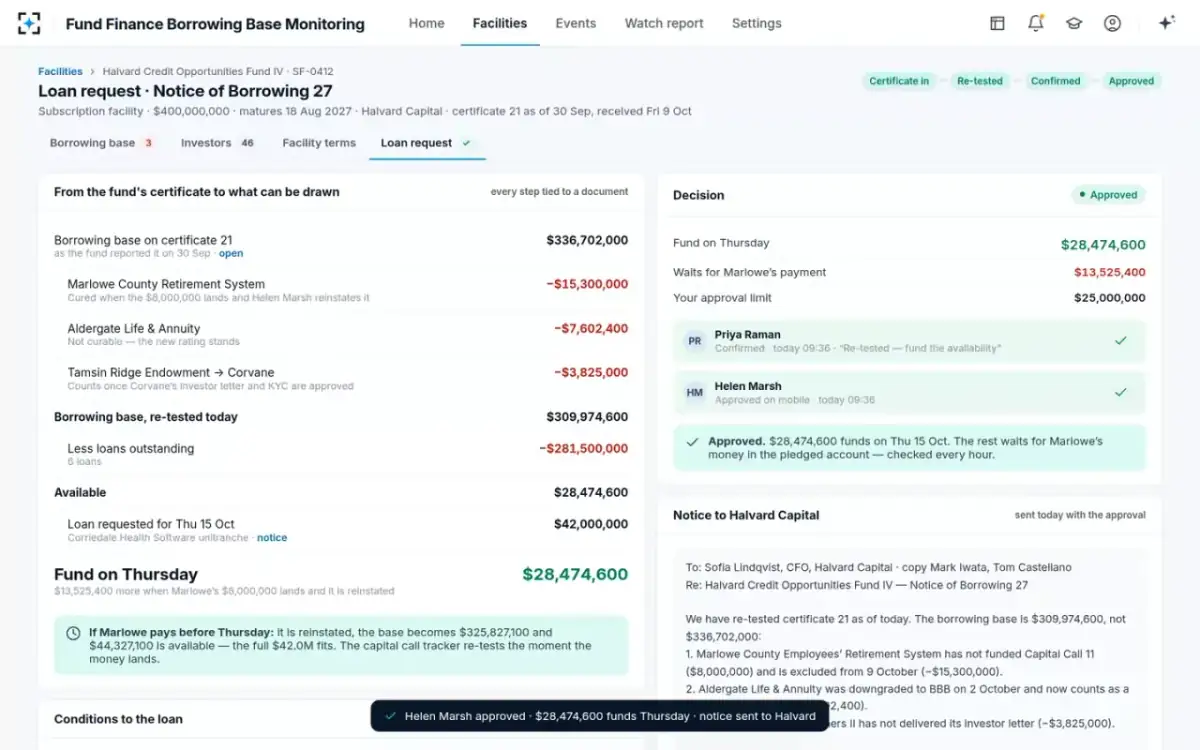
None of this removes a seat. The four jobs are still four jobs, and the two that carry a signature still carry it. What changes is that the collateral analyst's week stops being spent rebuilding a figure the fund already sent, and starts being spent on the three lines where the bank and the fund disagree. To see the whole sequence on one facility, from certificate to funding, start from Fund Finance Borrowing Base Monitoring.
Questions people ask
Who reviews a fund's borrowing base certificate at a bank?
A collateral analyst on the fund finance desk performs the review, re-testing the fund's certificate against the credit agreement as of the date the loan will fund. A credit officer approves loans above the analyst's limit, any waiver and any reinstatement; the relationship manager carries the result to the fund; the Head of Fund Finance sees it in a book-level report. At the sample bank in this guide the analyst's own limit is $25,000,000.
What does a fund finance collateral analyst do?
The analyst re-derives the borrowing base: ties each investor's uncalled commitment to the facility's schedules, matches capital-call receipts in the pledged account, checks today's ratings, transfers, side letters and sanctions screening, and re-applies the advance rates and concentration limits the credit agreement sets. The output is a re-tested base and availability, signed for, with each difference from the fund's certificate carrying the document behind it.
Who approves a loan against a subscription line facility?
Within the analyst's delegated limit and within re-tested availability, the analyst's signature is enough. Above that limit, or where an exclusion event has to be waived or an investor reinstated, a credit officer approves. Funding more than the re-tested availability is a separate decision again — a waiver, with a reason recorded, that then appears on the credit committee's watch report.
What is the difference between a collateral analyst and a credit officer in fund finance?
The analyst establishes the facts and the figure; the credit officer decides what the bank does about them. An analyst who disagrees with a fund's certificate produces a lower base and the evidence for it. A credit officer who agrees with the fund anyway can waive the difference, but must say why. Keeping the two in separate seats is what stops a disputed figure being settled by whoever is closest to the deadline.
Does a relationship manager see the borrowing base before the fund does?
He should, and on a weekly re-test he does. Where re-testing happens only just before a draw, the relationship manager often learns of a shortfall within hours of the fund being told — which leaves no time to chase a late wire or approve a transferee. Re-testing when the certificate arrives, rather than when the notice of borrowing does, is what creates the days in between.
Is fund finance collateral analysis a growing job?
The published categories point in different directions. Employment of Financial Analysts, the broadest category covering this work, is projected to grow 7 percent from 2025 to 2035 against 443,100 jobs in 2025, while Loan Officers are projected to grow 1 percent over the same decade (BLS, Occupational Outlook Handbook). Neither category is fund finance specifically. The demand side is clearer: the FDIC reports that bank lending to non-bank financial firms grew at 21.9 percent a year from 2010 to 2024, the fastest of any loan segment, with the fastest growth in lending to credit intermediaries and to private equity or venture capital funds (FDIC, Banking Issues in Focus No. 1).