A fund finance software pilot is worth running only on your own borrowing base certificates, and the safest way to start is backwards: replay certificates your analysts have already re-tested and signed, where you know the right answer, before the tool touches anything live. Then run it beside the desk for one reporting cycle, and only then judge it — against pass marks written down before the first result arrived. Fund Finance Borrowing Base Monitoring is designed to be tested this way, and the sections below set out what data a bank brings, what the weeks look like, and what a disagreement with a signed-off certificate actually means.
This is written for the Head of Fund Finance and the credit-risk technology people who have shortlisted a monitoring tool and want a test that survives contact with their own credit committee. The screens and figures are from the solution's fictional sample facility; the supervisory material is the agencies' own current text.
Why the pilot has to use your files, not a demonstration
3
changes between the certificate and the loan date on one sample facility — the kind a replay is designed to find
46
investors behind that one facility, each with its own rating, transfers, side letters and capital-call history
1day
the design target from a certificate arriving to a re-test the analyst has signed
Why the pilot starts on files you've already signed
Most software pilots in credit are run forward: the tool is pointed at next month's work, and at the end everyone argues about whether it did well. The argument is unwinnable because nobody established the truth independently. A borrowing base re-test is unusual in that the truth already exists in your own records — a signed re-test, an approved loan amount, the analyst's own working — for every certificate you have processed in the last year.
Replaying those is the cheapest, sharpest test available. Take twenty certificates across your fund mix, hand the tool the same documents the analyst had on the day, and compare the base it produces with the one the bank actually used. Every difference is diagnostic: it is a rule the tool read differently, a document the analyst had that the tool did not, or a mistake somebody made. All three are worth knowing, and only the first two are the tool's problem.
A replay also tests the thing a forward pilot cannot: completeness. A tool that produces the right base on a clean facility and quietly misses a side letter on a messy one looks identical in a live trial for weeks. Against a signed record, the omission shows up immediately as a difference you can explain.
What the pilot runs against: one facility, re-tested, with every change sourced
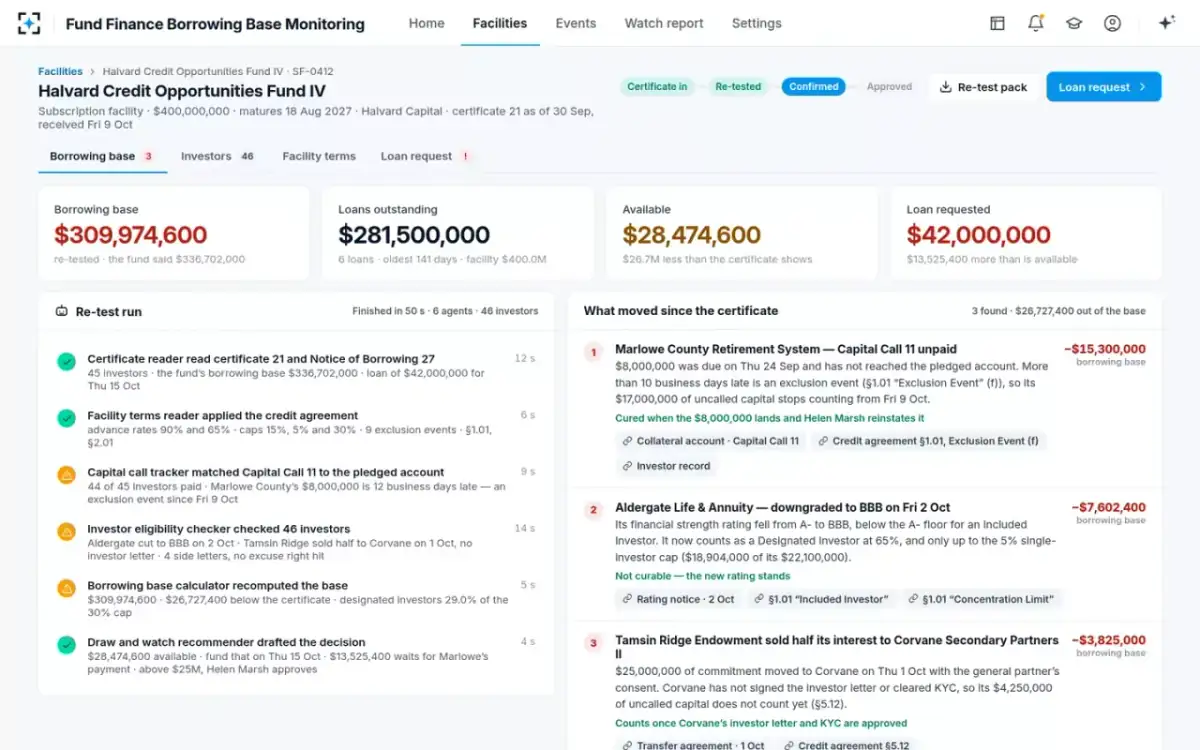
What data a bank brings to the pilot
The list is short and the sequencing matters more than the volume. A pilot stalls far more often on a missing credit agreement amendment than on anything technical, because an amendment that changes an advance rate changes every number downstream of it.
The data a bank brings, and why each item is on the list
- Twenty borrowing base certificates across your fund mix
Not twenty from one fund. A subscription line, a NAV facility and a back-leverage line stress completely different parts of the tool.
- The executed credit agreements and every amendment
The amendments are the part most often missing and the part most likely to cause a difference. Bring them dated and in order.
- Investor schedules and side letters
Including the schedules as they stood on each certificate date, not only as they stand today — a replay is a test as of a past date.
- Pledged collateral account statements for the same periods
This is what turns a capital call notice into a paid or unpaid call and a business-day count.
- The ratings feed you already subscribe to
With the rating scales your credit policy actually watches. A tool reading different scales will disagree for a reason that is not an error.
- Your own signed re-tests and approved loan amounts
The answer key. Without these the pilot is a demonstration, not a test.
- Your thresholds: approval limits, warning days, stress haircuts
Configure these before the replay. A tool run on a vendor’s defaults will disagree with your desk by design.
One item on that list deserves its own sentence. Configure your own thresholds before the replay, not after. The solution's settings — target time to re-test, the headroom warning as a share of the base, which rating scales are watched, the late capital-call warning in business days, the loan-to-value early warning below the draw-stop, the valuation haircuts for the stress, and the approval limits — all change what the tool reports. Running a replay on someone else's defaults and then tuning until the answers match is not a test; it is a curve fitted after the fact.
Set your own thresholds before the first replay, not after
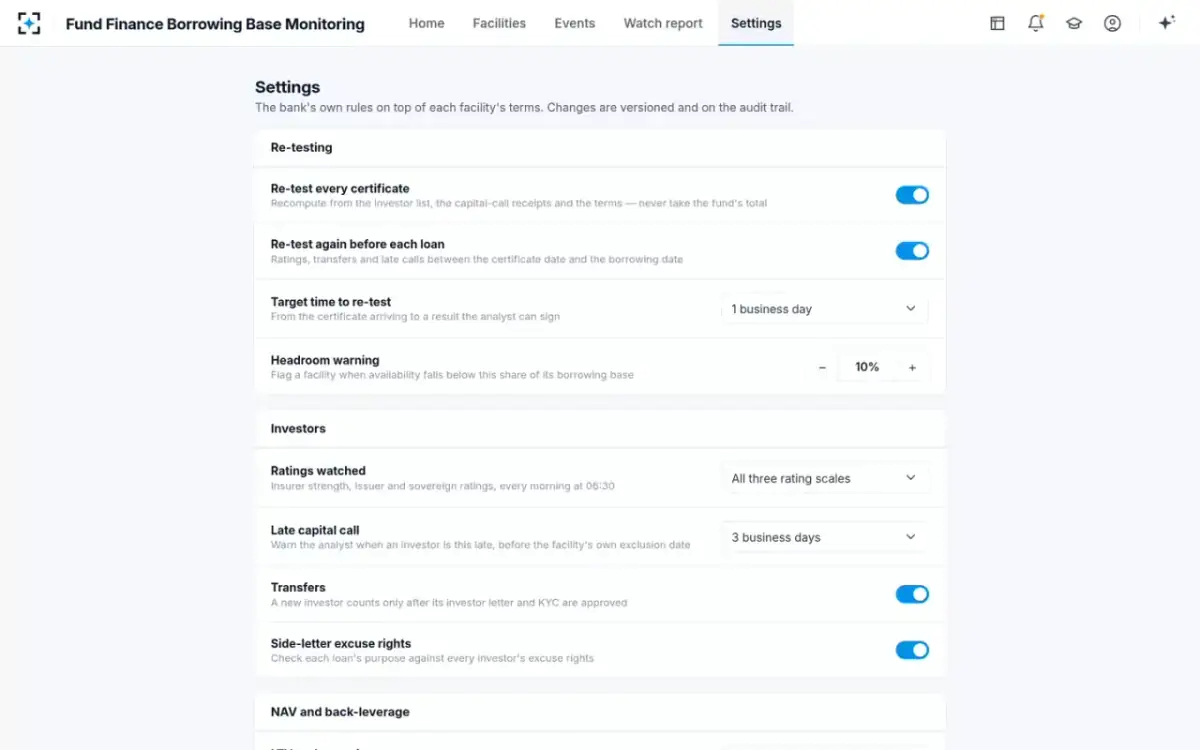
Week by week: replay, shadow, decide
A pilot that answers the question has three phases and takes about eight weeks, of which only the middle one touches live work. The shape below is ours; the durations are targets, not commitments, and a bank whose credit agreements are slow to collect should expect the first phase to stretch.
Eight weeks, and what each phase is actually testing
- Collect and configure · 2 wks
- Replay 20 signed certificates · 2 wks
- Shadow one live cycle · 3 wks
- Decide · 1 wk
Collect and configure. Two weeks, almost all of it gathering credit agreements and amendments and agreeing the thresholds. Nothing is being measured yet. The useful output of this phase is a list of what you could not find, which is itself a finding about the desk.
Replay. Two weeks on twenty signed certificates. Every difference is logged and categorised before anyone adjusts anything: a rule read differently, a document the tool did not have, or an error in the original. Resist the temptation to fix as you go — the distribution of differences across those three categories is the single most informative number the pilot produces.
Shadow. Three weeks, or one full reporting cycle, whichever is longer. The tool re-tests live certificates alongside the analyst, and the analyst's answer is the one the bank uses. This phase is testing timing and completeness rather than arithmetic: does the re-test arrive when the certificate does, does it see the ratings move at 06:30, does it catch the receipt landing in the pledged account at noon?
Decide. One week against the pass marks you wrote in week one. If the marks were written honestly, this week is short.
What should a pilot's pass and fail marks be?
They should be written before the replay, expressed as numbers, and include at least one mark the tool can actually fail. A pilot whose marks are all directional — "improves visibility", "reduces manual effort" — cannot produce a negative result, which means it cannot produce a result.
Pass marks worth writing down, and the failure each one is designed to catch
| What is measured | A mark worth setting | The failure it catches |
|---|---|---|
| Base agreement on replay | The re-tested base matches your signed re-test to the dollar on at least 18 of 20 certificates, and every difference has a named cause. | A tool that is approximately right — the worst outcome, because it is invisible until it is expensive. |
| Unexplained differences | Zero. Every difference is a rule, a missing document or an error in the original, and is categorised. | Differences absorbed as "the tool sees it differently", which is how a wrong rule survives a pilot. |
| Rule-to-clause traceability | Every rule applied cites a section of the executed agreement; sample ten and check them against the paper. | Rules configured by hand during the pilot and forgotten at go-live. |
| Completeness on the messy facility | The tool finds the side letter, the amendment and the transfer on the facility you chose because it is awkward. | A tool tested only on clean files. |
| Timing in the shadow phase | The re-test is available on the day the certificate arrives, on every facility, through one full cycle. | A tool that is fast on demand and slow in practice. |
| Escalation behaviour | At least one term is escalated to a person as unreadable rather than guessed, and you can see where it went. | Silent inference — a definition the tool could not resolve applied anyway. |
| Nothing acted on | No notice sent, no approval recorded, no investor contacted by the tool at any point in the pilot. | A tool whose limits turn out to be settings. |
The supervisory material supports proportionality rather than a fixed standard here. The revised interagency model risk guidance notes that "the frequency and scope of monitoring reports will depend on the nature of the model, the availability of new data or modeling approaches, and model materiality" (Revised Guidance on Model Risk Management, April 2026). The same logic applies to a pilot: a $400 million subscription line deserves a harder test than a small back-leverage line, and the marks should say so. Whether a re-test is a model under that guidance at all is a separate question, and worth settling before the pilot rather than during it.
What a disagreement with a signed-off certificate actually means
This is the moment a pilot either becomes useful or becomes political, and it is worth deciding in advance how you will handle it. The tool will, on some replayed certificate, produce a lower base than the one your bank lent against. There are only three explanations, and they call for completely different responses.
Three reasons a replay disagrees with a signed re-test, and what each one means
What the difference is: The tool applied a concentration limit, an advance rate or an exclusion definition differently from the analyst.
What to do about it: Read the clause together. One of the two readings is wrong, and finding out which is worth the pilot on its own.
What the difference is: The analyst had a side letter, a waiver or an amendment the tool was not given — or the tool saw a rating notice the analyst missed.
What to do about it: Not an arithmetic problem. Fix the inputs and re-run that certificate; count it separately in your results.
What the difference is: The signed re-test was wrong, and the loan funded on a base that was overstated.
What to do about it: Stop and route it through your own error process. Do not let it be logged as a pilot finding and closed with the pilot.
The third row needs a decision from someone senior before week one. A replay can surface a loan that funded past the base the agreement supported, which is a borrowing base deficiency, and that is a credit matter rather than a software evaluation. Agreeing in advance who is told and on what timetable is what stops the pilot being quietly narrowed the first time it finds something. The exclusion events a replay most often turns up covers the categories that produce these differences.
How long does a fund finance software pilot take?
About eight weeks on the shape above: two to collect and configure, two to replay, three to shadow a live cycle, one to decide. The two phases that slip are the first and the third, for unrelated reasons. Collection slips because credit agreement amendments live in more places than anyone expects. The shadow phase slips because it is pegged to a reporting cycle, and a quarter-end certificate that is late in your book will be late in the pilot too — which is itself data.
What should not be compressed is the replay. It is cheap, it is the only phase with an independent answer key, and it is the phase that tells you whether the rest is worth doing. A vendor who proposes skipping straight to a live trial is proposing a test with no control.
What the shadow phase has to cover: the whole book, not one facility
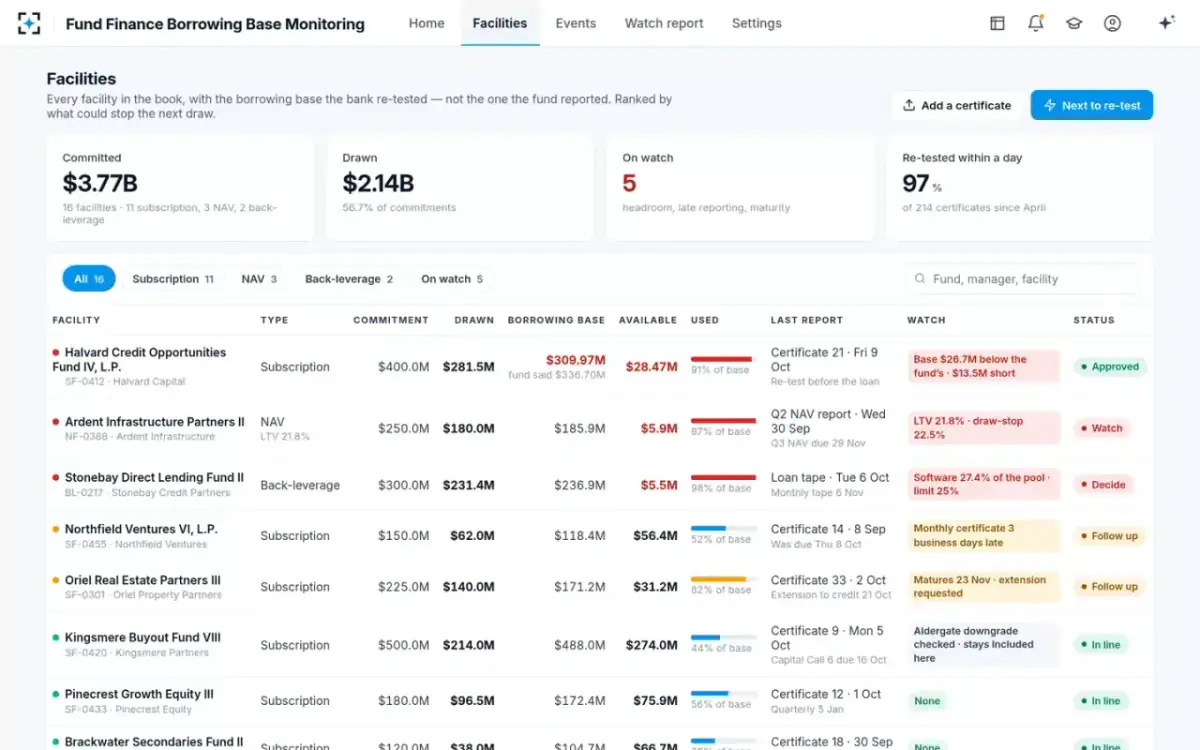
What the pilot cannot tell you
Three things, and being clear about them is what keeps the pilot's conclusion defensible.
It cannot tell you how the tool behaves on a fund whose format nobody has seen. A replay uses the certificates you already have, which means it tests the formats you already receive. Onboarding a new fund is a different exercise and should be scheduled as one.
It cannot tell you what happens under stress in the market rather than in the spreadsheet. The OCC's Spring 2026 Semiannual Risk Perspective records that "credit conditions and refinancing risk in certain segments of commercial real estate lending and of private credit markets warrant ongoing monitoring" (OCC, Semiannual Risk Perspective, Spring 2026). A pilot run across eight calm weeks tells you about arithmetic and timing; it tells you nothing about how the desk uses the tool in a week when three funds are all short at once.
And it cannot settle capacity. The hours released are real, but whether they become headcount savings or extra facilities covered is a management decision, and the published wage data gives only a bracket for the value of an analyst hour — Financial Analysts had a median wage of $103,570 a year, or $49.79 an hour, in May 2025 (BLS, Occupational Outlook Handbook). The hour-by-hour cost of a re-test works that arithmetic through properly.
From pilot to go-live
The transition is mostly about scope and sequence rather than technology. Go live on the facilities whose documents are complete and whose formats the replay covered, keep the shadow running on the rest, and move each remaining facility across as its credit agreement and amendments are confirmed. Resist a single cutover across a whole book: the facilities you have not replayed are precisely the ones whose first live re-test will produce a surprise.
Two things should be in place on the first live day. The thresholds and approval limits should be the bank's own, versioned, with the change history visible — and the escalation path for a term the tool cannot read should have been exercised at least once during the pilot, so the first time it happens in production is not the first time at all.
It is also worth setting the expectation that this product is growing faster than the processes around it. Bank loans to non-bank financial firms, the category subscription lines sit in, "have grown quickly since they were added to the Call Report in first quarter 2010" (FDIC, Banking Issues in Focus No. 1). A monitoring process that is adequate for today's book at today's pace is the one most likely to be strained next year. To see what the pilot would be testing, start from Fund Finance Borrowing Base Monitoring.
Questions people ask
How do you pilot fund finance monitoring software?
In three phases over about eight weeks: collect credit agreements, amendments, investor schedules, account statements and your own thresholds; replay twenty certificates your analysts have already signed and categorise every difference; then run live alongside the desk for one full reporting cycle before deciding against marks written at the start. The replay phase is the one with an independent answer key, so it is the one not to skip.
What data do you need to test a borrowing base monitoring tool?
Twenty certificates spread across subscription lines, NAV facilities and back-leverage lines; the executed credit agreements and every amendment; investor schedules and side letters as they stood on each certificate date; pledged collateral account statements for the same periods; your ratings feed on the scales your policy watches; your own signed re-tests as the answer key; and your thresholds and approval limits, configured before the first replay rather than after.
How long does a fund finance software pilot take?
About eight weeks: two to collect and configure, two to replay signed certificates, three to shadow one live reporting cycle, one to decide. Collection and the shadow phase are the two that slip — the first because amendments are scattered, the second because it is pegged to a reporting cycle and a late certificate in your book is late in the pilot too.
What should a pilot's pass and fail marks be?
Numbers, written before the replay, including at least one the tool can fail. Useful ones: the re-tested base matches your signed re-test to the dollar on at least 18 of 20 certificates; zero unexplained differences; every rule cites a clause you can check against the paper; the tool finds the side letter on the awkward facility; the re-test is available the day the certificate arrives through a full cycle; and nothing was sent, approved or acted on by the tool at any point.
Can you test it on certificates you've already approved?
That is the best way to test it. You already hold the answer: the re-test your analyst signed and the amount the bank lent. Handing the tool the same documents the analyst had on the day and comparing outputs turns a subjective evaluation into a measurable one, and it catches incompleteness — a missed side letter or amendment — that a live trial can hide for weeks.
What happens if the pilot disagrees with a signed-off certificate?
Categorise it before you fix it: a rule read differently, a document one side did not have, or an error in the original. The first two are evaluation findings. The third is a credit matter — a loan may have funded past the base the agreement supported — and it needs an agreed route to someone senior, decided before the pilot starts rather than in the week it happens.