A subscription credit facility is secured by the fund's right to call the capital its investors have promised but not yet paid, by the general partner's power to make that call, and by the account the called money is paid into. Under Article 9 of the Uniform Commercial Code those are not one kind of property but two: the capital call right is a general intangible, perfected by filing a financing statement, and the collection account is a deposit account, which may be perfected only by control. A lender that signs one security agreement, files one UCC-1 and calls the job done is perfected on the first and unperfected on the second. Botminds' Fund Finance Borrowing Base Monitoring re-tests both halves before each loan funds: the investors and their advance rates on one side, the capital-call receipts in the pledged account on the other.
The worked figures on this page come from a fictional sample facility inside the solution — Halvard Credit Opportunities Fund IV, a $400,000,000 subscription facility with 46 investors. The funds, banks, investors and people are invented. The legal statements are general: Article 9 is enacted state by state, and a few states vary their own text, so a transaction's own jurisdiction has the last word.
Two different kinds of collateral, one facility
Start with what the lenders themselves take. The Financial Stability Board, describing bank lending to private credit funds, sets out the standard package: the loans "are secured by (i) interest in the uncalled capital commitments of limited partners, (ii) general partners' rights to call capital from the limited partners, and (iii) interests in the accounts where capital call proceeds are deposited" (FSB, May 2026). Three interests, and the Code sorts them into two boxes.
The first two are rights under contracts — the partnership agreement and the subscription documents behind it. The third is money in a bank account. Article 9 treats those as different classes of collateral with different perfection rules, different priority rules and different paperwork, and the difference is not cosmetic. Filing in the wrong box leaves an unperfected interest in the only part of the collateral that is actually cash.
What secures a subscription line, layer by layer — and how each layer is perfected
Layer 1
The investors’ uncalled capital commitments
What each limited partner has promised the fund but not yet paid in.
Under the Code
Reached through the fund’s own right to call it — a general intangible, and specifically a payment intangible
Perfected how
Perfected by filing a financing statement
This is the layer the borrowing base measures: eligible uncalled capital × advance rate, after concentration limits
Layer 2
The general partner’s right to make the call
The power, under the partnership agreement, to issue a call notice and enforce it.
Under the Code
A contract right, assigned to the lender so it can call capital if the fund will not
Perfected how
Perfected by filing, with the partnership agreement and investor letters in the file
Without it, the first layer is a promise the lender cannot make anyone keep
Layer 3
The account the called money lands in
The pledged collection account that every capital-call payment is directed to.
Under the Code
A deposit account — a different kind of property under the Code, with its own rule
Perfected how
Perfected only by control: being the account bank, a control agreement, or becoming its customer
A financing statement does nothing here. This is the layer a single filing misses
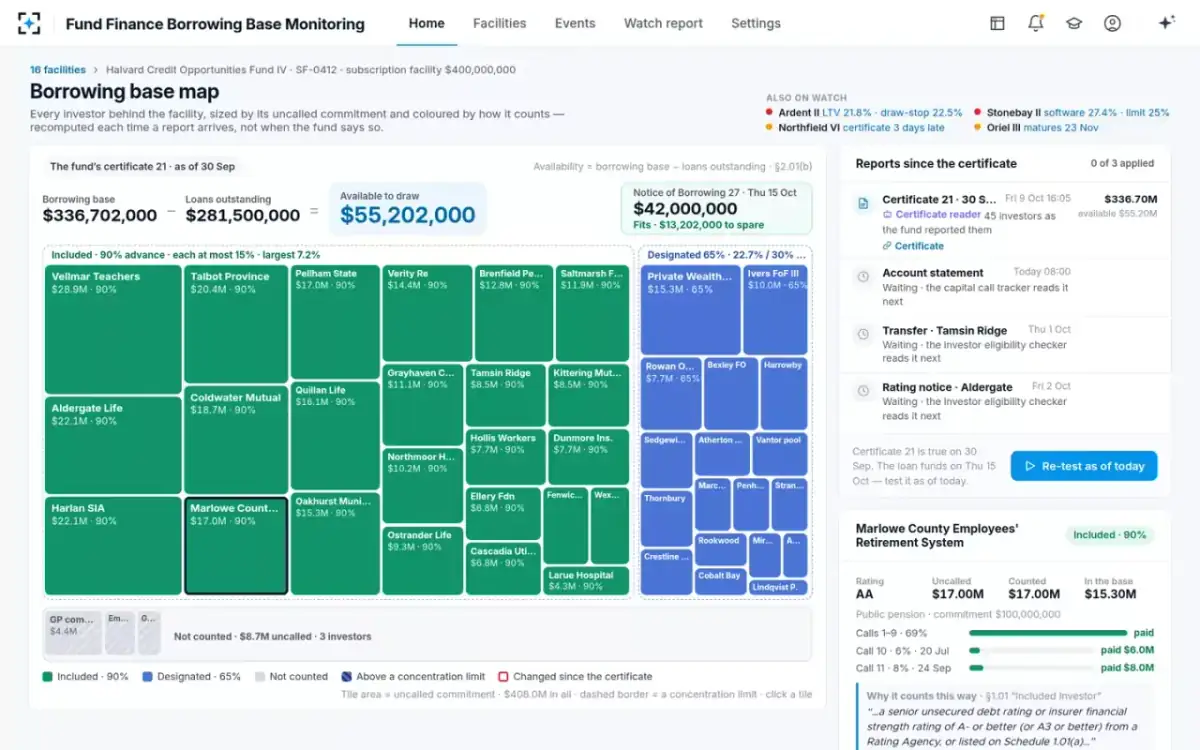
Read the layers top to bottom and the facility's logic appears. The money the bank expects to be repaid from does not exist yet; it exists as a promise from 46 investors. The borrowing base is an estimate of how much of that promise is good enough to lend against. The collection account is where the promise turns into cash, and it is the only layer the bank can put its hands on.
Layer one, drawn: every investor behind the facility, and how each counts
The capital call right: a payment intangible
A limited partner that signs a subscription agreement owes the fund money when the fund calls it. The fund's right to that money is property, and the Code gives it a name. A general intangible is "any personal property, including things in action, other than accounts, chattel paper, commercial tort claims, deposit accounts, documents, goods, instruments, investment property, letter-of-credit rights, letters of credit, money, and oil, gas, or other minerals before extraction. The term includes payment intangibles and software." A payment intangible, in turn, is "a general intangible under which the account debtor's principal obligation is a monetary obligation."
That is exactly what an uncalled capital commitment is. The investor — the account debtor, in the Code's language — owes money and nothing else. So the fund's right to call is a general intangible and, being a right to money, a payment intangible within it. It is not an "account" in the Article 9 sense, because an account is a right to payment for property sold or services rendered, and a capital commitment is neither.
The Code's own words for each piece of a subscription line's collateral
| The Code’s term | What §9-102 says it is | What it is in the facility |
|---|---|---|
| General intangible, §9-102(a)(42) | "any personal property, including things in action, other than accounts, chattel paper, commercial tort claims, deposit accounts … The term includes payment intangibles and software." | The fund’s right to call capital, and the general partner’s power to make the call |
| Payment intangible, §9-102(a)(61) | "a general intangible under which the account debtor’s principal obligation is a monetary obligation." | The investor’s obligation to pay a capital call: money, and nothing but money |
| Account debtor, §9-102(a)(3) | "a person obligated on an account, chattel paper, or general intangible." | Each limited partner, for its own unpaid commitment |
| Deposit account, §9-102(a)(29) | "a demand, time, savings, passbook, or similar account maintained with a bank. The term does not include investment property or accounts evidenced by an instrument." | The pledged collection account the call proceeds are paid into |
| Proceeds, §9-102(a)(64) | "whatever is acquired upon the sale, lease, license, exchange, or other disposition of collateral … whatever is collected on, or distributed on account of, collateral." | The cash a paid capital call produces, once it lands |
Classification is not an academic exercise: it decides which perfection rule applies, which office the filing goes to, and which priority rule settles a fight. Get the class right and the rest of Article 9 follows mechanically. Get it wrong — treat the collection account as though it were part of the same general intangible — and the mechanical consequence is that the interest in the cash never attaches the way the lender thinks it has.
What secures a subscription credit facility, in the fund's own documents
The layers above live in four or five documents, and a credit file that cannot produce all of them has a gap in the security, whatever the UCC search says. The partnership agreement creates the commitments and the call mechanics. The subscription agreements and investor letters bind each investor, and often say directly that the investor will pay a call made by the lender after an event of default. The security agreement grants the interest. The financing statement perfects the first two layers, and an account control agreement, where the account is not at the lender, perfects the third.
The credit agreement then does something the Code does not: it decides how much of the first layer counts. Each investor sits in a class, each class has an advance rate, and each class has a concentration limit. On the sample facility, an Included Investor's uncalled capital counts at 90% and a Designated Investor's at 65%; no single Designated Investor may be more than 5% of the base, and all of them together no more than 30%. Those are definitions in one credit agreement, not market standards — the next facility's schedules will read differently, which is why every re-test has to start from the agreement rather than from a template.
The terms the re-test applies, each with its section — Fund Finance Borrowing Base Monitoring
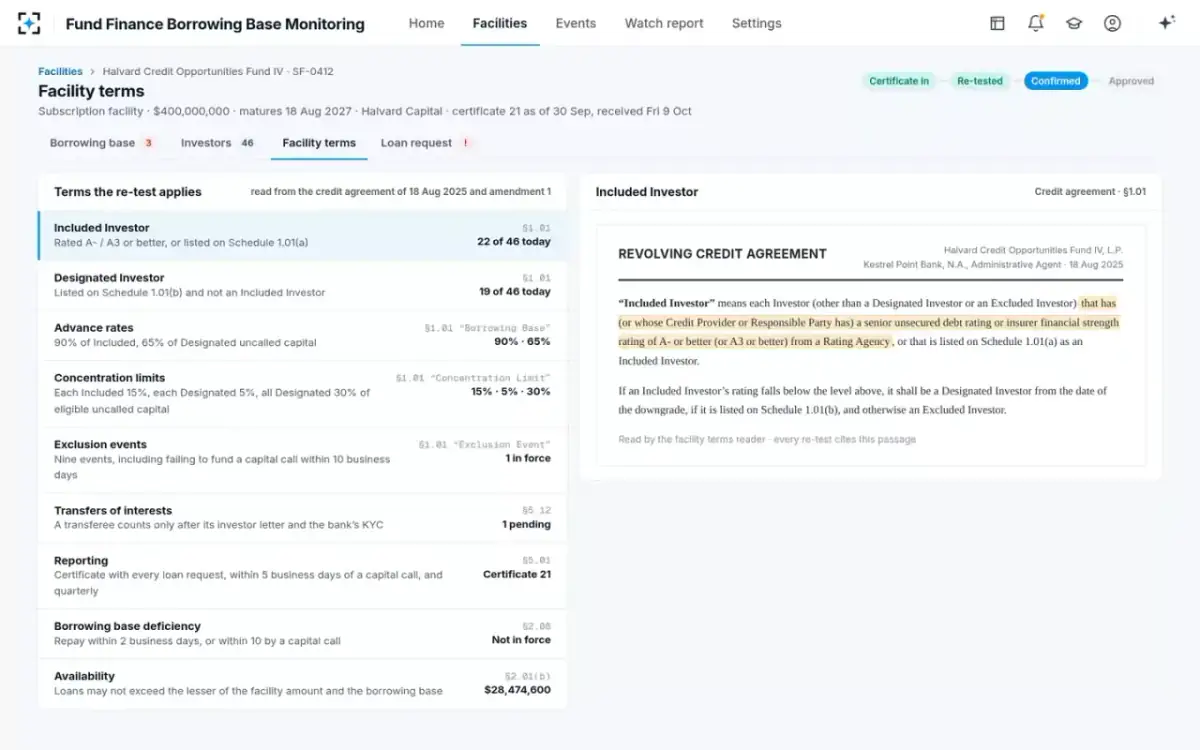
One term on that screen belongs to the second layer rather than the first. Transfers of interests — an investor selling its commitment to someone else — change who the account debtor is. Until the buyer has an investor letter and has cleared the bank's checks, the bank has a promise from a party it has not agreed to lend against. What happens when an investor is late, downgraded or sells out works through each of those clauses separately.
Perfecting the capital call right: filing a UCC-1
For the first two layers the rule is the plain one. "Except as otherwise provided in subsection (b) and Section 9-312(b)," says §9-310, "a financing statement must be filed to perfect all security interests and agricultural liens." A general intangible is not in any of the ten exceptions that follow, so filing is how it is done, in the office of the state whose law Article 9's choice-of-law rules point to — for most funds, the state where the fund is organised.
One wrinkle is worth knowing, because it comes up whenever a fund's counsel says the partnership agreement forbids an assignment. Article 9 overrides most such terms, and which section does it depends on the layer. For the investors' obligation to pay, the payment intangible, the rule is §9-406(d): a term in an agreement between an account debtor and an assignor is ineffective to the extent that it "prohibits, restricts, or requires the consent of the account debtor … to the assignment or transfer of, or the creation, attachment, perfection, or enforcement of a security interest in" the payment intangible. For the general partner's power to make the call, a general intangible that is not a payment intangible, §9-408(a) makes such a term ineffective to the extent it "would impair the creation, attachment, or perfection of a security interest", and §9-408(b) confirms it reaches a payment intangible only when the interest "arises out of a sale", which is why the payment obligation sits under §9-406 instead. §9-408 is the weaker of the two: under §9-408(d) an interest that attaches only because of it "is not enforceable against" the account debtor and does not entitle the lender to use the debtor's rights. That is why lenders still negotiate express consent and investor letters rather than lean on the Code alone.
What the filing cannot do is reach the account. §9-310 says so by cross-reference, and §9-312(b) says it in terms.
The collection account: a deposit account, perfected only by control
A deposit account is "a demand, time, savings, passbook, or similar account maintained with a bank" (§9-102(a)(29)). For that property, Article 9 takes filing off the table: "a security interest in a deposit account may be perfected only by control under Section 9-314" (§9-312(b)(1)). A financing statement naming "all deposit accounts" is not wrong, exactly; it is simply not how the interest is perfected. Nothing in the filing index tells a court that the lender had control.
There is a partial answer, and it is worth being precise about, because it is the fallback lenders rely on without always realising it. The cash a paid capital call produces is proceeds of the capital call right, and "a security interest in proceeds is a perfected security interest if the security interest in the original collateral was perfected" (§9-315(c)). That perfection continues past twenty days where "the proceeds are identifiable cash proceeds". The catch is the word identifiable: proceeds commingled with other property are identifiable only "to the extent that the secured party identifies the proceeds by a method of tracing". A dedicated collection account, swept and reconciled, is traceable. An operating account with four funds' money in it is a tracing argument in a bad week.
That is the practical reason the collection account is dedicated and pledged rather than convenient: not because the law demands a separate account, but because the one legal theory that survives without control depends on being able to point at the dollars.
The three ways to get control, and why most lenders pick one
§9-104 gives three routes to control of a deposit account, and they are alternatives, not a sequence. The secured party is the bank where the account is maintained; or the debtor, the secured party and the bank have agreed in an authenticated record that the bank will follow the secured party's instructions; or the secured party becomes the bank's customer for the account.
"the debtor, secured party, and bank have agreed in an authenticated record that the bank will comply with instructions originated by the secured party directing disposition of the funds in the deposit account without further consent by the debtor"
U.C.C. §9-104(a)(2), control of a deposit account
Subsection (b) adds the detail that makes the structure workable in a live facility: a secured party that has satisfied one of the three routes "has control, even if the debtor retains the right to direct the disposition of funds from the deposit account." The fund can keep running its own treasury, drawing capital-call money out to fund investments, and the lender still has control. Control is about whose instructions the bank must obey, not about whether the money is frozen.
The priority rules in §9-327 then explain why the agent bank usually insists the collection account sits with it. An interest held by a secured party with control "has priority over a conflicting security interest held by a secured party that does not have control"; competing control interests "rank according to priority in time of obtaining control"; an interest "held by the bank with which the deposit account is maintained has priority over a conflicting security interest held by another secured party"; and an interest perfected by becoming the bank's customer beats even the account bank. Being the account bank, or becoming its customer, is simply a stronger position than holding a control agreement with someone else's bank.
Perfected by filing, perfected by control: the two halves of one security package
Layer 1 and 2 — the capital call right: A general intangible, and within it a payment intangible (§9-102(a)(42), (61)).
Layer 3 — the collection account: A deposit account (§9-102(a)(29)).
Layer 1 and 2 — the capital call right: By filing a financing statement — "a financing statement must be filed to perfect all security interests" (§9-310(a)).
Layer 3 — the collection account: Only by control: the account bank, a control agreement in an authenticated record, or becoming the bank’s customer (§9-104, §9-312(b)(1)).
Layer 1 and 2 — the capital call right: The public UCC index for the fund’s jurisdiction.
Layer 3 — the collection account: Nowhere. Control is private, so a later lender cannot discover it by searching.
Layer 1 and 2 — the capital call right: First to file or perfect, under §9-322(a)(1).
Layer 3 — the collection account: Control beats no control; between control parties, first to obtain control; the account bank beats other secured parties (§9-327).
Layer 1 and 2 — the capital call right: Security agreement, partnership agreement, investor letters, the filed UCC-1 and its searches.
Layer 3 — the collection account: The account control agreement, or evidence the account is maintained with the lender, plus the sweep instructions.
Layer 1 and 2 — the capital call right: Who the investors are today, their ratings, transfers and classes — the base.
Layer 3 — the collection account: That each call’s money actually arrived in the pledged account, investor by investor.
What happens if a lender never gets control of the account?
It has an unperfected security interest in the deposit account, and an unperfected interest loses to almost anyone. §9-322(a)(2) is blunt: "A perfected security interest or agricultural lien has priority over a conflicting unperfected security interest or agricultural lien." If the account is at another bank and that bank has its own security interest — and under §9-327(3) the account bank's interest beats other secured parties anyway — the unperfected lender is behind it. In an insolvency, an unperfected interest is the one most exposed to attack.
The lender is not left with nothing. It still has its perfected interest in the capital call right, and the proceeds rule above gives it an argument about the cash in the account, for as long as the cash can be traced. But it has swapped a clean rule for a tracing exercise, and it has done so on the only part of the collateral that is money.
This is the reason a collateral file review on a subscription line should not stop at the UCC search. The search proves layer one. Layer three is proved only by producing the control agreement, or by the account being at the lender in the first place.
Why a bank's re-test has to watch both halves
Perfection is a point-in-time question; a borrowing base is a weekly one. The security package tells the bank what it can reach. The re-test tells it how much is actually there on the day a loan funds, and the two halves of the package generate two different monitoring jobs.
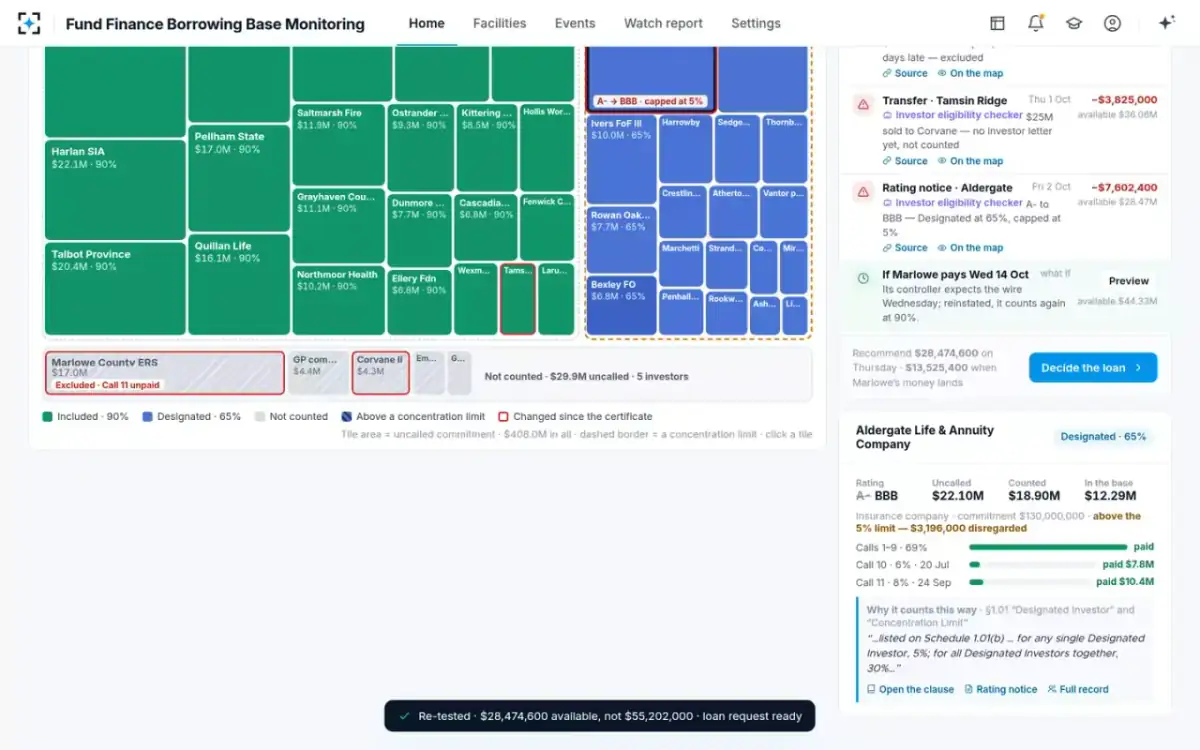
On the first half, what changes is who the investors are and how they count. An investor downgraded below the Included floor moves to a lower advance rate and a tighter concentration limit. An investor that has sold part of its commitment to a buyer with no investor letter yet contributes nothing until the buyer is approved. Neither event shows on the fund's last certificate, because the certificate was true on its own as-of date and nothing since has been re-applied.
On the second half, what changes is whether the money arrived. The capital call tracker in the solution matches each call notice to the receipts in the pledged collection account, investor by investor, and counts business days late using the facility's own day count. That is a collateral check as much as a credit one: it is the layer-three evidence that the cash the lender has control over is the cash the call was supposed to produce. On the sample facility it is also what caught the one investor that had not paid at all.
One investor, with the clause that sets how it counts
Six specialist agents run on a subscription facility like this one — the certificate reader, the facility terms reader, the capital call tracker, the investor eligibility checker, the borrowing base calculator and the draw and watch recommender. A seventh, the NAV and loan tape monitor, only has work to do where the collateral is the portfolio rather than the commitments, which is a different facility with a different security package: subscription line against NAV facility, and what secures each. None of them approves anything. The analyst confirms the re-test and approves loans up to her limit; the credit officer approves larger loans, waivers and any reinstatement.
What a subscription line's collateral file needs, layer by layer
- The partnership agreement and every amendment
The call mechanics, the excuse and default provisions, and any transfer restriction. Layer two lives here.
- Investor letters for every counted investor
Including each transferee. An investor the bank has not papered is a promise from a party it never agreed to lend against.
- The filed financing statement, and a current search
In the right office, against the right debtor name, with the searches that prove nobody filed first.
- The account control agreement — or the account itself
Filing does not perfect a deposit account. Produce the authenticated record, or show the account is maintained with the lender.
- The schedules of Included and Designated Investors
The classes and advance rates the base is built from, as amended. Agents never add an investor to a schedule.
- Evidence each capital call was paid into the pledged account
Matched investor by investor. This is the only layer-three evidence that is generated weekly rather than at closing.
Two halves, two rules, two monitoring jobs. The one-sentence version a credit officer can carry into a meeting: the UCC search proves the promise, the control agreement proves the cash, and the re-test proves how much of the promise still counts today. To see the re-test on a sample certificate end to end, read one borrowing base re-test from certificate to funding, or start from Fund Finance Borrowing Base Monitoring.
Questions people ask
What is a capital call right, legally?
It is a contract right of the fund against each limited partner to pay money when called, which Article 9 classes as a general intangible and, because the obligation is purely monetary, as a payment intangible within that class — "a general intangible under which the account debtor's principal obligation is a monetary obligation" (§9-102(a)(61)). A lender takes a security interest in it and perfects by filing.
Does filing a UCC-1 protect the collection account too?
No. "A security interest in a deposit account may be perfected only by control under Section 9-314" (§9-312(b)(1)). The filing perfects the capital call right and, through the proceeds rules, can carry an interest into identifiable cash proceeds — but the deposit account as original collateral needs control: the lender is the account bank, holds a control agreement in an authenticated record, or has become the bank's customer for the account.
Who has priority if two lenders file against the same fund?
For the capital call right, the general rule in §9-322(a)(1) applies: conflicting perfected interests "rank according to priority in time of filing or perfection", and a perfected interest beats an unperfected one. For the collection account the filing index is irrelevant: under §9-327 control beats no control, competing control interests rank by the time control was obtained, and the bank where the account is maintained outranks other secured parties.
Can a partnership agreement stop a fund pledging its capital calls?
Mostly not. For the investors' obligation to pay, §9-406(d) makes a term restricting "the creation, attachment, perfection, or enforcement of a security interest" ineffective (§9-406(d)); for the general partner's call right, §9-408(a) does the same for creation, attachment and perfection, but under §9-408(d) the interest is not enforceable against the investors (§9-408). Neither hands the lender the fund's governance rights, so lenders still take express consent and investor letters.
Does the lender have to be the bank where the collection account sits?
No, but it is the strongest position short of becoming the bank's customer. §9-104(a)(1) gives control to a secured party that is the account bank, and §9-327(3) gives the account bank priority over other secured parties — so a lender holding only a control agreement at a third-party bank sits behind that bank's own interest in the account.
Is the fund's portfolio part of a subscription line's collateral?
Usually not. A subscription line looks to the uncalled commitments, the call right and the collection account; the assets the fund buys are financed and secured separately, and a facility lent against the value of those assets is a NAV facility, with its own collateral, its own tests and its own early-warning levels.