The cost of borrowing base monitoring is best measured per re-test, not per licence, and on the figures below one subscription-line re-test costs a bank somewhere between $965 and $1,223 in staff time by hand, against $193 to $221 with the mechanical work automated — a saving of roughly $772 to $1,002 each time a certificate is re-tested. Those numbers are not a vendor claim and they are not a customer's measured result. They are arithmetic: published median wages for the closest occupations the US Bureau of Labor Statistics names, grossed up by the published benefits share of employer compensation, applied to the hours one re-test takes. Fund Finance Borrowing Base Monitoring is the thing being priced on the right-hand side; the method is yours to re-run with your own rates.
Everything that follows is stated so it can be checked. The hours are estimates for one subscription line certificate and loan request, from the solution's own figures. The rates are public. Where we have made a judgement — which occupation stands in for a fund finance collateral analyst, how many re-tests a year a book of sixteen facilities produces — it is named as a judgement and the alternative is shown.
One certificate: the unit this guide prices
16.0hrs
estimated staff time for one subscription line certificate and loan request, done by hand
2.5hrs
the same work with the reading, matching and recalculation automated
13.5hrs
released per re-test — almost all of it from one seat
Five steps, and where the hours go
A re-test is not one task. It is five, and they are wildly unequal in both effort and in how much of them a machine can take. Re-keying a fund's certificate and investor schedule into the bank's own template is four hours of work with no judgement in it at all. Checking forty-six investors against today's ratings, any transfers, their side letters and sanctions screening is another four hours, and has judgement only at the edges. Credit approval and the notice to the fund is two hours that are almost entirely judgement.
Where the hours go, by step, before and after
By hand · 16.0 hours
- Re-keying the certificate · 4.0h · 25%
- Matching capital-call receipts · 3.0h · 18.75%
- Ratings, transfers, side letters · 4.0h · 25%
- Advance rates and concentration limits · 3.0h · 18.75%
- Approval and notice · 2.0h · 12.5%
With agents · 2.5 hours
- Certificate · 0.25h · 10%
- Receipts · 0.25h · 10%
- Investors · 0.5h · 20%
- Rates and limits · 0.5h · 20%
- Approval and notice · 1.0h · 40%
Read the two bars together and the shape of the saving is obvious. Approval is 12.5% of the work by hand and 40% of what is left afterwards — not because it got slower, but because everything around it got faster. That is the correct outcome. A desk whose approval step shrank in proportion with the rest would be a desk that had stopped reading.
Building a loaded hourly rate from public wage data
A median wage is not what an hour costs. Employers pay benefits on top, and the US Bureau of Labor Statistics publishes the split: for private industry workers in December 2025, "wages and salaries averaged $32.36 per hour worked and accounted for 70.1 percent of employer costs, while benefit costs averaged $13.79 per hour worked and accounted for the remaining 29.9 percent" (BLS, Employer Costs for Employee Compensation, released March 2026). Dividing a published wage by 0.701 therefore gives total compensation per hour, before any allocation of desk, systems or management overhead.
The wage itself is harder, because the Bureau publishes no occupation called "fund finance collateral analyst". The honest move is to bracket it with the two published categories the work sits between, and to say so. Financial Analysts had a median wage of $103,570 a year, or $49.79 an hour, in May 2025, against 443,100 jobs (BLS, Occupational Outlook Handbook); Loan Officers had a median of $76,690, or $36.87 an hour (BLS, Occupational Outlook Handbook). For the approval hour, Financial Managers had a median of $166,570 a year, or $80.08 an hour (BLS, Occupational Outlook Handbook).
From a published wage to a loaded hourly rate, with every step shown
| Seat | Published median hourly wage | Divided by the wage share (70.1%) | Loaded hourly rate |
|---|---|---|---|
| Analyst, lower bracket — Loan Officers | $36.87 | $36.87 ÷ 0.701 | $52.60 |
| Analyst, upper bracket — Financial Analysts | $49.79 | $49.79 ÷ 0.701 | $71.03 |
| Approver — Financial Managers | $80.08 | $80.08 ÷ 0.701 | $114.24 |
Two warnings about these rates. They are national medians across every employer, and a fund finance desk at a large bank in a money centre may pay well above them, so for a money-centre desk the Financial Managers median is better read as a floor than as a midpoint. And none of the three is this job. They bracket it, which is the most a published source can honestly do when the occupation has no code of its own.
What one re-test costs by hand
Fourteen of the sixteen hours belong to the analyst's four steps; the remaining two are the approval and the notice, carried by a credit officer and a relationship manager. Pricing each block at its own loaded rate gives the unit cost directly.
One subscription line re-test, by hand, priced at both ends of the analyst band
| Block | Hours | At the lower rate ($52.60) | At the upper rate ($71.03) |
|---|---|---|---|
| Analyst: re-keying, matching, checking, re-applying | 14.0 | $736.40 | $994.42 |
| Approval and notice, at $114.24 | 2.0 | $228.48 | $228.48 |
| One re-test, by hand | 16.0 | $964.88 | $1,222.90 |
| One re-test, with agents (1.5h analyst + 1.0h approval) | 2.5 | $193.14 | $220.79 |
| Released per re-test | 13.5 | $771.74 | $1,002.11 |
So the unit cost of a borrowing base re-test, measured only in the time of the people who do it, is about a thousand dollars by hand and about two hundred with the mechanical part automated. For a facility of $400,000,000 drawing $42,000,000, those are not large numbers, and anyone selling on this arithmetic alone is selling the wrong thing. The number that matters more is the one underneath it: thirteen and a half hours, which is the reason a desk re-tests when it must rather than when something changes.
What the thirteen and a half hours used to produce
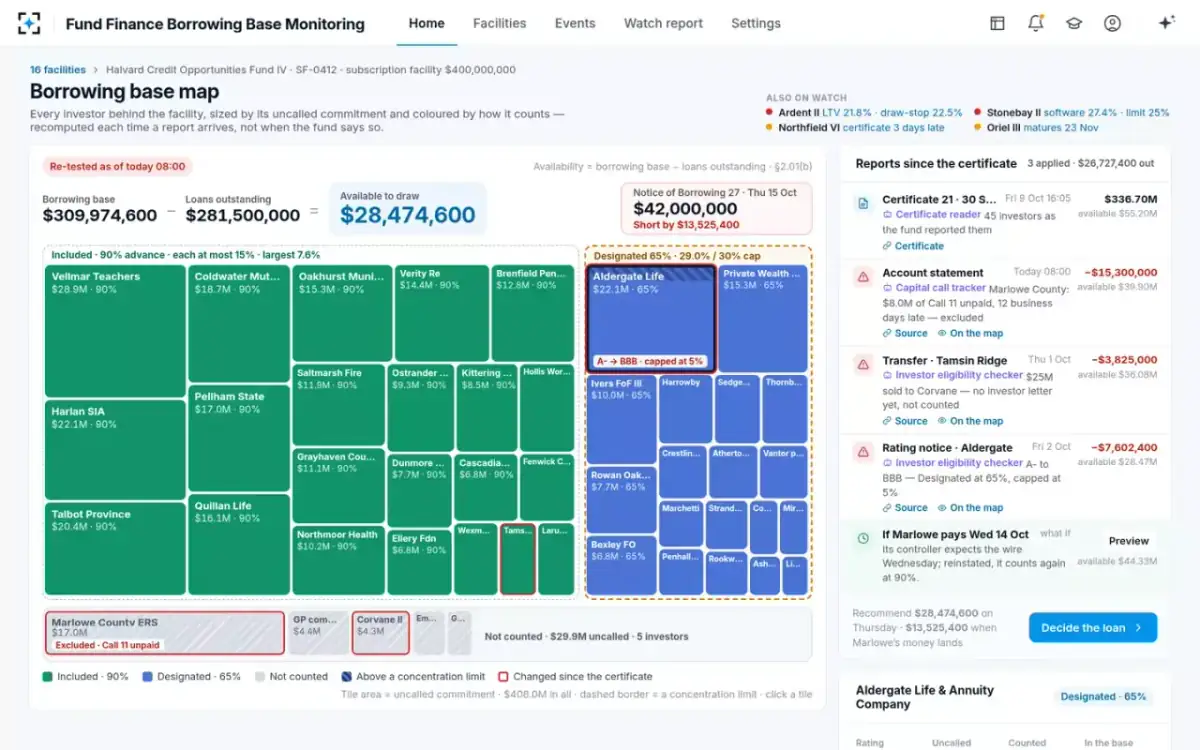
What one re-test costs with agents
On the right-hand side of the comparison the hours fall to 2.5 and the money to roughly $193 to $221, but the composition changes more than the total. Of the 1.5 analyst hours that remain, almost none is re-keying: it is reading the three changes the re-test found, deciding whether each really is an exclusion event under this agreement's words, and signing. The approval hour is unchanged in substance and shorter in practice only because the credit officer is now given what stopped counting, why, and what would cure it, rather than a reconciliation she has to take on trust.
Two costs belong on this side of the comparison and are not in the table, because we cannot price them honestly for your bank. The software has a price, which the vendor quotes. And the change itself costs time: the pilot, the credit policy update, the first fund whose certificate format nobody has seen before. How to pilot the tool on your own certificates sets out what that period actually involves.
How many hours does a subscription line re-test take?
About sixteen hours of staff time by hand for one certificate and the loan request that follows it, on these estimates, concentrated almost entirely in one seat. That is not sixteen hours of elapsed time: a re-test typically spans several days because it waits on an account statement, a ratings feed, a transfer agreement or a colleague. The elapsed figure is the one that hurts, because the certificate is true on its as-of date and the loan funds later — and every day of elapsed re-testing is a day in which the base can move again.
The distinction between staff hours and elapsed days is also what makes the per-re-test dollar figure a poor summary of the problem. A desk that re-tests in a day can re-test every facility when anything moves; a desk that takes a week re-tests when a draw forces it. The cost of the second desk is not the extra hours. It is the re-tests it never does. Who reviews a borrowing base certificate, seat by seat follows the same hours through the four seats that carry them.
The ROI formula, with every input named
The return has four terms, and only two of them can be built from public figures. Writing all four out is the point: a return that counts only the easy terms is not a return, it is a saving.
The return on one year of fund finance monitoring, term by term
Analyst hours released
12.5 hrs × loaded analyst rate × re-tests a year
At 192 re-tests and $71.03, $170,472. At the lower bracket, $126,240.
Head of Fund Finance
Approval time released
1.0 hr × $114.24 × re-tests a year
At 192 re-tests, $21,934. Smaller, and the hardest to redeploy, because it is senior time in small pieces.
Credit officer
Deficiency avoided
not counted here
A loan that funds past the re-tested base is a borrowing base deficiency the fund must repay. We can price neither its likelihood nor its cost from a published source, so it is left at zero.
Credit committee
Software and change
licence + implementation + pilot time
Priced by the vendor, plus the desk’s own time through the pilot and the credit policy update.
Procurement and the desk
At 192 re-tests a year the two countable terms come to roughly $148,000 at the lower analyst bracket and roughly $192,000 at the upper, before the cost of the software. In hours rather than money that is about 2,592 hours, or roughly 1.4 full-time equivalents at 1,800 productive hours a year. Whether that is a saving or a capacity gain is a decision for the bank: a desk that redeploys the hours into facilities it could not previously cover is buying coverage, not cost reduction.
What moves the answer most: volume, rate or rework
Sensitivity matters more than the baseline, because the baseline is built on an assumption about hours that nobody has measured at your bank. Moving each input by a quarter and holding the rest still shows where the uncertainty actually lives.
Change one input by a quarter: what happens to the annual return
The result is a useful warning. Volume and rate are inputs a bank knows precisely — it can count its facilities and it knows what it pays. The hours by hand are the one input taken on trust, and they are the input the answer is most sensitive to. Any evaluation of this kind of tool should begin by timing two real re-tests at your own desk before accepting anyone's figure, including this one.
Rework sits outside the table because it cannot be priced from a public source, and it is probably the largest term. Fund a loan past the re-tested base and the facility is in a borrowing base deficiency that the fund has to repay, with the relationship consequences that follow. Lending to funds is also where the growth has been: at the US banks with more than $10 billion in assets, loans to private equity funds were 24 percent of all their loans to non-bank financial firms in the third quarter of 2025, "most of which are loans secured by a fund's capital call commitments" (FDIC, Banking Issues in Focus No. 1). A control failure in this product is not a small, contained error.
The thing a cost model cannot price: one investor, and the clause behind it
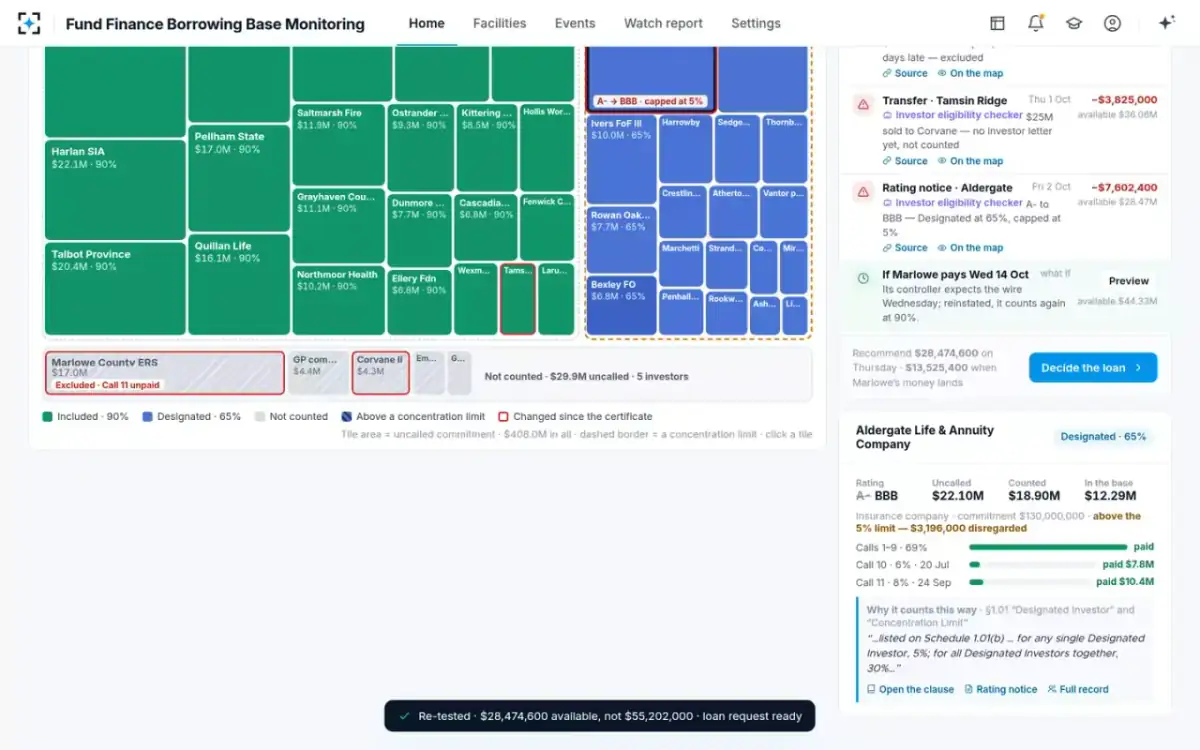
What is the ROI of fund finance monitoring software?
On this method, and counting only staff time: roughly $148,000 to $192,000 a year on a sixteen-facility book re-tested monthly, against a licence and an implementation the vendor prices. Expressed per unit it is $772 to $1,002 per re-test. Expressed in the unit that usually decides the business case, it is about 1.4 full-time equivalents of analyst capacity.
Three honest qualifications belong with that figure. It omits the largest term, which is the cost of funding past the base. It assumes a monthly re-test cadence that your facilities may not have. And it uses national median wages for occupations that bracket the job rather than name it. A bank that wants a defensible number should take the method, substitute its own fully absorbed rate, its own facility count and its own timed hours, and leave the deficiency term at zero as we have — a return that is large without it does not need it, and one that is small without it should not be rescued by it.
To see the hours the model prices — the certificate read, the receipts matched, the forty-six investors checked, the base rebuilt — running on one facility, start from Fund Finance Borrowing Base Monitoring.
Questions people ask
How much does it cost to re-test a borrowing base certificate by hand?
On these figures, about $965 to $1,223 of staff time for one subscription-line certificate and the loan request that follows it: fourteen analyst hours at a loaded rate of $52.60 to $71.03, plus two hours of approval and notice at $114.24. The rates are built from published US median wages grossed up by the published 70.1% wage share of employer compensation, and they exclude desk, systems and management overhead.
What is the ROI of fund finance monitoring software?
Counting only staff time, roughly $148,000 to $192,000 a year for a sixteen-facility book re-tested monthly — about 2,592 hours, or 1.4 full-time equivalents — before the cost of the software and the change. The term left out is the cost of funding past a re-tested base, which cannot be priced from a public source and is probably larger than everything counted.
How many hours does a subscription line re-test take?
About sixteen hours of staff time by hand, on the estimates used here, of which fourteen sit with the collateral analyst: four re-keying the certificate and investor schedule, three matching capital-call receipts, four checking ratings, transfers and side letters, and three re-applying advance rates and concentration limits. Elapsed time is longer, because the re-test waits on statements, feeds and colleagues.
What loaded rate should I use for a collateral analyst's time?
If you have a fully absorbed internal rate, use it. If not, take a published median hourly wage for the closest occupation and divide by 0.701, the wage share of employer compensation for private industry workers in December 2025. That gives $52.60 from the Loan Officers median and $71.03 from the Financial Analysts median — a bracket, not a measurement, because the Bureau publishes no fund finance collateral analyst occupation.
Does the ROI change with facility count?
Linearly, on this method, because the saving is per re-test. Twenty-five per cent more re-tests gives twenty-five per cent more return. What is not linear is coverage: a desk at capacity does not re-test more facilities when it gets busier, it re-tests the same ones less often, so the real effect of volume often shows up as missed re-tests rather than extra hours.
What's the biggest driver of the cost — hours, rate or rework?
Rework, almost certainly, and it is the one nobody can price from public data. Among the inputs that can be priced, the hours-by-hand assumption moves the answer furthest: cutting it from sixteen to twelve takes about 30% off the annual return, while a quarter on volume or rate moves it by exactly a quarter. Time two real re-tests at your own desk before trusting any figure built on assumed hours.