The Treasury clearing mandate is the SEC's rule, adopted on December 13, 2023, that requires every clearing agency that clears US Treasury securities to make its direct participants submit their "eligible secondary market transactions" for central clearing. The compliance dates, extended once in 2025, are December 31, 2026 for eligible cash transactions and June 30, 2027 for eligible repo. For a fund the mandate bites mainly through repo: cash trades between a dealer and a fund are generally outside it, but a repo between a fund and a dealer that is a direct participant is inside it, and clearing it means signing up to sponsored or agent clearing, which takes negotiated agreements. That work lands on the same documentation desk that negotiates the fund's ISDAs. Botminds' ISDA Negotiation reads repo masters and clearing agreements alongside ISDA Schedules, places their terms on the fund's playbook and routes each decision to its owner.
Every rule and date on this page comes from the SEC's own releases in the Federal Register, read on October 28, 2026. Examples of the documentation work come from a fictional sample firm, Quillfield Capital.
The mandate in four numbers
Dec 312026
compliance date for eligible cash transactions in US Treasuries
SEC, March 2025
Jun 302027
compliance date for eligible repo transactions
SEC, March 2025
3
clearing agencies the SEC names for US Treasuries: FICC, CME Securities Clearing and ICE Clear Credit
SEC, 2026
~2,200
sponsored members already clearing through about 350 sponsoring members when the rule was adopted
SEC, 2024
What is the Treasury clearing mandate?
The Treasury clearing mandate is a requirement on clearing agencies that reaches market participants through their membership rules. Each US Treasury securities clearing agency must have policies "reasonably designed to require that any direct participant must submit for clearance and settlement all “eligible secondary market transactions” to which that direct participant is a counterparty" (SEC, March 2026). Funds are rarely direct participants; they are reached because the dealers they trade with are.
The definition does the work. An eligible secondary market transaction is "(i) a repurchase or reverse repurchase agreement collateralized by U.S. Treasury securities, in which one of the counterparties is a direct participant (“repo”); or (ii) a purchase or sale, between a direct participant and: (A) any counterparty, if the direct participant of the covered clearing agency brings together multiple buyers and sellers using a trading facility (such as a limit order book) and is a counterparty to both the buyer and seller in two separate transactions; or (B) a registered broker-dealer, government securities broker, or government securities dealer" (17 CFR 240.17ad-22(a), as the SEC summarised it in March 2026). The rule adds that the transaction must be "of a type accepted for clearing by a registered covered clearing agency".
The reason is risk to the clearing agency itself. The SEC said the requirement "is designed to reduce the amount of ‘contagion risk’ to a U.S. Treasury securities CCA arising from what has been described as ‘hybrid clearing’", where "any default on a bilaterally settled transaction could impact the direct participant's financial resources and ability to meet its obligations to the covered clearing agency" (SEC, June 2026, quoting the 2024 adopting release). Its estimate of how much went uncleared was stark: "Based on 2017 data, the TMPG estimated that 13 percent of cash U.S. Treasury securities transactions are centrally cleared; 68 percent are bilaterally cleared; and 19 percent involve hybrid clearing" (SEC adopting release, 2024).
When does the Treasury clearing mandate apply, and was the deadline delayed?
The mandate applies to eligible cash transactions from December 31, 2026 and to eligible repo from June 30, 2027. Both dates were delayed once: in March 2025 the SEC extended them "by one year, from December 31, 2025, to December 31, 2026, for eligible cash market transactions, and from June 30, 2026, to June 30, 2027, for eligible repo transactions" (90 FR 11134). As of October 28, 2026, the Federal Register shows no further change to either date; in August 2026 the SEC reopened comment on a request for relief for certain non-US transactions (91 FR 52354).
The time left is the planning problem. From late October 2026, a fund has about nine weeks before the cash date and about eight months before the repo date. The SEC's extension release recorded industry requests that cited "a significant onboarding process that dealers and clients must undertake (including negotiation and execution of clearing agreements)", and a fund association's view that "it can take a registered fund several months, and potentially longer, to negotiate the bespoke sponsoring member documentation" (SEC, March 2025, summarising the requests it received).
From late October 2026, the repo date leaves about eight months for agreements that take months
- Map scope3 wk
- Clearing set-up4 wk
- Test2 wk
- Choose model6 wk
- Negotiate clearing agreements13 wk
- Repo masters, opinions11 wk
- Test and buffer5 wk
Does the Treasury clearing mandate apply to hedge funds?
For cash trades, mostly not; for repo, yes. The SEC had proposed to include cash trades with hedge funds and leveraged accounts, and dropped them: "The Commission is not including purchases and sales of U.S. Treasury securities between a direct participant and either a hedge fund or a levered account within the definition of an eligible secondary market transaction" (SEC adopting release, 2024). A hedge fund's cash trades with a dealer are in scope only through the trading-facility limb, where the direct participant "brings together multiple buyers and sellers using a trading facility (such as a limit order book) and is a counterparty to both".
Repo is different. Any repo "in which one of the counterparties is a direct participant" is eligible, whoever the other party is. A hedge fund that finances Treasury positions through repo with a bank or broker-dealer that is a direct participant must, from June 30, 2027, have those repos cleared. The SEC noted that it was already common: "numerous hedge funds conduct such same-day transactions as sponsored members of FICC" (2024).
A June 2026 order eased one structure that private funds use. It excludes "repo transactions between a Private Fund and its Captive Clearing Sub that is a direct participant", provided the subsidiary is "directly or indirectly wholly owned by one or more Private Funds", any funds sharing it have a common adviser, and the inter-affiliate exclusion's other conditions are met, including that the fund clears its other repos (SEC order, 91 FR 37446).
Which of a fund’s Treasury trades must be cleared, and from when
| Trade | In scope? | From | Why |
|---|---|---|---|
| Cash purchase or sale with a dealer that is a direct participant, bilaterally | Generally no | — | The final rule dropped hedge funds and levered accounts from the cash definition. |
| Cash trade on a platform where the direct participant faces both buyer and seller | Yes | Dec 31, 2026 | The trading-facility limb covers "any counterparty". |
| Repo or reverse repo with a dealer that is a direct participant | Yes | Jun 30, 2027 | "one of the counterparties is a direct participant". |
| Repo between a private fund and its wholly owned captive clearing subsidiary | No, if the conditions are met | — | Conditional exemption of June 2026; the fund’s outward repos must still be cleared. |
| Any trade with a central bank, sovereign entity, international financial institution or natural person; repo with a state or local government or a clearing house | No | — | Excluded by 17 CFR 240.17ad-22(a)(iii)–(v). |
Does the Treasury clearing mandate apply to repo, including for registered funds?
Yes. Repo is where the mandate reaches most buy-side firms, because their cash trades with dealers are largely outside it, and registered funds are large users of Treasury repo. The SEC's adopting release recorded that "Filings of Form N-MFP by money market funds show that, as of September 30, 2023, these funds invested approximately $2.2 trillion in Treasury repos" (2024). Those repos are eligible whenever the money market fund's counterparty is a direct participant.
The SEC also declined to exclude triparty repo. It noted that the operational route already existed: the sponsored service had been expanded in 2021 to "enable sponsored members (e.g., registered funds) to conduct centrally cleared triparty repo transactions". For a registered fund, the documentation question is less whether clearing is possible than how many sponsoring relationships it needs and on whose terms.
What is sponsored clearing?
Sponsored clearing is the model in which a direct participant brings its client into central clearing as a limited member and stands behind it. The SEC described the largest version: "The Sponsored Service allows eligible direct participants (Sponsoring Members) to (i) sponsor their clients into a limited form of FICC membership (Sponsored Members) and then (ii) submit certain eligible client securities transactions for central clearing ... FICC interacts solely with the Sponsoring Member/direct participant as agent. Sponsoring Members guarantee to FICC the payment and performance obligations of its Sponsored Members" (SEC adopting release, 2024).
A sponsored member is not a direct participant. "Because sponsored members cannot clear or settle government securities transactions without a sponsoring member, the Commission believes that these sponsored members are not “direct participants”", the SEC wrote. When the rule was adopted there were "approximately 350 Sponsoring Members and approximately 2,200 Sponsored Members" with access to central clearing.
The alternative is agent clearing, in which the client's trade is given up to a direct participant without the client becoming a member: the SEC described "an agent clearing model like FICC's Prime Broker or Correspondent Clearing models, in which it would essentially “give up” its transaction to a direct participant for submission". It also noted that some access models "may not result in a contractual relationship or direct obligation between FICC and the indirect participant, meaning that FICC itself cannot guarantee settlement of such transactions". Which model a fund uses changes what its agreements must say about default, margin and porting.
Which clearing agencies clear US Treasuries?
As of 2026 the SEC names three: "The U.S. Treasury securities CCAs are the Fixed Income Clearing Corporation (“FICC”), the CME Securities Clearing Corp. (“CMESC”), and ICE Clear Credit, LLC (“ICC”)" (SEC, March 2026). The SEC approved CME Securities Clearing's registration on December 1, 2025 and the Treasury business of ICE Clear Credit on January 30, 2026, according to its June 2026 order.
More than one clearing agency means more than one set of rules a fund's agreements may have to fit. Each clearing agency's rulebook governs default management, margin and the client account structures it accepts, and the fund's agreements with its clearing members sit on top of those rules. A fund that clears through two members at two clearing agencies negotiates two stacks of documents, which is the reason to decide the access model before the first draft arrives.
What documents does a fund need for Treasury clearing?
A fund needs an agreement with each clearing member it will use, the clearing agency's own membership or sponsored-member documents where it becomes a limited member, changes to its repo master agreements for cleared trades, and the internal approvals and legal opinions behind them. The SEC's releases name the pieces that commenters said take time: "negotiation and execution of clearing agreements", "development of legal opinions on bankruptcy and enforceability", "consideration of any Investment Company Act of 1940 (“1940 Act”) issues to be negotiated between the parties" for registered funds, and, for sponsored members, "the need for Sponsoring Members to file UCC financing statements" (SEC, 2025; SEC, 2024).
The Treasury clearing document set a fund should have signed before its dates
- Scope map
Every Treasury counterparty and venue, marked direct participant or not, cash or repo, in scope or excluded.
- Access-model decision
Sponsored, agent or another model, per counterparty, with the default and porting consequences written down.
- Clearing member agreements
One per sponsoring or clearing member: margin, default, termination, fees, and what happens if the member fails.
- Clearing agency documents
The sponsored-member or equivalent documents each clearing agency requires, and the security-interest filings that come with them.
- Repo master changes
Amendments so cleared trades are no longer governed bilaterally, and so uncleared trades keep their existing terms.
- Opinions and approvals
Bankruptcy and enforceability opinions where needed; for registered funds, the Investment Company Act analysis and board approvals.
Several of these documents reopen terms a fund has already settled in its ISDAs: margin, eligible collateral, default and termination rights, set-off. A fund that has a playbook position on each for its derivatives agreements should start from it, and record where clearing requires something different. The waiting between the owners of those terms, rather than the drafting, is usually where the time goes; ISDA negotiation delays shows where the days go on an ISDA, and the clearing agreements follow the same path.
Why the clearing documents land on the ISDA desk
The clearing documents go to the people who negotiate ISDAs because they are the same kind of agreement with the same dealers, decided by the same owners. Credit risk owns the margin and default terms, treasury owns collateral and funding, and legal owns the language, exactly as with a Schedule and a credit support annex. The difference is the deadline: an ISDA waits for a trading date the fund chooses; a clearing agreement waits for a date the SEC set.
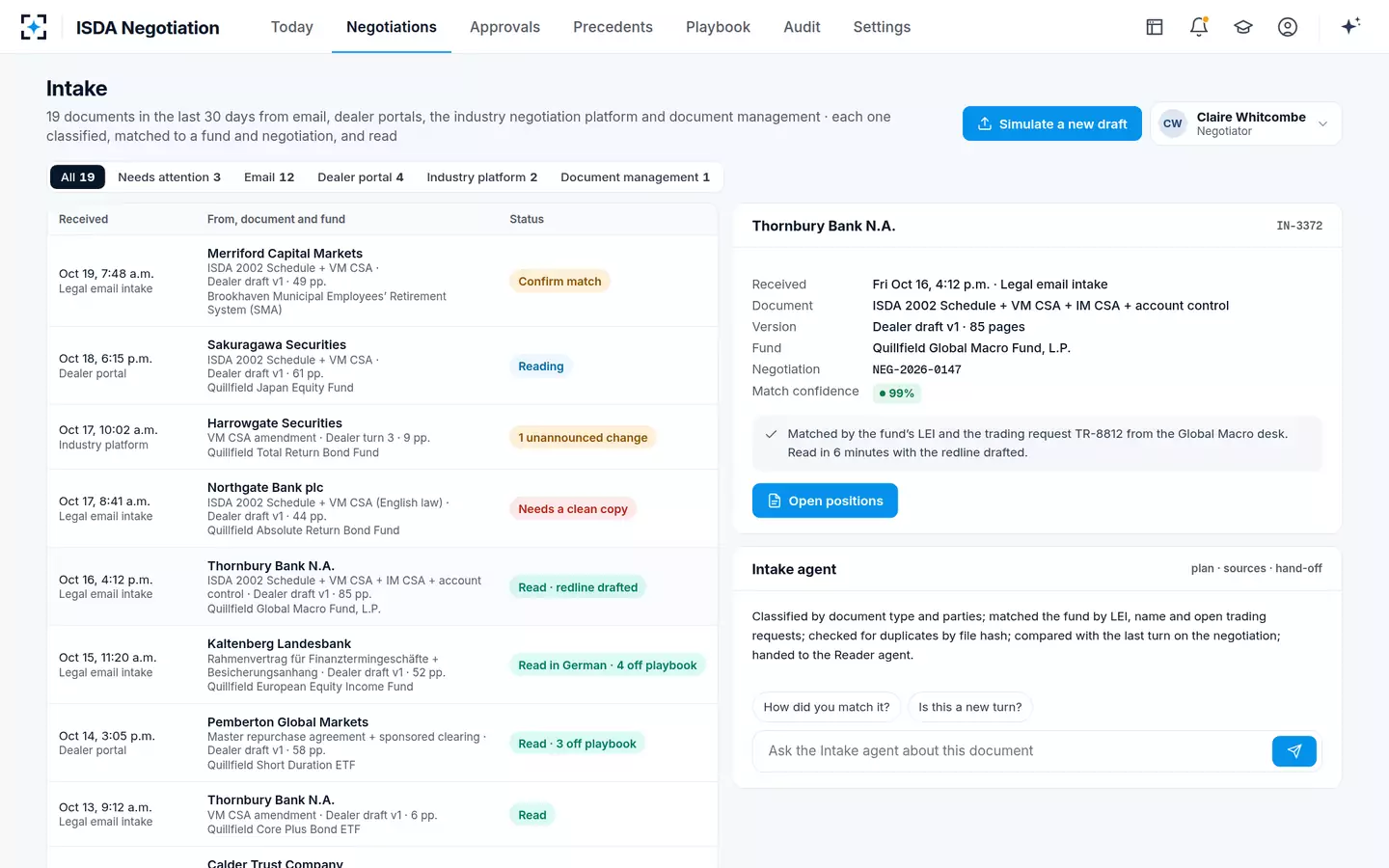
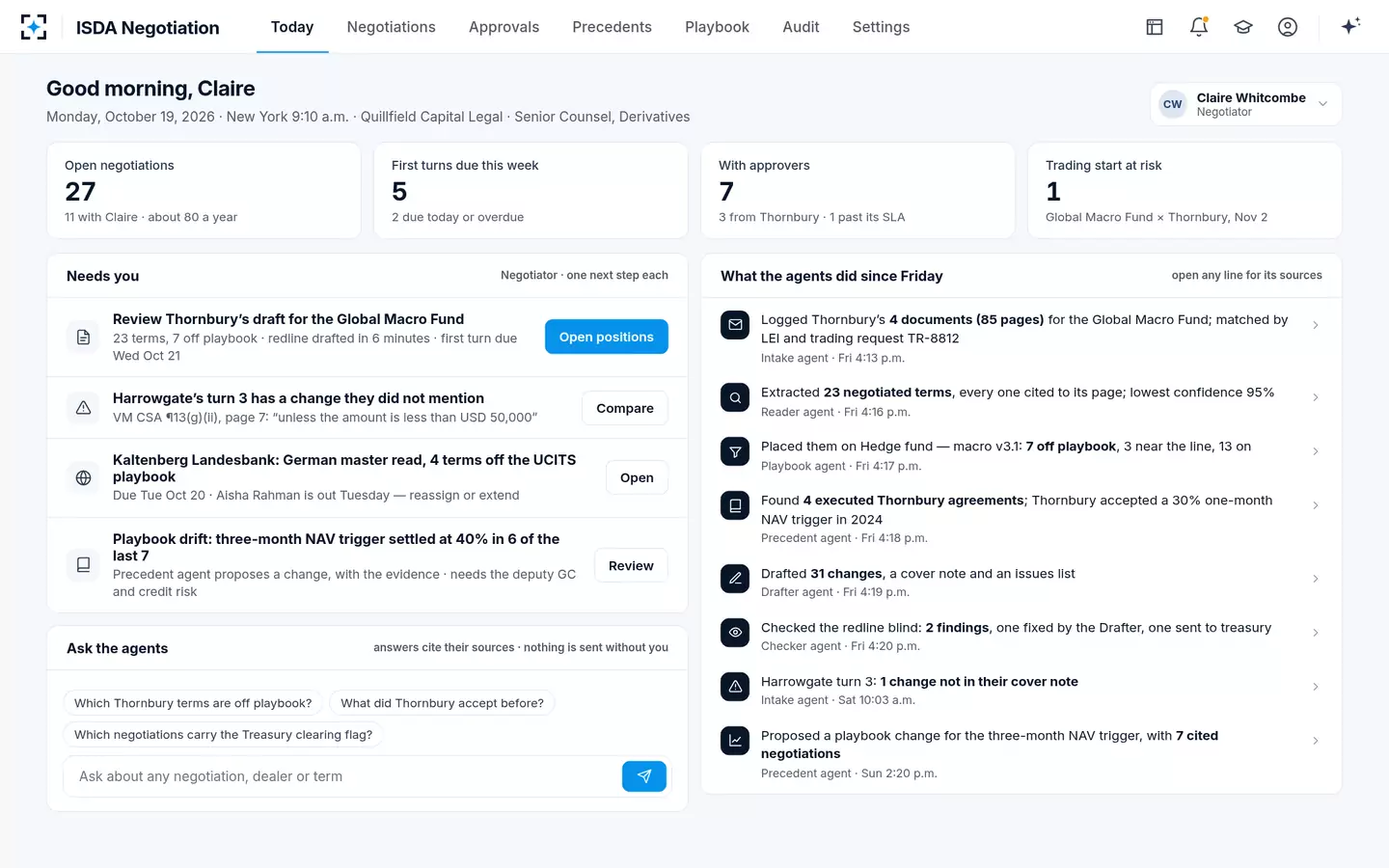
The sample firm's month shows the overlap. Beside dealers' ISDA 2002 Schedules and credit support annexes, its intake held a draft master repurchase agreement with sponsored clearing terms, 58 pages, with three terms off the fund's playbook, and the documentation lawyer could ask which negotiations carried the Treasury clearing deadline. How the seats divide that work is the subject of the decision rights over ISDA credit terms.
ISDA Negotiation’s intake holds clearing and repo drafts beside ISDA Schedules
How ISDA Negotiation helps with Treasury clearing documentation
ISDA Negotiation helps by treating a clearing or repo draft like any other dealer paper: the agents read it, cite each term to its page, place it on the fund's playbook, find what the same dealer accepted before, and draft the redline; the lawyer decides each term, and credit risk and treasury approve the terms they own. Nothing goes to a dealer until the deputy general counsel releases it.
What it does not do is decide scope. Whether a given trade is an eligible secondary market transaction, and which access model a fund should use, are legal and business decisions for the fund's counsel and its clearing members. The solution's job is to make sure that once those decisions are made, the agreements that implement them say the same thing as the fund's ISDAs where they should, and that every difference is a decision someone owns.
The documentation lawyer’s day in ISDA Negotiation, with deadlines and dealer turns in one place
Questions people ask
Does the Treasury clearing mandate apply to mutual funds and money market funds?
Their repo does whenever the counterparty is a direct participant, from June 30, 2027. The SEC recorded about $2.2 trillion of money market fund investment in Treasury repo as of September 30, 2023, and registered funds can already clear triparty repo through the sponsored service.
Is there a de minimis exemption from Treasury clearing?
The definition has no size threshold. Exclusions run by counterparty type instead: trades with a central bank, sovereign entity, international financial institution or natural person are excluded, as are repos with a state or local government or a clearing house, and qualifying inter-affiliate repos.
Do I need a new ISDA for Treasury clearing?
No. Cash Treasuries and repo are documented under repo masters and clearing agreements, not ISDAs. But the same terms recur, margin, eligible collateral, default and set-off, so a fund's ISDA playbook positions are the natural starting point.
What is done-away clearing?
Done-away clearing is submitting a trade executed with one dealer for clearing through a different clearing member. The SEC declined to require clearing agencies to make members accept done-away trades, noting that existing client clearing models "allow for the submission of done-away transactions" without requiring any direct participant to submit them.
Can the SEC delay the Treasury clearing mandate again?
It can, as it did in March 2025, but as of October 28, 2026 the Federal Register shows no further extension. A fund should plan to the published dates and check the Federal Register before relying on any change.