ISDA negotiation software is software a fund's legal team uses to negotiate ISDA Schedules, credit support annexes and related agreements with dealers: it takes in each dealer's draft, extracts the negotiated terms, compares them with the fund's playbook and with what the dealer accepted before, drafts the redline, routes each term to its owner for approval, and keeps a trail of who decided what. The hard part is not building those features but getting derivatives lawyers to rely on them, because a lawyer who has to re-read the dealer's draft to check the software saves nothing. Lawyers use software that shows its reading, cites every value to the page, and leaves every decision with them. Botminds' ISDA Negotiation was built to those requirements: seven agents do the reading, placing, precedent search, drafting and checking; the lawyer decides; owners approve; the deputy general counsel releases.
The examples on this page come from a fictional sample firm, Quillfield Capital. Supervisors' statements and research are linked where they are used.
What ISDA negotiation software has to earn
33%
the highest hallucination rate measured in commercial legal research tools (lowest 17%), against providers’ claims of far less
J. Empirical Legal Studies, 2025
1,846
executed agreements across 212 funds and mandates and 38 dealers in the sample firm’s precedent library
fictional sample
120
executed agreements in the golden set the sample firm’s agents are evaluated on
fictional sample
41,880
append-only trail entries since go-live in the sample firm, kept 10 years
fictional sample
What is ISDA negotiation software?
ISDA negotiation software supports the negotiation itself, from the dealer's draft to the released turn, rather than storing the signed result. That separates it from three neighbours a fund probably already has. A document comparison tool shows what changed between two versions. A contract repository holds signed agreements and their data. The industry negotiation platform carries drafts between the parties. None of them tells a lawyer whether a dealer's 20% NAV trigger is acceptable for this fund, what the dealer gave a sister fund, or who must approve the answer.
Those three questions are the job. They need the fund's playbook as a scale for each term and fund type, its executed agreements as a precedent library, and its approval rules as routing. Software that brings the three together around a dealer's draft is negotiation software; software that does one of them is a component.
What are the requirements for ISDA negotiation software?
The requirements that decide whether lawyers use ISDA negotiation software are about trust, not features: every value cited to its source, every decision with a named person, nothing sent or booked without approval, and a trail an auditor can read. The table sets out ten, with the reason each matters.
Ten requirements for ISDA negotiation software, and why each decides adoption
| Requirement | What it means in practice | Why it matters |
|---|---|---|
| Reads the whole package | Schedule, both credit support annexes, account control agreement, local-law masters, in the original language | A term in one document often depends on another |
| Cites every value | Document, clause and page for each term; one click opens the passage | Lawyers check the source, not the software |
| Asks when unsure | A confidence floor below which a person confirms | A guessed threshold is worse than a missing one |
| Playbook as a scale | Preferred to walk-away for each term and fund type, versioned | Turns a memo into decisions that can be measured |
| Precedent from executed agreements only | What this dealer signed with the firm’s funds; superseded and old agreements flagged | The strongest counter is the dealer’s own history |
| Checks the package for consistency | Definitions, numbers and times across documents | A definition elsewhere can quietly undo a counter |
| Routes to owners, separates duties | Thresholds to credit, collateral to treasury; a maker never approves | Credit and collateral terms are not the lawyer’s alone |
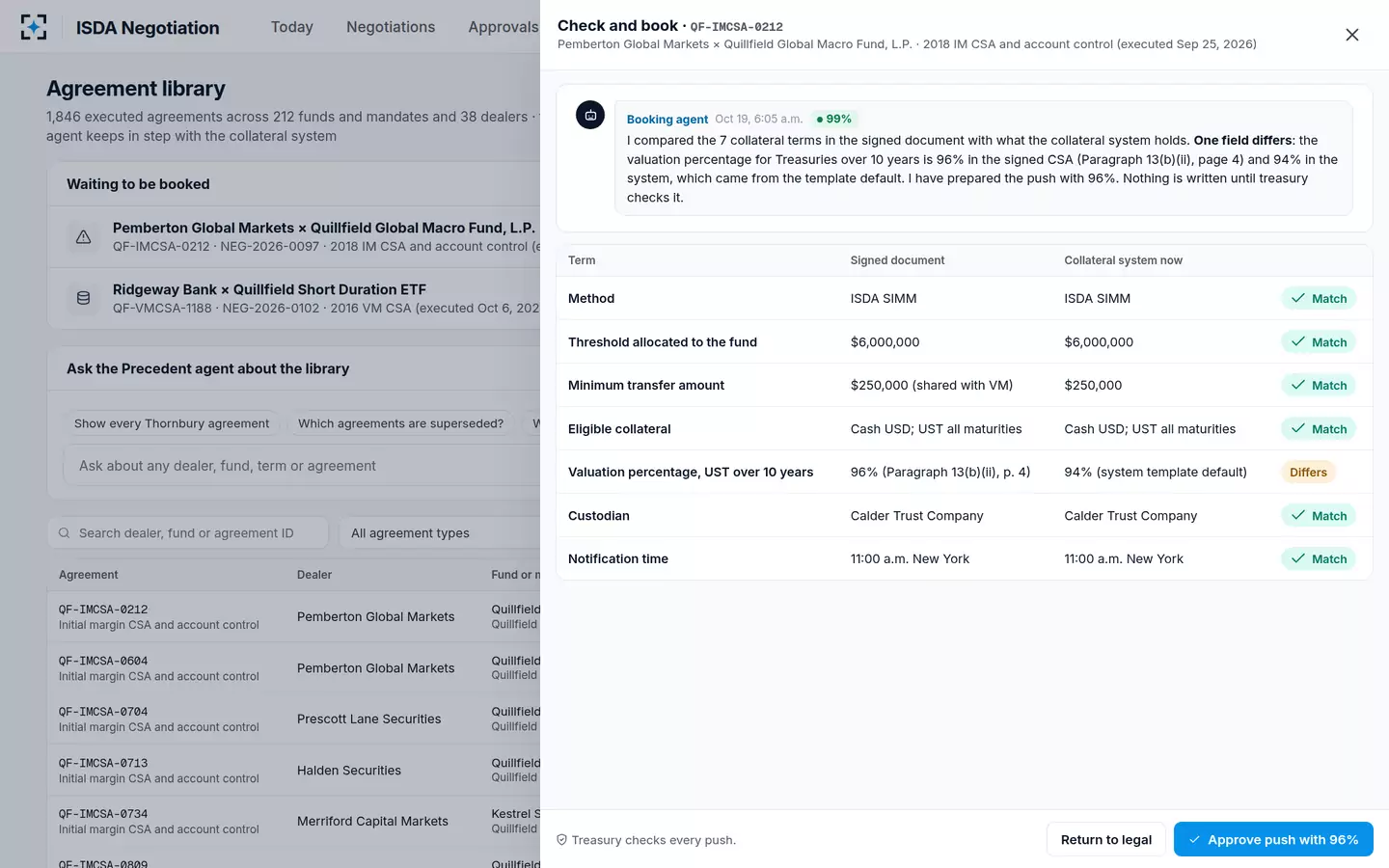
| Never sends or books on its own | Release by a named person; collateral updates after a treasury check | One unreviewed turn can cost a term for years |
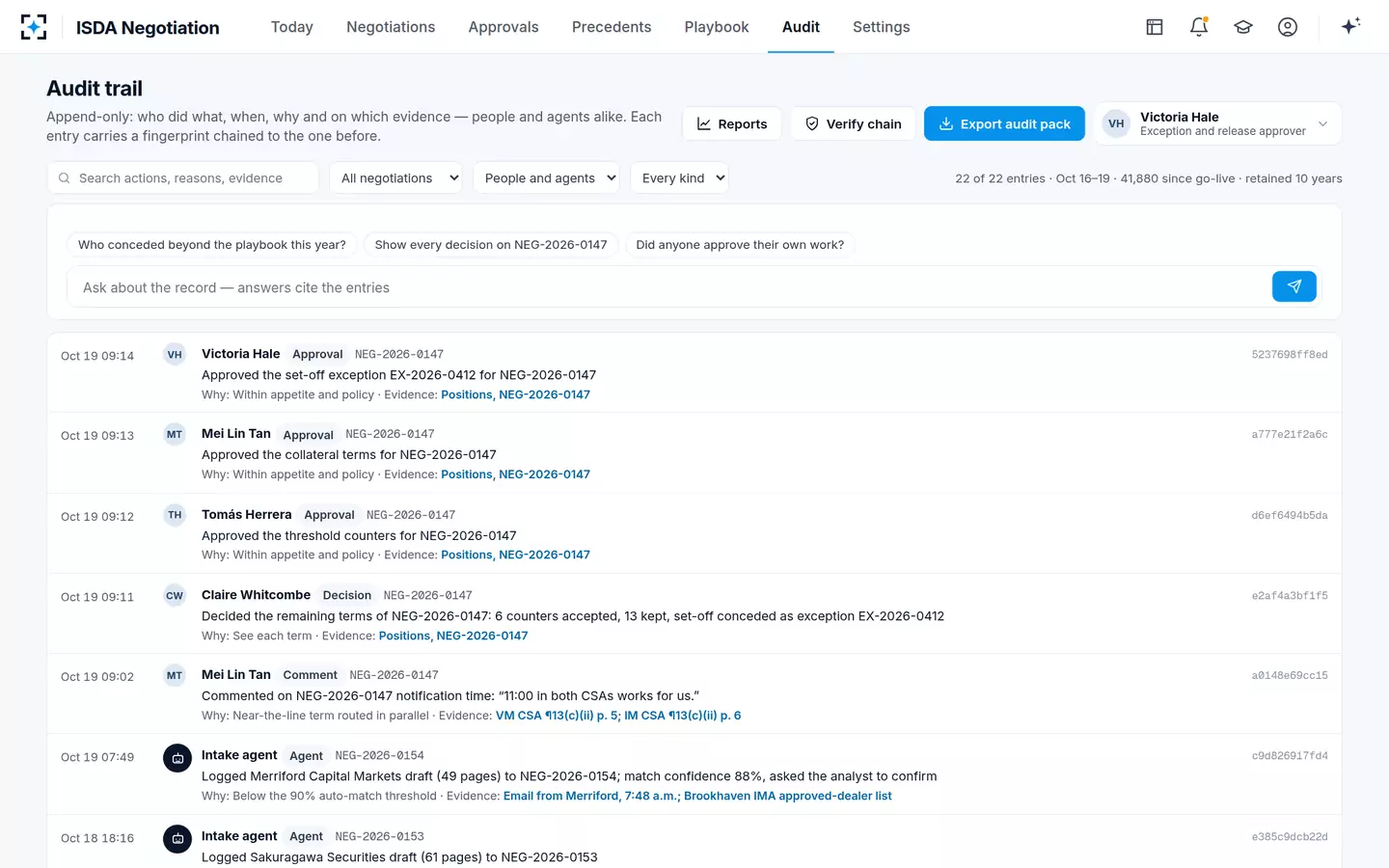
| Keeps a trail | Who, role, what, why, evidence, for people and agents alike | Supervisors and auditors ask who conceded what and why |
| Puts signed terms into systems accurately | Field-by-field comparison with the collateral system before any update | Supervisors expect accurate legal terms in systems, not only in files |
Two of the ten are regulatory before they are commercial. US banking supervisors expect dealers to control legal documentation and incorporate "accurate legal terms and provisions" into their systems (Federal Reserve SR 11-10), and the CFTC requires swap dealers to have documentation policies audited periodically for "any material weakness" (17 CFR 23.504(c)). A fund's own collateral and risk systems face the mirror-image problem, and the auditors who test them will ask for the trail.
What should ISDA negotiation software do that a comparison tool does not?
It should say what a change means, not only that it happened. A comparison tool tells a lawyer that a dealer's third turn added a phrase; negotiation software tells her that the phrase sits outside the fund's playbook, that the dealer did not mention it in its cover note, and that it goes to treasury for approval. Both are useful; only one shortens the negotiation.
A comparison tool and negotiation software on the same dealer turn
Document comparison: Two versions of one document
ISDA negotiation software: The whole package, the playbook, the precedent library and the approval rules
Document comparison: Inserted and deleted text
ISDA negotiation software: Each negotiated term, its value, its page, and whether it is on, near or off the playbook
Document comparison: Shown as a redline if both versions are loaded
ISDA negotiation software: Flagged as a change the dealer’s cover note did not mention, with its playbook position
Document comparison: One document at a time
ISDA negotiation software: Definitions and numbers checked across the Schedule and both CSAs
Document comparison: None
ISDA negotiation software: What the dealer accepted with the firm’s other funds, cited
Document comparison: Left to the lawyer, unrecorded
ISDA negotiation software: Taken by the lawyer with a reason code, approved by the term’s owner
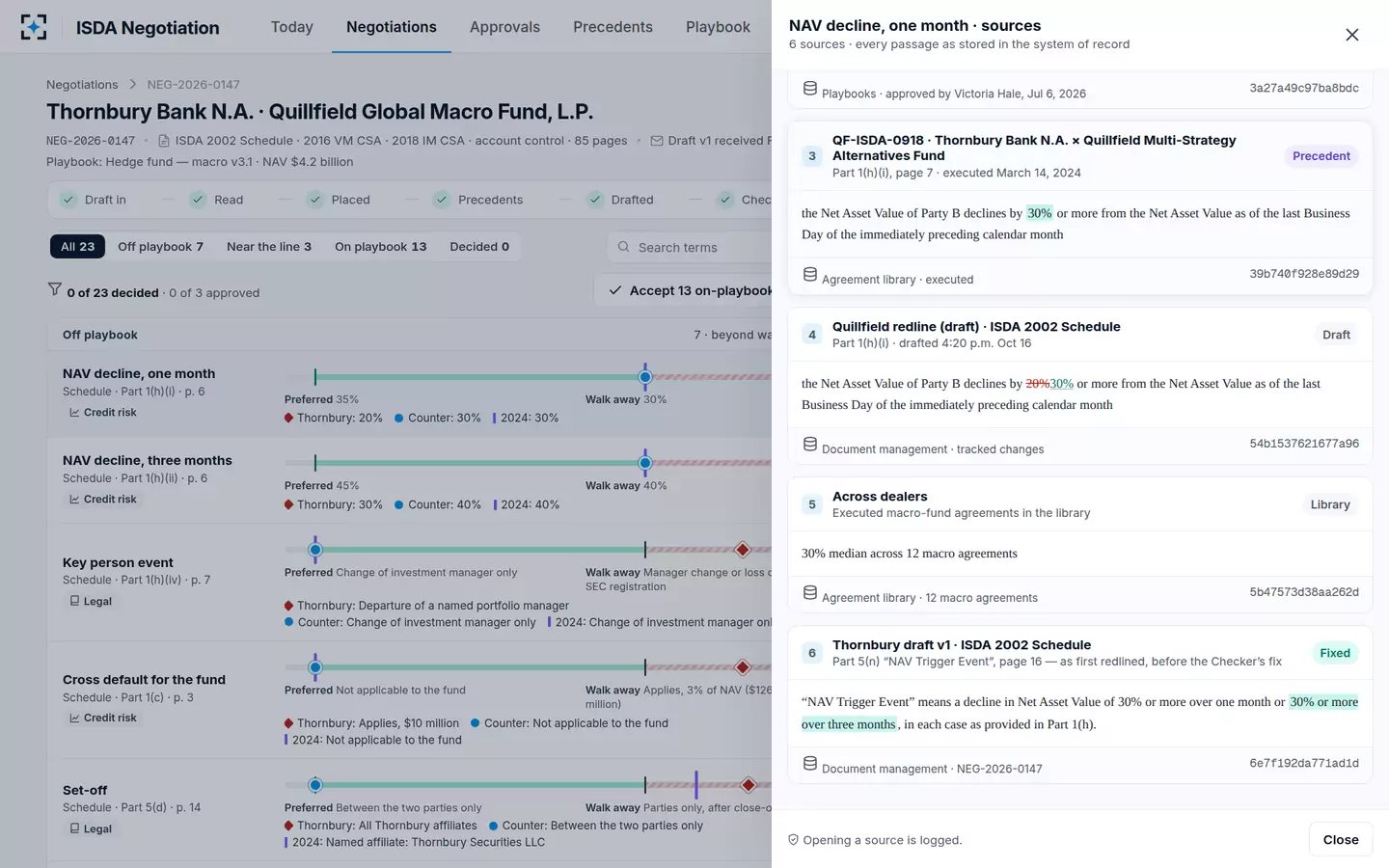
The difference shows on precedent most of all. In the sample case, the agents searched 1,846 executed agreements and anchored six counters on one: the same dealer's 2024 agreement with another of the firm's funds, which had accepted a 30% one-month NAV trigger where the new draft asked 20%. The lawyer opened the source, saw the 2024 wording on page 7, and accepted the counter with the reason code "Matches the dealer's precedent with Quillfield".
Every counter in ISDA Negotiation opens its sources, from the dealer’s own executed agreement
Does ISDA negotiation software replace the industry negotiation platform?
No. The industry negotiation platform carries drafts between firms; negotiation software decides what the fund says in them. In ISDA Negotiation, drafts and new turns come in from legal email, dealer portals, the industry negotiation platform and document management, read-only, and are matched to a fund and a negotiation before anything is read. The released redline goes back the way the fund's lawyers choose.
The same applies to the fund's other systems. Signed agreements are filed in document management; legal entities and dealer limits come from the counterparty database and credit system; fund NAVs and holdings come from portfolio accounting, which is how the sample negotiation knew that a 10-year cap on eligible Treasuries would have stranded $610 million of the fund's $1.84 billion of Treasuries. Software that asks a fund to move its documents into a new repository before it can negotiate will wait a long time for adoption.
How do lawyers come to trust ISDA negotiation software?
Lawyers trust negotiation software when they have checked it against their own work and found it right, and when they can see that it never decides for them. The order matters: first prove the reading on past packages, then use it on live first turns with every decision still manual, then let the routing and the trail carry the approvals. The checklist sets out the steps and what each proves.
Adoption in six steps, and the trust each one earns
- Back-test on past packages
Run dealer drafts the fund has already negotiated; compare the agents’ placements and counters with what its lawyers did. Earns: proof on the fund’s own files.
- Score extraction against the lawyers
For each value, did the cited page say what the software said? Earns: a measured error rate, not a vendor’s claim.
- Live first turns, decisions manual
The agents draft; the lawyer decides every term and edits freely. Earns: lawyers see the reading before relying on it.
- Turn on owner routing
Thresholds to credit, collateral to treasury, exceptions with two names. Earns: approvers see the clause and precedent, not an email.
- Watch overrides
Every person can override an agent with a reason code; read the reasons weekly. Earns: the fund knows where the agents are weak.
- Let the trail carry the audit
Internal audit reads one append-only trail. Earns: the second line trusts it too.
The first two steps are the ones vendors would rather skip. The researchers who tested commercial legal research tools found "the providers' claims are overstated", and that the tools differed substantially "in responsiveness and accuracy" (Magesh et al., 2025). A fund that measures the tool on its own executed agreements, with values its lawyers agree, has a number it can defend; one that relies on a demonstration does not. Broader benchmarks help frame the question but not answer it: LegalBench, whose tasks were written by legal professionals, tests general legal reasoning, not a fund's playbook (Guha et al., arXiv, not peer reviewed; how to measure a legal search tool on ISDA clauses builds the fund's own test).
Supervisors expect the same discipline. The SEC's examiners note that registrants already use generative tools of what the staff call "super intelligence" (SI) for drafting among other work, and say they will check that firms still meet the obligations they already had, which do not depend on the technology (SEC Division of Examinations, Fiscal Year 2027 Examination Priorities, October 2026). FINRA has said the same of its own rules (Regulatory Notice 24-09), and ESMA warns against relying on AI so far that human judgment is set aside (ESMA, 2024). Software that leaves the judgement with the lawyer makes those obligations easier to meet, not harder.
How long does it take to roll out ISDA negotiation software?
Rollout time depends on what the fund already has written down, and no regulator or independent study publishes a benchmark. The inputs that decide it are the fund's playbook memos for each fund type, its clause library, its approval rules and its executed agreements. A fund whose playbook is a set of memos needs them turned into scales, term by term, before any software can place a dealer's term on them.
ISDA Negotiation is built from exactly those inputs and goes live after its quality checks pass, including a back-test on the fund's past negotiations. The sample firm went live in July 2026; its reports on sample data since then show a median of 0.8 business days to a first turn, against 5.0 by hand in 2025. Those are sample-data figures, not a customer's result, and the right expectation for any fund is the one its own back-test produces. Where those days went before is shown in ISDA negotiation delays.
How do you test ISDA negotiation software before buying?
Test it on a past dealer package of your own, against your own playbook and executed agreements, and score it the way your lawyers would. A demonstration on the vendor's documents proves the vendor's documents. A test on a package your lawyers already negotiated shows whether the software finds the terms they found, places them where they would, cites the right pages, proposes the counters they made, and catches the inconsistencies they caught.
Five measures make the test comparable across vendors: the share of negotiated terms found; the share of values that match the cited page; agreement with the lawyers' on, near or off placement; whether the precedent cited was the one the lawyers used; and the inconsistencies the second read found that the lawyers missed, or missed that they found. Add the boundary tests from the ISDA AI tool guide: try to send, try to concede beyond the playbook, ask for the trail. The concessions the test surfaces are also the start of measuring the playbook.
After signature, ISDA Negotiation checks every collateral term before the system is updated
Where ISDA Negotiation fits, and where it does not
ISDA Negotiation fits a fund manager that negotiates ISDAs and credit support annexes with many dealers for several fund types, has or will write a playbook with preferred and walk-away positions, and wants credit risk, treasury and the general counsel's office to approve the terms they own with evidence beside them. It reads ISDA Schedules, variation and initial margin CSAs, account control agreements and local-law masters, and, as the sample firm's intake shows, repo and clearing drafts as well.
It is not a contract repository for every agreement the firm signs, and it does not decide questions of law or business: whether a trade is in scope of a clearing rule, whether a fund should use a dealer at all. It does not replace the fund's lawyers, its playbook or its approvers; it gives them the reading, the precedent and the draft. A fund that negotiates a handful of ISDAs a year with no playbook may get more from writing the playbook first.
ISDA Negotiation’s audit trail: who conceded what, why, and who checked it
Questions people ask
Is ISDA negotiation software the same as contract lifecycle management?
No. Contract lifecycle management covers many kinds of contract across their life; ISDA negotiation software is specialised in negotiating derivatives documentation term by term, against a playbook and precedent, with credit and collateral approvals.
Can ISDA negotiation software handle the uncleared margin documents?
It should, because initial margin terms interact with the Schedule and the variation margin CSA. ISDA Negotiation reads the 2018 IM CSA and the custodian's account control agreement with the rest of the package and flags differences, such as a notification time of 10:00 a.m. in one CSA and 11:00 a.m. in the other.
Who should own ISDA negotiation software inside a fund?
Legal, with the deputy general counsel or head of derivatives documentation as the business owner, because the playbook, exceptions and releases sit there. Credit risk and treasury own their routing rules, and an administrator who cannot approve terms manages settings.
Does ISDA negotiation software work with outside counsel?
It can. In ISDA Negotiation outside counsel see only the negotiations shared with them, and their work goes into the same trail as the fund's own lawyers'.
What does ISDA negotiation software cost?
Vendors don't publish prices, and the right comparison is the fund's own cost of a negotiation: lawyer and approver hours per first turn, turns per agreement, and the value of concessions made under deadline. Measure those first, so any price can be judged against them.