An ISDA Schedule is the document in which two parties to an ISDA Master Agreement make their elections and write their changes to the printed form: whether cross default applies and at what threshold, which extra termination events exist, which entities count, how notices are given, what set-off is allowed. The Master Agreement is a standard form; the Schedule is where a fund's terms with one dealer live, which is why a fund's lawyers spend their time on it, not on the form. Negotiating it is slow because each election belongs to a different owner — credit risk, treasury, legal — and dealers send their own paper. Botminds' ISDA Negotiation exists for that work: its agents read a dealer's Schedule and credit support annexes, place every term on the fund's playbook and draft the redline, and named people decide.
The examples on this page come from a fictional sample firm, Quillfield Capital, as a dealer's draft runs through the solution. The law comes from courts' judgments and regulators' rules, linked where they are used.
What the Schedule decides, in three numbers
23
negotiated terms in one dealer’s sample Schedule and credit support annexes, 7 off the fund’s playbook
fictional sample
80%
of Lehman Brothers Special Financing’s counterparties terminated under the ISDA within five weeks
New York Fed, 2014
$50m
initial margin threshold between two groups, below which a US swap dealer need not collect initial margin
CFTC §23.151
What is an ISDA Schedule?
An ISDA Schedule is the negotiated half of an ISDA Master Agreement: the standard terms stay printed, and the Schedule supplements or varies them. An English judge described the arrangement in one sentence: "the main body of the agreement consists of standard terms which are supplemented or varied by the terms set out in the schedule" (Grant v WDW 3 Investments, 2017). Each trade is then documented in a confirmation that sits under the same agreement.
Economists at the Federal Reserve Bank of New York, writing about the Lehman bankruptcy, put the hierarchy plainly: the Master Agreement and schedule "collectively set forth the fundamental contractual terms of all derivatives transactions that are executed between the parties. Each individual transaction is documented with a confirmation" (Fleming and Sarkar, 2014). One Schedule can therefore govern hundreds of trades, which is why a single badly negotiated election can end all of them at once.
For a fund, the Schedule also carries the terms a dealer asks for because a fund has no credit rating and its capital can leave. Net asset value triggers, key person events and NAV reporting duties are all Schedule terms. None of them is in the printed form.
Why the printed form stays fixed and the Schedule takes the strain
Courts read the printed Master Agreement as a market standard, so parties change it only through the Schedule. The English courts have said the agreements should "so far as possible be interpreted in a way that achieves the objectives of clarity, certainty and predictability, so that the very large number of parties using it know where they stand" (Briggs J, quoted in Lehman Brothers Special Financing v National Power, 2018). A fund that edited the form itself would lose that predictability. A fund that edits through the Schedule keeps it.
There is more than one printed form in use. The High Court noted in 2022 that the 1992 and 2002 versions "share the same basic architecture" and both "continue to be used, depending on the parties' preference" (Grant v FR Acquisitions, 2022). The Schedule's job is the same under both, but some elections exist only under one: a 1992 Schedule must choose a payment measure and method for close-out, a 2002 Schedule does not. The differences are set out clause by clause in ISDA 1992 vs 2002.
What are the parts of the ISDA Schedule?
A Schedule is organised in numbered parts that follow the printed form, and courts cite them by number: Part 1 for termination provisions, Part 3 for documents to be delivered, Part 4 for miscellaneous mechanics such as jurisdiction, Part 5 for other provisions. Nearly all of a fund's negotiation happens in Part 1 and Part 5. The figure takes the four parts that move, with the place a court has recorded each in a real agreement, and the seat that owns the decision.
The ISDA Schedule part by part: what each holds and who decides it
Part 1Termination provisions
What it holdsWhich entities count for default, whether Cross Default applies and at what Threshold Amount, Automatic Early Termination, the close-out election under a 1992 form, Additional Termination Events such as NAV triggers and key person events.
Where a court or the sample shows itPart 1(c) cross default (Grant v WDW 3, 2017); Part 1(e) Automatic Early Termination, Part 1(f) "Loss and Second Method", Part 1(h) a ratings Additional Termination Event (Lehman v Klaus Tschira, 2019).
Who decidesCredit risk sets the numbers; legal sets the words
Part 3Documents to be delivered
What it holdsTax forms, financial information and, for a fund, NAV statements and how fast they arrive.
Where a court or the sample shows itPart 3(b) identified information whose accuracy was represented under Section 3(d) (Dexia v Comune di Torino, 2026). In the sample: Part 3(a) tax forms, Part 3(b) a monthly NAV statement within 15 Business Days.
Who decidesOperations and credit risk
Part 4Miscellaneous
What it holdsAddresses for notices, process agent, jurisdiction and the other mechanics of the relationship.
Where a court or the sample shows itPart 4(h) conferred exclusive jurisdiction on the English courts (Dexia v Comune di Torino, 2026). Notices go "to the address or number provided in the Schedule" (Lehman v National Power, 2018).
Who decidesLegal and operations
Part 5Other provisions
What it holdsEverything the parties write over the printed form: set-off, extra definitions, statements about advice and reliance, the fund’s own riders.
Where a court or the sample shows itPart 5(f) replaced several Events of Default with a "Default under Loan" (Grant v WDW 3, 2017); Part 5(4) and 5(5)(vi) said the bank was not an adviser and was not relied on (Dexia, 2026).
Who decidesLegal, with each term’s owner
The judgments show how much rides on Part 1. In the Klaus Tschira case the parties had agreed in Part 1(e) that Automatic Early Termination applied to both of them, in Part 1(f) that "Loss and Second Method" applied, and in Part 1(h) that a Lehman entity "failing to maintain a certain ratings level would constitute an Additional Termination Event" ([2019] EWHC 379 (Ch)). Two of those lines, Part 1(e) and Part 1(f), later fixed when the swaps ended and how the close-out was measured, and the date of that valuation became one of the main issues the court had to decide.
Part 5 is where the printed form is overwritten. In Grant v WDW 3, a property company's Schedule switched off several standard Events of Default and substituted a "Default under Loan" tied to its bank facility. When the loan went unpaid on 30 June 2014, that single Part 5 line let the bank terminate the swaps and claim an early termination payment of £6,324,214.50 ([2017] EWHC 2807 (Ch)).
Which ISDA Schedule elections matter most for a fund?
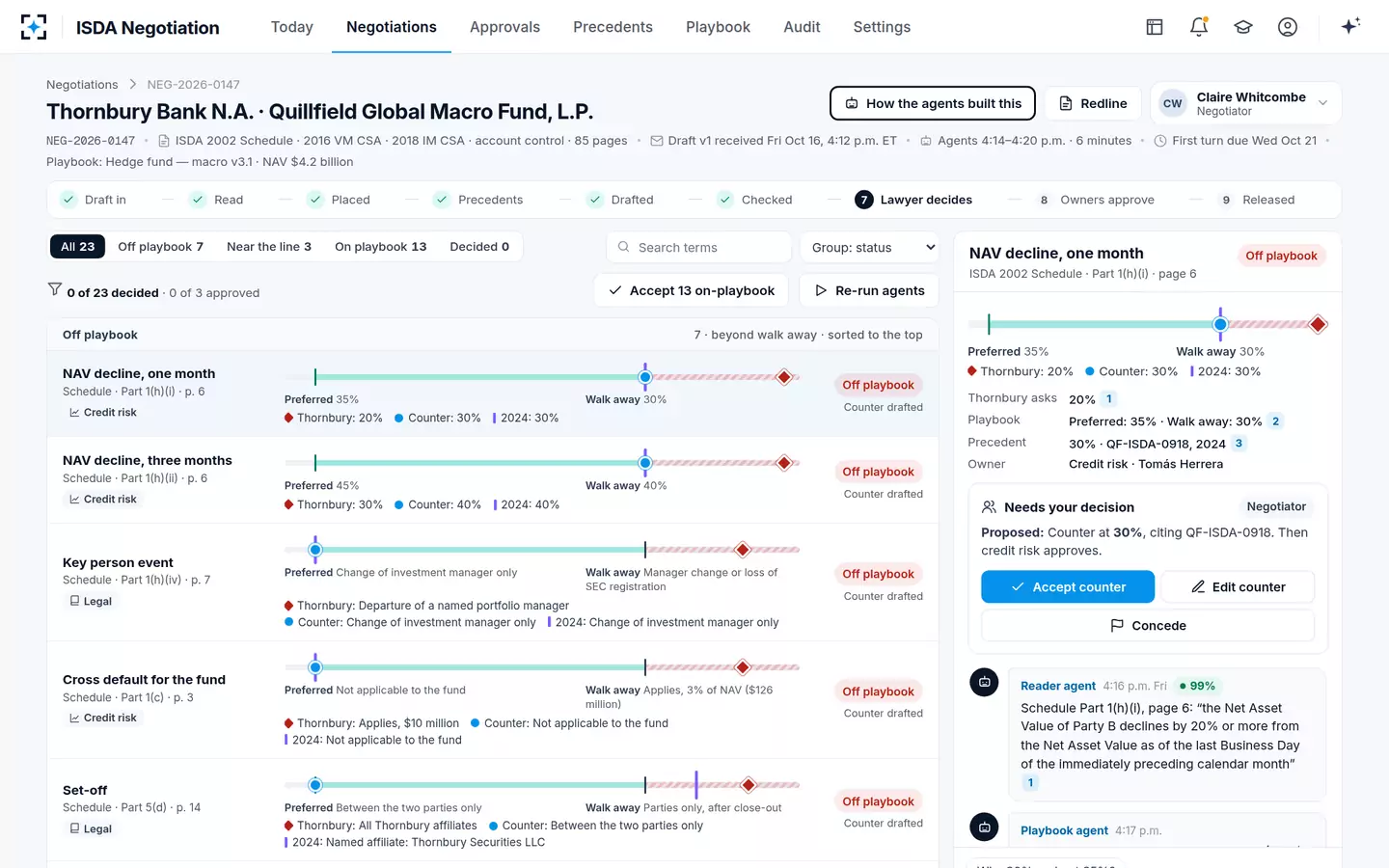
The elections that matter most are the ones that let a dealer end every trade with the fund: Additional Termination Events, Cross Default and its Threshold Amount, Automatic Early Termination, and the scope of set-off. A wrong word in the notices clause costs a day; a wrong number in Part 1 can close out a portfolio in a bad month. The sample draft below shows how a dealer's first draft looks to a fund's playbook.
Seven of 23 terms in one dealer’s draft sat beyond the fund’s walk-away
| Term and place | Dealer’s draft | Fund’s playbook (preferred · walk away) | Owner |
|---|---|---|---|
| NAV decline, one month · Part 1(h)(i) | 20% | 35% · 30% | Credit risk |
| NAV decline, three months · Part 1(h)(ii) | 30% | 45% · 40% | Credit risk |
| Key person event · Part 1(h)(iv) | Departure of a named portfolio manager | Change of investment manager only · manager change or loss of SEC registration | Legal |
| Cross default for the fund · Part 1(c) | Applies, $10 million | Not applicable to the fund · applies at 3% of NAV | Credit risk |
| Set-off · Part 5(d) | All dealer affiliates | Between the two parties only · parties only, after close-out | Legal |
| Independent amount · VM CSA Paragraph 13 | 8% on FX options | None | Credit risk |
| Eligible collateral · VM CSA Paragraph 13 | US Treasuries up to 10 years | Cash and Treasuries of all maturities | Treasury |
Two things stand out. First, five of the seven are credit terms, and credit terms are numbers that a lawyer should not set alone; who owns which election is the subject of who decides ISDA credit terms. Second, the eligible-collateral line lives in the credit support annex, not the Schedule, yet it moves money as directly as anything in Part 1: in the sample, the fund held $1.84 billion of Treasuries and $610 million of them matured after ten years, so a 10-year cap would have made a third of its Treasuries ineligible.
Where do additional termination events go in the Schedule?
Additional Termination Events go in Part 1 of the Schedule, or in a confirmation for a single trade. The Court of Appeal described Section 5(b) of the Master Agreement as listing Termination Events "including at sub-section (v) any “Additional Termination Event” specified in the Schedule to the ISDA agreement or in any Confirmation" (Lomas v JFB Firth Rixson, 2012). The printed form provides the slot; the Schedule fills it.
For funds, the usual entries are a decline in net asset value over one, three and twelve months, the departure of a key person or a change of investment manager, and a failure to deliver NAV statements. Each is worded as a Termination Event rather than an Event of Default, which matters: the European Central Bank observed in a 2007 study of hedge fund triggers that termination events, unlike events of default, generally do not set off cross-defaults in a fund's agreements with third parties. How dealers set NAV triggers, and what the central bank research says about how well they work, is the subject of NAV triggers in an ISDA.
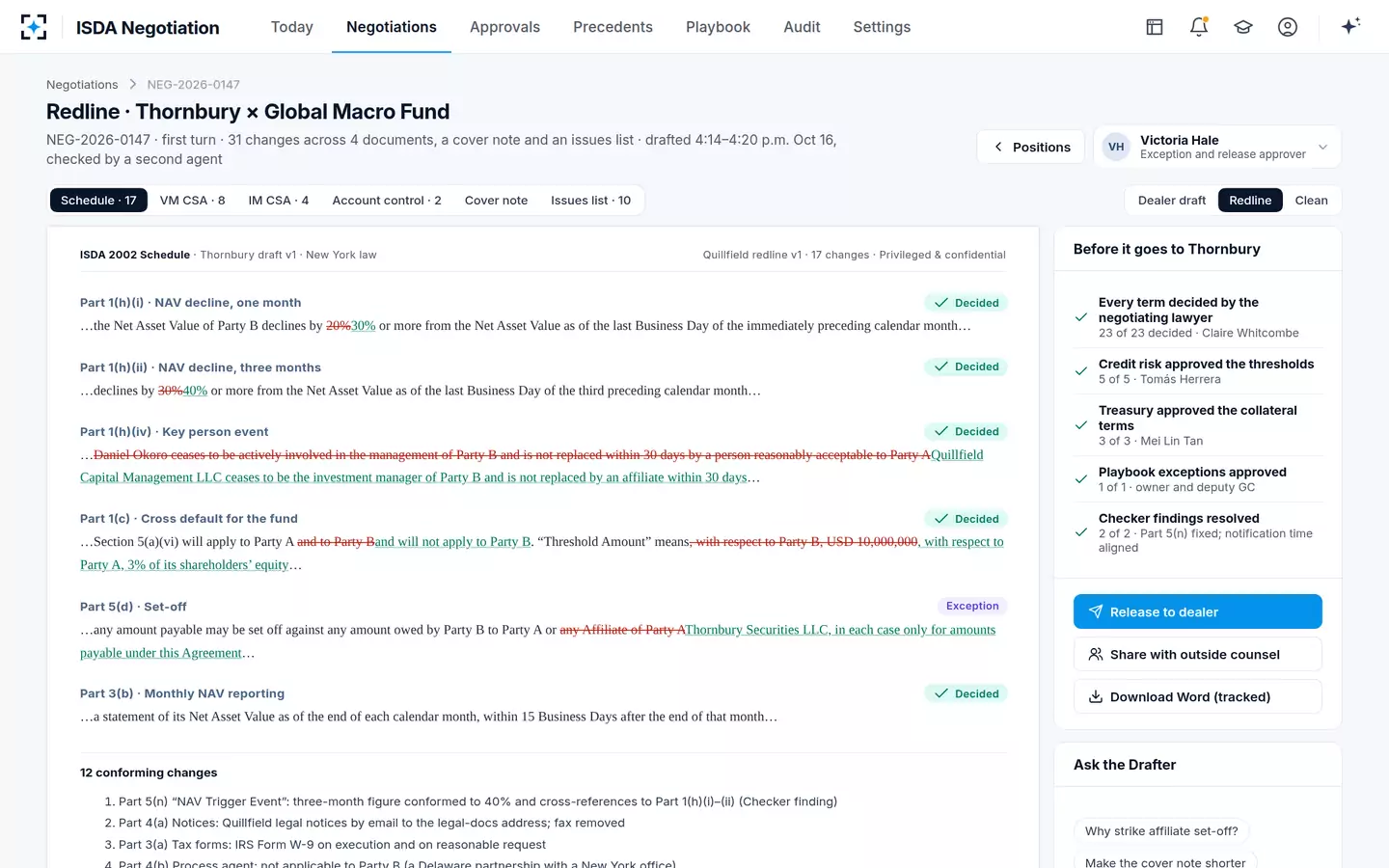
The numbers inside those events need more care than the words. A trigger can be undone by its own definition: in the sample draft, the agents' blind second read found that the defined term "NAV Trigger Event" in Part 5(n) still said 30% over three months after the counter in Part 1(h)(ii) had moved to 40%. Left alone, the definition would have reinstated the dealer's number.
What must swap trading documentation include under CFTC rules?
For a US swap dealer, the CFTC requires written trading relationship documentation covering a fixed list of terms, signed before or with the first trade. The rule says it "shall include all terms governing the trading relationship ... including, without limitation, terms addressing payment obligations, netting of payments, events of default or other termination events, calculation and netting of obligations upon termination, transfer of rights and obligations, governing law, valuation, and dispute resolution", and it must be executed "prior to or contemporaneously with entering into a swap transaction" (17 CFR 23.504). The SEC applies the same list to security-based swaps (17 CFR 240.15Fi-5).
In the EU and the UK, the margin rules for uncleared derivatives make the same demand of both counterparties, not just the dealer. The terms must be agreed "at the latest, at the moment in which a non-centrally cleared OTC derivative contract is concluded, including the terms of the netting agreement and the terms of the exchange of collateral agreement" (Delegated Regulation 2016/2251, Article 2, as it applies in the UK; the EU text is the same).
What US and EU rules require a swap agreement to settle before the first trade
CFTC §23.504 (US swap dealers): "payment obligations, netting of payments"
Regulation 2016/2251, Article 2 (EU and UK counterparties): "any payment obligations arising between counterparties"; "the conditions for netting payment obligations"
CFTC §23.504 (US swap dealers): "events of default or other termination events"
Regulation 2016/2251, Article 2 (EU and UK counterparties): "events of default or other termination events"
CFTC §23.504 (US swap dealers): "calculation and netting of obligations upon termination"
Regulation 2016/2251, Article 2 (EU and UK counterparties): "all calculation methods used in relation to payment obligations"; "the conditions for netting payment obligations upon termination"
CFTC §23.504 (US swap dealers): "transfer of rights and obligations"
Regulation 2016/2251, Article 2 (EU and UK counterparties): "the transfer of rights and obligations upon termination"
CFTC §23.504 (US swap dealers): "governing law"
Regulation 2016/2251, Article 2 (EU and UK counterparties): "the governing law of the transactions"
CFTC §23.504 (US swap dealers): "valuation, and dispute resolution"; a valuation process and an alternative or a dispute process
Regulation 2016/2251, Article 2 (EU and UK counterparties): Calculation of margins and valuation of collateral, in the exchange of collateral agreement (Article 3)
CFTC §23.504 (US swap dealers): "prior to or contemporaneously with entering into a swap transaction"
Regulation 2016/2251, Article 2 (EU and UK counterparties): "at the latest, at the moment in which a non-centrally cleared OTC derivative contract is concluded"
The lists explain why the Schedule cannot be left half-done while trading starts. Termination events, close-out calculation and governing law are all Schedule or Master Agreement terms, and the dealer is the party that must prove they were settled first. The US rule also makes the dealer have its documentation policies and procedures audited periodically, by an independent internal or external auditor, for material weaknesses (§23.504(c)), so a dealer's documentation team works under its own audit as it negotiates with the fund. Once signed, the same terms have to be found again under pressure, which is where additional termination events and where they hide picks up.
How does the credit support annex relate to the Schedule?
The credit support annex is the collateral agreement that hangs off the Schedule: the Schedule names it as a credit support document, and it governs margin under the same Master Agreement. The CFTC lists what those "credit support arrangements" must contain: initial and variation margin requirements; "types of assets that may be used as margin and asset valuation haircuts"; investment and rehypothecation terms; and custodial arrangements, including segregation with an independent third party (§23.504(b)(3)).
Where a dealer must exchange margin under the uncleared margin rules, the documentation must also "Specify the methods, procedures, rules, inputs, and data sources to be used for determining the value of uncleared swaps", describe how initial margin is calculated, and specify how valuation disputes are resolved (17 CFR 23.158). Initial margin must sit with a custodian under an agreement that "Prohibits the custodian from rehypothecating, repledging, reusing, or otherwise transferring" it (§23.157), which is why an in-scope fund signs an account control agreement with its custodian alongside the initial margin CSA.
The rules also set the outer limits of two numbers that funds negotiate. The minimum transfer amount "shall be $500,000" as a combined cap for initial and variation margin, and initial margin need not be exchanged up to an initial margin threshold of "$50 million" across both groups (§23.151). Within those limits, the figures are commercial. The sample fund's playbook held minimum transfer amounts at $250,000, inside the cap.
The CSAs and the Schedule must agree with each other, and frequently do not. In the sample package, the variation margin CSA set the notification time at 11:00 a.m. and the initial margin CSA at 10:00 a.m. Neither number was wrong on its own; together they would have given treasury two clocks for one margin call. The EU and UK rule lists "the procedures for notification, confirmation and adjustment of margin calls" among the terms the collateral agreement must hold (Article 3), so a mismatch is a drafting defect, not a style point.
ISDA Negotiation places every Schedule and CSA term on the fund’s playbook
Why the Schedule's terms must be in systems, not only in a signed PDF
A Schedule matters most on the day nobody planned for, and on that day the terms have to be found in minutes. When Lehman failed, "Out of more than 900,000 trades, 733,000 were automatically terminated by November 13, 2008", and "About 80 percent of the derivatives counterparties to Lehman Brothers Special Financing (LBSF) terminated their contracts under the ISDA Master Agreement within five weeks" (Fleming and Sarkar, 2014). Settlement took far longer: "only 6 percent of ISDA contracts had been settled by July 2009, with this number rising slowly to 46 percent by September 2010."
US banking supervisors draw the conclusion for dealers. A banking organisation "should ensure proper control of (and access to) legal documentation and agreements, incorporating accurate legal terms and provisions into its systems infrastructures. Significant credit losses can occur if a counterparty questions a contract's appropriateness" (Federal Reserve SR 11-10). A fund has the mirror-image problem: the thresholds, triggers and collateral terms it agreed must reach its own risk and collateral systems exactly as signed.
That last step is where small differences hide. In a second sample agreement, the agents compared a signed initial margin CSA with the collateral system field by field and found one difference: a 96% valuation percentage for Treasuries over ten years in the signed document against 94% in the system, which had come from a template default. Nothing was written to the system until treasury checked it.
How ISDA Negotiation reads a dealer's ISDA Schedule
ISDA Negotiation treats the Schedule as a list of decisions, each with an owner. The agents read the dealer's Schedule and CSAs clause by clause and cite each term to its page; place it on the fund type's playbook from preferred to walk away; find what the same dealer accepted for the firm's other funds; and draft the redline, which a second agent re-reads blind. In the sample, a 38-page Schedule, two CSAs and an account control agreement, 85 pages in all, were read and the redline drafted in six minutes.
What the agents do not do is decide. The negotiating lawyer decides each term; credit risk approves thresholds and NAV triggers; treasury approves collateral terms; any concession beyond the playbook needs the term owner and the deputy general counsel; and only the deputy general counsel releases a turn to the dealer. The redline below is what she sees before she does.
The Schedule redline ISDA Negotiation drafts, with the checks before release
Questions people ask
Is the ISDA Schedule the same as the credit support annex?
No. The Schedule amends and completes the Master Agreement; the credit support annex is the separate collateral agreement under it. US rules list the CSA's subjects separately, as "credit support arrangements" covering margin, eligible assets and haircuts, rehypothecation and custody (17 CFR 23.504(b)(3)).
Can a Schedule change the printed Master Agreement?
Yes, and that is its purpose. Courts describe the main body as standard terms "supplemented or varied by the terms set out in the schedule". In Grant v WDW 3, Part 5(f) of the Schedule switched off several standard Events of Default and put a loan default in their place.
What is the Threshold Amount in an ISDA Schedule?
It is the size of other debt in default that triggers Cross Default under Section 5(a)(vi), and it is "specified in the Schedule". It can be a dollar figure or a percentage of equity, and it can differ for each party; how to set the cross default threshold works through the choice.
What is Automatic Early Termination, and should a fund elect it?
Automatic Early Termination is a Part 1 election under which certain bankruptcy events end every trade at once, without a notice. Without it, the Court of Appeal noted in Lomas, the non-defaulting party chooses whether to end the trades, by a notice of not more than 20 days. The election buys certainty on insolvency at the price of a close-out timed by the event, not by either party.
How long is a typical ISDA Schedule?
No regulator or independent study publishes a typical length, and dealers' forms vary. The sample dealer's ISDA 2002 Schedule ran to 38 pages, with a 14-page variation margin CSA, a 22-page initial margin CSA and an 11-page account control agreement.
Does every derivatives counterparty need a Schedule?
Every uncleared swap with a US swap dealer needs written trading relationship documentation signed before or with the first trade (17 CFR 23.504). In practice that is usually a Master Agreement with a Schedule; the sample firm also negotiates a German-law master with one bank, and cleared swaps are outside the rule.