An additional termination event (ATE) is a termination right that the parties add to an ISDA Master Agreement, usually in Part 1 of the Schedule, on top of the termination events the printed form already contains. It is where a dealer writes the risks particular to a fund, such as a fall in net asset value or the loss of the investment manager, and where a fund writes the dealer's credit rating. Because ATEs are negotiated one agreement at a time and later moved by amendments, side letters and handwritten changes, an estate's ATEs are scattered across hundreds of documents, and the list a risk team needs on a bad morning cannot be read from the printed form. Botminds' Derivatives Documentation Search reads every agreement in the estate, finds each additional termination event wherever it is written, applies the latest amendment and cites it to its clause and page.
The worked examples use the solution's fictional sample estate: Quillfield Capital's 61 master agreement families with the Hollins Brothers Bank group. The legal rules and court decisions are real and linked.
Where additional termination events hide, and what to read with each
Rating downgrade of the dealer or its guarantor
Usually written inSchedule, Part 1 termination provisions
Read with itAmendment agreements that move the level; the definition of the rating agencies counted
In the sample estateSchedule Part 1(h)(ii), p. 7; moved by Amendment §2.1 (2023)
Decline in the fund's net asset value
Usually written inSchedule, Part 1, beside the fund's other events
Read with itSide letters that waive or reset a test; the fund administrator's NAV dates
In the sample estateSchedule Part 1(h)(iii): 25% in 1 month, 35% in 3, 50% in 12
Change or departure of the investment manager or key persons
Usually written inSchedule, Part 1, or an amendment signed when the fund changed adviser
Read with itAssignment and novation letters; the fund's own offering documents for definitions
In the sample estate—
Rating clause in a local-law master
Usually written inThe annex to a German or French master, in the original language
Read with itHandwritten changes initialled at signing
In the sample estateRahmenvertrag Anhang Nr. 4(1), p. 4, "BBB-" struck to "BBB"
Rating-linked collateral terms (not a termination right)
Usually written inCredit support annex elections, usually Paragraph 11 or 13
Read with itLater annexes that replace earlier ones for new trades only
In the sample estateCollateral threshold zero below A-, Paragraph 11(b)(iii)
What is an additional termination event?
An ATE is a contractual event, chosen by the parties, that lets one party end some or all transactions early without the other party having defaulted. The printed ISDA form already carries standard termination events, such as the illegality and force majeure events that the 2002 form's Section 6(b)(i) refers to; an ATE adds the risks the printed form does not know about. The court in Macquarie Bank v Phelan Energy described a 1992-form agreement in which the parties had supplemented the termination events "by an additional termination event for 'Russian market events', with both parties being treated as affected parties" ([2022] EWHC 2616 (Comm), at [49], describing an earlier case). The example shows what an ATE really is: a bespoke clause, with its own trigger, its own choice of who is affected and its own measure of what is paid.
For a dealer under US swap rules, these clauses are not optional extras in the file. The swap trading relationship documentation must cover every term of the trading relationship, and the rule lists defaults, termination events and the calculation and netting of amounts on termination among them (17 CFR 23.504(b)(1); how those terms are elected in the first place is in the ISDA Schedule elections a fund negotiates). A fund's counterparties therefore hold these terms in writing; the question for the fund is whether it can find its own copy of them, as amended, in an hour.
Additional termination event vs event of default: what changes
An event of default is a failure by a party, such as non-payment or insolvency; a termination event, including an ATE, is a change in circumstances that need not be anyone's fault. The difference decides who may terminate, which transactions end and what the notice must say. On an event of default the non-defaulting party may terminate everything. On a termination event, rights belong to the party that is not the "Affected Party", and the notice under Section 6(b)(i) of the form must specify, in the court's summary, "the nature of [a Termination Event other than a Force Majeure Event] and each Affected Transaction" ([2022] EWHC 2616 (Comm), at [22]).
Event of default or additional termination event: five differences that change the morning
Event of default: A party failed: missed a payment, breached the agreement, became insolvent.
Additional termination event: A negotiated circumstance arose: a rating cut, a NAV fall, a manager left.
Event of default: The non-defaulting party.
Additional termination event: The party that is not the Affected Party, as the Schedule defines it for that event.
Event of default: All outstanding transactions under the agreement.
Additional termination event: The Affected Transactions, as the Schedule defines them for that ATE.
Event of default: The event of default relied on.
Additional termination event: The nature of the termination event and each Affected Transaction.
Event of default: Mostly in the printed form, Section 5(a).
Additional termination event: Almost entirely in the Schedule, its amendments and side letters.
The last row is the one that matters for search. Events of default live mostly in the printed text every agreement shares, so a lawyer can recite them. ATEs live almost entirely in the negotiated text, which is different in every agreement and changes over time, so nobody can recite them for an estate of sixty families. That is the work the solution exists to do.
What are common additional termination events for funds?
The ATEs a fund sees most are the ones a dealer uses to watch a counterparty that has no credit rating: falls in net asset value over one or more periods, a change of investment manager, the departure of named key persons, breaches of the fund's own leverage or investment limits, and failure to deliver NAV statements on time. The fund's own ATEs against a dealer are usually rating triggers on the dealer or on the guarantor that supports it. No regulator or independent study publishes how often each kind appears or at what levels, so the useful exercise is to count your own estate, which the solution does from the documents.
The ATEs a fund's estate usually holds, and the trap in each
| ATE | What it measures | Where the number comes from | The trap |
|---|---|---|---|
| NAV decline | Fall in the fund's net asset value over one month, three months, twelve months | The fund administrator's NAV, by fund entity | Tests run on different dates and different bases; a redemption-driven fall may be carved out in a side letter |
| Investment manager change | Replacement or removal of the adviser named in the Schedule | Advisory agreements and novation letters | An internal reorganisation can trip it if the named entity changes |
| Key person | Departure of named individuals | The Schedule's list of names, often amended | The list in force is the last amendment's, not the original's |
| Dealer rating downgrade | The dealer's or guarantor's long-term rating | Agency ratings, as the Schedule defines them | Any one agency or the lower of two; "below BBB-" and "below BBB" fire at different notches |
| Information failure | Late delivery of NAV statements or financial reports | Delivery dates in the Schedule's documents clause | A grace period may sit in a different part of the Schedule |
The rating trap deserves a sentence of its own. A trigger written as "below BBB-" does not fire on a cut to BBB-; "below BBB" does. In the sample estate, that one notch is the difference between six terminable Hollins agreements and nine. How to read a whole estate's rating triggers in the hour after a downgrade is the subject of the guide to downgrade triggers.
Where are additional termination events written?
In the Schedule first, and then in every document that has changed the Schedule since. A fund's ATEs start in Part 1 of the Schedule, under the termination provisions, but by the time anyone needs them they may have been moved by an amendment agreement, suspended or reset by a side letter, or altered by hand on the executed copy. Local-law masters, such as a German Rahmenvertrag or a French FBF master agreement, carry the equivalent clauses in their own annexes and in their own language. The map at the top of this page sets out where each kind usually sits; the sample estate shows each failure in practice.
Take three Hollins agreements. The Global Macro Fund's rating trigger is where you would expect it, in Schedule Part 1(h)(ii) on page 7. The Absolute Return Bond Fund's is in the same place in the Schedule, but the words there are no longer the words in force: section 2.1 of an amendment of 14 March 2023 replaced them. The Euro Rentenfonds trades under a German Rahmenvertrag, whose rating clause is Anhang Nr. 4(1) on page 4, where "BBB-" was typed, struck by hand and replaced with "BBB", initialled by both parties at signing. A search over Schedules finds one of the three correctly.
Are additional termination events in the Schedule or the CSA?
Termination rights are in the Schedule; the credit support annex holds collateral terms, some of which also move on a rating. A CSA election such as a threshold that drops to zero when a party falls below A- changes how much collateral must be posted, not whether anyone may terminate. The two are often confused because both react to the same rating action, and on a downgrade morning the risk team needs both answers: which agreements may be terminated, and which collateral calls the downgrade will produce. They are different questions about different documents, and an inventory that merges them will answer neither well.
Failing to post collateral the annex requires is another matter: that becomes a failure under the agreement itself and can lead to an event of default, with its own notice and grace period. Close-out arithmetic once either kind of right is exercised is covered in what a missed amendment costs at close-out.
Who can terminate on an additional termination event?
The party that is not the Affected Party, as the Schedule defines the Affected Party for that event. A rating ATE on the dealer names the dealer as the Affected Party and gives the fund the right; a NAV ATE names the fund and gives the dealer the right. Where the Schedule treats both parties as affected, as in the Russian market events clause the court described, the right and the valuation work differently again, which is why the Schedule's wording, not the label, decides.
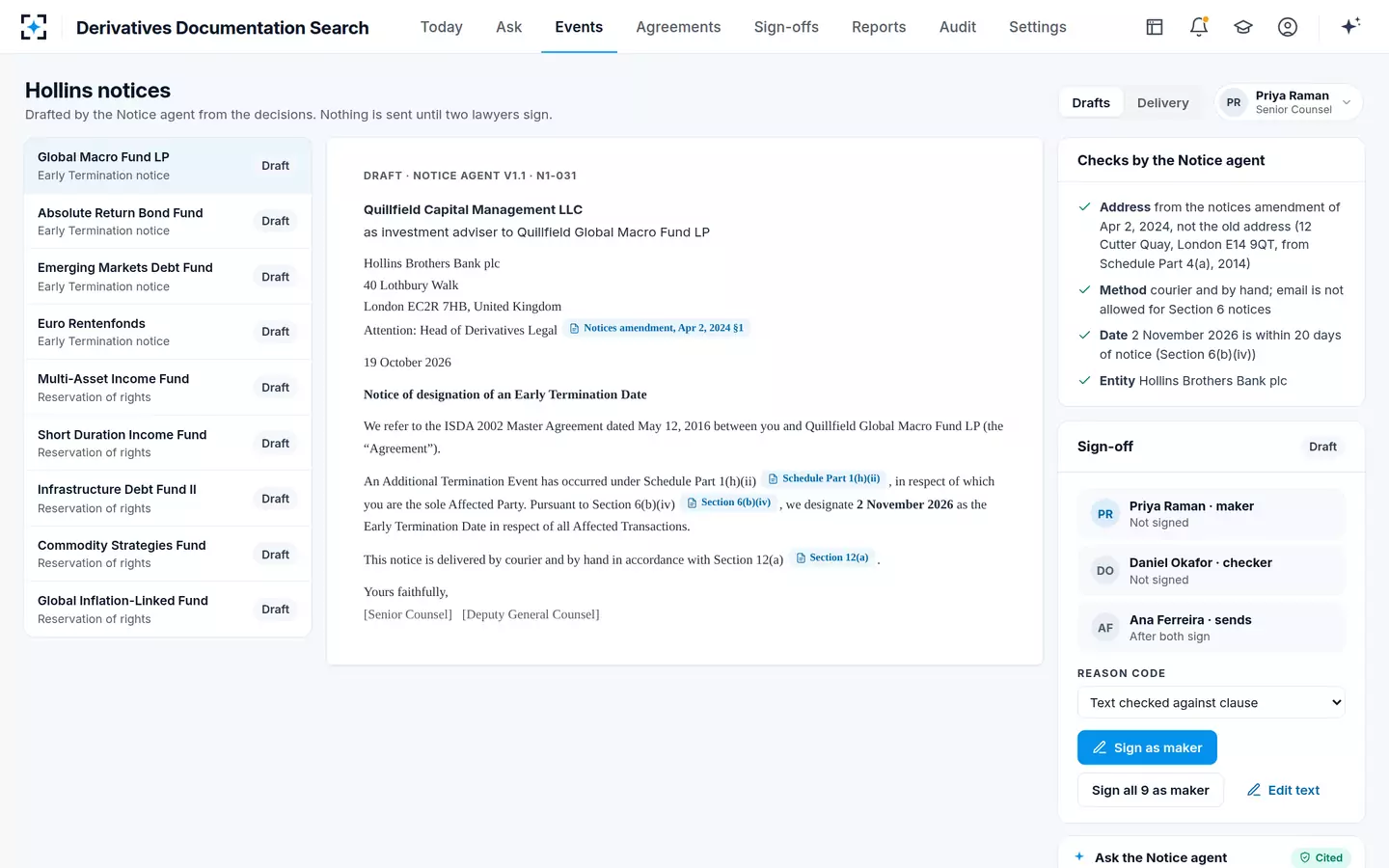
In the sample estate the Notice agent drafts the designation for the Global Macro Fund as the form requires: an additional termination event "has occurred under Schedule Part 1(h)(ii), in respect of which you are the sole Affected Party", and Quillfield designates an Early Termination Date of 2 November 2026 in respect of all Affected Transactions. Every reference in the draft is cited to the clause it relies on, and nothing is sent until two lawyers have signed.
The ATE, the Affected Party and the address, each traced to its clause in the draft notice
How do you list every additional termination event you have?
You read every agreement family to the end of its chain, record each ATE with the page that sets it today, and say where you looked when you find none. Supervisors expect the same discipline of banks. Among the close-out practices the interagency guidance expects is periodic review of the documents that govern termination:
"Requirements for periodic review of documentation related to counterparty terminations, and confirmation that appropriate and current agreements that specify the definition of events of default and the termination methodology that will be used are in place."
Interagency Supervisory Guidance on Counterparty Credit Risk Management (SR 11-10, revised June 2026)
"Current" is the operative word. An inventory built at signing and never re-read is an inventory of the 2014 Schedules. The checklist below is the method the solution follows, written so a team can run it by hand on one dealer group and compare.
Six steps to an ATE inventory you can use on the day
- Start from the counterparty group, not the folder
Every fund entity against every dealer entity, matched by legal entity name and LEI, including guarantors and credit support providers.
- Read Part 1 of every Schedule and every local-law annex
In the original language; keep the English reading beside it, never instead of it.
- Apply amendments, side letters and handwritten changes in date order
Show the original wording struck through beside the term in force, with the amending document cited.
- Record the trigger as written, not as summarised
"Below BBB-" and "below BBB" are different triggers; "any one agency" and "the lower of two" are different definitions.
- Separate termination rights from rating-linked collateral terms
Two columns, two questions; both matter on the same morning.
- When an agreement has no ATE of a kind, say where you looked
An empty cell with no search trail is indistinguishable from a missed clause.
Why a question nobody set up a field for still gets an answer
Most ATE inventories fail on the question nobody anticipated. An abstract built at signing has fields for the termination events someone thought of then; a new risk, such as a cyber attack treated as force majeure or a manager change after an acquisition, has no field, so the abstract has nothing to say. The solution's Planner turns a plain-language question into a reading plan instead, and the Reader reads every planned document for the clause; where the question is ambiguous, the Planner asks before reading.
The Planner asks which reading of 'below investment grade' to use before a single page is read
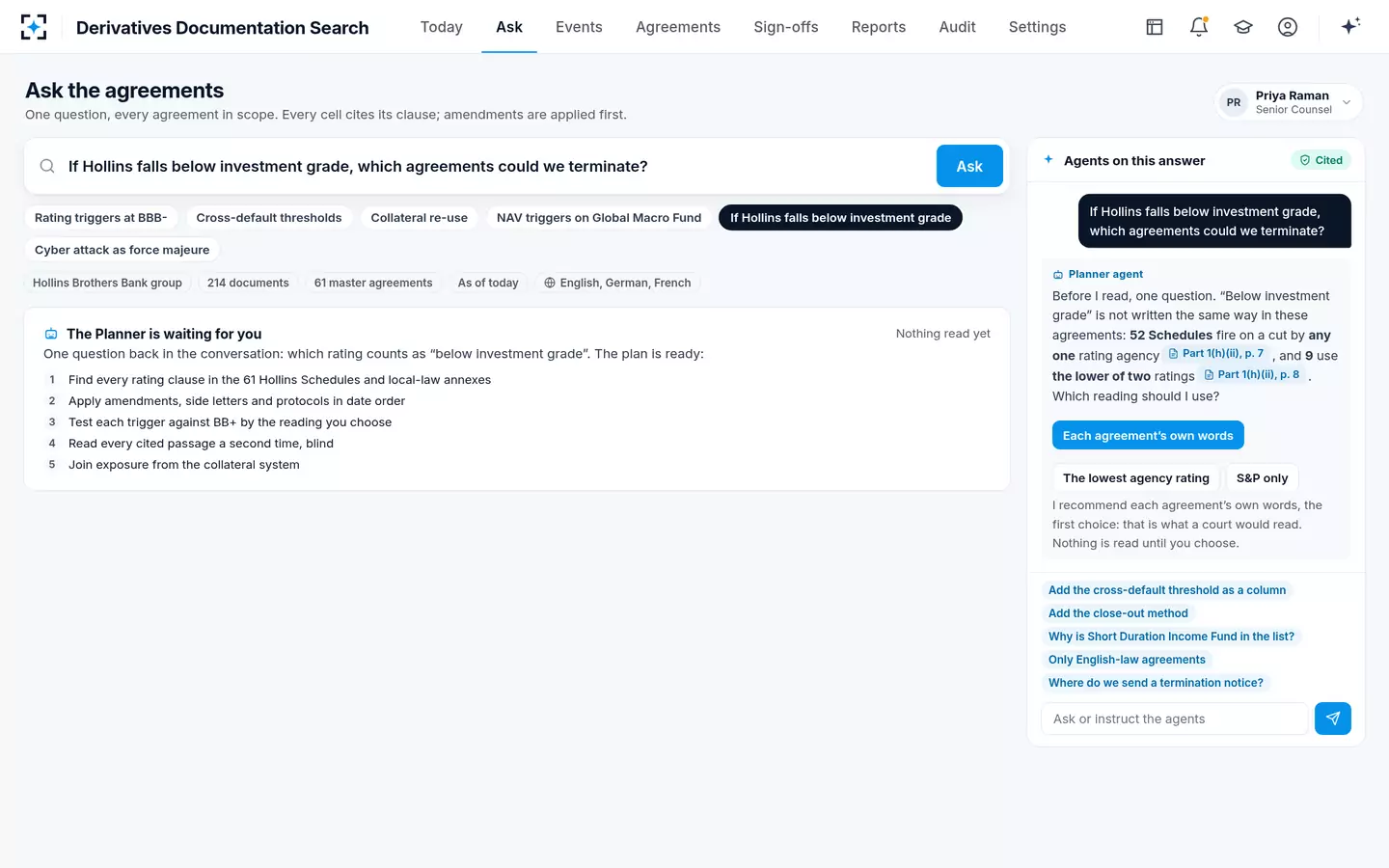
That design matters for ATEs because their wording is the whole of their meaning. A system that guessed "below investment grade" meant one agency's scale would return a confident list that a court would not recognise. One that asks, and then reads each agreement in its own words, returns the list counsel can sign. Start from Derivatives Documentation Search to see the inventory on the sample estate.
Questions people ask
Are additional termination events negotiated?
Yes. They are the most negotiated part of the termination provisions, because the printed form has no events for a fund's NAV, its manager or a dealer's rating. Each agreement's set therefore differs, and the levels in force are often those of a later amendment rather than the original Schedule.
What is an Affected Party under the ISDA?
It is the party to which a termination event relates, as the agreement defines it for that event. For a rating ATE on the dealer, the dealer is the Affected Party and the fund holds the right to terminate. Some ATEs treat both parties as affected, which changes who may terminate and how the payment is measured.
Can an additional termination event apply to only some transactions?
It can, if the Schedule says so. The Schedule defines the Affected Transactions for each ATE; most fund ATEs are written to cover all transactions under the agreement, but some are limited to a product or a fund. A notice must identify each Affected Transaction, so the definition has to be read before the notice is drafted.
Does an ATE terminate the agreement automatically?
Not as normally drafted. An ATE gives the non-affected party a right to designate an Early Termination Date by notice; nothing ends until that notice is effective. Choosing not to terminate is also a decision, often taken with a reservation-of-rights letter so the right is not lost by delay.
Is every termination event an additional termination event?
No. The printed form's own termination events, such as illegality, apply to every agreement without negotiation. Additional termination events are the ones the parties add in the Schedule or later documents, which is why they differ from agreement to agreement and have to be read rather than assumed.