A downgrade trigger is a clause in a derivatives or financing agreement that changes a party's rights when the other party's credit rating falls: in an ISDA Schedule it is usually an additional termination event that lets one side terminate, and in a credit support annex it is usually a threshold that falls and turns into a collateral call. When a dealer is cut, legal, counterparty risk and treasury need one answer within hours: which agreements let us terminate, at what level, with what exposure and what notice. The answer is spread across every Schedule, amendment and local-law annex with that dealer group. Botminds' Derivatives Documentation Search reads all of them as soon as the rating feed reports the cut, applies the latest amendments, and returns every agreement with its trigger as amended, cited to its clause and page, before the morning's risk call.
Every example below is from the solution's fictional sample: on Monday 19 October 2026 at 7:42 a.m. the rating feed reports Hollins Brothers Bank plc cut from BBB to BBB-, and Quillfield Capital, which trades with the Hollins group through 63 fund entities, has 61 master agreement families to read. The regulatory and enforcement figures are real and linked.
Why the answer is needed in hours, not days
$5.5B
approximate losses Credit Suisse suffered in 2021 from the default of one fund counterparty
$268.5M
Federal Reserve fine, July 2023, for that bank's counterparty credit risk management
4 hours
the supervisory benchmark for a bank to aggregate counterparty exposures
3 notches
the downgrade banks must assume when sizing collateral calls from rating triggers
What is a downgrade trigger? Two clauses, two consequences
A downgrade trigger is any contract term that bites on a rating action, and it comes in two forms that answer different questions. A termination trigger, written as an additional termination event in the Schedule, decides whether a party may end the agreement. A collateral trigger, written as a rating-dependent threshold or independent amount in the credit support annex, decides how much collateral must move. Bank regulators size the second kind for liquidity: the Basel standard notes that "contracts governing derivatives and other transactions have clauses that require the posting of additional collateral, drawdown of contingent facilities, or early repayment of existing liabilities upon the bank's downgrade by a recognised credit rating organisation", and requires banks to hold liquid assets against "any downgrade up to and including a 3-notch downgrade" (Basel Framework, LCR40.51). The US rule counts "100 percent of all additional amounts of collateral" a bank "could be contractually required to pledge" as a result of a change in its financial condition (12 CFR 249.32(f)(1)).
Termination trigger or collateral trigger: what each does on the morning of a cut
Termination trigger (Schedule): Whether the non-affected party may designate an Early Termination Date.
Collateral trigger (credit support annex): How much collateral the downgraded party must post, and sometimes how fast.
Termination trigger (Schedule): The party holding the right decides whether to terminate; nothing happens unless it gives notice.
Collateral trigger (credit support annex): Collateral moves on the next call; no decision is needed to start it.
Termination trigger (Schedule): Which agreements let us terminate, and should we?
Collateral trigger (credit support annex): Which calls will we make or receive, and how large?
Termination trigger (Schedule): Derivatives legal, with counterparty risk deciding.
Collateral trigger (credit support annex): Treasury and collateral operations.
Termination trigger (Schedule): Reading the original Schedule and missing the amendment that moved the level.
Collateral trigger (credit support annex): Using the collateral system's abstract after the annex was amended.
The two forms feed each other, and the worst failures happen when they do. The Congressional Oversight Panel's account of AIG in 2008 describes the loop: valuation write-downs and collateral calls "intensified pressure on AIG's own credit rating", and "Subsequent downgrades of AIG's credit rating in turn precipitated additional collateral calls" (Congressional Oversight Panel, June 2010). A fund on the other side of a dealer's downgrade is not in that loop, but it does hold the choice the loop forces on everyone else: terminate, reserve rights, or wait.
Which agreements let us terminate if a dealer is downgraded?
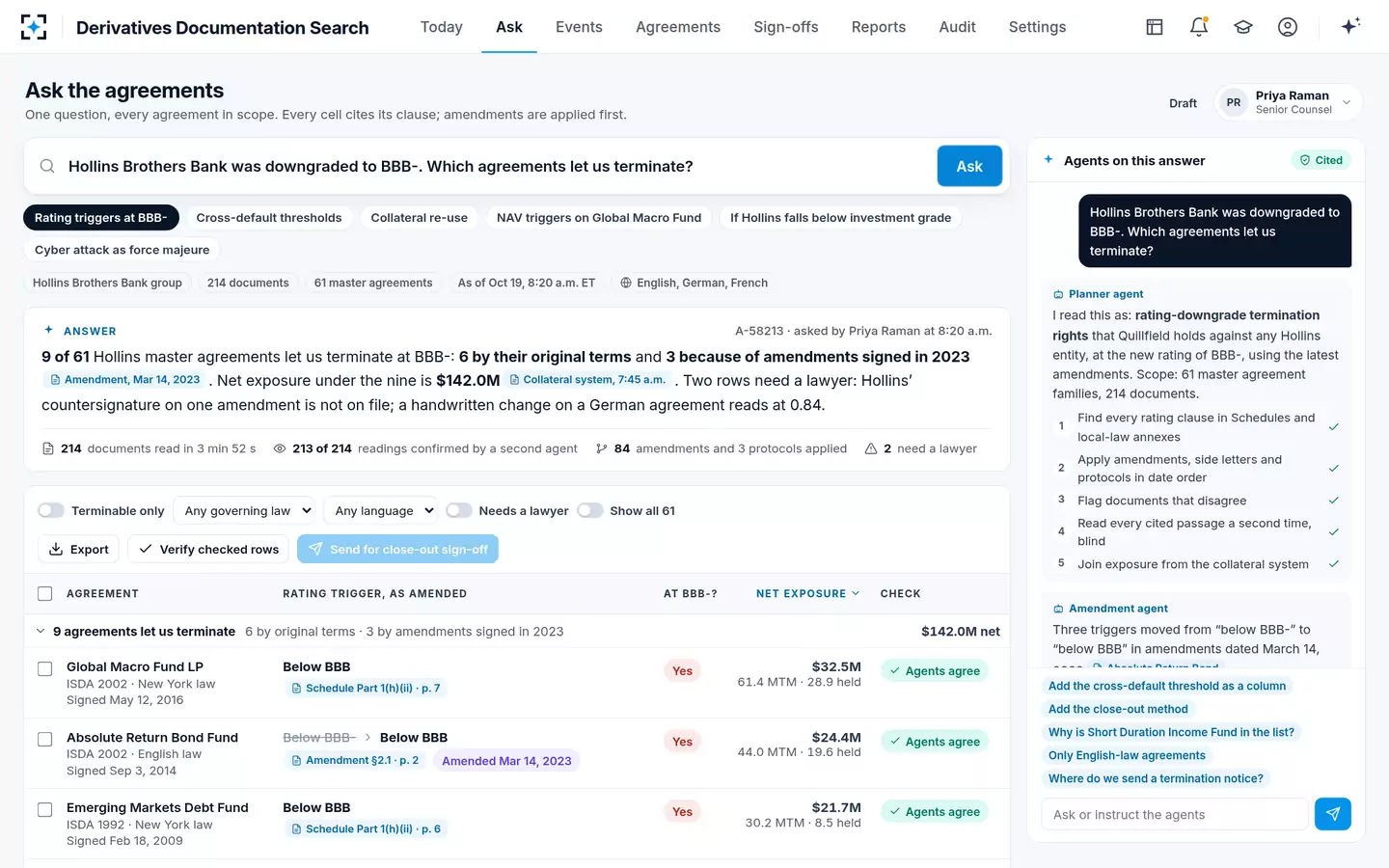
Only those whose trigger, as amended, is set at or above the new rating, and only if the clause counts the agency that made the cut. Everything else about the morning depends on getting that list right. In the sample estate, the cut to BBB- splits Hollins' 61 agreement families into four groups.
A cut to BBB- makes 9 of 61 agreements terminable; the next notch would add 15
The bars show why "how exposed are we to Hollins?" is the wrong first question. Total net exposure across the three groups is $311.4 million by our sum, but only $142.0 million sits under agreements Quillfield can act on today. Another $33.4 million becomes actionable one notch lower, and $105.7 million is under agreements with no rating trigger at all, where the fund's protection is collateral and the ordinary events of default. A risk call that sees one total sees none of those choices.
Every Hollins agreement in one grid, the trigger as amended and the clause behind it
How fast do you need the downgrade trigger answer?
Before the decisions are due, which on a downgrade morning means hours. Supervisors put a number on the related task for banks: among sound close-out practices, the interagency guidance lists "Standards for the speed and accuracy with which the banking organization can compile comprehensive counterparty exposure data and net cash outflows", and adds: "Operational capacity to aggregate exposures within four hours is a reasonable standard." (SR 11-10 guidance). Exposure without the agreements behind it cannot be acted on, so the legal answer has to arrive inside the same window.
By hand, it does not. The solution's own estimate for one question across the 61 Hollins families is about 30 minutes a family, about 30 hours, or four lawyer-days of about 7.5 hours: pulling every document, reading Schedule elections and local-law masters, applying amendments in order, checking execution, joining exposure and getting a second lawyer's sign-off. That is the time a risk team usually spends waiting.
From the rating feed to approved decisions in 87 minutes, on the sample morning
- Event opened, answer ready7:42–8:20
- Lawyer reviews, verifies8:20–8:41
- Approved8:53
- Decisions9:05–9:09
The shape of the top lane matters more than its length. The agents' reading takes minutes; the remaining hour and a half is people doing what only people should do: a lawyer deciding the two rows the agents could not settle, a second lawyer approving the answer, counterparty risk recording a decision for each agreement, and the Deputy General Counsel approving those decisions.
What happens if an amendment changed the downgrade trigger?
Then the amendment decides, and an answer built from Schedules is wrong. In the sample estate, three Hollins agreements are terminable at BBB- only because an amendment of 14 March 2023 moved their triggers from "below BBB-" to "below BBB". The grid shows the struck-through original beside the amended level and cites the amendment, so the lawyer reviewing the row sees why it is on the list.
One of the three amendments has a gap: Quillfield signed it, and Hollins' signature page is not in the document store. The agents found a countersigned scan in the email archive, but they do not decide whether it is good enough. They state the consequence of each choice instead. Accept the countersignature and the answer is nine agreements and $142.0 million; reject it and the answer is eight and $130.8 million. Senior counsel decides, with a reason code, before anything reaches the Deputy General Counsel. How amendment chains are rebuilt for every agreement is the subject of the guide to ISDA amendment chains.
What does "below investment grade" mean in an ISDA Schedule?
Whatever that Schedule says it means, which is not the same in every agreement. Some triggers fire when any one named agency cuts below the level; others use the lower of two ratings, or count only long-term, unsecured, unsubordinated ratings, or include a withdrawal of the rating. The sample's German Rahmenvertrag, for instance, lets either party terminate if the other's long-term, unsecured and unsubordinated rating "is downgraded below BBB ... or withdrawn". A list built on one agency's scale answers a question no agreement asked.
So when Senior Counsel asks the what-if, "If Hollins falls below investment grade, which agreements could we terminate?", the solution's Planner reads nothing until she chooses how to read the phrase, and recommends each agreement's own words, "that is what a court would read". On that reading the answer is 24 of 61 agreements and $175.4 million net, with the 15 new ones all written as "below BBB-", each re-read blind by the Checker.
Do QFC stay rules limit a downgrade trigger?
Not a trigger tied to the dealer's own rating as such; they limit default rights tied to a bank group entering resolution. Under the Federal Reserve's rules, a covered qualified financial contract may not let a party use a default right because an affiliate of its counterparty has entered receivership, insolvency, liquidation, resolution or a similar proceeding (12 CFR 252.84(b)(1); how to set the cross default threshold explains what that does to a fund's cross-default clause). After an affiliate's failure, the contract must also put the burden of proof on the party exercising a default right and set a standard of "Clear and convincing evidence or a similar or higher burden of proof".
The practical consequence for a downgrade morning is timing. A cut that comes with, or turns into, a resolution brings the stay period, which runs from the start of the proceeding to the later of "5:00 p.m. (eastern time) on the business day following" its commencement and "48 hours after the commencement of the proceeding". US swap documentation already warns of it: a dealer's documentation must state that, if either party is a covered financial company or an insured depository institution in FDIC receivership, "certain limitations" under Title II of the Dodd-Frank Act or the Federal Deposit Insurance Act "may apply to the right of the non-covered party to terminate, liquidate, or net any swap" (17 CFR 23.504(b)(5)(iii)). Knowing which agreements are amended by a stay protocol is therefore part of the downgrade answer, not a footnote to it.
What did the Archegos losses show about counterparty risk?
That a counterparty's risk can grow faster than the controls watching it, and that the price is measured in billions. The Federal Reserve's order against Credit Suisse records that "In 2021, Credit Suisse suffered approximately $5.5 billion in losses because of the default of Archegos, an investment fund", and that the bank "failed to adequately manage the risk posed by Archegos despite repeated warnings"; the fine was $268.5 million (Federal Reserve, 24 July 2023). The SEC's 2022 complaint alleged how far the exposure ran: Archegos grew from about $1.5 billion "with $10 billion in exposure in March 2020" to "more than $36 billion with $160 billion in exposure at its peak in March 2021", and the SEC alleged it "repeatedly and deliberately misled many of Archegos's counterparties about Archegos's exposure" (SEC press release 2022-70).
Archegos is the dealer's side of the problem this page addresses from the fund's side: a counterparty deteriorating while the people holding termination and margin rights work out what those rights are. Supervisory guidance describes the control that answers both sides:
"Maintain systems that track and monitor changes in credit terms and have triggers for relevant factors, such as net asset value, credit rating, and cross-default."
Interagency Supervisory Guidance on Counterparty Credit Risk Management (SR 11-10)
A system that tracks triggers needs the triggers as they stand today, which is why a rating feed alone is not enough. The solution watches the rating feed and, when an agency acts, opens a counterparty event and reads the affected agreements as amended. It can also keep a what-if as a standing watch: the sample's Planner offers to save the BB+ scenario as a watch on the rating feed.
From the answer to a decision: terminate, or reserve rights
The list of terminable agreements is not a decision to terminate. Termination crystallises exposure, ends hedges and can damage a relationship, so many firms decide agreement by agreement against a written rule. The sample firm's rule D1 proposes designating an Early Termination Date where net exposure is $15 million or more, and a reservation-of-rights letter otherwise. On the Hollins answer that proposes designation on four agreements ($97.2 million) and reservation of rights on five ($44.8 million).
A decision per agreement, proposed by the firm's rule, recorded by counterparty risk
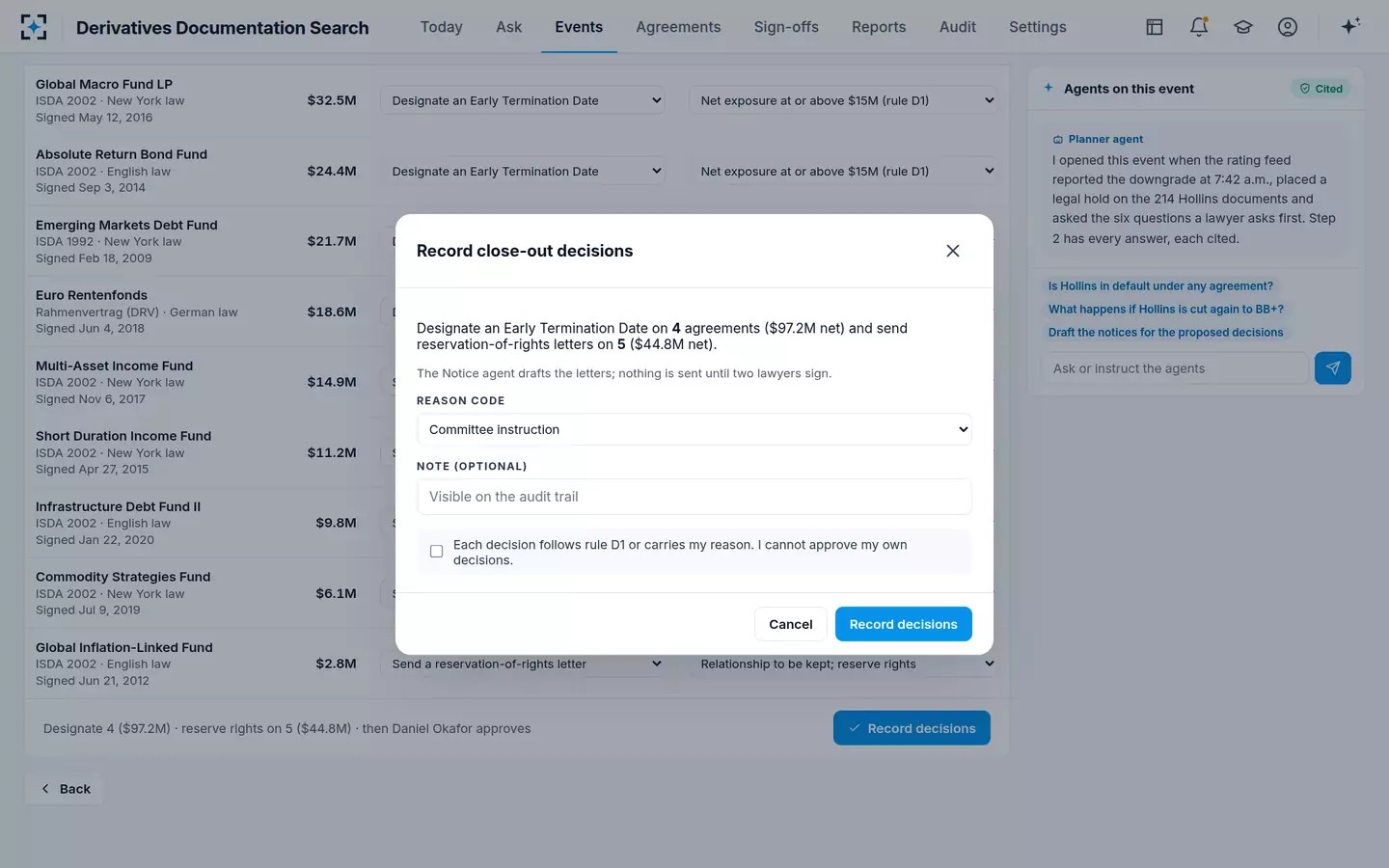
The decisions then become notices, and notices are where a correct answer can still fail: wrong address, wrong method, wrong date. The guide to ISDA termination notices takes the four designations from here. To run the downgrade question on your own agreements, start from Derivatives Documentation Search.
Questions people ask
What is a rating trigger in a credit support annex?
It is a collateral term that changes with a party's rating, such as a threshold that falls to zero, or an independent amount that rises, when the rating drops below a set level. It produces a larger collateral call rather than a termination right. In the sample annex the collateral threshold for the dealer is zero below A-.
Does a downgrade trigger fire on a negative outlook or a watch?
Only if the clause says so. Most triggers refer to the rating itself being downgraded below a level, and some add a withdrawal of the rating, as the sample German clause does. Outlooks and watches matter for planning the what-if, not for the trigger, unless the wording includes them.
Is a downgrade trigger an event of default?
No. It is normally an additional termination event: nobody has failed to perform, and the party holding the right may choose whether to use it. The notice must describe the termination event and the affected transactions, which differs from an event-of-default notice.
Which rating agency counts for a downgrade trigger?
The agencies the Schedule names, in the way it names them: any one of them, the lower of two, or a specific agency. The same cut can therefore trip one agreement with a dealer and not another. The only safe answer reads each agreement's definition.
Should we terminate every agreement a downgrade makes terminable?
Not necessarily. Termination ends hedges and turns exposure into a claim, so firms often decide by exposure and relationship. The sample firm's rule designates where net exposure is $15 million or more and sends reservation-of-rights letters on the rest, every decision recorded with a reason and approved by a second person.