Derivatives documentation is the set of legal agreements under which a firm trades over-the-counter derivatives and related financing, from ISDA Master Agreements and their Schedules to credit support annexes, confirmations, amendments, protocol adherence letters, repo and prime brokerage agreements, and the work of negotiating, executing, keeping, reading and reporting from them. After signing, the work splits four ways: derivatives lawyers say what the documents mean, counterparty risk decides what to do with that meaning, treasury knows where the collateral sits, and operations keeps the terms reconciled and reported to regulators. The hard part is the handoffs, because one question on a bad morning crosses all four. Botminds' Derivatives Documentation Search reads the whole estate for each question and gives every seat the same cited answer, with exposure shown only to the roles entitled to it and every decision signed by a different person from the one who prepared it.
The roles and examples below follow the solution's fictional sample firm, Quillfield Capital, on the morning its dealer Hollins Brothers Bank is cut to BBB-. Regulatory and labour figures are real and linked.
Five seats one counterparty question crosses, and what each keeps
Today
Pages through Schedules and amendments family by family on a downgrade morning, building the table at night.
With agents
Asks once and gets every agreement in a cited grid with amendments applied; spends the morning on the rows that need judgment.
Still theirs: Verifying each row; the reason for every judgment call; signing as maker.
Today
Signs close-out decisions from a spreadsheet built overnight.
With agents
Approves the answer and then the decisions, where every value opens its clause and the preparer could not approve.
Still theirs: Approval of close-out answers and decisions; changes to thresholds and rules.
Today
Waits on legal, then joins exposure by hand before the 10 a.m. call.
With agents
Opens an event room with exposure per agreement and a decision proposed by the firm's rule.
Still theirs: Recording each decision with a reason; approval belongs to the Deputy General Counsel.
Today
Waits on legal to learn which dealers may re-use posted collateral or could pull lines.
With agents
Sees re-use terms and amounts by annex, and tests NAV-decline triggers at a chosen fall.
Still theirs: Collateral movements and funding decisions.
Today
Waits days for legal to answer "what does the annex say?"
With agents
Asks in plain words and gets every agreement in a cited column, without exposure he is not entitled to.
Still theirs: Reconciliation, reporting fields and corrections, each checked by a second person.
What is derivatives documentation?
It is everything that defines the legal relationship behind a firm's derivatives trades, and it is larger than the master agreement. For a swap dealer, US rules require the trading relationship documentation to include all terms governing the relationship, all confirmations, and credit support arrangements, and require the dealer to keep it and "make them available promptly upon request to any representative of the Commission or any applicable prudential regulator" (17 CFR 23.504(d)). A fund's own estate mirrors its dealers': every relationship has a master, a Schedule, usually one or more annexes, confirmations for each trade, and years of amendments and protocol letters on top.
What is OTC derivatives documentation?
It is the same estate seen from the trade: the bilateral agreements for products not traded on an exchange, as opposed to the clearing and exchange terms behind listed futures and cleared swaps. The term also covers local-law masters, which matter more than their number suggests. The EU's derivatives reporting rules give them their own codes, alongside the ISDA: "DERV" for the German Rahmenvertrag, "FMAT" for the French FBF master, and codes for Spanish, Swiss and other masters (Implementing Regulation (EU) 2022/1860). In the sample estate, German and French masters sit in the same counterparty families as the ISDAs and have to be read in the original.
What does a derivatives documentation specialist do?
Keeps the estate complete, current and consistent with the systems that depend on it. In practice that means tracking execution until both signatures are in, filing each executed document in its agreement family, keeping abstracts of key terms, reconciling those terms with the collateral and trading systems, and answering the operations questions that do not need a lawyer. The regulatory calendar adds fixed work. Under US rules a swap dealer must reconcile its portfolio with a buy-side counterparty "Once each calendar quarter for each swap portfolio that includes more than 100 swaps" and "Once annually" for smaller ones (17 CFR 23.502(b)(3)); in the EU, financial counterparties with 500 or more uncleared contracts outstanding with each other reconcile "each business day" (Delegated Regulation (EU) No 149/2013, Article 13, as adopted in 2013).
Disputes have their own clocks. A US swap dealer must notify regulators of a valuation dispute "in excess of $20,000,000" not resolved within "Five (5) business days" when the counterparty is not a dealer (17 CFR 23.502(c)). EU financial counterparties must report disputes "for an amount or a value higher than EUR 15 million and outstanding for at least 15 business days" (Article 15, as adopted in 2013). A dispute is often a documentation question in disguise: which annex, which threshold, which valuation terms, as amended.
Who decides on termination of a derivatives agreement?
Not the person who read the agreement, and not alone. Legal establishes that a right exists; counterparty risk decides whether to use it; a senior lawyer approves; operations executes. Supervisors expect the sequence to be written down. Among close-out practices, the interagency guidance lists "The sequence of critical tasks, and decision-making responsibilities, needed to execute a close-out" (SR 11-10 guidance).
The sample firm writes it as maker and checker at each step. Senior counsel prepares and verifies the close-out answer and the Deputy General Counsel approves it; the Head of Counterparty Risk records a decision for each terminable agreement, by the firm's net-exposure rule or with a reason, and the Deputy General Counsel approves those decisions; only then can notices be signed, by two lawyers, and sent by legal operations. Nobody can approve what they prepared, and administrators cannot sign at all.
Every item has a maker and a different checker
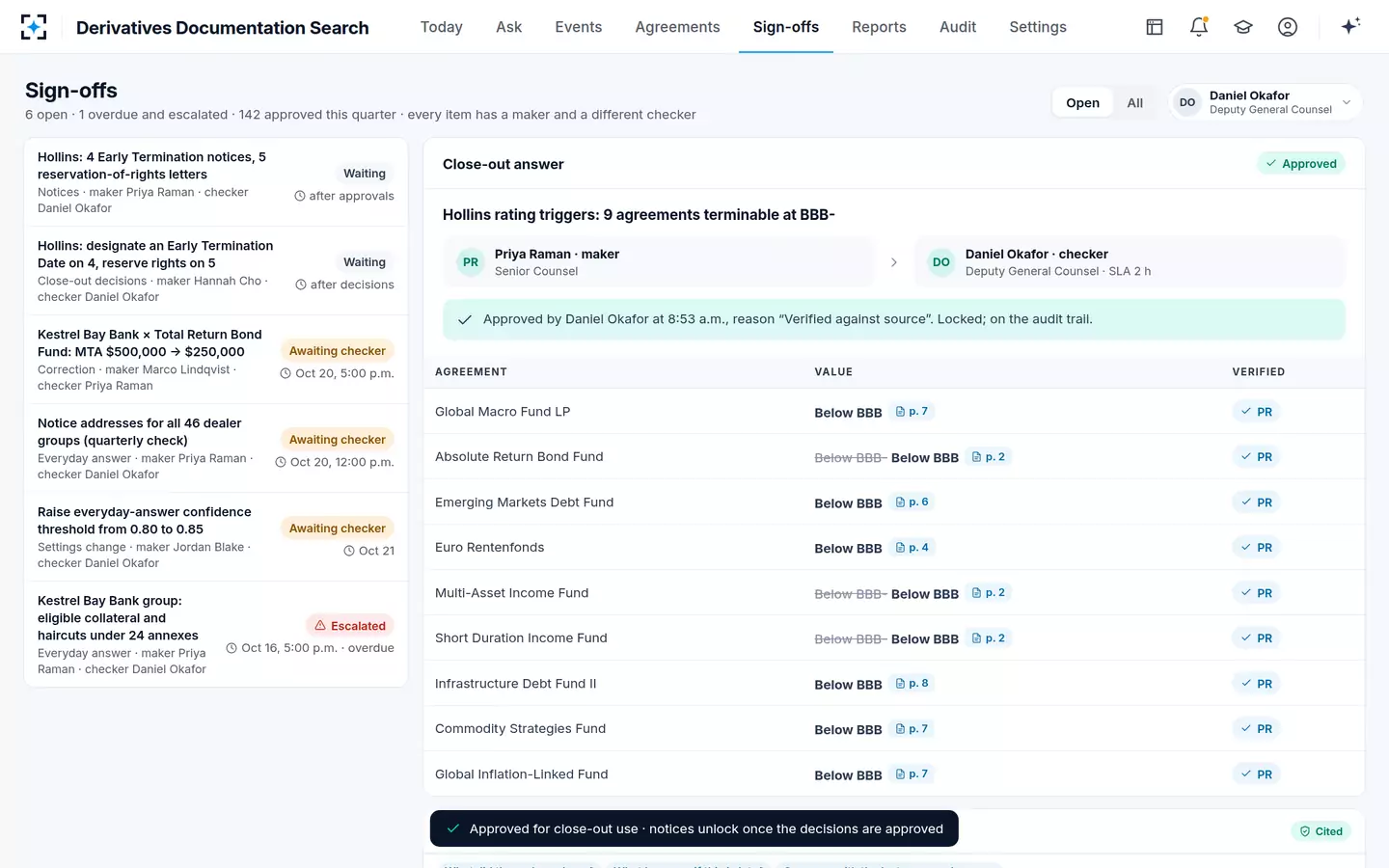
How do legal, risk and treasury split derivatives documentation work?
By question. Legal owns "what does the agreement say, as amended?", risk owns "what should we do about it?", treasury owns "where is the collateral and what moves next?", and operations owns "is what we hold, report and reconcile consistent with what was signed?". The split fails at the joins: risk waiting for legal's table, treasury waiting for legal's reading of re-use, operations waiting days for an answer that is one sentence long. In the sample, a derivatives operations analyst asks a dozen questions of legal a week; with the solution he asks the agreements directly, sees the clause and its citation, and sees no exposure figures, because exposure is shown only to derivatives legal, counterparty risk and treasury.
Where one counterparty question's four lawyer-days go, and the third of a day that remains
By hand: about 4.0 lawyer-days
- Pulling documents · 17.5%
- Reading elections · 32.5%
- Applying amendments · 22.5%
- Exposure · 10%
- Checks and sign-off · 17.5%
With the solution: about 0.3 lawyer-days
- Reading flagged rows · 33.3%
- Checks and sign-off · 66.7%
What regulatory reporting depends on derivatives documentation?
More than most firms map. Trade reports carry fields that can only be filled correctly from the documents, and a wrong field is a reporting error with its own clock. EU rules require counterparties to report the "Reference to the master agreement type under which the counterparties concluded a derivative" and the "Reference to the year of the master agreement relevant to the reported trade" (Delegated Regulation (EU) 2022/1855, Annex), applying from 29 April 2024, and a collateralisation category for each trade or portfolio.
Reporting fields a trade report takes from the documents, and where each is read
| Field | What the rule requires | Where the answer is in the documents |
|---|---|---|
| Master Agreement type (EU) | A four-letter code: ISDA, DERV, FMAT, GMRA, GMSL, BIAG and others, or OTHR with a name | The executed master, not the trading system's product label |
| Master Agreement version (EU) | "ISO 8601 date in the format YYYY" | The form year: 1992 or 2002 for an ISDA, or the local master's edition |
| Collateralisation category (EU) | One of nine codes, from UNCL (uncollateralised) to FLCL (fully collateralised), with one-way and partial variants | Which annexes exist, for which party, with which thresholds, as amended |
| Collateral portfolio code (EU) | A code linking trades margined together as one portfolio | Which trades fall under which annex |
| Corrections (US swap data) | Errors corrected "within seven business days after discovery" | The documents that show the reported value was wrong |
The collateralisation category shows why reporting is a documentation question. The codes distinguish, for example, "OWC1 = one way collateralised: counterparty 1 only" from "PRC1= partially collateralised: counterparty 1 only" (ITS 2022/1860), and which applies depends on the annexes in force and their thresholds, which amendments change. In the US, a reporting counterparty that "by any means becomes aware of any error" must correct it, and "In all cases, errors shall be corrected within seven business days after discovery" (17 CFR 45.14). An amendment nobody linked to its master can therefore become a reporting error as well as a legal one.
How much do derivatives lawyers and paralegals earn?
Government statistics do not separate derivatives specialists, so the nearest measures are the occupations as a whole. In May 2025 the Bureau of Labor Statistics put lawyers' median annual pay at $159,670 and that of paralegals and legal assistants at $62,890; who decides ISDA credit terms shows how the negotiating seat shares its decisions with credit risk and treasury.
The legal seats are expensive, and the paralegal bench is not growing
$159,670
median annual wage for lawyers, May 2025
863,700
lawyer jobs in the United States in 2025
5%
projected growth in lawyer employment, 2025 to 2035
$62,890
median annual wage for paralegals and legal assistants, May 2025
For a manager the arithmetic is simple: four lawyer-days per counterparty question is a large share of a small, expensive team, spent on the mechanical part of the job. Moving that part to agents leaves the team its judgment work, which is also the part that most needs experience.
What skills does derivatives documentation work need?
Precision about words, discipline about versions, and a habit of proving rather than assuming. The checklist below is what the sample firm asks of the people in these seats, and the same standard the agents are held to.
Six habits of a good derivatives documentation team
- Read the words, not the label
"Below BBB-" and "below BBB" are different triggers; "any one agency" and "the lower of two" are different definitions.
- Read to the end of the chain
Master, Schedule, annexes, amendments, side letters, protocols and initialled changes, in effective-date order.
- Prove execution
Both signature pages, or a countersigned copy matched page for page; anything less goes to a senior lawyer.
- Read local-law masters in the original
With the English reading beside the German or French text, never instead of it.
- Cite everything
Every value to its document, clause and page; where there is no clause, say where you looked.
- Never approve your own work
A different person checks every answer, decision and correction, with a reason on the trail.
The solution's home screen for senior counsel shows how those habits look when agents do the reading: the event the agents opened two minutes after the downgrade, the five items that need her by deadline, and an ask box over the whole estate of 1,184 documents and 46 dealer groups.
Senior counsel's morning: what the agents read, and what needs her by deadline
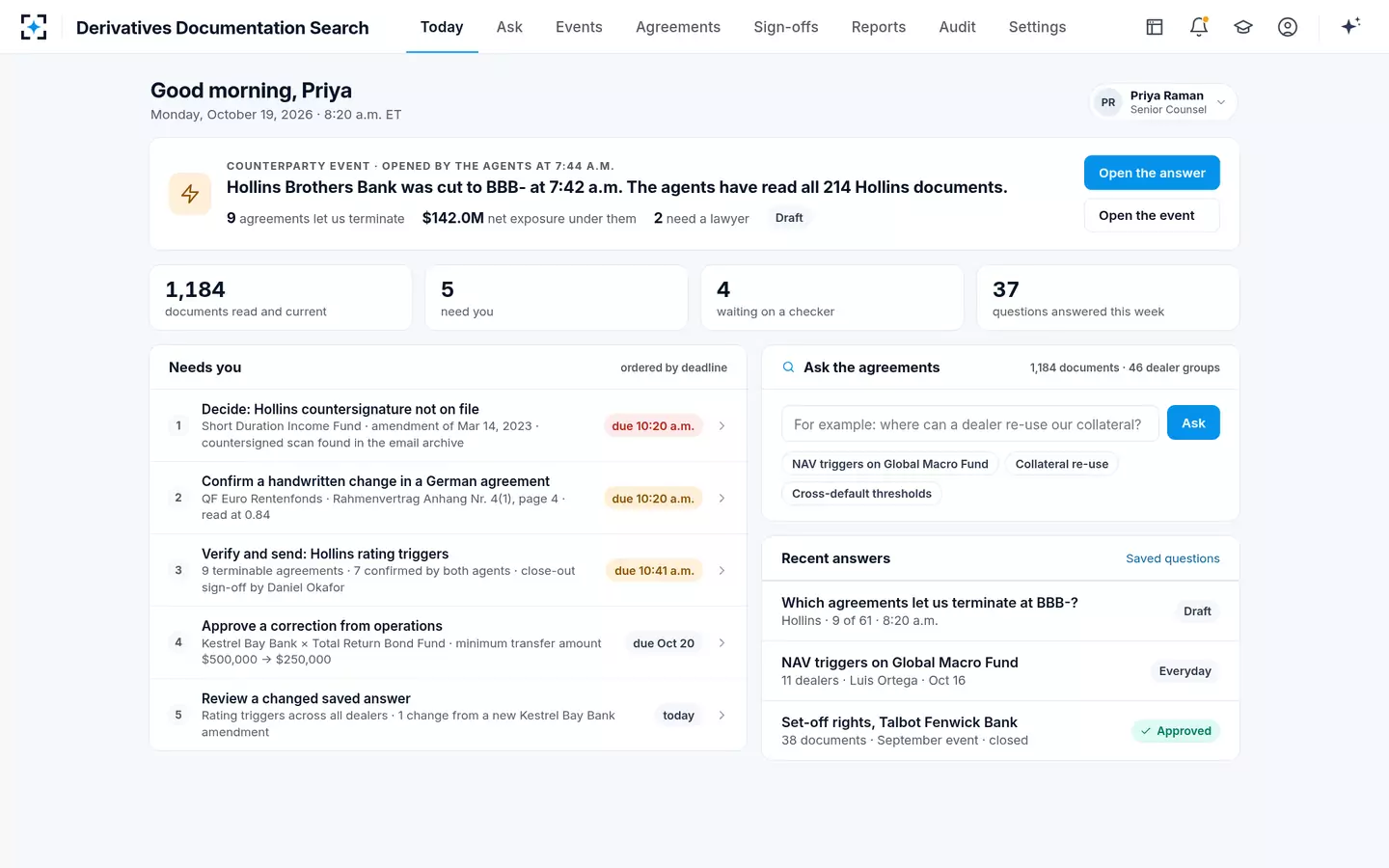
For the agents themselves, what each does and what none may do, see derivatives documentation software: the agents and their limits; for the downgrade morning in detail, the downgrade trigger guide. Or start from Derivatives Documentation Search.
Questions people ask
Is derivatives documentation a legal or an operations job?
Both. Negotiation and interpretation sit with derivatives lawyers; execution tracking, filing, reconciliation and reporting usually sit with documentation specialists in operations. The joins between them, especially on a counterparty event, are where time is lost.
What is a derivatives documentation analyst?
Usually an operations role that keeps the agreement estate complete and consistent: chasing signatures, filing executed documents, abstracting key terms, reconciling them with systems and answering routine questions. Many such roles also own the reporting fields that depend on the documents, such as the master agreement type and collateralisation category under EU rules.
Do buy-side firms need their own derivatives documentation team?
They need the capability, whether in-house or shared. Dealers hold their own copies and must produce them to regulators on request, but a fund deciding whether to terminate, where its collateral sits or what it reported needs its own answer, from its own executed documents, in hours.
How do you know the documentation team has the latest version of an agreement?
Only by sweeping every source where a change can arrive, including email and e-signature records and protocol adherence lists, and proving execution before applying it. A team that relies on the agreement folder alone has the latest version only when nobody has sent anything by email.
Who should approve corrections to documentation data?
Someone other than the person who made them. In the sample firm an operations correction to a minimum transfer amount waits for a lawyer as checker, and a change to an answer threshold waits for the Deputy General Counsel; both are logged with the reason.