An ISDA termination notice is the written notice by which one party designates an Early Termination Date under Section 6 of the ISDA Master Agreement: under Section 6(a) after an event of default, or under Section 6(b) after a termination event such as a rating trigger. It is effective only if it identifies the right event and transactions, names a date the agreement allows, goes to the address the agreement specifies as most recently amended, and travels by a method the agreement permits. English courts have held notices ineffective for getting the method and the address wrong, even when the recipient knew what was coming. Botminds' Derivatives Documentation Search drafts each notice from the decisions approved after a counterparty event, cites every reference to the clause it relies on, checks the address, method and date against the latest notices terms, and leaves sending to people once two lawyers have signed.
The drafts shown come from the solution's fictional sample: Quillfield Capital's Early Termination notices to Hollins Brothers Bank after a downgrade on 19 October 2026. The court decisions quoted are real; their quotations of the ISDA form are the courts' own.
Seven elements of a valid ISDA termination notice, and the document each comes from
- The right event, named precisely
An event of default under Section 5(a), or a termination event with its Schedule clause; for a termination event, its nature and each Affected Transaction.
- The right parties and capacity
Each fund entity and the dealer entity as named in the agreement, and the adviser's capacity ("as investment adviser to") where it signs for the fund.
- A date the agreement allows
An Early Termination Date not earlier than the day the notice is effective and within the notice period the section sets.
- The address in force today
Part 4 of the Schedule as changed by any notices amendment or change-of-address notice, not the address at signing.
- A permitted delivery method
One of the methods the notices section allows for Section 5 and 6 notices, read with the Schedule.
- Authorised signatures
Signatories with authority for that fund entity; in the sample, two lawyers sign every notice.
- Proof of delivery
A courier receipt or equivalent, filed with the agreement, because the sender usually bears the burden of proving receipt.
How do you terminate an ISDA?
By giving a notice that designates an Early Termination Date, after an event that gives you the right to do so. For an event of default the court in Macquarie Bank v Phelan Energy quoted the operative words of Section 6(a): the non-defaulting party "may, by not more than 20 days notice to the Defaulting Party specifying the relevant Event of Default, designate a day not earlier than the day such notice is effective as an Early Termination Date in respect of all outstanding Transactions" ([2022] EWHC 2616 (Comm)). Section 6(b) does the same for termination events, including additional termination events written in the Schedule, with the right held by the party that is not the Affected Party.
Once the notice is effective the date is fixed. The same judgment quotes Section 6(c)(i): if notice is given under Section 6(a) or 6(b), "the Early Termination Date will occur on the date so designated, whether or not the relevant Event of Default or Termination Event is then continuing". A rating that recovers the next day does not undo a valid designation. That finality is why the details below matter: a valid notice ends the transactions on the date it names, and an invalid one ends nothing.
What must an ISDA termination notice contain?
Enough to tell a reasonable recipient, without ambiguity, what the sender relies on and what it is doing. The High Court in Macquarie declined to require perfect detail but set a clear test for a notice of failure to pay: it must "communicate clearly, readily and unambiguously to the reasonable recipient in the context in which it is received" the failure in question, so that the recipient "will clearly understand the trade under which the obligation to pay or deliver has arisen" (at [24]). A notice that overstated the amount by 0.5% still met it, because no reasonable recipient could have mistaken which trade was meant, and the transactions were held terminated.
For termination events the form itself asks for more. The same court contrasted the bare default notice with Section 6(b)(i), which requires the notification "to specify 'the nature of [a Termination Event other than a Force Majeure Event] and each Affected Transaction'" (at [22]), and with "the detailed requirements as to the form of notice, and where it is to be sent, in section 12". A downgrade notice that says only "a termination event has occurred" invites the argument that it specified neither the event nor the transactions.
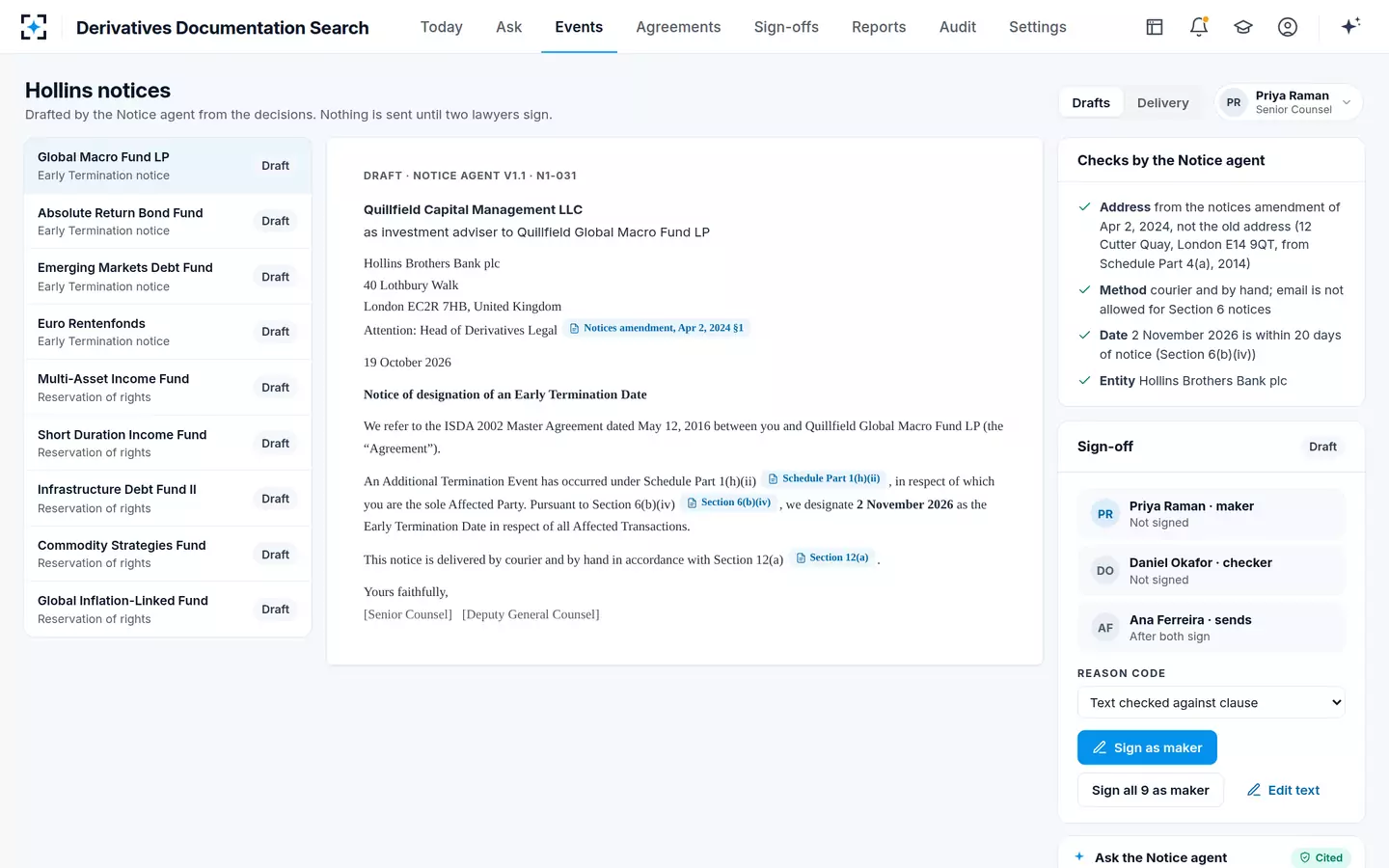
The sample draft to Hollins for the Global Macro Fund shows the pattern: it names the 2002 Master Agreement and its date, states that an additional termination event has occurred under Schedule Part 1(h)(ii) "in respect of which you are the sole Affected Party", designates 2 November 2026 under Section 6(b)(iv) "in respect of all Affected Transactions", and states the delivery method under Section 12(a). Each of those references carries a citation to the clause it rests on.
A draft Early Termination notice with every reference cited and the Notice agent's checks
Where must an ISDA termination notice be sent?
To the address, number or system details the agreement specifies, as changed by any later notice of change of address, and by one of the methods it lists. In Greenclose v National Westminster Bank, Andrews J held that "the natural interpretation of s.12(a) is that there are a limited number of permitted means of giving notice, and that the party giving notice has a free choice between them, save insofar as notices under s.5 and s.6 are concerned, when the choice of methods becomes more restricted" ([2014] EWHC 1156 (Ch), at [94]). The bank's notice, which exercised its option to extend an interest rate collar, went by email to an address never specified in the Schedule, and it failed.
"By leaving it to the last minute to give notice, and failing to check the terms of the contract, the Bank took a calculated risk, and it got it wrong."
Mrs Justice Andrews, Greenclose Ltd v National Westminster Bank plc [2014] EWHC 1156 (Ch), at [155]
The rule cuts both ways on stale addresses. The Schedule's address governs until a party changes it by notice, so a notices amendment signed years after the master is the controlling document, and a notice sent to the address printed at signing can miss. In the sample, the 2 April 2024 notices amendment moved Hollins' address to 40 Lothbury Walk, and the Notice agent's check says so in terms: the address comes from the 2024 amendment, "not the old address (12 Cutter Quay ...)". Repo agreements are no more forgiving. Under the Global Master Repurchase Agreement, Blair J held that "a faxed notice must be sent to the number set out in Annex 1" (LBIE v ExxonMobil Financial Services [2016] EWHC 2699 (Comm), at [133]), although on the facts the recipient had waived the point.
Can an ISDA termination notice be sent by email?
Not under the 1992 form unless the parties changed it, and under any form only if the notices terms as amended allow it. The 1992 form's Section 12(a), as quoted in Greenclose, says notices "may be given in any manner set forth (except that a notice or other communication under Section 5 or 6 may not be given by facsimile transmission or electronic messaging system)". The court added that "In any event, the phrase 'Electronic Messaging System' in the 1992 ISDA Master Agreement does not include email" (at [129]).
Later forms and amendments changed the list of methods, and parties often narrow it again in the Schedule, so the only reliable answer for a given agreement is the one written in its own notices section and Part 4 as amended. In the sample estate that reading produces a split answer: email is not a permitted method for Section 6 notices under the Hollins agreements except one, the Commodity Strategies Fund's. A desk that defaults to email for speed is betting on the one agreement where it happens to be allowed.
Delivery methods for a Section 6 notice under the 1992 form, as the court quoted it
| Method | When it is deemed effective | Allowed for Section 5 or 6 notices? |
|---|---|---|
| In writing, delivered in person or by courier | On the date it is delivered | Yes |
| Telex | On the date the recipient's answerback is received | Yes |
| Facsimile | When received by a responsible employee in legible form; burden of proof on the sender | No, under the parenthetical in Section 12(a) |
| Certified or registered mail, return receipt | On the date delivered or delivery is attempted | Yes |
| Electronic messaging system | On the date the message is received | No; and the court held email is not an electronic messaging system |
What is Section 6 of the ISDA Master Agreement?
Section 6 is the early termination machinery: who may designate an Early Termination Date and how, what happens on that date, and how the amount payable is calculated and paid. The courts quoted on this page walk through its parts. Section 6(a) gives the right to terminate after an event of default; Section 6(b) after a termination event, with the notice requirements of Section 6(b)(i); Section 6(c) fixes the date once designated; Section 6(d) requires a statement of the calculation and sets when payment is due; Section 6(e) sets how the amount is measured, by Loss or Market Quotation under the 1992 form and by Close-out Amount under the 2002 form; and in the 2002 form Section 6(f) adds set-off.
The notice is the hinge between them. It is the only step a party controls on the day, and every later step runs from its effective date. The calculation that follows, and how an unread amendment changes it, is the subject of what a missed amendment costs at close-out.
What is automatic early termination under the ISDA?
It is an election, usually made in the Schedule, under which certain insolvency events terminate the transactions without any notice at all. Its price is control: the Early Termination Date arrives whether or not the non-defaulting party knows. In Fondazione Enasarco v Lehman Brothers Finance, the holding company's Chapter 11 filing on 15 September 2008 was an event of default for the Lehman counterparty, and "This caused the automatic occurrence of an Early Termination Date (ETD)" ([2015] EWHC 1307 (Ch), at [29]).
With automatic early termination, the date is fixed before anyone acts; the valuation can take a year
- Automatic termination, then the search for a replacement15 Sep 2008 to 6 May 2009
- Calculation of Loss, statement served16 Sep 2009
For a documentation team the lesson is a column in the inventory, not a story. Each agreement either elects automatic early termination for one party, both or neither, and on a counterparty's insolvency the first question is which agreements have already terminated without a notice. Those agreements need a valuation started, not a designation sent.
What is a reservation of rights letter in a derivatives close-out?
It is a letter telling the counterparty that a right has arisen and that the sender is not exercising it now but is not giving it up. Firms send one where they decide not to terminate, or not yet, so that silence and continued performance are not later read as a waiver. Courts treat delay as meaningful: in LBIE v ExxonMobil a defect in where a repo notice had been faxed was raised six and a half years later, and Blair J held that "If a point as to the fax number that a notice is sent to is to be taken, it should be taken promptly" (at [137]), finding the requirement waived.
Designation notice or reservation-of-rights letter: same morning, different consequences
Notice designating an Early Termination Date: Ends the affected transactions on the date designated.
Reservation-of-rights letter: States that a right exists and is preserved; nothing ends.
Notice designating an Early Termination Date: The event, the transactions, a permitted date, under the right section.
Reservation-of-rights letter: The event relied on and that rights are reserved; no date.
Notice designating an Early Termination Date: A method the notices section allows for Section 6 notices.
Reservation-of-rights letter: Prudently, the same method, so its receipt cannot be disputed.
Notice designating an Early Termination Date: Calculation statement, payment, release of hedges and collateral instructions.
Reservation-of-rights letter: Monitoring; the right can still be exercised while the event continues.
Notice designating an Early Termination Date: 4 agreements, $97.2 million net, by rule D1 (net exposure of $15 million or more).
Reservation-of-rights letter: 5 agreements, $44.8 million net.
After the notice: the calculation statement and when payment falls due
Effectiveness under the notices section also drives the payment date. In Videocon Global v Goldman Sachs International, Gloster LJ held that the words "notice of the amount payable is effective" in Section 6(d)(ii) "must, in my judgment, be a reference to the language of section 12, which expressly addresses the question of the precise day upon which a notice is deemed" effective ([2016] EWCA Civ 130, at [60]). The same delivery rules that make a termination notice valid therefore decide when the money is due, and the statement deserves the same care as the designation.
Who signs, who sends, and what happens the same day
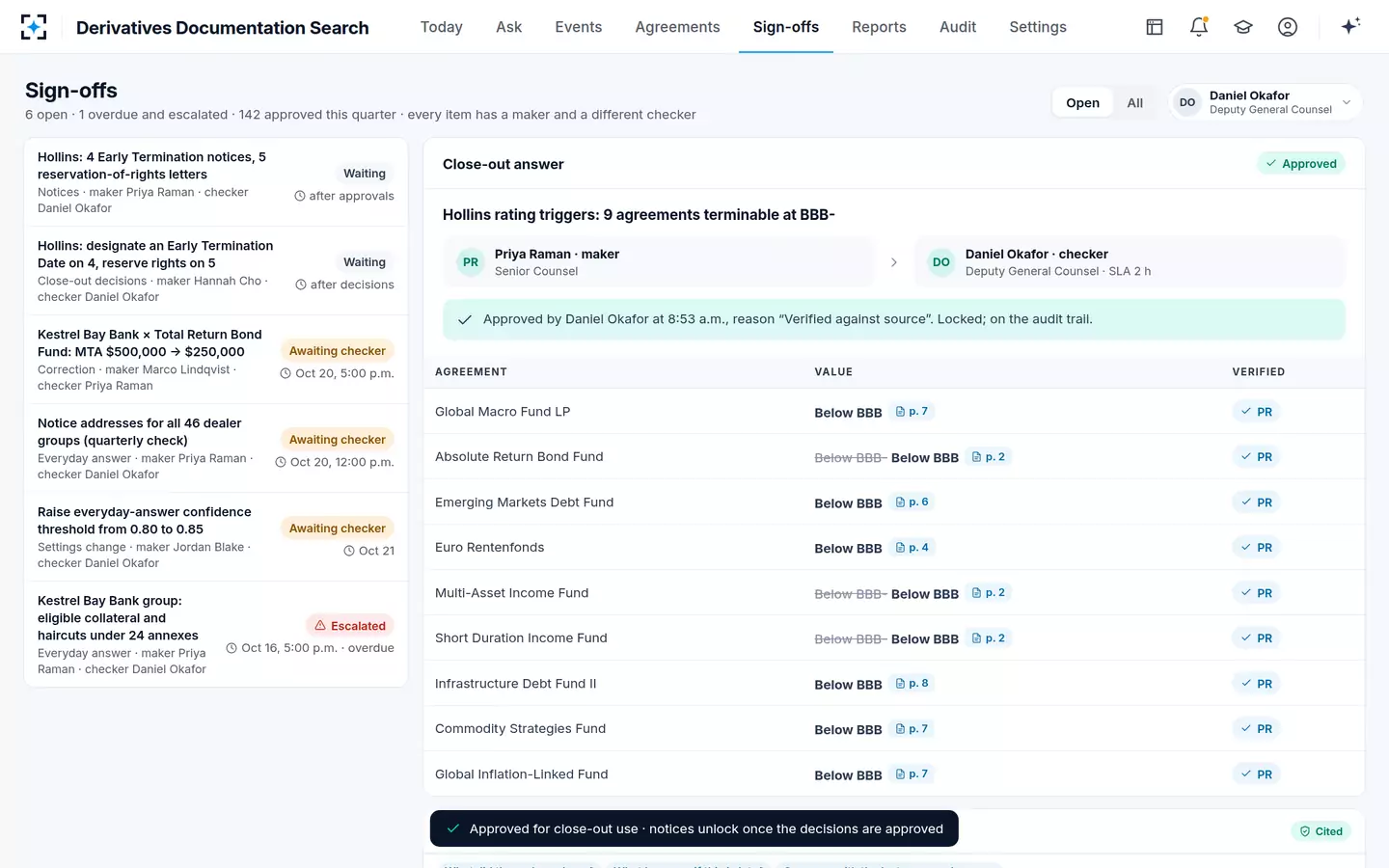
Two lawyers sign and an operations colleague sends. In the sample, the Notice agent drafts four Early Termination notices and five reservation-of-rights letters from the approved decisions; senior counsel signs as maker, the Deputy General Counsel as checker, and Ana Ferreira in legal operations sends them by courier or by hand and files each receipt with its agreement. The agent never sends, and its drafts stay locked until both signatures are in place.
Termination also starts operational work that the notice does not do by itself. Bank supervisors list among close-out practices "A requirement that the banking organization transmit immediate instructions to its appropriate transfer agent(s) to deactivate collateral transfers, contractual payments, or other automated transfers contained in 'standard settlement instructions'" for counterparties that have defaulted (SR 11-10 guidance). A fund's equivalent is the instruction to custodians and the collateral team the moment a designation is effective, so that automated payments do not keep flowing to a counterparty whose transactions have ended.
Maker and checker: the answer behind the notices, approved with a reason and locked
To see the drafts produced from your own notices clauses, start from Derivatives Documentation Search; the decisions that feed them come from the downgrade trigger answer.
Questions people ask
What is an Early Termination Date?
It is the date on which the transactions covered by a termination end and the amount payable is measured. It is designated by notice under Section 6(a) or 6(b), or occurs automatically where automatic early termination applies. Once a valid designation is effective, the date stands even if the event stops continuing.
How many days' notice does an ISDA termination need?
The section sets a ceiling rather than a floor: under Section 6(a), as the court quoted it, the notice may designate a date "not earlier than the day such notice is effective" by "not more than 20 days notice". A designation can therefore be effective almost immediately, but not set more than 20 days out.
Is there an ISDA termination notice template?
Many firms keep one, and a template helps with structure. It cannot supply the parts that decide validity: the event's clause, the Affected Transactions, the address in force and the permitted method for that agreement. In the sample, each draft is generated from the agreement's own clauses for exactly that reason.
Who should sign an ISDA termination notice?
A person with authority to act for the terminating entity, which for a fund is often its investment adviser acting for it. Many firms require two signatures for a step that crystallises exposure; in the sample, senior counsel and the Deputy General Counsel both sign before legal operations sends.
What if the notice was sent to the wrong address?
It may be ineffective, as the email in Greenclose was, unless the recipient waives the defect or the agreement allows another route. In LBIE v ExxonMobil a repo notice faxed to an unspecified number survived only because the recipient raised the point six and a half years late. Re-serving correctly at once is usually safer than arguing later.