The difference between a GMRA and an ISDA is the trade each governs: the Global Master Repurchase Agreement governs repos, sales of securities paired with an agreement to buy them back, while the ISDA Master Agreement governs over-the-counter derivatives such as swaps, options and forwards. A prime brokerage agreement is a third thing again: it governs a broker's financing, custody, clearing and execution for a fund, and usually gives the broker a right to re-use the fund's assets. A fund trading with one dealer group typically holds all three, plus securities lending terms and local-law masters, and each has its own events of default, notice rules and valuation on termination. Botminds' Derivatives Documentation Search reads every one of them in a counterparty's estate, so the answer to "can we terminate, and where is our collateral?" covers the repo and prime brokerage terms as well as the swaps.
Sample figures on this page come from the solution's fictional estate of Quillfield Capital and the Hollins Brothers Bank group. Regulatory texts and court decisions are real and linked.
Which document governs this trade? Start from the trade, not from the folder
Bilateral OTC derivative: swap, option, forward, total return swap
Governing documentISDA Master Agreement and Schedule, or a local-law master (German Rahmenvertrag, French FBF)
Read nextCredit support annex for collateral; confirmations for each trade
Repo or reverse repo: sell securities, agree to buy them back
Governing documentGlobal Master Repurchase Agreement (GMRA) and its annexes
Read nextThe annexes for the parties' elections; Annex I for notice details
Securities lending or borrowing
Governing documentGlobal Master Securities Lending Agreement (GMSLA)
Read nextCollateral schedule; whether lent securities are recalled before a vote or record date
Financing, custody, short sales and execution through a prime broker
Governing documentPrime brokerage agreement, often with its own margin terms
Read nextRight-of-use limit and the disclosure annex; cross-references to the ISDA for synthetic exposure
Cleared derivative
Governing documentClearing documentation with the clearing broker; the bilateral trade is replaced
Read nextThe clearing house rules and the clearing broker's terms for default and porting
What is a GMRA?
A GMRA is the standard master agreement for repurchase transactions, used across international repo markets. The High Court described it in Lehman Brothers International (Europe) v ExxonMobil Financial Services: "The GMRA is used internationally for such transactions, the current 2011 version being published by the Securities Industry and Financial Markets Association (SIFMA) and the International Capital Markets Association (ICMA)" ([2016] EWHC 2699 (Comm), at [3]). In that case the repo was, in substance, a loan of $250 million secured on a diversified portfolio of equities and bonds.
EU law defines the transaction the GMRA governs. A "repurchase transaction" is one by which a counterparty "transfers securities, commodities, or guaranteed rights relating to title to securities or commodities ... subject to a commitment to repurchase them, or substituted securities or commodities of the same description at a specified price on a future date" (Regulation (EU) 2015/2365, Article 3). Title passes outright, which is why a repo's close-out is about valuing securities rather than enforcing a pledge.
What is the difference between ISDA and GMRA?
Beyond the products they govern, the two agreements differ most at the moment that matters: termination. Under the ISDA a party designates an Early Termination Date by notice and measures each terminated transaction; under the 2000 GMRA construed in the ExxonMobil case, the non-defaulting party could value the securities by a Default Valuation Notice, but only within a window ending at "the close of business in the Appropriate Market on the fifth dealing day after the day on which that Event of Default occurs" (at [82]). Miss the window and a different route applies, valuing the securities at the amount which, "in the reasonable opinion of the non-Defaulting Party, represents their fair market value" (at [92]).
ISDA and GMRA at a counterparty's default: the same morning, different clocks
ISDA Master Agreement: OTC derivatives: swaps, options, forwards, many with no exchange of principal.
GMRA (2000 version, as construed in LBIE v ExxonMobil): Repos: outright sale of securities against cash, with a commitment to repurchase.
ISDA Master Agreement: A separate credit support annex, by title transfer or security interest.
GMRA (2000 version, as construed in LBIE v ExxonMobil): Built in: the securities sold are, in effect, the collateral for the cash.
ISDA Master Agreement: Notice designating an Early Termination Date, or automatic where elected.
GMRA (2000 version, as construed in LBIE v ExxonMobil): Default Notice, then valuation of the securities.
ISDA Master Agreement: The determination follows the Early Termination Date, as soon as reasonably practicable.
GMRA (2000 version, as construed in LBIE v ExxonMobil): A Default Valuation Notice only within the window to the fifth dealing day; otherwise fair market value at the Default Valuation Time.
ISDA Master Agreement: Section 12 and the Schedule's Part 4, as amended.
GMRA (2000 version, as construed in LBIE v ExxonMobil): Paragraph 14 and Annex I; a faxed notice must go to the number in Annex I.
The window is not academic. LBIE argued that, for securities priced in markets that close earlier, the window had shut on the Friday, not the Monday, and the trial turned partly on what "close of business" meant in London. A desk that treats its repos like its swaps on a counterparty's default can miss a five-day clock nobody told it about.
What does a prime brokerage agreement cover?
Nearly the whole relationship between a fund and its prime broker: execution, financing, clearing, custody, margin and what happens at the end. In Lomas v RAB Market Cycles, a case about Lehman's European prime brokerage, Briggs J described those services as "trade execution, financing, clearing, processing and custodial services", and noted that by September 2008 the firm "had in the region of 900 prime brokerage clients" ([2009] EWHC 2545 (Ch), at [7]). The agreement "was designed to define the scope and terms of the whole of the broker client relationship" (at [9]).
The same judgment explains the distinction that decides what a fund gets back. Under a title transfer agreement the broker "was to have all right, title and interest in and to securities delivered by or on behalf of the client", whereas under a charge agreement it held securities "as custodian", described as "continuing to belong to the client, subject to a charge" (at [8]). The first can leave the fund an unsecured creditor for equivalent assets if the broker fails; the second leaves it an owner, subject to whatever the broker was allowed to re-use.
Can collateral be rehypothecated?
Yes, where the agreement grants a right of use or transfers title, and within the limits each jurisdiction sets. The rules differ by market, and each one points back to the documents.
Rehypothecation and re-use: what the rules require the documents to say
| Rule | What it requires | What to look for in the agreement |
|---|---|---|
| US swap documentation, 17 CFR 23.504(b)(3)(iii) | A swap dealer's credit support arrangements must contain "Investment and rehypothecation terms for assets used as margin for uncleared swaps, if any" | The annex's re-use paragraph and any custodial arrangement for segregated margin |
| US broker-dealer custody, 17 CFR 240.15c3-3 | Securities in a customer's margin account worth more than 140% of the debit balance are "excess margin securities" the broker must keep in its possession or control | The margin agreement's pledge terms; which securities are fully paid or excess margin |
| EU securities financing, Regulation 2015/2365, Article 15 | Re-use only after the provider is "duly informed in writing" of the risks and has given "prior express consent" | A signed risk disclosure and the consent clause in the collateral arrangement |
| UK prime brokerage, FCA CASS 9.3.1R | Every prime brokerage agreement that lets the firm use the client's assets must include a disclosure annex summarising the right of use | The contractual limit on use, the definitions behind it, and the numbered clauses that grant it |
The UK rule is the most useful to a reader trying to answer the question quickly, because it forces a summary into the agreement. The disclosure annex must set out "the contractual limit, if any, on the safe custody assets which a prime brokerage firm is permitted to use", "all related contractual definitions upon which that limit is based", and "a list of numbered references to the provisions within that prime brokerage agreement which permit the firm to use the safe custody assets", and the firm must send "an updated disclosure annex" if amendments make the original inaccurate (FCA CASS 9.3.1R). In other words, the regulator requires exactly the cited, amendment-aware answer that a documentation team needs for every other agreement too.
Re-use is a number in the documents, not a policy statement
140%
of a customer's debit balance: above it, US broker-dealers must hold margin securities in possession or control
~900
prime brokerage clients of one firm when it entered administration in 2008
$61.8M
posted collateral a dealer may re-use under 19 New York-law annexes in the sample estate
18
sample English-law annexes under which posted collateral passes by title transfer
What is title transfer collateral?
Title transfer collateral passes outright to the receiver, who owes back equivalent assets rather than the same ones. EU law defines the arrangement through the Financial Collateral Directive and, for securities financing, treats re-use as covering both "transfer of title" and the exercise of "a right of use" under a security arrangement (Regulation (EU) 2015/2365, Article 3). Title transfer is common in English-law credit support annexes and in GMRA repos; New York-law annexes usually create a security interest, often with a right of use attached. In the sample estate the split is clean: 18 English-law annexes by title transfer, 19 New York-law annexes where the dealer may re-use what was posted.
What is the difference between GMRA and GMSLA?
The GMRA is for repos, where securities are sold for cash and bought back; the GMSLA is for securities lending, where securities are lent against collateral and returned. EU law draws the same line: securities lending is a transaction in which a counterparty "transfers securities or commodities subject to a commitment that the borrower will return equivalent securities or commodities on a future date or when requested to do so by the transferor" (Article 3). The economic effect can be similar; the documents, the default mechanics and the collateral terms are not, and a fund that lends securities through an agent may hold the GMSLA through that agent rather than directly.
What happens when derivatives agreements overlap?
They interact through cross-default clauses, set-off and cross-references, so an event under one agreement can open rights under another. A prime brokerage agreement may sit beside an ISDA covering the same fund's synthetic exposure; default clauses in the ISDA that reach other agreements can make a default under the repo an event under the swaps; and a set-off clause can reach amounts owed under other agreements, unless the Schedule switches it off. The sample estate shows how uneven this is: set-off on close-out applies under 41 of 61 Hollins master agreements, 14 Schedules disapply it, and 6 have no clause. The close-out arithmetic is in what a missed amendment costs at close-out.
Supervisors also expect someone to decide, as a policy, when trading without a master agreement is acceptable at all. The interagency guidance asks banks to "Maintain policies on when it is acceptable to trade without a master agreement, using metrics such as trading volume or the counterparty's risk profile" (SR 11-10 guidance). A fund's estate review is the mirror image: find the trades whose governing document is missing, unsigned or of the wrong type, before an event finds them.
Five questions to ask of any trade before reading a clause
- What is the product, legally?
Derivative, repo, securities loan, prime brokerage financing or cleared trade; the label in the trading system is not always the legal one.
- Which entities are the parties?
The fund entity and the dealer entity, by name and LEI; group names hide different legal entities and different agreements.
- Which master governs it, and which version?
ISDA 1992 or 2002, GMRA 2000 or 2011, a local-law master, or a prime brokerage agreement, with its amendments.
- Which way does collateral move, and on what terms?
Title transfer or security interest; whether the receiver may re-use it; where it is held.
- What links this agreement to the others?
Cross-default, set-off and cross-references that turn an event under one agreement into a right under another.
How Derivatives Documentation Search reads all three side by side
The solution treats each counterparty's estate as one set of agreement families, not one folder per document type. Asked about close-out under the repo agreements, it reads the 14 GMRA 2011 agreements in the sample estate; asked where Hollins may re-use what Quillfield posted, it reads every annex and returns the New York-law and English-law answers separately, each cited to its paragraph. A treasury and collateral manager sees the terms in force today for any agreement family, from the NAV trigger to re-use of posted collateral.
One family, three kinds of term: termination, close-out and re-use of posted collateral
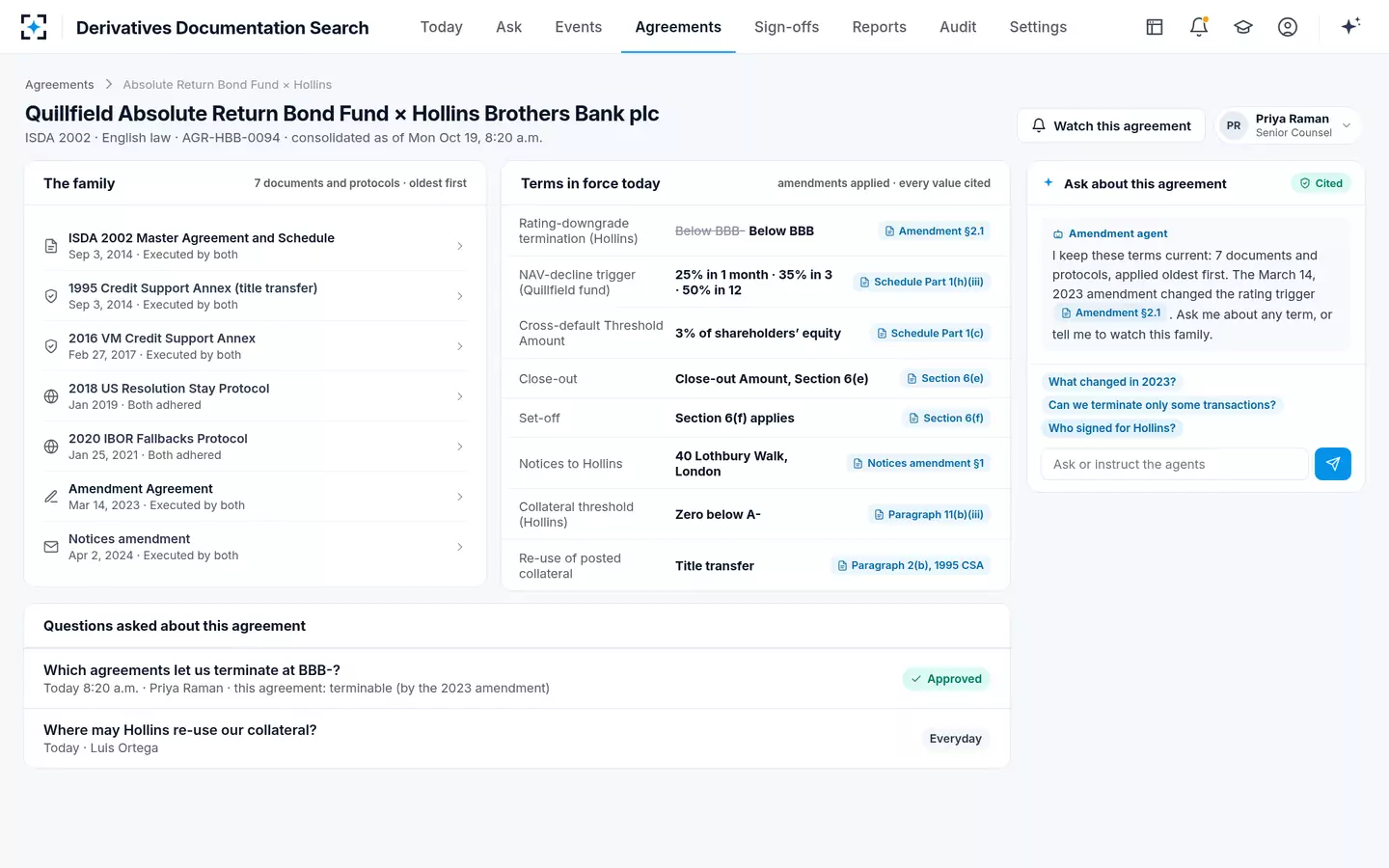
What the solution does not do is as clear: it does not negotiate these agreements, which is the job of Botminds' ISDA Negotiation solution (see the ISDA Schedule elections a fund negotiates), and it does not run margin calls, which belong to collateral operations. It answers what the signed documents say, across all of them, with the page behind every answer. See it on the sample estate at Derivatives Documentation Search, or follow a counterparty event from the downgrade trigger onward.
Questions people ask
Which agreement governs a repo?
Usually a GMRA, the standard master agreement for repurchase transactions, in its 2000 or 2011 version, with annexes for the parties' elections. US domestic repo is often documented on a different master agreement, so the version in each relationship has to be checked. The EU's reporting codes list the GMRA as its own master agreement type, separate from the ISDA.
Can one fund have an ISDA and a GMRA with the same bank?
Yes, and most active funds do, often with different legal entities of the same group on each. The two agreements have separate default and notice provisions, and they may be linked by cross-default or set-off clauses. A counterparty event has to be answered under both.
Is a prime brokerage agreement the same as an ISDA?
No. A prime brokerage agreement governs financing, custody, clearing and execution with the broker and usually grants a right to use the fund's assets; the ISDA governs OTC derivatives. Synthetic prime brokerage exposure is often traded under an ISDA that sits beside the prime brokerage agreement.
What is the risk of rehypothecation for a fund?
If the receiver fails, assets it re-used or held by title transfer may come back only as an unsecured claim for equivalent assets. The FCA requires UK prime brokerage agreements to state the risks to the client's assets "on the failure of the firm" in their disclosure annex. Knowing how much has been re-used, and under which agreements, is the first step in measuring that risk.
Does the GMRA have its own notices clause?
Yes. In LBIE v ExxonMobil the court held that, under paragraph 14 of the 2000 GMRA, a faxed notice must be sent to the number set out in Annex I. A repo notice therefore needs the same address and method checks as an ISDA notice, against the GMRA's own annex.