Derivatives documentation software helps legal, risk and operations teams answer questions about their ISDA Master Agreements, Schedules, credit support annexes, repo and prime brokerage agreements and the amendments to them, without reading every document by hand. Products fall into three kinds: repositories that store and index executed documents, abstraction tools that turn key terms into fields at signing, and reading systems that read the documents themselves when a question is asked. Each fails differently, and a buyer should know which kind is on offer. Botminds' Derivatives Documentation Search is a reading system built from eight AI agents: they plan the reading, read every document in its own language, apply amendments in order, flag documents that disagree, read every cited value a second time, join exposure, draft notices and keep the estate filed, and each has a written list of things it may never do. Senior counsel verifies each row and a second lawyer approves any answer used in a close-out.
The screens and figures below come from the solution's fictional sample estate, Quillfield Capital and the Hollins Brothers Bank group, and its sample settings. Regulatory texts are real and linked.
Eight agents, three people: who reads, who checks, who decides
Agent
Intake agentFiles new executed documents from the document store, email archive and e-signature records into their agreement families; flags missing signature pages and poor scans.
Never: Overwrites an executed copy, or files a scan below 150 dpi; it goes back to the sender.
Agent
PlannerTurns a plain-language question into a reading plan: document families, clause types, fund entities, as-of time.
Never: Answers itself, or reads before an ambiguous question is settled; it asks back first.
Agent
ReaderReads every planned document in its own language, scans included, and finds the clause and value with page and paragraph.
Never: Infers a value that is not written; when nothing is found, it says where it looked.
Agent
Amendment agentOrders each family's chain and applies the latest effective change, keeping the original value visible.
Never: Treats an unsigned or one-sided document as effective.
Agent
Conflict agentFlags documents that disagree, searches the email archive, proposes a resolution with both passages side by side.
Never: Resolves a conflict without a written rule; everything else goes to a lawyer.
Agent
CheckerRe-reads every cited passage blind, on a different model family, and confirms or disputes the value with a score.
Never: Approves anything; a close-out reading below 0.90 goes to a lawyer.
Agent
Exposure agentJoins mark-to-market and collateral per agreement from the collateral system and proposes a decision by the firm's rule.
Never: Decides, or shows exposure to roles not entitled to it.
A person decides
Senior counsel, then Deputy General CounselVerifies each row, decides the flagged ones with a reason; a second lawyer approves the answer.
Never: Approves an answer they prepared.
A person decides
Head of counterparty riskRecords a decision per agreement, by the firm's rule or with a reason; the Deputy General Counsel approves it.
Never: Approves their own decisions.
Agent
Notice agentDrafts Early Termination notices and reservation-of-rights letters to the latest address, by a permitted method, every reference cited.
Never: Sends; drafts stay locked until two lawyers sign.
What does derivatives documentation software do?
It answers questions about executed agreements faster than reading them, and the three kinds do it in different ways. A repository finds documents; an abstraction tool returns the fields someone filled in; a reading system returns what the documents say now. The choice matters most on the questions nobody anticipated and on agreements amended after the abstract was made.
Three kinds of derivatives documentation software, judged on a downgrade morning
Repository or abstraction tool: Documents to read, or fields keyed in at signing.
Reading system with agents: An answer per agreement, each value cited to its page.
Repository or abstraction tool: Only if someone filed and re-keyed them; abstracts drift from the documents.
Reading system with agents: Read and applied in date order every time, with the original shown.
Repository or abstraction tool: No field, so no answer; back to reading by hand.
Reading system with agents: The Planner builds the reading from the question; the answer arrives as a new column.
Repository or abstraction tool: Often abstracted from a translation, or not at all.
Reading system with agents: Read in the original, with the English reading beside it.
Repository or abstraction tool: A confident field that no longer matches the executed document.
Reading system with agents: A misreading; which is why every value is read twice and low scores go to a lawyer.
Where Derivatives Documentation Search fits, and where it does not
It fits after signing, when the questions are "what does every agreement with this counterparty say, as amended?" and "who may terminate, on what terms, with what exposure?". It does not negotiate agreements; drafting counters and tracking concessions is the job of Botminds' ISDA Negotiation solution, whose agents are described in ISDA AI tool: agents draft the counter, lawyers make the concession. It does not keep the collateral system's margin data or make margin calls; Botminds' ISDA and CSA Data Extraction and Margin Call Management solutions do that. And it does not replace the collateral system: the Exposure agent reads mark-to-market and collateral from it, for entitled roles only.
Supervisors have asked for this kind of automation for a long time. The interagency guidance tells banks to "Automate processes to track and manage legal documentation, especially when there is a large volume of legal agreements" (SR 11-10 guidance). The guidance does not say how; the rest of this page is about how to do it without handing judgment to a machine.
Can derivatives documentation software read scanned and foreign-language agreements?
It must, because an estate's hardest rows are scans and local-law masters. In the sample the Reader reads every planned document in its own language, scans included, and shows German and French originals beside the English reading. The Hollins estate holds 214 documents in English, German and French; one German Rahmenvertrag has a rating trigger typed as "BBB-", struck by hand and replaced with "BBB", initialled by both parties. The Reader scored its reading 0.84 and the blind Checker 0.86, both below the 0.90 a close-out answer needs, so the row waited for a lawyer even though both agents read "BBB".
Scan quality is set as a rule, not left to chance: the Intake agent sends scans below 150 dpi back to the sender. A system that silently reads a poor scan produces a confident value nobody can verify; one that refuses it produces a request for a better copy.
The agents at work: a plan first, then each agent reports as it finishes
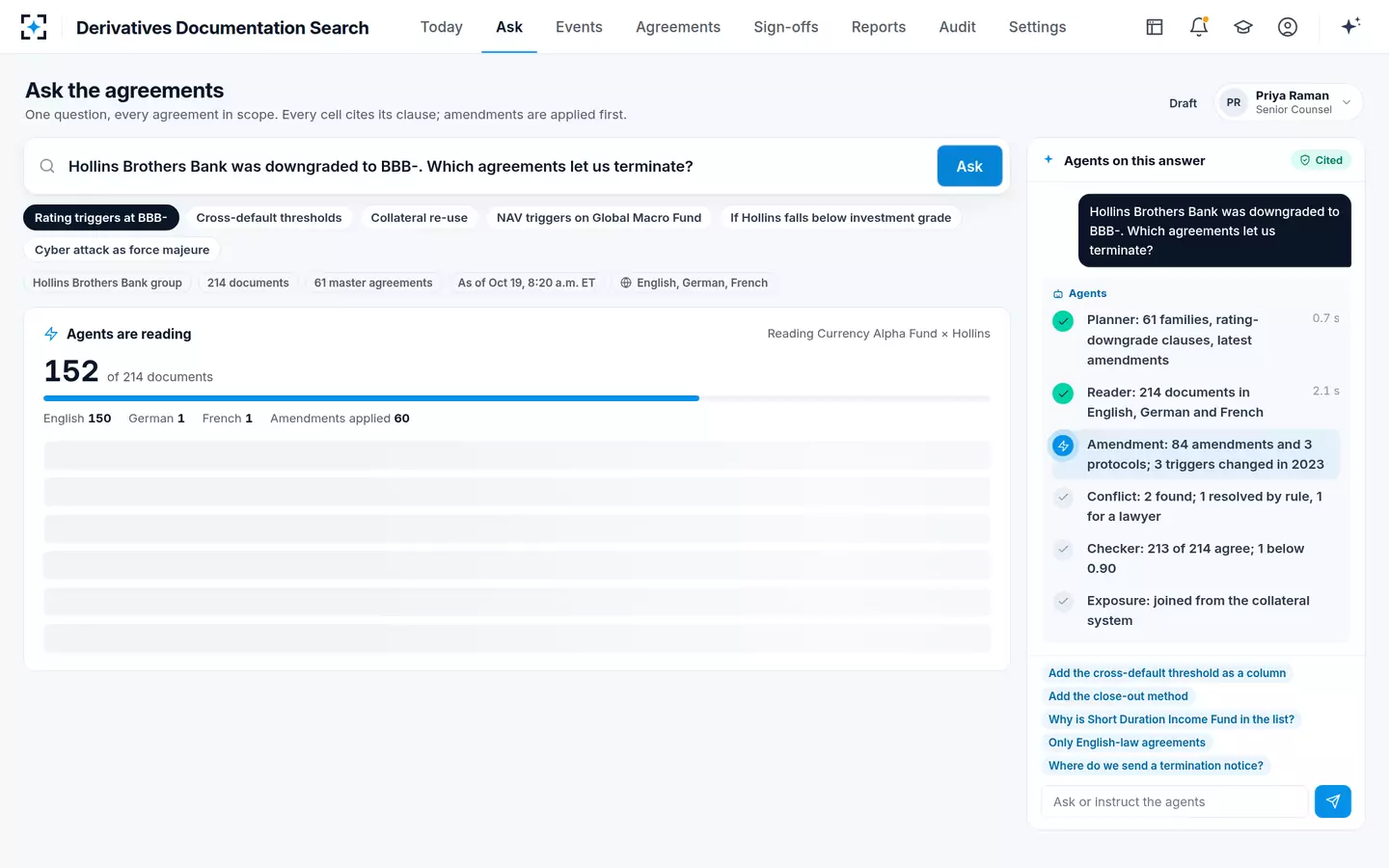
How does derivatives documentation software handle amendments?
Properly, only by reading the chain every time. The Amendment agent orders each family's documents, applies the latest effective change, and shows the original value struck through beside the term in force, citing the amendment. Its rule is a written setting: latest effective amendment wins, protocols apply from their effective date, initialled handwritten changes count. It never treats an unsigned or one-sided document as effective. The guide to ISDA amendment chains explains why each of those choices is there.
Can derivatives documentation software send termination notices?
It should not, and this one does not. The Notice agent drafts Early Termination notices and reservation-of-rights letters to the address in the latest notices clause, by the delivery methods each agreement allows, with every reference cited; the drafts stay locked until senior counsel and the Deputy General Counsel have both signed, and legal operations sends them. The table sets out each agent's limits and the risk each limit closes.
The 'never' list, and the risk each one closes
| Agent | What it may never do | The risk it closes |
|---|---|---|
| Notice agent | Send a notice | An irreversible step taken without the two people accountable for it |
| Amendment agent | Treat a one-sided amendment as effective | A termination right claimed on a document the counterparty never executed |
| Conflict agent | Resolve a conflict without a written rule | A silent choice between two versions of an agreement |
| Checker | Approve anything | A machine certifying its own colleague's work |
| Exposure agent | Decide, or show exposure to roles not entitled to it | A decision made by arithmetic; exposure leaking to staff who do not need it |
| Planner | Read on a guess when a question is ambiguous | A confident answer to a question nobody asked |
The Financial Stability Board's final sound practices on AI put unauthorised actions first among the risks of agentic AI: an agent working toward a goal by its own route may do something illegal, unethical or simply unapproved before any person has looked (FSB, Sound Practices for Responsible Adoption of AI, 15 October 2026). A notice that terminates billions of dollars of trades is the clearest case of an action that should never be within an agent's reach.
Who approves an answer from derivatives documentation software?
A person who did not prepare it. In the sample, senior counsel verifies each row, deciding the flagged ones with a reason code, and the Deputy General Counsel approves any answer used in a close-out; the approve button is locked for the person who prepared it. The same split applies to close-out decisions recorded by counterparty risk. An everyday answer, such as an operations analyst's question about a minimum transfer amount, needs a 0.80 confidence rather than 0.90 and is not used in a close-out unless a lawyer verifies it.
The FSB's sound practice on human oversight explains why the signature has to mean something: oversight counts only when the people doing it have the ability, the authority and the reason to step in; a sign-off given for form's sake does not (FSB, Sound Practice 10). Citations to the page are what give a reviewing lawyer the ability; the locked approve button and the reason codes give the authority and the accountability.
How is derivatives documentation software audited?
Through an append-only trail of every question, reading, decision and signature, and through release tests for each agent version. US rules already expect documentation controls to be audited: a swap dealer must have an independent internal or external auditor audit its documentation policies and procedures periodically, often enough to catch any material weakness (17 CFR 23.504(c)). A fund using agents needs the same evidence for its own processes, and for its auditors and board.
Every agent's version, model and test result before release, and the thresholds only the Deputy GC can change
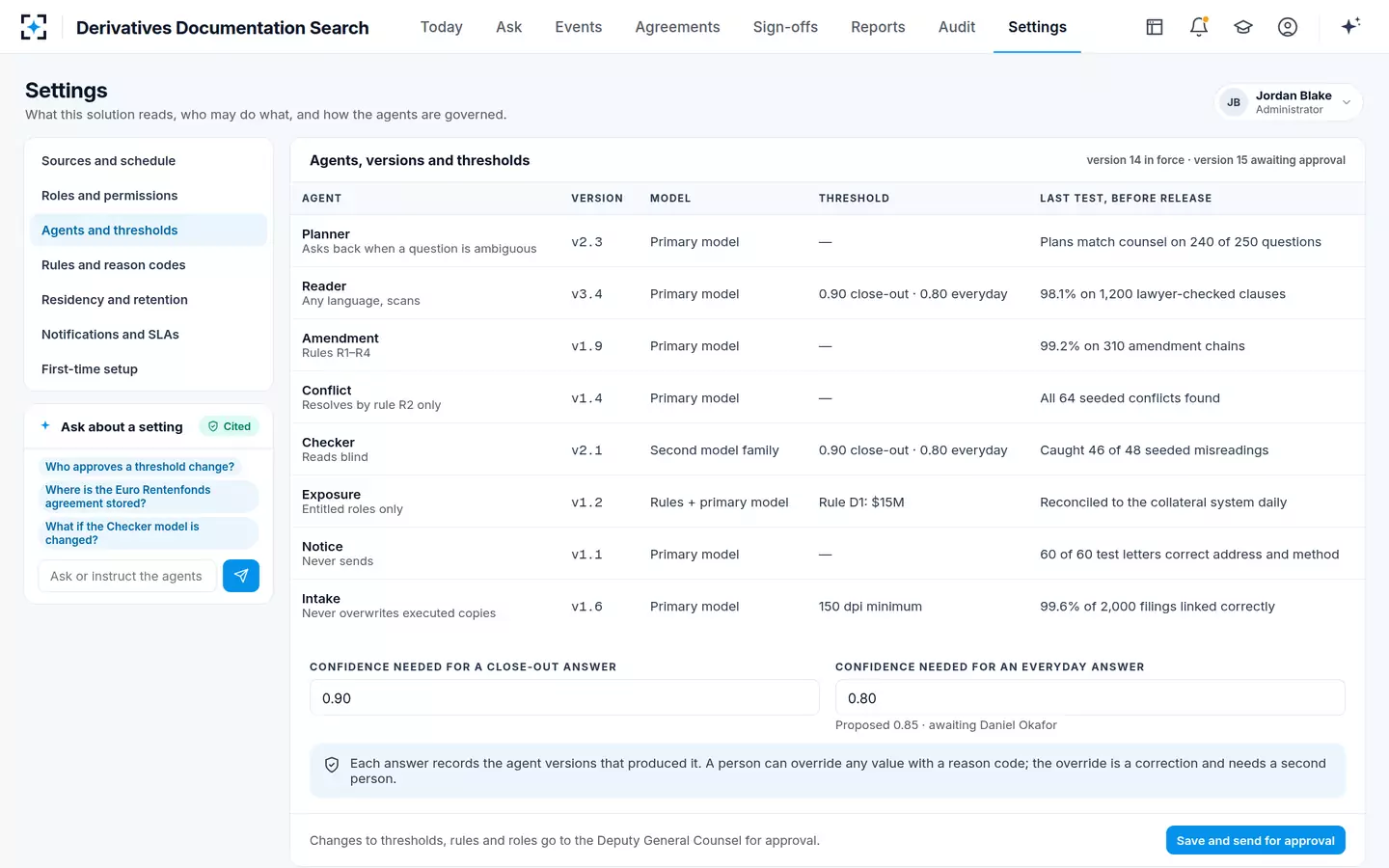
What the trail holds in the sample
41,286
trail entries since 1 October in the sample estate, people and agents alike
10 years
retention set for the trail and every export
2
lawyers on every close-out answer: one verifies, one approves
0.90
confidence a reading needs before a close-out answer can use it without a lawyer deciding the row
The trail: who asked, who read, who decided, and why
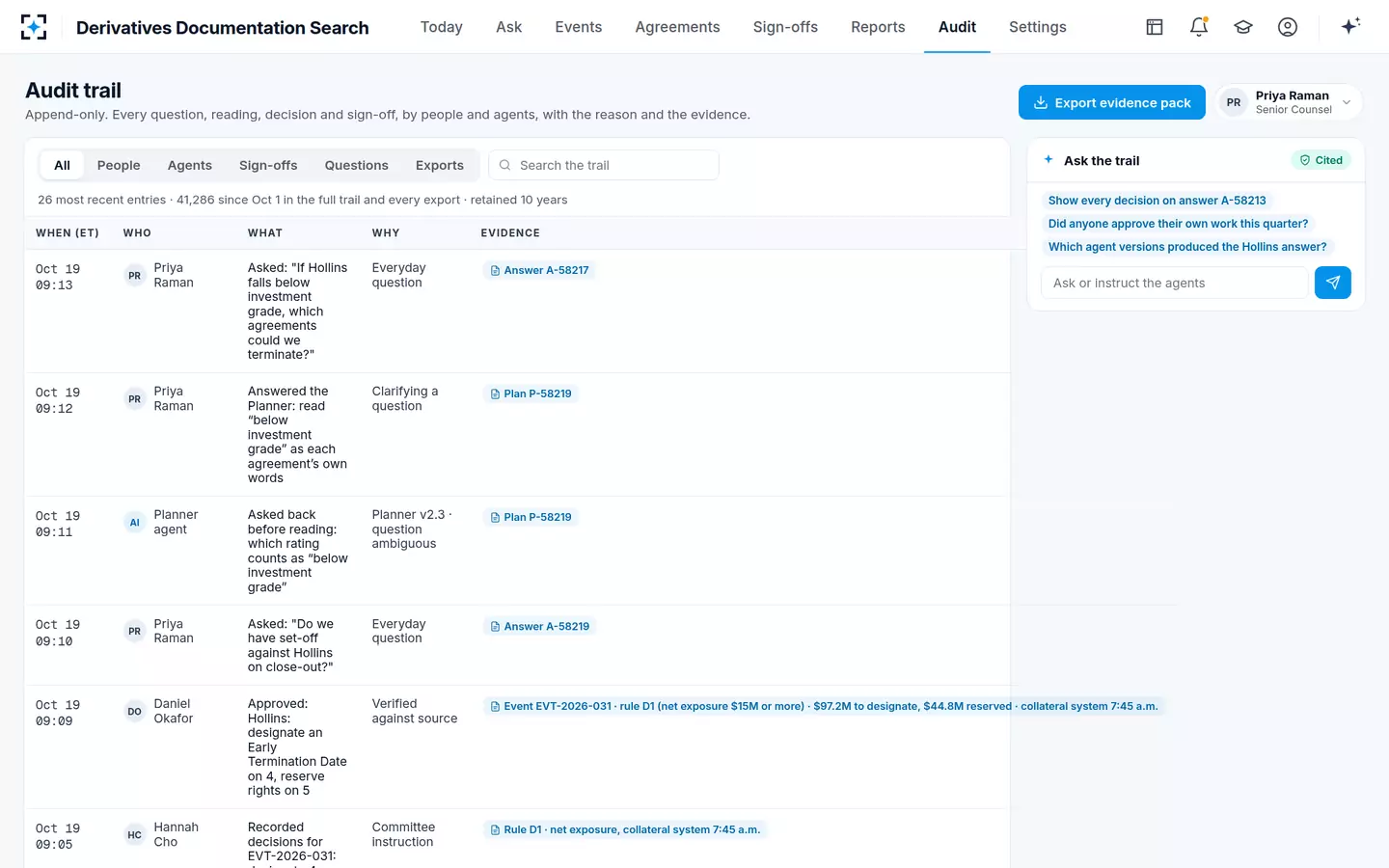
Does derivatives documentation software replace the collateral system?
No, and it should not try. The collateral system calculates and moves margin; the documentation software reads what the agreements say about it. They meet in two places: the Exposure agent reads mark-to-market and collateral per agreement to size decisions, and operations corrections to collateral terms, such as a minimum transfer amount, go through a maker and a checker before anyone relies on them. The useful division is that the documents remain the source of the terms, and the system remains the source of the numbers.
What should you ask a derivatives documentation software vendor?
Ask for evidence on your own documents, not a demonstration on someone else's. The checklist below is the set of questions we would ask any provider, including ourselves; the guide to measuring legal document search AI turns the accuracy questions into a test you can run.
Eight questions for any derivatives documentation software
- Does every value cite its document, clause and page?
And does an empty answer list where the system looked?
- How are amendments, side letters and protocols applied?
In what order, from what date, and is the original value shown?
- What happens with a one-sided or unsigned amendment?
The only acceptable answer is that a person decides.
- Is every reading checked independently?
By a second reading, ideally on a different model, with a threshold below which a lawyer decides.
- Can it answer a clause question nobody set up?
Without a new field or a project; and does it ask back when the question is ambiguous?
- Can it act on its own?
Send, approve, change a value: each should be impossible for the software.
- Who sees exposure, and who can approve?
Entitlements by role, fund entity and region; maker and checker enforced, not suggested.
- What does the audit trail hold, and for how long?
Questions, readings, versions, decisions, reasons and signatures, append-only, exportable for auditors.
To see the agents on the sample estate, start from Derivatives Documentation Search.
Questions people ask
Is there free derivatives documentation software?
Repositories and generic document search can be cheap or bundled with other systems, but they return documents rather than answers. The cost that matters is the lawyer time spent reading after the search: by our estimate about four lawyer-days for one question across one dealer group's 61 agreement families.
How long does it take to go live?
The solution's first-time setup connects the document store, email archive, collateral system and rating feed, maps fund entities and regions, and runs a first full read of the estate. A pilot on one dealer group, tested against questions your lawyers already answered, is the sensible first step.
Can AI agents be trusted with legal documents?
With reading, under checks; with decisions, no. The design that earns trust is the one where every value is cited, read twice, and decided by a person when the readings disagree or fall short, and where the agents cannot send, approve or change anything.
Does the software work for repo and prime brokerage agreements?
Yes. The Reader reads GMRAs, prime brokerage terms and local-law masters alongside ISDAs; in the sample estate it reads 14 GMRA 2011 agreements when asked about close-out under the repo agreements.
What data does it need?
The executed documents from the legal document store, the email archive for countersigned copies and notices, the collateral system for exposure, the counterparty database and rating feed for entities and ratings, the industry protocol adherence list, and NAV by fund entity from the fund administrator for NAV-decline tests.