An ISDA amendment is a signed document that changes named terms of an existing ISDA Master Agreement, its Schedule or its credit support annex, and leaves everything it does not mention in force. Over a decade one agreement collects amendment agreements, a notices amendment, side letters and the adherence letters for industry protocols, so the term that governs today is whichever effective document last changed it. That is why a clause question takes a lawyer days: the Schedule in the file is rarely the answer. Botminds' Derivatives Documentation Search reads every document in each agreement family, orders the chain by effective date, applies the latest signed change and cites each term to the page that set it, keeping the original wording visible beside the amended one.
The examples come from the solution's sample data: Quillfield Capital, a fictional investment manager with 63 fund entities, and its fictional dealer group, Hollins Brothers Bank, whose 61 master agreement families hold 214 documents. Research figures come from regulators and are linked where they appear.
A protocol changes thousands of agreements at once; an amendment changes one
14,000+
entities had adhered to one industry protocol, the IBOR fallbacks protocol, by end-May 2021
~90
jurisdictions those adhering entities came from
7
documents in one sample agreement family, from the 2014 Schedule to a 2024 notices amendment
3 of 9
sample agreements terminable at BBB- only because of amendments signed in 2023
What is an ISDA amendment? Five ways a term changes after signing
A term in an ISDA agreement can change in five ways, and each leaves a different kind of evidence. Two are bilateral documents the parties negotiate and sign. One is a letter outside the master file. One is a market-wide protocol that each party joins by its own adherence letter. The fifth happens at signing: a handwritten change, initialled by both parties, that makes the executed copy differ from the draft everyone keeps on the shared drive.
Five ways an ISDA term changes, and the evidence each one leaves
| How the term changes | What it usually does | What proves it took effect | Where it tends to be filed |
|---|---|---|---|
| Amendment agreement | Changes named sections of the Master Agreement, Schedule or annex; everything else stands | Signature pages of both parties and an effective date | Legal document store, often under the counterparty rather than the agreement |
| Amendment and restatement | Replaces the whole text with a new consolidated version from a stated date | Both signatures; the restated text becomes the new base of the chain | Document store, sometimes beside the superseded original |
| Side letter | Varies a term for one fund, product or period without touching the Schedule | Signed letter, frequently exchanged by email | Legal mailboxes and the email archive |
| Protocol adherence | Incorporates standard amendments into every covered agreement between two adherents | Each party's adherence letter and the protocol's effective date | Industry adherence list; a copy in the agreement file only if someone put it there |
| Handwritten change at signing | Alters a typed term on the executed copy | Initials of both parties beside the change | Only on the scan of the executed copy |
The last column is the problem. An amendment agreement filed under the counterparty's name, a side letter that lives in a lawyer's inbox, and an adherence that exists only on an industry list are three changes the agreement's own folder does not show. The sample estate has all of them. Across Hollins' 214 documents the solution applied 84 amendments and three protocols before answering a single question.
Which version of an ISDA term applies today?
The term that applies today is the one set by the latest document that changed it, took effect, and was executed by both parties, read in effective-date order rather than in the order documents were filed. An amendment and restatement resets the chain from its own date; anything earlier survives only if the restated text keeps it. Everything else accumulates: a 2023 amendment can change the rating trigger while the 2014 Schedule still governs set-off, and a 2024 notices amendment can move the address without touching either.
One agreement family, six changes in twelve years: today's terms come from four different documents
- Below BBB- · 12 Cutter Quay · LIBOR termsSep 2014 onward
- Master, Schedule, annex2014
- VM annex2017
- US stay protocol2019
- IBOR fallbacks2021
- Trigger2023
- New notices address2024
The top lane is what a reader sees who opens the Schedule and stops. On a downgrade to BBB- that reader concludes the Absolute Return Bond Fund cannot terminate, because its 2014 trigger fires only below BBB-. The amendment of 14 March 2023 moved the trigger to "below BBB", which BBB- does trip. The same reader would send a termination notice to an address the parties replaced in 2024. Neither mistake needs a careless lawyer, only a chain read in the wrong order or not read at all.
For the sample estate the difference is not one agreement. Six of the nine Hollins agreements that let Quillfield terminate at BBB- do so on their original terms; the other three only because of amendments signed in 2023. A desk that worked from Schedules would report six, and would leave three termination rights unused on the morning they mattered. The downgrade trigger guide follows that morning from the rating feed to the risk call.
Do protocols amend my ISDA?
Yes, but only between two parties that have both adhered, and only from the protocol's effective date. A protocol is a standard set of amendments published once, which each firm accepts by delivering an adherence letter; it changes the agreements between adherents and nothing else. The Financial Stability Board described the reach of the IBOR fallbacks protocol in exactly those terms: once it took effect on 25 January 2021, the new fallbacks were incorporated into "legacy non-cleared derivatives where the counterparties had bilaterally agreed to include them, or where both had adhered to the IBOR Fallbacks Protocol" (FSB, July 2021).
The scale makes protocols the largest single source of amendments in most estates. By end-May 2021, "over 14,000 entities across nearly 90 jurisdictions" had adhered to that one protocol. When it was announced, the FSB called it "a readily available avenue to adopt fallbacks into most derivatives contracts" and urged "widespread and early adherence" (FSB, 9 October 2020). Readily available is not the same as universal: an agreement with a counterparty that never adhered kept its old terms.
US banking regulation relies on the same mechanism. Under the Federal Reserve's rules on qualified financial contracts, a covered contract "is deemed to comply with this subpart if it is amended by the universal protocol or the U.S. protocol", and the rule spells out that amendment "with respect to covered QFCs between adherents to the protocol, includes amendments through incorporation of the terms of the protocol (by reference or otherwise)" (12 CFR 252.85). For a fund, adherence to a stay protocol is therefore not paperwork. It changes which default rights the fund can exercise against a bank group in resolution, and it belongs in the chain like any signed amendment.
Bilateral amendment or protocol: the same change, two very different trails
Bilateral amendment: Both parties sign one document for one agreement, or for a named list of them.
Protocol adherence: Each party signs its own adherence letter; the amendment exists only where both did.
Bilateral amendment: Exactly the sections it names, in the agreements it names.
Protocol adherence: Every covered agreement between the two adherents, unless an agreement is carved out.
Bilateral amendment: The date in the document, once both have signed.
Protocol adherence: The protocol's effective date, or the later date the second party adhered.
Bilateral amendment: In the agreement file, if someone filed it there.
Protocol adherence: On the protocol's adherence list; rarely in the agreement file.
Bilateral amendment: Both signature pages and the effective date.
Protocol adherence: Both adherence dates, the counterparty entity that adhered, and any exclusions.
When nobody adhered: where a statute fills the gap and where it does not
Some gaps are filled by law rather than by contract, and the chain decides which. For US dollar LIBOR, Congress supplied a replacement rate only for contracts that lacked a workable fallback of their own: the Board-selected benchmark replacement applies to any LIBOR contract that "contains no fallback provisions" or "contains fallback provisions that identify neither" a specific benchmark replacement "nor" a determining person (12 U.S.C. 5803(a)).
So whether an agreement carries the statutory rate or the protocol's depends on documents a reader may not have looked at: the adherence letters, any bilateral fallback amendment, and the confirmations of the trades themselves. The lesson outlasts LIBOR. Any question of the form "which rule governs this agreement?" has two parts, what the agreement says after every change, and what the law supplies where it says nothing, and the second part cannot be answered until the first has been read to the end of the chain.
Is a one-sided ISDA amendment effective?
Treat it as unproven until both parties' execution is evidenced, and let a lawyer decide. Whether an amendment signed by one side binds both is a question of the agreement's own amendment clause and its governing law, not something a reader can settle from a filing cabinet. US swap rules point the same way for dealers: swap trading relationship documentation must be written and signed no later than the swap it governs (CFTC, 17 CFR 23.504).
The sample estate has the classic case. The amendment that moves the Short Duration Income Fund's trigger to "below BBB" was signed by Quillfield on 9 March 2023; the document store holds no Hollins signature page. The solution does not treat it as effective, and does not treat it as void either. It searches the email archive, finds a countersigned scan attached to a 16 March 2023 email from Hollins' legal team, matches it to the amendment text page for page, four of four, and proposes treating the amendment as effective from 15 March 2023, with both passages side by side.
A countersignature that was never filed, found in the email archive
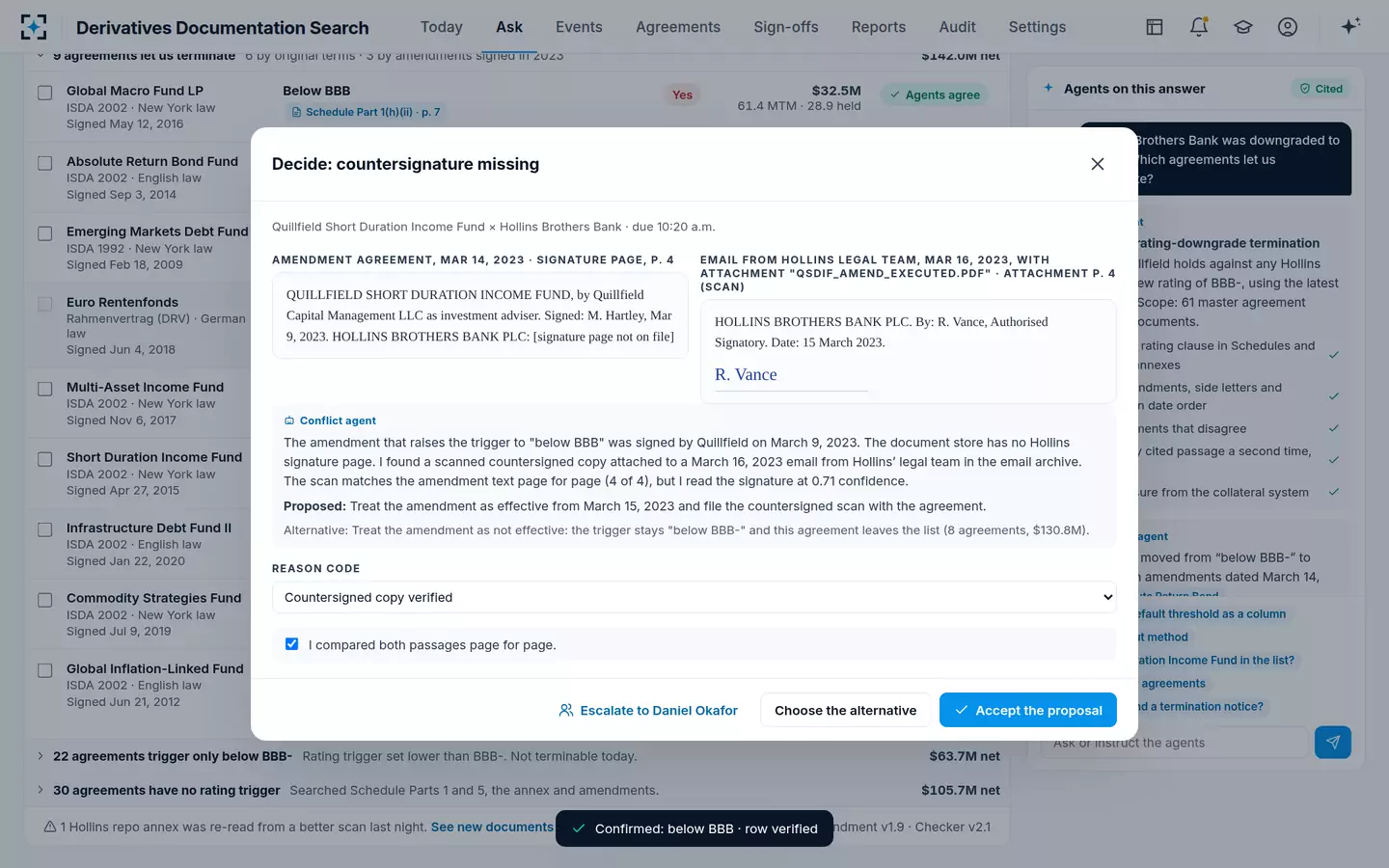
The decision belongs to senior counsel, and the reason code goes on the audit trail with it. That is the right division of labour: the search for the missing page is mechanical and the agents do it in seconds; the judgment that a scanned countersignature is good enough to act on in a close-out is a lawyer's, and nobody should be able to make it silently.
How do side letters interact with the ISDA Schedule?
A side letter varies a term for one fund, one product or one period without changing the Schedule's text, so the Schedule keeps reading as if the letter did not exist. It ranks as a later agreement between the same parties, which means a reader who knows the letter exists applies it and a reader who does not applies the Schedule. Side letters are also the documents most often exchanged as email attachments and never filed with the master, which is why the solution's Intake agent files new executed documents from the email archive and e-signature records as well as the document store, and flags any that arrive without a signature page.
The safest reading order is mechanical: master agreement and Schedule, then annexes, then every amendment and side letter by effective date, then protocols from the date both parties adhered, then any initialled handwritten change on the executed copy, which dates from signing. The solution writes that order down as a rule (latest effective amendment wins; protocols from their effective date; initialled handwritten changes count), and a change to the rule goes to the Deputy General Counsel for approval, so the reading order is a policy rather than a habit.
Why an abstract in the collateral system drifts from the documents
An abstract drifts because amendments change the documents and nobody is required to change the abstract at the same moment. Collateral and risk systems hold a summary of the margin terms keyed in when the annex was signed; a later amendment to a threshold, a minimum transfer amount or an eligible collateral schedule reaches the system only if someone re-keys it. US swap rules expect the documents themselves to keep changing: the parties "may agree on changes or procedures for modifying or amending the documentation" at any time (17 CFR 23.504(b)(4)(iv)).
Supervisors have long treated the gap as a control failure. The interagency counterparty credit risk guidance tells banks to "harmonize netting and collateral data across systems" and to "maintain a robust reconciliation process, to ensure that internal systems have terms that are consistent with those formally documented in agreements and credit files" (Interagency Supervisory Guidance on Counterparty Credit Risk Management, SR 11-10, revised June 2026). The guidance is addressed to banking organisations, but a fund's documentation team faces the same arithmetic: every amendment is a reconciliation the abstract needs and may not get.
The sample shows a small instance on the senior counsel's home screen: a correction from operations, waiting for a checker, that changes one dealer's minimum transfer amount from $500,000 to $250,000. Corrections need a second person, so until one approves it the old figure stands. Reading the documents themselves, rather than a re-keyed summary, is how the solution keeps the two from drifting apart unnoticed.
How do you find every amendment to one ISDA agreement?
You sweep every place an amendment can live, match each find to the right legal entity, and prove execution before you apply it. Searching the agreement's folder is the first step and the least sufficient. The checklist below is the one the solution follows for each agreement family; a team can run it by hand on one counterparty to see how many changes the folder alone misses.
Seven checks before you trust an ISDA agreement's terms
- Pull the family, not the file
Master, Schedule, every annex, repo or prime brokerage terms with the same group, all amendments and side letters, matched by legal entity name and LEI, including renamed and merged entities.
- Search the email archive for executed copies
Countersignatures, side letters and notices amendments often exist only as attachments.
- Check e-signature records
An amendment signed electronically may never have been downloaded into the document store.
- Read the protocol adherence list for both entities
Record both adherence dates; the protocol applies from the later one, and only to covered agreements.
- Prove execution before applying a change
Both signature pages, or a countersigned copy matched page for page; anything less goes to a lawyer.
- Prefer the executed copy over drafts
A draft filed beside the executed version is the commonest conflict; the executed copy wins, and the choice is logged.
- Apply in effective-date order and keep the original visible
Show the superseded wording struck through beside the amended term, with the amendment cited.
What Derivatives Documentation Search does with the chain, and where it stops
The solution's Amendment agent orders each family's chain and applies the latest effective change, and the answer shows its work. In the estate-wide grid, the three Hollins agreements whose triggers moved in 2023 show "Below BBB-" struck through beside "Below BBB" and the 14 March 2023 amendment, cited to its section and page. Asked "Why is Short Duration Income Fund in the list?", the agents answer from the chain: the 2014 Schedule said below BBB-, the 2023 amendment changed it, and the amendment counts only because a lawyer accepted the countersigned scan.
Today's terms for one agreement family, each cited to the document that set it
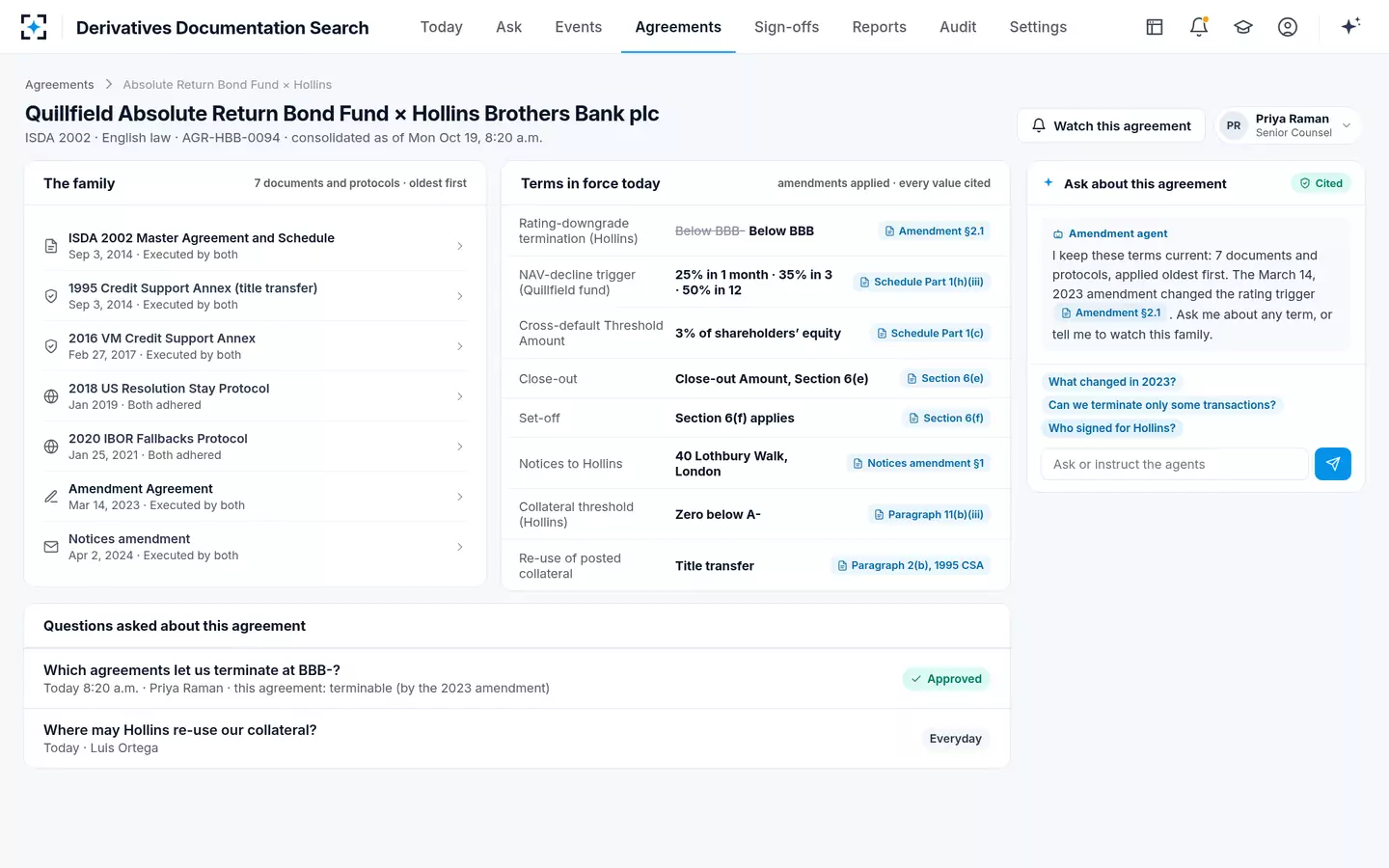
Where it stops is as important. The agents never treat an unsigned or one-sided document as effective, never resolve a conflict except by a rule the firm has written down (executed copy over draft is the only one set in the sample), and never change a value without a person. A reading below the confidence a close-out answer needs, 0.90 in the sample settings, goes to a lawyer even when both agents agree. The same discipline applies to a credit agreement's amendment history; Lending's guide on which version of an amended and restated credit agreement governs works through the loan-market equivalent. To build the same chain for your own estate in a pilot, see how to build an ISDA clause library from executed agreements, or start from Derivatives Documentation Search.
Questions people ask
What is an ISDA amendment agreement?
It is a short bilateral document, signed by both parties, that changes named sections of an existing ISDA Master Agreement, Schedule or credit support annex from a stated date. Everything it does not mention stays as it was, so it must be read together with the documents it amends. In the sample estate, one such agreement of 14 March 2023 moved three funds' rating triggers from below BBB- to below BBB.
What is the difference between an amendment and an amendment and restatement?
An amendment changes some terms and leaves the original text standing. An amendment and restatement replaces the whole text with a consolidated version from its effective date, so it becomes the new start of the chain. Changes made before a restatement survive only if the restated text keeps them.
What is an ISDA notices amendment?
It is an amendment that changes the addresses, contacts or permitted delivery methods for notices, usually in Part 4 of the Schedule. It matters more than its length suggests, because a termination notice sent to the old address can fail. In the sample, the 2 April 2024 notices amendment moved Hollins' address to 40 Lothbury Walk, and every draft notice follows it.
Does a protocol need both parties to adhere?
Yes. A protocol amends only the covered agreements between two adherents, from the later of their adherence dates. The FSB's account of the IBOR fallbacks protocol is explicit: legacy trades took the fallbacks where the parties agreed bilaterally "or where both had adhered".
How often should the amendment chain be checked?
Whenever a document arrives, and in full before any close-out. Bank supervisors expect at least an annual review; the interagency guidance's words are "At least annually, conduct a review of the legal enforceability of collateral and netting agreements for all relevant jurisdictions." A chain that is re-read on every new filing makes that review a check rather than a project.
Can a confirmation change the master agreement's terms?
A confirmation sets the terms of one transaction and is part of the documentation for it; US rules count all confirmations as part of the swap trading relationship documentation. It changes the master agreement only for that transaction and only where the documents give it priority. A term that should apply to every trade belongs in an amendment, not a confirmation.