An amended and restated credit agreement is a single document that carries the whole agreement forward in its new wording: it does not sit beside the original, it takes its place. An ordinary amendment does the opposite — it edits named sections and leaves the rest of the original standing. That difference decides which paper you quote, and it is why a loan file with three amendments and an amended and restated agreement in it has no single document you can call “the credit agreement”. The only answerable question is what a given section said on a given date. Botminds’ Loan Document Search rebuilds each section as amended, keeps every version it replaced beneath it with the document and page, and answers as of whatever date you ask.
The loan on this page is fictional sample data from the solution: Halvorsen Cold Chain Holdings, a Term Loan B and revolver with Ashgrove Bank as administrative agent, 23 executed documents and 412 pages. The research figures come from regulators, a federal court of appeals and a peer-reviewed working paper, linked where they appear.
A credit agreement is a chain, not a document
4½yrs
maturity at origination for the typical bank loan
5×
times that typical loan is renegotiated before it matures
9mths
between renegotiations, on average
What is an amended and restated credit agreement?
It is the agreement rewritten in full and signed again, so that from its effective date the restated text is the contract and the earlier text is history. Lenders reach for it when the edits have piled up — a second or third amended and restated credit agreement usually means the parties decided that one more set of cross-references would be unreadable. The restatement does not wipe out what happened under the old text: obligations already incurred, payments already made and defaults already waived stand. It replaces the words, not the past.
An amendment is narrower and far more common. It names the sections it touches and says what to do with them: strike a number, insert a clause, or — the form that causes the most trouble — amend and restate one section in its entirety. In the sample loan, Amendment No. 3 does exactly that to the prepayment premium clause: “Section 2.11(f) of the Credit Agreement is hereby amended and restated in its entirety as follows”. One section is restated; the other 639 are untouched. A document can therefore restate a clause without being an amended and restated agreement, which is the distinction that trips people reading a file quickly.
The practical consequence is the same in both cases. After the effective date, quoting the superseded wording is quoting a text nobody is bound by. The original §2.11(f) in the sample file still reads perfectly well on page 79 of the 2023 agreement; it stopped governing on 14 February 2025 and has been wrong to rely on ever since.
Amendment, amended and restated, or conformed copy: three documents, one text
Three kinds of paper sit in a loan file and look alike at a glance. Only two of them are executed, and only the executed ones decide anything. The third is the one that quietly causes mistakes, because it is the easiest to read and the only one with no signature behind it.
What each document is, and whether you may cite it
What it is: An executed document that edits named sections. Everything it does not mention is unchanged. It carries its own effective date and its own conditions to effectiveness.
What it does to the agreement: Replaces the wording of the sections it names, from its effective date. Earlier versions of those sections stop governing; the rest of the agreement carries on.
What it is: An executed document that sets out the whole agreement again in its current wording, usually numbered — second, third — by how many restatements have come before.
What it does to the agreement: Becomes the agreement from its effective date. Prior amendments are folded into it and are no longer read on their own, though what happened under them stands.
What it is: An unexecuted working copy in which someone has typed the amendments into the original so the text reads continuously. Nobody signs it.
What it does to the agreement: Nothing. It is a reading aid. It can be out of date, can contain a typing error nobody has caught, and can never be the citation behind an answer a borrower or a lender relies on.
Conformed copies earn their place: a 412-page agreement rewritten by hand into one continuous text is faster to read than four documents side by side. The danger is that a conformed copy records someone’s reading of the chain rather than the chain itself. If the typist missed an amendment, applied one twice, or applied one whose conditions to effectiveness were never satisfied, the error is invisible — the page looks like a credit agreement. An answer built on a conformed copy inherits whatever that person got wrong, with none of the page and section references that would let a reviewer catch it.
How often are credit agreements amended?
Often enough that treating the original as current is a losing habit. Roberts, studying amendments filed with the SEC, found that “the typical bank loan is renegotiated five times, or every nine months” against a maturity at origination of about four and a half years, and that renegotiation is not limited to distress: “the majority (54%) of renegotiations modify the interest rate, amount, or maturity”, the terms a servicing desk is asked about most ( NBER Working Paper 20484).
That cadence is the reason the chain, not the document, is the unit of work. A loan five years into its life has probably been rewritten in part four or five times; the question is never whether the original is current but which of the rewrites touched the section you were asked about. On the sample loan, three amendments in three and a half years moved the margin twice, the amortisation once, the soft call twice and the maturity once — and left most of the agreement exactly as signed.
Scale makes the habit expensive. The 2025 Shared National Credit review of large syndicated loans “included 6,857 borrowers, totaling $6.9 trillion in commitments, an increase of 6 percent from a year ago” ( Federal Reserve, FDIC and OCC, January 2026). Every one of those credits is a chain, and the agent on each of them answers questions from it daily.
When does an amendment take effect — signing, effective date or closing?
On its effective date, which is usually neither the date printed at the top nor the date the last signature arrived. Most amendments define an effective date as the day on which a list of conditions is satisfied, then record that it happened. Amendment No. 3 in the sample file does both in two sentences: “This Amendment shall become effective on the date (the ‘Amendment No. 3 Effective Date’) on which each of the following conditions is satisfied: (a) the Administrative Agent shall have received counterparts of this Amendment executed by the Borrower, each Guarantor and each Term Lender…”, followed by “The Amendment No. 3 Effective Date occurred on July 22, 2026.”
Three dates can therefore be in play on one page, and the one that matters is the third: the date stated on the document, the date the last counterpart was signed, and the date the conditions were met. Where an amendment also sets a window measured from its own effective date — a repricing premium for six months, an amortisation holiday until the next anniversary — getting the effective date wrong moves every date derived from it by the same amount.
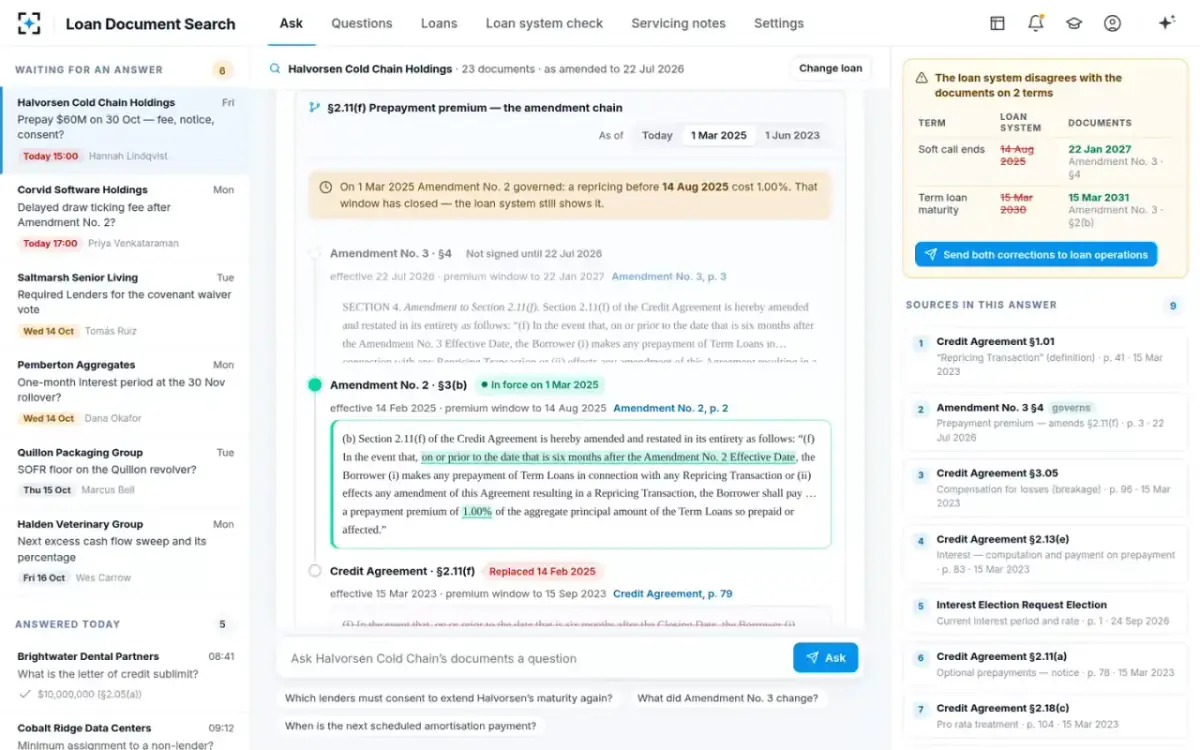
It also matters that an amendment not yet effective is not merely inoperative but absent. Asked what the loan said on 1 March 2025, the honest answer ignores Amendment No. 3 entirely: not “Amendment No. 3 says X but was not yet in force”, simply that on that date the governing text was Amendment No. 2’s. The solution draws exactly that line — on an earlier date, Amendment No. 3 is shown greyed with the note “Not signed until 22 Jul 2026”.
The chain: how one section is rebuilt from four documents
Rebuilding a section means answering, for each document in the file, whether it touched that section and when its change began. The sample loan’s prepayment premium clause, §2.11(f), runs through four executed documents and ends up with three versions — because Amendment No. 1, which added a $50 million incremental term loan and reset the amortisation, never mentioned it.
§2.11(f), the prepayment premium, in three executed versions
| Version | Effective | What it said | Where it is | Stopped governing |
|---|---|---|---|---|
| Credit Agreement §2.11(f) | 15 Mar 2023 | 1.00% on a repricing on or before the date six months after the Closing Date — a window to 15 Sep 2023 | Credit Agreement, p. 79 | 14 Feb 2025 |
| Amendment No. 2 §3(b) | 14 Feb 2025 | The same clause restated, the window measured from the Amendment No. 2 Effective Date — to 14 Aug 2025 | Amendment No. 2, p. 2 | 22 Jul 2026 |
| Amendment No. 3 §4 | 22 Jul 2026 | Restated again, measured from the Amendment No. 3 Effective Date — a window to 22 Jan 2027 | Amendment No. 3, p. 3 | in force |
Two things are worth noticing in that table. The first is that the three versions read almost the same: the wording that changed is a defined term — Closing Date, then Amendment No. 2 Effective Date, then Amendment No. 3 Effective Date — and a reader skimming for a changed number finds none. The second is that a term can move without its section being amended at all. If a later amendment redefines a term the clause uses, the clause’s words are untouched and its meaning is not; a chain built section by section without following the defined terms will miss it.
The chain beneath the answer: what governs, and what it replaced
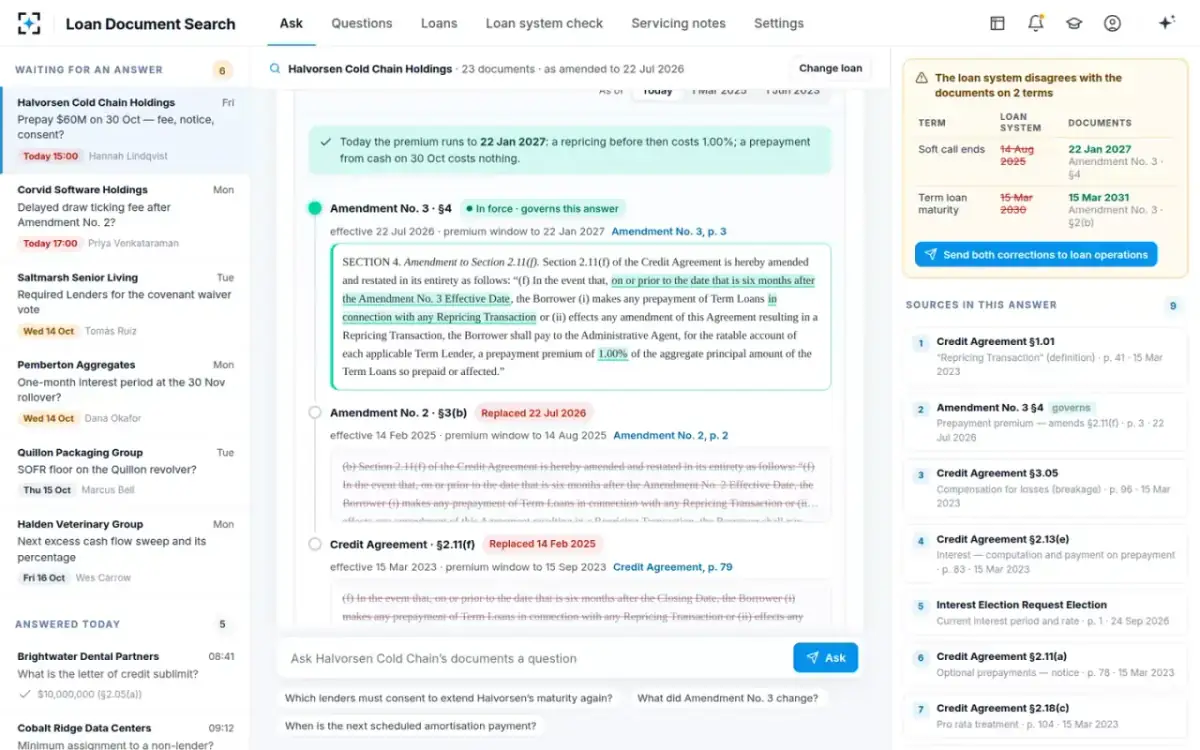
Reading as of a date, and why the date is usually not today
A servicing desk is asked about the past more often than it expects. A lender querying an invoice wants the rate that applied last quarter. A borrower disputing a fee wants the clause as it stood when the fee was charged. An auditor sampling a file wants to know what the agreement required on the day a notice went out. Each of those is a different reading of the same loan, and answering any of them from today’s text produces a confident wrong answer.
Four documents, three versions of one clause, 1,409 days
- Credit Agreement15 Mar 2023
- Amendment No. 1 — incremental term loan6 Nov 2023
- Amendment No. 2 — repricing14 Feb 2025
- No. 3 — repricing and extension22 Jul 2026
- Original §2.11(f) — window to 15 Sep 2023702 days
- Amendment No. 2 §3(b) — to 14 Aug 2025523 days
- No. 3 §4 — to 22 Jan 2027in force
Reading as of a date is mechanical once the chain exists. Take the date, discard every document whose effective date is later, and the top of what remains is the governing text. In the solution that is a control above the answer: move it to 1 March 2025 and Amendment No. 2 lights up as in force, Amendment No. 3 greys out as not yet signed, and a line of reading says what the loan said that day — a repricing before 14 August 2025 cost 1.00%, a window that has since closed.
The same clause, read as of 1 March 2025
Which version of a credit agreement governs when the documents disagree
Disagreement between documents is usually not a conflict at all; it is a chain that has not been put in order. Six questions settle almost every case, and they settle it from the paper rather than from a recollection of what the deal was meant to do.
Six questions that settle which text governs on a date
- Is it executed?
A draft, a markup, a term sheet and a conformed copy all read like the agreement and none of them is one. Only counterparts actually signed by the parties the amendment requires can govern.
- What is its effective date, and did the conditions occur?
Read the conditions-to-effectiveness section, not the date on the cover. An amendment whose conditions were never satisfied never took effect, however neatly it is filed.
- Which section does it amend?
Follow the section numbers the amendment names. A document that rewrites §2.11(f) says nothing about §2.11(a), even when a reader would expect the two to move together.
- Does a later amendment touch the same section?
If one does, the later one governs from its own effective date and the earlier version joins the history. Work down the chain from the date asked, not up from the original.
- Does a defined term the clause uses move with it?
A restated clause that measures a window from “the Amendment No. 3 Effective Date” changes meaning when that term is defined, not when the clause is read. Chase every capitalised term the clause depends on.
- Does the loan system agree with what you found?
If the billing system and the chain disagree, one of them is wrong and it is usually not the executed document. Raise the difference rather than reconciling it in your head.
Where the documents genuinely conflict, the agreement’s own amendment section is what decides, and courts read it strictly. In the Serta Simmons appeal the Fifth Circuit worked through which changes the 2016 agreement allowed a majority to make, and noted that its amendment clause generally required the consent of every affected lender before the pro rata sharing of payments could be altered ( In re Serta Simmons Bedding, L.L.C.). A purported amendment made without the consent that clause required is not a later version to be placed on top of the chain. Which thresholds apply to which changes is the subject of who must consent to what in a credit agreement.
What the loan system holds, and why it drifts from the chain
The system that bills interest and schedules amortisation is keyed from the documents once, at booking, and maintained by hand afterwards. The OCC’s handbook describes the booking step plainly: “Loan booking includes recording loans in the bank’s systems in accordance with documented loan terms as well as attaching and perfecting the bank’s lien on the collateral”, and post-closing reviews “generally confirm that loan information has been accurately entered into the bank’s systems” ( OCC, Lending and Loan Portfolio Risk Management). Both controls look at the loan once. Nothing in them re-reads the file after the third amendment lands.
So the drift is structural rather than careless. Each amendment creates a separate task — someone must notice which terms moved, key them, and have the change checked — and that task sits outside the document chain entirely. On the sample loan the system still carries a soft call ending 14 August 2025 and a maturity of 15 March 2030, both of which Amendment No. 3 replaced on 22 July 2026 with 22 January 2027 and 15 March 2031.
Neither difference would show up in a payment this quarter, which is what makes them durable. A repricing before 22 January 2027 would be billed without its 1.00% premium, and the final payment would be scheduled a year early. Across the sample agency book, a nightly comparison of 2,968 terms across 212 facilities found nine such differences on eight facilities — including a margin billed at 4.25% when the documents say 4.00%, about $180,000 a quarter. The cost of a stale system is explored further in what contract software leaves to the servicing desk.
How Loan Document Search keeps the chain and the date together
Six agents do the mechanical part and stop there. One reads every executed agreement, amendment, joinder, fee and side letter in the file and splits each into sections with its page and defined terms, indexing no unsigned draft. One builds each section as amended — which amendment last changed it, from when, and every earlier version — and never treats an amendment as effective before its effective date or merges two versions of a clause. One drafts the answer from the as-amended text, one clause per sentence. One reads every sentence back against the clause it cites and removes any the clause does not support. One counts business days and works the amounts. One compares the loan system with the top of each chain and sends differences to loan operations, where a named supervisor approves every correction.
What a reader gets is the version in force with the chain beneath it, each citation opening the executed document at its page with the clause highlighted — on the sample loan, Amendment No. 3 (Repricing and Extension), §4, page 3 of 18. Beside it sit the three versions, a redline of what each amendment changed, and the answers that have cited the clause, so a saved answer can be re-checked when a later amendment moves the text underneath it.
The citation, on the executed page it came from
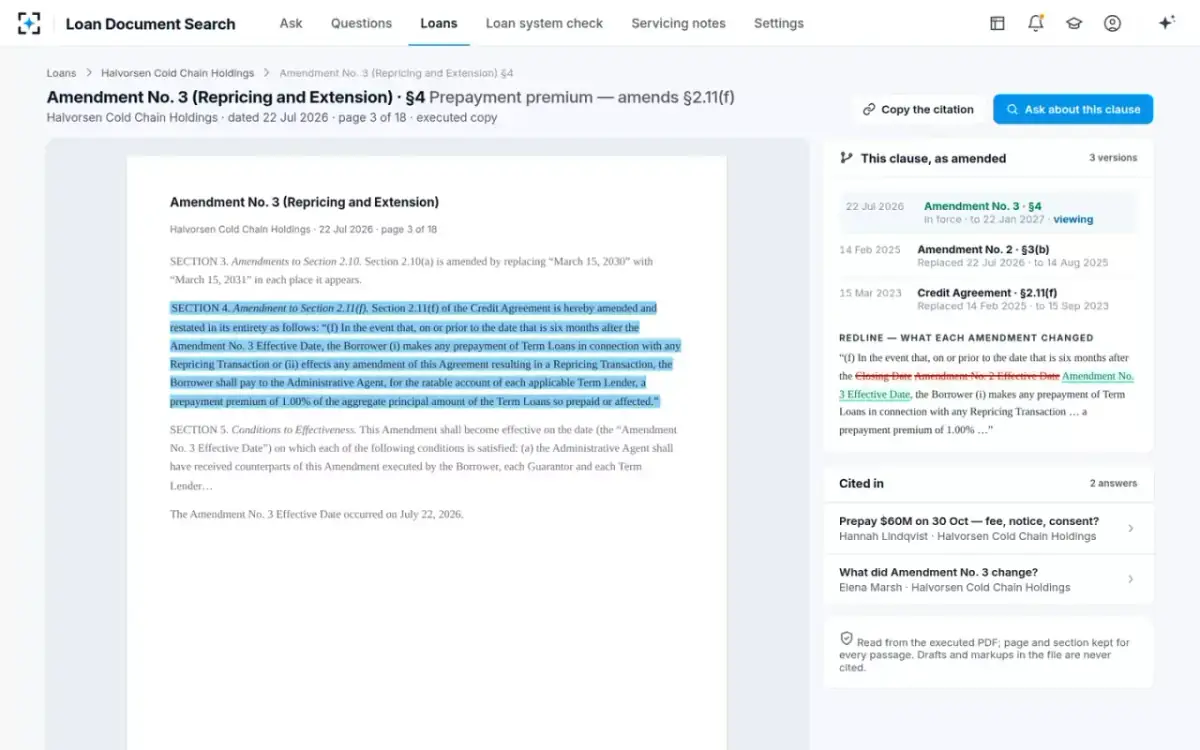
None of that is a claim about judgement. The agents read, rebuild and check; the servicing officer reads the clauses and sends the reply. To see the chain, the as-of control and the citations on a loan file, start from Loan Document Search.
Questions people ask
Does an amended and restated agreement replace the original?
It replaces the text, from its effective date forward. The restated agreement becomes the contract and the earlier wording is no longer read on its own. What happened under the old text is untouched: amounts already borrowed, payments already made, consents already given and defaults already waived all stand, and the restatement usually says so expressly.
What is a conformed credit agreement?
A working copy in which the amendments have been typed into the original so the agreement reads as one continuous text. It is unsigned, so it governs nothing. It is useful for reading and dangerous for answering: if an amendment was missed, applied twice, or applied although its conditions were never satisfied, the error is invisible on the page.
How do you tell which amendment changed a term?
Work forward from the original through every executed document, note which ones name that section, and take the latest whose effective date is on or before the date you are reading. Then check the defined terms the section uses, because a term can move in an amendment that never mentions the section at all. On the sample loan, three documents restate §2.11(f) and one — Amendment No. 1 — passes over it.
When does an amendment take effect?
On the date its conditions to effectiveness are satisfied, which the amendment usually defines and then records. That is often later than the date on the cover and later than the last signature. Where a clause measures a window from that date, every derived deadline moves with it, so the effective date is the first thing to establish and the easiest to assume wrongly.
How often are credit agreements amended?
Research on amendments filed with the SEC found the typical bank loan is renegotiated about five times, roughly every nine months, against a maturity at origination of four and a half years, and that most renegotiations move the rate, the amount or the maturity rather than only covenants ( NBER Working Paper 20484). Any particular loan may sit untouched for years; the point is that an unamended agreement is the exception.
Can you cite a conformed copy to a borrower?
You can quote from one, but the citation should name the executed document, section and page the wording actually comes from, because that is what the borrower and the lenders signed. In the solution this is a setting rather than a habit: executed documents only, with drafts, markups and term sheets kept in the file and never cited.