Required Lenders in a credit agreement are the lenders whose agreement counts as the syndicate’s agreement — almost always holders of more than half the loans and unused commitments, as the agreement’s own definition counts them. They can amend most of the document. They cannot amend all of it: a credit agreement sets its consent clause by clause, so a change that moves one lender’s money needs that lender, and a short list of terms needs every lender in the facility. The hard part is never the arithmetic of the vote. It is knowing which of the three thresholds a proposed change falls into, and that is a question about the text, not about precedent. Botminds’ Loan Document Search answers it from the agreement’s amendment section and the loan’s own register of holdings, with the clause behind each sentence.
The facility used throughout is fictional sample data from the solution: Halvorsen Cold Chain Holdings, a $475,000,000 term loan with $458,750,000 outstanding across 14 Term Lenders, Ashgrove Bank as administrative agent. Research figures come from regulators and a federal court of appeals, linked where they appear.
What are Required Lenders in a credit agreement?
The term is a defined term, and that is the whole of its meaning: whatever §1.01 says Required Lenders are, they are. In most syndicated agreements the definition is a threshold — lenders holding more than 50% of the sum of outstanding term loans and revolving commitments — with one or two refinements that matter more than they look. Defaulting lenders are usually excluded from both the numerator and the denominator. Loans held by the borrower or its affiliates are often disregarded as well, so the vote cannot be bought from the inside. Some agreements require two unaffiliated lenders, so that a single holder with 51% is not the syndicate on its own.
None of that is market practice to be assumed. It is text to be read, and the version to read is the one in force today: the definition itself can be amended, and a repricing or extension amendment is a common place for it to move. On the sample loan, every term shown as current is the version on top of its amendment chain, which is also the rule applied to the consent clause when a question like this is asked.
The three consent thresholds, and the clause that sets each
Syndicated agreements almost always use three levels, and the amendment section allocates each change to one of them. The default is the majority; everything else is an exception the clause names expressly.
Three levels of consent, and what each one is for
| Who must agree | What it typically covers | Where it is written |
|---|---|---|
| Required Lenders — the defined majority | The default. Covenant changes, waivers of a default, baskets, reporting, most definitions, and anything the amendment section does not single out. | The opening words of the amendment section, which make the majority sufficient except as the proviso states. |
| Each directly affected Lender | Changes to that lender’s own money: a reduction in principal or rate, an extension of a date on which its loan is due, a postponement of its interest, a change to its commitment. | The first list of provisos, usually written as a prohibition on doing any of these “without the written consent of each Lender directly affected thereby”. |
| All Lenders | The constitutional terms: the definition of Required Lenders itself, the amendment section, the pro rata sharing and payment provisions, and releases of all or substantially all guarantors or collateral. | The second list of provisos, written as a prohibition on acting “without the written consent of each Lender”. |
Two practical consequences follow. First, “each directly affected Lender” is not the same as “all Lenders” and the difference is often large: extending the maturity of one tranche affects the lenders in that tranche, and a lender in another tranche has no vote on it. Second, the allocation is per change, not per amendment. An amendment that reprices the margin and extends the maturity carries two thresholds at once, and the signature list has to satisfy both.
Which terms can Required Lenders not change?
The terms the agreement protects from the majority by requiring the consent of each lender they touch, or of all of them — the protections the market calls sacred rights, which the sacred rights guide catalogues in full. The phrase is market shorthand rather than a defined term, and courts use it to describe what the proviso does. The Fifth Circuit used it in the Serta Simmons appeal to explain why the ratable sharing provision sits outside the majority’s reach.
Ratable treatment is such an important norm that it is often described as a lender’s “sacred right” under syndicated loan agreements.
United States Court of Appeals for the Fifth Circuit, In re Serta Simmons Bedding, L.L.C. (2024)
The court was specific about the mechanism rather than the label. Most of the 2016 agreement could be changed by the borrower and a simple majority of its lenders; the ratable sharing provision in § 2.18 was the exception, singled out for special protection. The protection exists for two reasons the court named — “to prevent SSB from repaying one lender to the prejudice of the others, and to prevent a majority of the lenders from bargaining away the ratable-sharing provision that protects all lenders.” A sacred right, in other words, protects a minority lender against its own syndicate as much as against the borrower.
Which terms are protected varies by agreement. Principal, interest rate, fees and the dates on which they fall due are almost always in the affected-lender list. The definition of Required Lenders, the amendment clause itself and pro rata sharing are almost always in the all-lender list, because a majority able to change those could change everything else by changing them first.
Which amendments need every affected lender to consent
The affected-lender list is written in the negative, and reading it that way is the fastest route to the answer. The clause does not say who may approve a maturity extension; it says the majority may not extend a date on which a lender’s loan is due without that lender’s written consent. So the question to ask of a proposed change is not “is this allowed?” but “does this do any of the things the proviso forbids a majority to do, and to whom?”
One proposed change, five steps to the signature list
Agent
Name the sectionIdentify the section the change would amend, in the version in force today, and the defined terms it depends on.
Never: Never work from a description of the deal — work from the section number.
Agent
Read the amendment sectionCheck whether that section, or that effect, appears in either proviso. If neither names it, the majority threshold applies by default.
A person decides
Decide who is affectedAn affected-lender clause needs the consent of the lenders the change actually touches — one tranche, one maturity, one commitment — not of the whole syndicate.
Agent
Take the holdings as of todayRead the loan’s register of lenders and amounts on the date of the vote, after every assignment that has settled.
Never: Never use the syndication list from closing.
A person decides
Collect the consentsTurn the threshold into a list of names and amounts, and get the signatures the clause requires.
Never: Never assume market practice where the clause is silent.
Most of the difficulty is in the third step. A change that looks neutral can touch one lender’s economics — an amendment to the order in which payments are applied, for instance, or to a defined term used in the amortisation schedule — and a change that looks drastic can touch nobody’s, because it moves a covenant everyone is comfortable with. Where the answer is genuinely unclear from the text, the honest reply names the clause and says it does not settle the question, which is what the solution does rather than filling the gap from market practice.
Pro rata sharing: the right a majority cannot amend away
Pro rata sharing is the promise that lenders in the same tranche are paid in the same proportion. Its usual form has two halves: payments are applied rateably, and a lender who receives more than its share by set-off or otherwise must buy participations from the others so that everyone ends up level. It is the provision that makes a syndicate a syndicate rather than a set of bilateral loans that happen to share a document.
Because everything else in the agreement depends on it, it is protected twice over — by its own proviso and by the proviso that protects the amendment section. In the Serta agreement, the Fifth Circuit noted, the amendment clause generally required the consent of every affected lender to any change that would alter the pro rata sharing of payments, and if the parties wanted to change or eliminate ratable sharing “they must do so unanimously”.
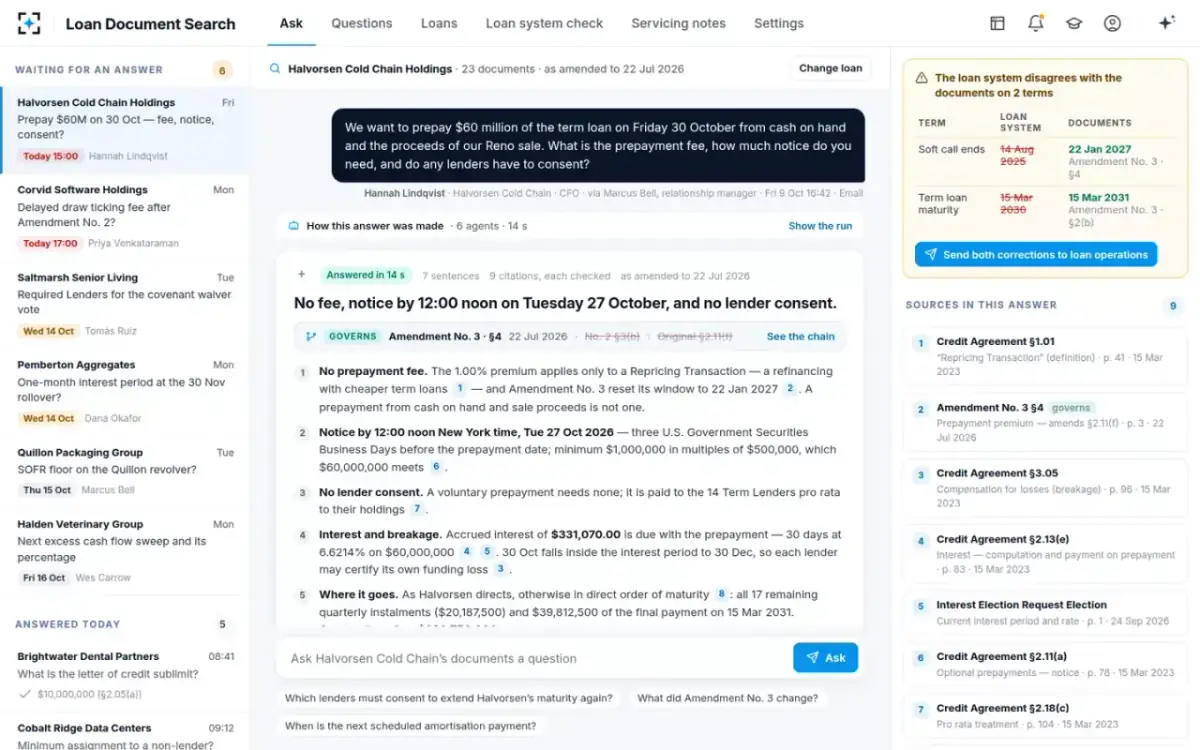
On the sample facility the same provision answers a much more ordinary question. Asked whether a voluntary prepayment of $60 million needs anyone’s consent, the answer is no — not because prepayments are generally free, but because the prepayment is paid to the 14 Term Lenders in proportion to their holdings, so no lender is treated differently from any other and nothing in the proviso is engaged. The full working behind that answer, including the premium and the notice, is in when a credit agreement actually charges a prepayment premium.
When the exception swallows the rule: a court reads “open market purchase”
Sacred rights are usually defended through an exception rather than attacked head-on. Most agreements permit a borrower to buy back its own loans by “open market purchase”, an exception written into the pro rata sharing regime so that ordinary repurchases are possible. The Serta transaction used that exception to do something much larger: a subset of lenders exchanged their debt for new, senior debt at a discount, with the rest of the syndicate left behind, and the parties argued the exception covered it.
The Fifth Circuit disagreed: the 2020 uptier, it held, was not an open market purchase the 2016 agreement permitted. The full dispute is set out in the Serta Simmons open market purchase fight. The reasoning is the part a servicing desk can use: an exception is read against the structure it sits inside, and an exception broad enough to defeat the protection it was drafted around is not the meaning the parties gave it. The practical lesson is procedural. When a proposed change relies on an exception rather than on a consent threshold, the analysis is no longer arithmetic, and the honest output is the clause, the exception and a note that the question is a legal one.
Working the answer: 14 Term Lenders, one maturity extension
Take the sample facility and a concrete question: the borrower asks to extend the maturity again, from 15 March 2031. Extending the date on which a term loan is due is squarely in the affected-lender list, and a full extension affects every Term Lender, so all 14 must sign. Required Lenders cannot do it alone, however large their majority. The question is then no longer a vote but a list — who holds what, today.
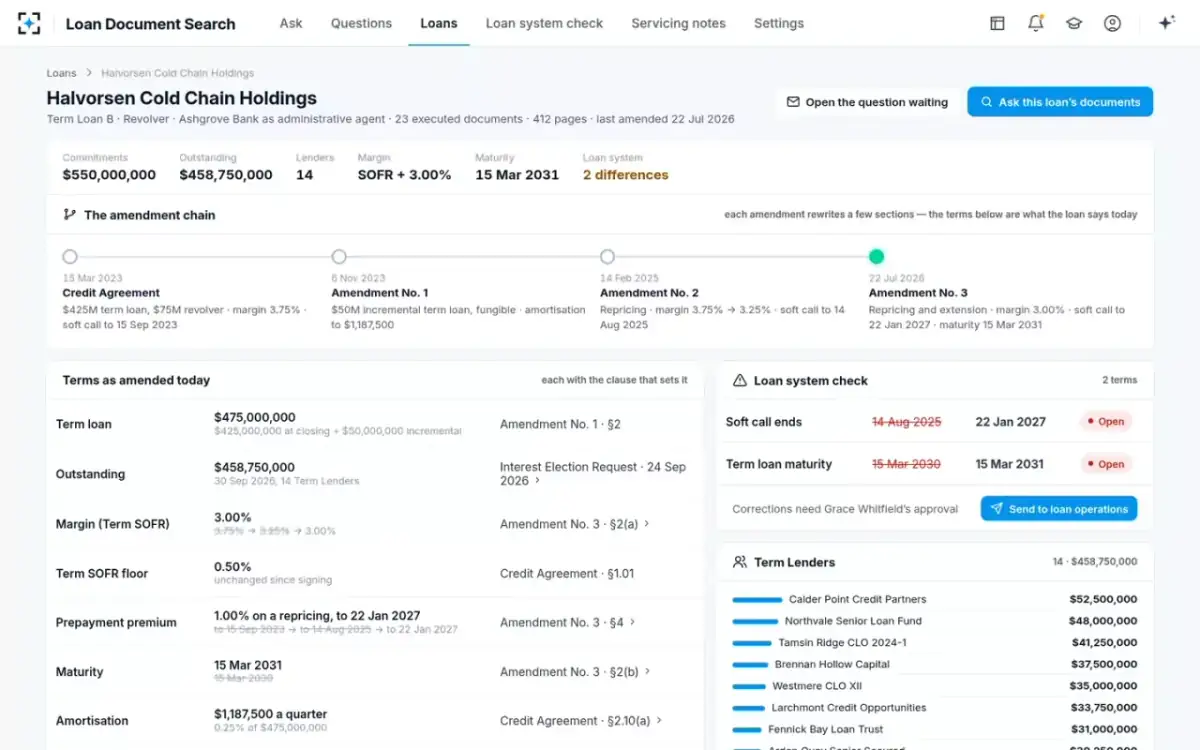
Who holds the $458,750,000, largest first
The shape of that register is the reason a consent question is rarely about one big holder. No lender here is close to a blocking position on its own, and none of the largest holdings is more than about 11% of the loan. What matters for a majority vote is the cumulative line rather than any one name.
Six of fourteen lenders are a majority; on a maturity extension that counts for nothing
A change the majority may make
- Six largest holders — $248.00M, 54.1% · 54.1%
- Eight smaller holders — 45.9%, bound by the vote · 45.9%
A full extension of the maturity
- Every one of the 14 Term Lenders must sign — 100% · 100%
Who holds the loan today, and why the register decides the answer
A syndicate is not the list of banks that signed at closing. Loans trade, and the holders on the day of a vote can be substantially different from the holders a year earlier — particularly where investment vehicles hold a large share. Across the market the 2025 Shared National Credit review found that “U.S. banks hold 45 percent of all SNC commitments”, with the rest held by other institutions; the same review notes that those banks “only hold 22 percent of non-pass loans” ( Federal Reserve, FDIC and OCC, January 2026). A majority counted from a stale register can be a majority that no longer exists.
Keeping the register current is the administrative agent’s work, and the documents behind it are their own small chain: assignment agreements, joinders, and any participation the agreement recognises. The OCC’s handbook expects the paperwork for purchased interests to set out “written documentation of transfer, servicing, events of default, collections, and recourse arrangements outlining the rights and obligations of each party”, and warns that failures of risk management in loan purchases “can subject banks to unwarranted risks such as elevated loan losses, increased legal expenses, and noncompliance with safety and soundness standards” ( OCC, Lending and Loan Portfolio Risk Management).
On the sample desk this used to be the slow half of a consent question: an agency services associate rebuilt the consent list by hand every time a lender traded out of a facility, then reconciled it against the amendment section before anyone could be asked to sign. In the solution the register sits in the loan file next to the terms as amended, so the list is read rather than rebuilt.
The loan file: terms as amended, the system check and all 14 lenders
How Loan Document Search answers a consent question from the documents
The answer to a consent question has a fixed shape: the threshold, the clause that sets it, the lenders it names, and their holdings today. Asked which lenders must consent to extend the sample loan’s maturity again, the solution answers that each Term Lender whose loan is extended must consent — a full extension needs all 14 — that Required Lenders cannot do it alone, and that Calder Point Credit Partners is the largest holder at $52,500,000. Every sentence carries its clause and page, and a sentence the citation check cannot tie back to a clause is removed before the answer is shown.
Two limits are worth stating because they are what makes the answer usable. The agents answer only from executed documents: drafts, markups and term sheets stay in the file and are never cited, and where the documents do not settle the question the answer says so and names the closest clause. And nothing is sent by an agent — the servicing officer reads the clauses, checks them, and sends the reply from their own mailbox.
A cited answer, with the governing amendment above it
Consent questions arrive beside every other kind. The same desk is asked about ticking fees, SOFR floors, excess cash flow sweeps and interest period elections, each of which needs the clause as amended rather than the clause as signed — the subject of which version of a credit agreement governs today. Research on amendments filed with the SEC found that “the plurality of renegotiations (46%) modify only the covenant package” ( NBER Working Paper 20484) — which leaves a majority of renegotiations touching the terms that carry the higher consent thresholds. To see the register, the thresholds and the citations together, start from Loan Document Search.
Questions people ask
What is the usual Required Lenders threshold?
Most syndicated agreements set it at holders of more than 50% of outstanding loans and unused commitments, with defaulting lenders excluded and loans held by the borrower’s affiliates often disregarded. Some set it higher, and some require at least two unaffiliated lenders so one holder cannot be the syndicate alone. The only threshold that binds a particular facility is the one in its own definition, as amended.
Can a majority of lenders bind the rest?
On most of the agreement, yes — that is what the majority threshold is for, and a dissenting lender is bound by an amendment it voted against. On the terms the provisos carve out it cannot: a change that reduces a lender’s principal or interest, or moves a date on which its money is due, needs that lender’s own signature however small its holding.
Who must consent to extend a loan’s maturity?
Each lender whose loan is being extended, because the extension moves a date on which that lender’s money is due. A partial extension therefore needs only the lenders who agree to extend, which is how non-pro-rata extension amendments are built; a full extension needs everyone in the tranche. On the sample facility that is all 14 Term Lenders.
What is pro rata sharing in a syndicated loan?
The requirement that payments be applied among the lenders in proportion to their holdings, with a sharing mechanism that makes a lender who recovers more than its share buy participations from the others. The Fifth Circuit described ratable treatment as a norm so important that it “is often described as a lender’s ‘sacred right’”, and noted that the agreement before it allowed the parties to change or eliminate it only unanimously.
Do defaulting lenders vote?
Usually not. Agreements commonly disregard a defaulting lender’s holdings in computing Required Lenders, so the threshold is measured over the rest. The protection is partial: most agreements still require a defaulting lender’s consent to a change that directly affects its own principal, rate or maturity, so it loses its share of the majority without losing its individual veto.
How long does it take to collect lender consents?
It depends almost entirely on the threshold rather than on the change. A majority can often be assembled from a handful of large holders in days; an all-lender item has to reach every holder, including investment vehicles whose approval runs through their own process, and a single unreachable lender stops it. That is why establishing the threshold first, from the clause, is worth more than starting the calls early.