A loan operations specialist is the person who makes sure a bank's loan records match the documents the bank actually signed, and who answers for them when a borrower, a lender or an examiner asks. On a commercial or syndicated book that means servicing the facility day to day: keying the terms, applying payments and rate resets, reconciling the loan system to the documents, chasing missing paperwork, and answering the questions that arrive by email about fees, notice periods and consents. The work is hard for an unglamorous reason — the answer is never in one place. It sits in a credit agreement of a hundred pages or more, rewritten in part by every amendment since closing, and the system that bills interest may still hold the term the last amendment replaced. Botminds' Loan Document Search is built for that desk: it reads the executed loan file, answers the question in plain words with the clause and page behind every sentence, and flags where the loan system and the documents disagree — while the specialist keeps the judgement and the send button.
The desk on this page is a fictional sample: Ashgrove Bank's agency services team, 212 facilities, five named people who do not exist. The research figures are from the Office of the Comptroller of the Currency and the Bureau of Labor Statistics, linked where they appear.
What does a loan operations specialist do?
Strip the job titles away and the desk does five things. It sets the loan up — the terms from the executed agreement keyed into the servicing system, the amortisation schedule, the rate basis, the fee grid. It runs the money — interest accruals, rate resets, scheduled amortisation, commitment and utilisation fees, payment application, lender distributions on a syndicated facility. It keeps the file — every executed amendment, joinder, assignment, fee letter, compliance certificate and notice, filed so that it can be found and so that exceptions are visible. It reconciles — the system against the documents, the subsidiary records against the general ledger, the lender register against what was actually funded. And it answers — the borrower's treasurer, the lenders, the relationship manager and, at intervals, internal audit and the examiner.
The last of those is the one that eats the week and never appears in a job description. A single question — what does it cost to prepay $60 million on 30 October, how much notice do we owe, and does any lender have to agree? — is three separate readings of the agreement as amended, a business-day count on the right calendar, and an interest calculation, before a word of the reply is written. The desk's quality is judged on the reply; almost all of its time goes on what comes before it.
One morning's questions, and who is waiting on each
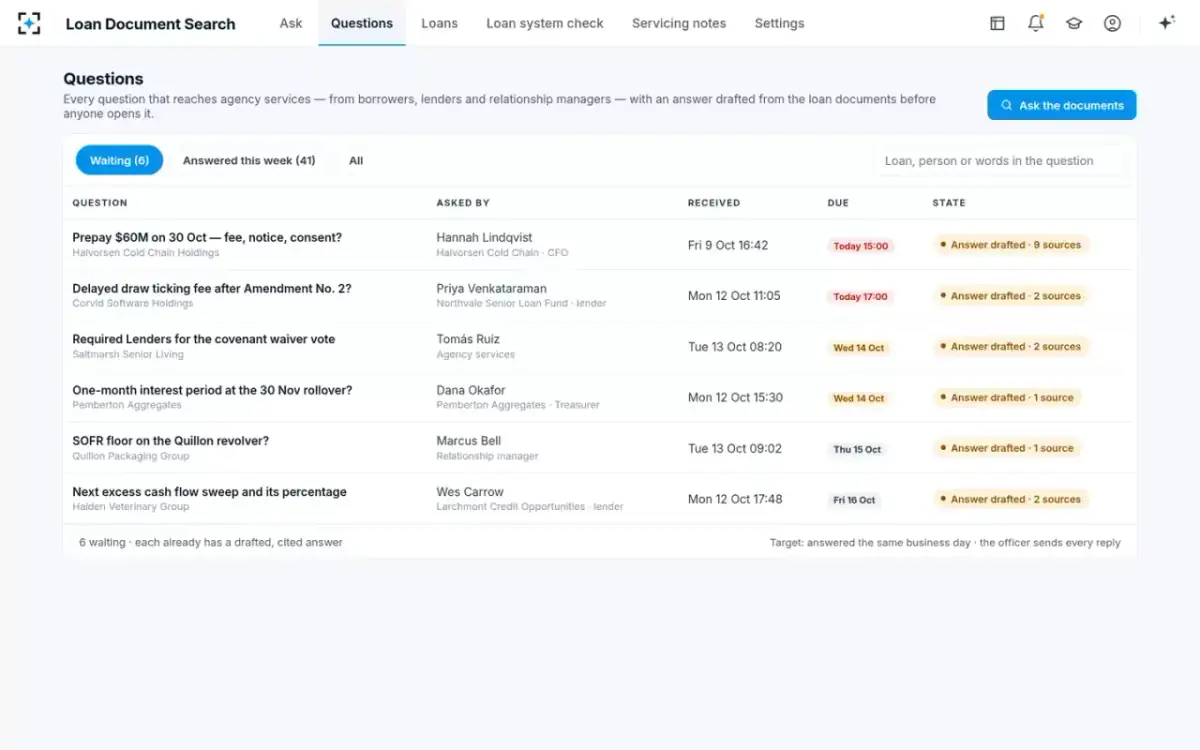
Who asks matters as much as what is asked. On the sample morning above, two of the six questions come from borrowers, two from lenders in the syndicate, one from a relationship manager asking on a client's behalf and one from inside agency services. Each has a different tolerance for delay and a different consequence if the answer is wrong. A lender told the wrong ticking-fee end date reconciles a smaller number than the agent billed; a borrower told there is no prepayment premium when there is cannot easily be told otherwise a week later.
Credit administration: the operations arm of lending
Supervisors have a name for the desk and a view of what it is for. "Credit administration is an important control mechanism, and it is often the operations arm of the lending function," the OCC's examiners are told in the Lending and Loan Portfolio Risk Management booklet of the Comptroller's Handbook, which also notes that "in many banks, the credit administration function has two primary components, loan administration and portfolio management" and that loan administration, the first of those, "is often referred to as back-office operations" (OCC, version 1.0, July 2026).
Two words in that first sentence do a lot of work. Control means the desk is not there to type faster; it is there so that the loan the bank believes it owns is the loan it signed. Operations arm means it sits downstream of a credit decision it did not make, carrying out terms somebody else negotiated — which is exactly why its authority to change anything is deliberately narrow.
The same booklet is blunt about what goes wrong. "There can be significant operational risk in credit administration due to risks of human error or fraud, which can result from factors such as inadequate staffing (e.g., in number or expertise), insufficient segregation of duties, inadequate or outdated reporting systems, lack of proper controls, or insufficient training." Every seat described below exists because one of those five failed somewhere, once.
Five seats around one borrower question
On a small book the five seats are two people wearing different hats; on an agency desk servicing hundreds of syndicated facilities they are distinct roles with distinct permissions. The division is not bureaucratic. It is the segregation of duties the control framework asks for, drawn around a single question so that nobody both calculates a number and approves it.
The five seats, and what each one owns in the week
Today
Services 38 facilities and fields 20 to 30 questions a day; each one starts with finding the right page in the right amendment.
With agents
Opens each question with a cited answer already drafted, checks the clauses and the working, and sends the reply herself.
Still theirs: The judgement, the wording of the reply, and the send button — every reply leaves from her own mailbox.
Today
Rebuilds who must consent every time a lender trades out of a facility.
With agents
Asks the loan documents which lenders must consent, and sees the fourteen term lenders and their holdings in the loan file.
Still theirs: The lender register, assignments, consent solicitations and the vote count.
Today
Terms are keyed once and amended by hand, so the system that bills can disagree with the signed amendment.
With agents
Gets each difference the morning after it appears, with the system value, the amended term, the clause behind it and what it costs.
Still theirs: Approval. No term changes in the loan system without her, and no agent touches it at all.
Today
Forwards a client question to agency services and waits, with a call already in the calendar.
With agents
Asks in plain words and sees the answers for his own clients; on the sample prepayment he is copied on the reply.
Still theirs: The client conversation — and only his own clients’ answers are visible to him.
Today
Owns 212 facilities, the response times and the audit findings — and every answer her team gives.
With agents
Sees the whole book: outstanding, lenders, last amendment, documents read and where the loan system differs, with seventeen facilities amended in the last ninety days.
Still theirs: The standard the desk answers to, and the escalation when it is not met.
Notice what the five seats have in common: not one of them is an approval of the borrower's credit. That decision was made elsewhere and is reviewed elsewhere. These five carry out a contract, and the discipline of the desk is to do only that — which is why "the agreement does not say" is an acceptable answer here and "market practice suggests" is not.
What is the difference between loan operations and loan servicing?
Loan servicing is one part of loan operations, not a synonym for it. The OCC booklet puts servicing inside the wider administration function and defines it narrowly: "Loan servicing and monitoring involve ongoing maintenance of each loan until payoff." Loan operations is the whole back office around that — closing and funding, document custody, system setup, payment processing, reconciliation, exception reporting and the controls over all of it.
In practice the line falls where the borrower stops being the counterparty. Servicing faces the borrower and, on a syndicated facility, the lenders: statements, rate notices, payment application, requests and consents. Operations faces the bank: that the system agrees with the file, that the general ledger agrees with the subsidiary records, that nothing was keyed twice and nothing was keyed by the person who also approved it. A job advertised as "loan servicing specialist" usually means the first; "loan operations specialist" usually means both, with the weighting set by how big the bank is.
The same facility, as each function sees it
| Question | Loan servicing answers | Loan operations answers |
|---|---|---|
| Who is the counterparty? | The borrower, and on a syndicated facility every lender in it. | The bank’s own records, auditors and examiners. |
| What is the daily work? | Payments, rate resets, draws and repayments, notices, borrower and lender questions. | Setup, document custody, reconciliation, exception reports, access and approvals. |
| What does failure look like? | A wrong number quoted to a borrower, or a notice deadline missed by a business day. | A term billed from a superseded amendment, or one person keying and approving the same change. |
| Who signs off? | The servicing officer, on the reply that goes out. | The operations supervisor, on anything that changes the system of record. |
| What does the desk keep? | The servicing notes: the answer, its clauses, who checked it and when. | The control evidence: who approved what, and the reconciliation that proves it. |
The controls between the seats, and why they exist
Ask an examiner what good looks like on this desk and the answer is a short list of controls, not a headcount. "Effective loan administration generally includes various internal controls such as segregation of duties, dual controls, independent reconciliation of fund disbursement and accounting records, and quality control processes," the handbook says. The list is worth reading as four separate promises rather than one phrase.
What a reviewer looks for between the seats
- Segregation of duties
The person who calculates a figure is not the person who approves it, and the person who answers a borrower is not the person who changes the system that bills them. On the sample desk the servicing officer sends the reply and the operations supervisor approves the correction; neither can do the other’s half.
- Dual controls
Anything that moves money or changes a term needs two sets of hands. The practical test is whether the second pair can actually see what they are approving: a correction presented as a clause, a system value and what the difference costs is reviewable; one presented as a field name and a new value is a signature, not a control.
- Independent reconciliation
Disbursement and accounting records are reconciled by someone outside the process that created them. Extend the same idea to terms, and the question becomes: who checks that the maturity date in the servicing system is the maturity date in the latest executed amendment, and how often?
- Quality control over the answers, not just the entries
Keying is checked in most banks; answers usually are not. A written answer that leaves the building with no record of which clause it rested on cannot be reviewed after the fact, and cannot be re-checked when a later amendment changes that clause.
- A named approver for every system correction
Not a role in a policy document — a person, on the record, for each change. The sample desk routes every difference to the operations supervisor by name, and no automated step may write to the loan system at all.
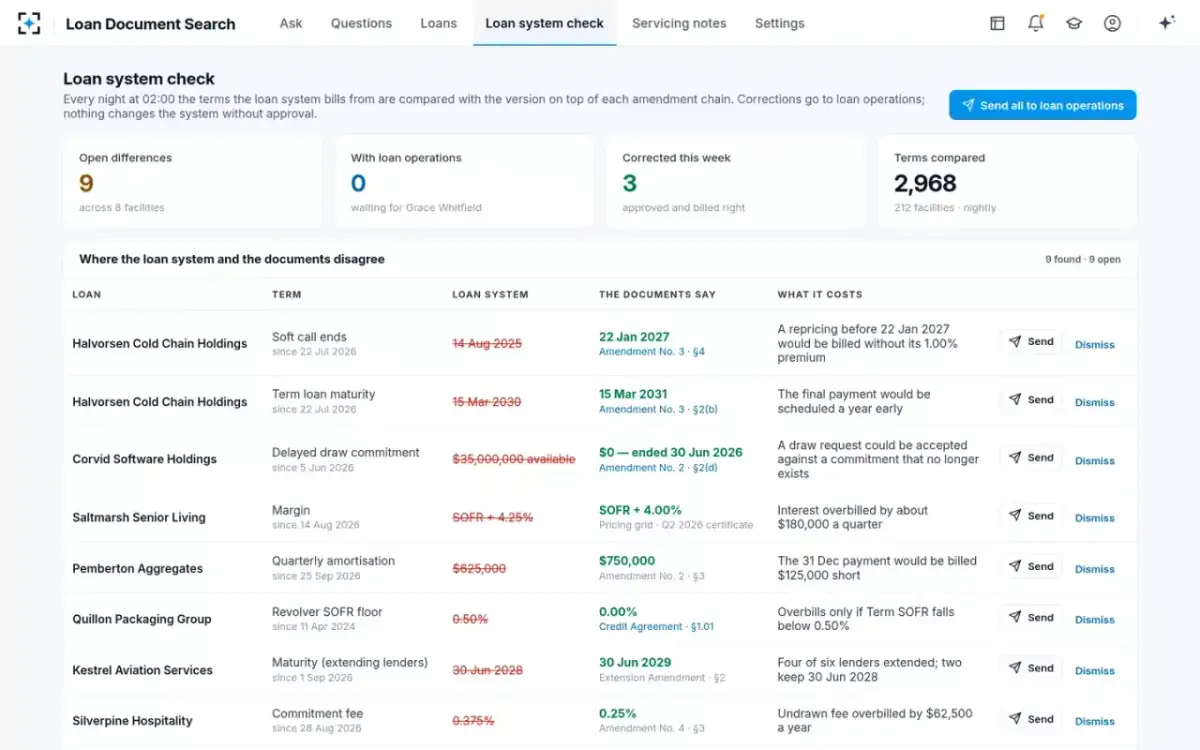
The reconciliation control is the one most often written for cash and not for terms. Cash breaks are loud: a payment that does not clear is chased the same day. A term break is silent. A soft call window that ended in the documents a year ago but still sits open in the servicing system costs nothing until the day somebody reprices, and then it costs the whole premium. Running the term reconciliation for the first time is usually how a desk discovers how many of those it has.
A term reconciliation, the morning after it ran
Loan operations specialist salary, and what the work is worth
There is no occupational code called "loan operations specialist", which is why salary searches for it return such a wide range: the title straddles two Bureau of Labor Statistics occupations with very different pay and very different outlooks. Loan officers — the lending-side occupation most servicing and agency roles are benchmarked against — had a median annual wage of $76,690 in May 2025. Financial clerks, the family that covers much of the processing and reconciliation work, had a median of $49,990 in the same month, and held about 1.1 million jobs.
Two occupations, one desk: the pay the title sits between
The gap between the two lines is the honest answer to "what is the work worth". The BLS attributes the slow growth on the lending side to specific causes: "the decline of bank branches and the increased use of productivity-enhancing technology in loan processing are expected to slow employment growth." The processing side is projected to shrink outright. Pay on this desk therefore tracks how much of a role is irreducibly judgement — reading a clause whose two versions disagree, deciding what to tell a borrower, approving a correction that will change what the bank bills — and how much is finding, re-keying and re-typing.
That is a useful way for a candidate to read a job advertisement and for a manager to write one. A posting that lists only tasks a well-built system performs is advertising a role whose market is declining. One that names the decisions the holder owns — which answers go out, which corrections are approved, which exceptions escalate — is advertising the part of the desk that is getting more valuable, not less.
Where the hours actually go in a servicing week
The time a document question takes is spent almost entirely before the answer exists. On the sample desk, a servicing officer's document-question work is estimated at about three of five working days, split across five tasks; the same five tasks are estimated at about three-quarters of a day once the loan file is read, sectioned and tracked by amendment. The table below sets each task against the seat that owns it and the control that sits on it, because the hours and the controls are the same argument seen twice.
One week of document questions: the task, the seat, the control and the estimated days
| Task | Whose seat | The control on it | By hand | With the solution |
|---|---|---|---|---|
| Finding the loan file and the latest executed amendment | Servicing officer | Document custody and exception reporting: an amendment that is not filed cannot be found, and will not be missed either. | 0.6 days | 0.1 days |
| Reading the section and the defined terms it depends on | Servicing officer | Quality control over answers: a reading nobody records cannot be reviewed. | 0.9 days | 0.2 days |
| Checking which amendment last changed the term | Servicing officer, with agency services | Independent reconciliation: the version in force is what the system should be billing from. | 0.5 days | 0.1 days |
| Counting business days and working the amounts | Servicing officer | Dual controls: the calculation and its approval are different hands. | 0.5 days | 0.1 days |
| Writing and checking the reply | Servicing officer, copied to the relationship manager | Segregation of duties: the person who sends is accountable for what was sent. | 0.5 days | 0.2 days |
The row that shrinks least is the last one, and that is deliberate. Writing and checking the reply is where the officer's judgement lives: whether the question asked is the question meant, whether a borrower needs the caveat spelled out, whether the answer should be a sentence or a call. Compressing the four rows above it is what buys the time to do that part properly.
What changes when agents draft and a person sends
The OCC's National Risk Committee describes where banks have landed on this: a measured approach to generative and agentic AI, used for specific purposes, with guardrails and a person accountable in the loop (OCC, Semiannual Risk Perspective, Spring 2026). On a loan desk, human-in-the-loop accountability has a precise meaning: a named person, in a named seat, is accountable for each thing that leaves the building or changes a system — and the automated steps stop one move short of both.
One borrower question through the desk, and the two things no automated step may do
A person decides
The question arrivesA borrower, a lender or a relationship manager asks in plain words. It lands in the agency queue with the loan it belongs to and the time it is due.
Agent
The loan file is readEvery executed agreement, amendment, joinder, fee letter and notice is opened and split into sections, each keeping its page and its defined terms.
Never: Never indexes an unsigned draft as an executed document
Agent
The term is built as amendedEach section is assembled as it stands today: which amendment last changed it, from what date, and every earlier version beneath it.
Never: Never treats an amendment as effective before its effective date, and never merges two versions of a clause
Agent
The answer is draftedA short answer in plain words from the as-amended text, one claim per sentence, each sentence carrying the clause it rests on.
Never: Never answers from memory or market practice; says so, and names the closest clause, when the documents are silent
Agent
The dates and amounts are workedBusiness days counted on the facility’s own calendar, interest and premiums calculated, and the application of a prepayment set out line by line.
Never: Never rounds a figure, and never estimates a lender’s breakage
Agent
Every sentence is read backEach sentence is checked against the clause it names; anything the clause does not support is rewritten or removed before a person sees it.
Never: Never adds a source the draft did not already use
A person decides
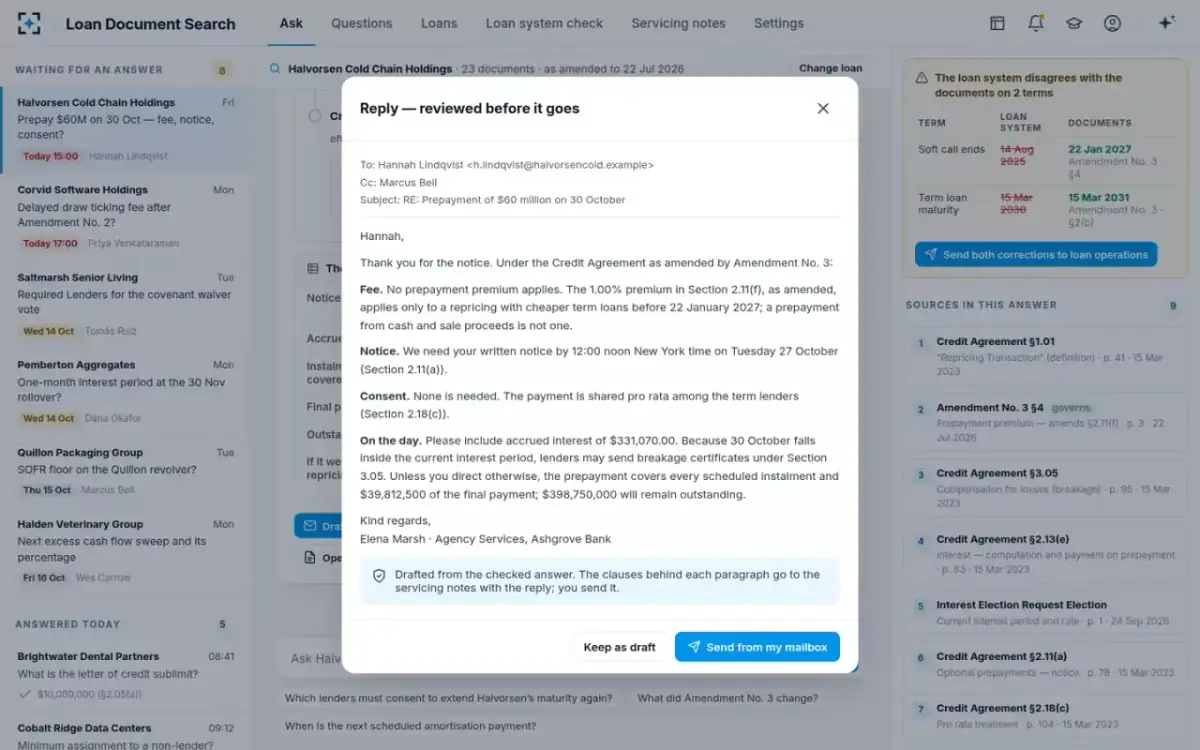
The officer checks and sendsThe servicing officer reads the answer and the working, opens any clause she wants to see, edits the reply and sends it from her own mailbox. The clauses behind each paragraph are saved with it.
Never: Nothing goes to a borrower or a lender except from the officer
A person decides
Loan operations approves any correctionWhere the loan system and the documents disagree, the difference goes to the operations supervisor with the clause and what it costs, and she approves each change.
Never: No automated step writes to the loan system
Read that chain from the control framework's point of view and nothing has actually been handed over. The calculation and the approval are still different hands. The sender is still accountable for what was sent. What has changed is the evidence: where the desk previously had a reply and a memory, it now has a reply, the clauses behind each paragraph, and the record of who checked them — which is the only form in which a cited answer can be tested at all.
The reply the officer sends, and the line under it
Is loan operations a good career as the work is automated?
The projections above say the headcount is flat to falling and the processing end is falling fastest. That is a real answer, and it is not the whole one. Two things on this desk are getting harder, not easier, and both sit on the judgement side of the line.
The first is that loan documents keep moving. A facility is amended, repriced, extended and assigned over its life, and each change means a term somewhere now has two versions and a date that separates them. Somebody has to decide which one governs on the day being asked about — a question that, as the difference between an amendment and an amended and restated agreement shows, is less obvious than it sounds. The second is that as more answers are drafted by software, the scarce skill becomes checking them. Reading a clause and deciding whether the sentence in front of you is actually supported by it is a harder skill than finding the clause was, and it is the one the desk will be paid for.
So the honest career advice is specific rather than cheerful. Depth in one product — syndicated agency, asset-based, real estate — is worth more than breadth across three, because the judgement is in the document conventions. Learn to read the amendment chain, not just the current conformed text. Learn which calendar a notice period runs on and why it matters. Be the person who can say what the agreement does not say. None of that is clerical, and none of it is in the projection that says financial clerk employment falls four percent.
Questions people ask
What qualifications does a loan operations specialist need?
Most postings ask for a degree in business, finance or accounting, or equivalent experience in a bank's back office; a few ask for none. What distinguishes candidates in practice is document literacy — being able to read a credit agreement and its amendments and say what a term is today — plus comfort with the servicing system and the reconciliation discipline behind it. On a syndicated agency desk, familiarity with loan market documentation conventions matters more than any certificate.
Is loan operations the same as credit administration?
Close, but credit administration is the wider term. The OCC describes credit administration as having "two primary components, loan administration and portfolio management" — the second being the credit risk monitoring side, such as risk ratings and portfolio reporting. Loan operations is essentially the first component: setup, servicing, custody, reconciliation and controls.
Who approves a correction to a loan system?
In a bank with properly segregated duties, never the person who found it. The finder documents the difference with the evidence behind it; a supervisor or a second approver with the authority to change the system of record signs it off. On the sample desk every difference routes to the loan operations supervisor by name, and no automated step has write access to the servicing system at all.
How many loans can one servicing officer handle?
It depends almost entirely on how much the facilities move. The officer on the sample desk services 38 syndicated facilities and fields twenty to thirty questions a day — a plausible load for agency work, where each facility has multiple lenders and a live amendment history. A book of bilateral term loans that never change can run into the hundreds per officer; one with frequent amendments, draws and assignments cannot.
What skills does a loan operations specialist need most?
Reading comprehension under a deadline, arithmetic you can show your working for, and the willingness to say "the documents do not answer that". The first two are teachable. The third is a cultural property of the desk: a team that treats "I do not know yet" as a failure will get confident wrong answers, which cost far more than slow right ones.
What does an agency services associate do that a servicing officer does not?
The associate owns the syndicate side: the lender register, assignments and trades, consent solicitations and vote counts. When a lender sells part of its commitment, the register changes and so does the list of who must consent to the next amendment — which is why who counts as Required Lenders is a question that has to be re-answered against the register as it stands today, not as it stood at closing.