Contract lifecycle management software manages a contract from request to signature: templates and clause libraries, negotiation and redlines, approvals, electronic signature, then a searchable repository with renewal dates and obligations attached. On a loan book that covers the first few months of a credit agreement’s life and almost none of the rest. A credit agreement is renegotiated repeatedly, each amendment rewrites a handful of sections, and the question the desk is actually asked — what does §2.11(f) say today, and what does it cost on Friday — is not a retrieval problem a repository was built to solve. The cost a loan book carries is not storage or workflow; it is the minutes between a question and a citable answer, multiplied by every amendment that moved a term since the file closed. Botminds’ Loan Document Search is built for that second half, and it sits beside the systems you already own rather than replacing them.
The figures that describe a desk come from fictional sample data in the solution: an agency book of 212 facilities and $38.6 billion of commitments, 4,906 executed documents. The research figures come from regulators, a peer-reviewed working paper and the Bureau of Labor Statistics, linked where they appear; the arithmetic built on them is ours, with its inputs stated.
Three numbers a finance committee can check
9mths
between renegotiations on the typical bank loan (NBER, 2014)
$76,690
median annual wage for loan officers, May 2025 (BLS)
≈30min
to answer one document question by hand — our estimate
What does contract lifecycle management software do?
It industrialises the path to signature. The standard set of capabilities is request intake, a template and clause library, drafting and negotiation with version control, approval routing, electronic signature, and a repository with metadata, reminders and reporting on the obligations and dates someone has tagged. Everything in that list is real work and most legal and procurement functions are better for having it.
Two assumptions sit underneath it, and both hold for the contracts it was designed around. The first is that the signed document is the end state: the repository stores a finished thing. The second is that the useful questions about a contract are metadata questions — when does it renew, who owns it, what is the notice period, which contracts contain this clause — answerable from fields someone filled in when the contract was filed.
A credit agreement breaks both. It is not a finished thing; it is the first document in a chain. And the questions it attracts are not field lookups but readings: what this section says once three amendments have rewritten parts of it, measured from a defined date, as at a day the asker usually has in mind.
The loan book’s shape: one agreement, five renegotiations, one question a day
Amendment is the normal state of a commercial loan rather than an exception to it. Roberts, studying amendments filed with the SEC, found that once the few short-term loans that are never renegotiated are set aside, the typical loan starts with a maturity of about four and a half years and is renegotiated almost five times — roughly every nine months ( NBER Working Paper 20484). A repository holding one credit agreement per borrower is holding roughly a fifth of each loan’s governing text.
The volume of those agreements is not small. The 2025 Shared National Credit review covered loans where “the reviews focused on leveraged loans and stressed borrowers from various industry sectors and assessed aggregate loan commitments of $100 million or more that are shared by multiple regulated financial institutions” ( Federal Reserve, FDIC and OCC, January 2026). Each of those credits has an administrative agent, and every agent is the single point of contact for a borrower and a syndicate that ask questions continuously.
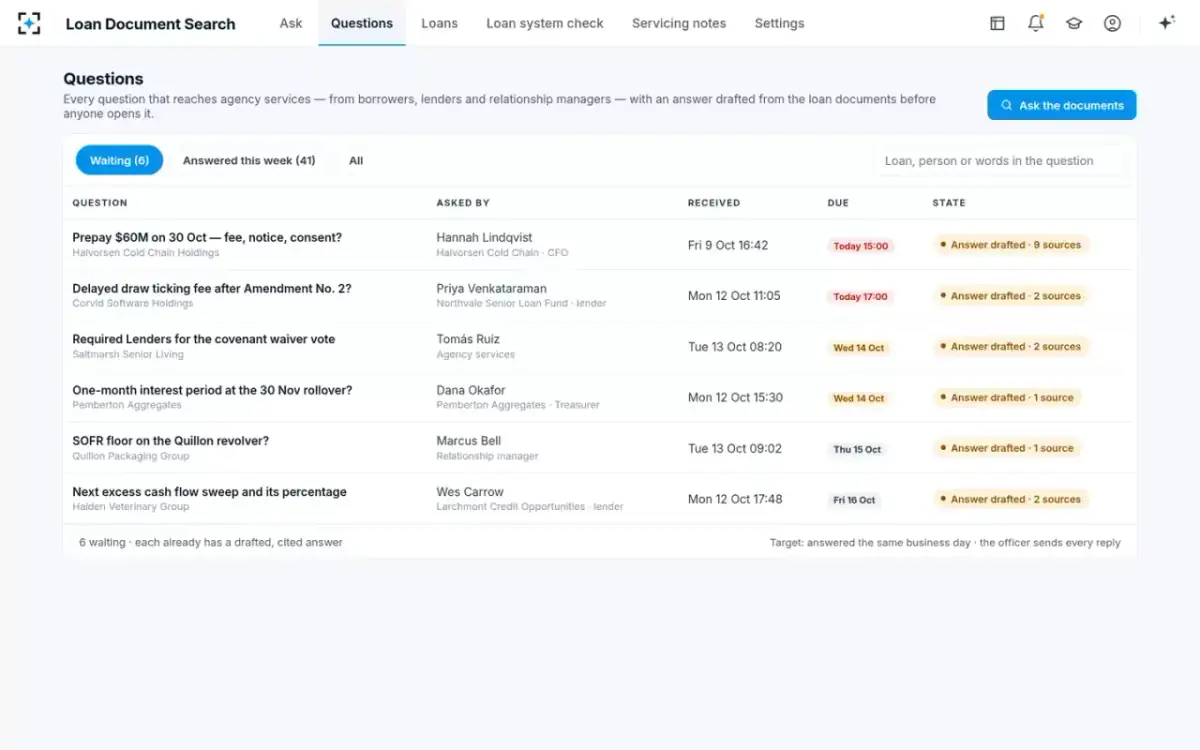
On the sample agency book, 212 facilities produce a steady queue: six questions waiting at any moment, 41 answered in a week, each one requiring the current text of a section, its defined terms, and usually a date or an amount worked out from it. The pattern is not a spike around a renewal; it is a constant, and it is the shape a system should be designed for.
Where contract lifecycle management software stops, and the servicing desk starts
The boundary is clean enough to draw. Up to and shortly after signature, contract software is working on the thing it was built for. After that the desk takes over and the tools stop helping in a specific, identifiable way: they can return the documents, and the person still has to do the reading.
A repository and a servicing desk are asked different questions
Contract lifecycle management: Executed contracts with metadata — parties, dates, values, clause tags — plus the negotiation history that produced them.
A loan document answer desk: Every executed agreement, amendment, joinder, fee and side letter, split into sections with page numbers and defined terms, with each section rebuilt as amended.
Contract lifecycle management: “Find the agreement.” “Which contracts renew in Q1?” “Which of these contain a change-of-control clause?”
A loan document answer desk: “What is the prepayment fee on Friday?” “How much notice does the borrower owe?” “Which lenders must consent?” “What did Amendment No. 3 change?”
Contract lifecycle management: Documents, fields and reports. The reading is the user’s job.
A loan document answer desk: A short answer in plain words, with the clause and page behind every sentence and the amendment chain beneath it.
Contract lifecycle management: Cycle time to signature, template adoption, repository completeness, renewals not missed.
A loan document answer desk: Time from question to a citable answer, share of answer sentences carrying a clause, and differences found between the documents and the billing system.
Contract lifecycle management: A term that moved after signature. Metadata ages the moment an amendment lands, and nothing in the workflow re-reads the file.
A loan document answer desk: Anything before signature. It does not negotiate, draft or route approvals, and it should not be bought to.
The symptom a head of servicing recognises is not a missing document. It is that the document was found in thirty seconds and the answer still took half an hour, because what followed was reading: the section, the defined terms it uses, the three amendments that may have touched it, the calendar the notice period is counted on, and then the arithmetic.
What a loan document system has to do that contract management does not
Four things, and none of them is search. It has to build each section as amended, so the text a reader sees is the text in force rather than the text as signed. It has to be able to answer as of a date, because lenders, auditors and borrowers routinely ask about the past. It has to carry a citation on every sentence, so an answer can be checked rather than trusted. And it has to count and calculate — business days on the right calendar, interest, premiums, where a prepayment lands — because a question about a loan is usually a question about a number.
A fifth is specific to lending and is the one most often discovered late. The system that bills the loan is keyed from the documents once, at booking, and maintained by hand afterwards. The OCC’s handbook is blunt about where that leads: it names human error and fraud as the operational risk in credit administration, and lists the conditions that breed them — thin or inexpert staffing, poor segregation of duties, outdated reporting systems, weak controls and too little training ( OCC, Lending and Loan Portfolio Risk Management). Comparing the billing system with the documents is a control, not a feature, and it is not one a repository can perform.
How much does contract lifecycle management software cost?
Published list pricing for these products comes from the vendors themselves, which is not a source this guide will put a number from in front of a committee. What can be said is how the pricing is shaped: it is usually a platform fee plus a per-seat charge, with modules priced separately, implementation and template migration charged once, and an annual uplift. The number is therefore a negotiation, and the proposals you receive are the only honest input for your own paper.
The cost that can be computed independently is the one the software is supposed to reduce — the desk’s time — and it comes from public wage data. The Bureau of Labor Statistics puts the median annual wage for loan officers at $76,690 in May 2025 ( BLS, Loan Officers) and for financial clerks at $49,990 ( BLS, Financial Clerks). Those are the two seats most document questions land on, and they give a defensible hourly rate before benefits and overhead: about $36.87 and $24.03 an hour at 2,080 hours a year.
The second computable cost is error. The OCC lists the ones banks have actually paid for — losses from unsigned documents, misdirected proceeds and unperfected liens, and notes that the same errors also surface as billing mistakes, payment processing errors and customer service problems — the list is quoted in full in the prepayment premium guide. A billing mistake has a number attached, and the sample book supplies one below.
The arithmetic: minutes a question, questions a day, a desk’s year
The business case is one multiplication, and every input in it should be a number your own desk can replace. Start with where a servicing officer’s week actually goes.
Where a week of document questions goes, before and after
By hand — about 3.0 of 5 working days
- Finding the loan file and the latest amendment · 20%
- Reading the section and its defined terms · 30%
- Checking which amendment changed the term · 17%
- Counting business days and working the amounts · 17%
- Writing and checking the reply · 16%
With the agents — about 0.7 of 5 working days
- Finding the loan file and the latest amendment · 3%
- Reading the section and its defined terms · 7%
- Checking which amendment changed the term · 3%
- Counting business days and working the amounts · 3%
- Writing and checking the reply · 7%
- Time returned to the desk · 77%
Three of five working days is 24 hours of a 40-hour week, or roughly 48 questions at half an hour each — a subset of the 20 to 30 questions a day the sample desk’s officer fields, most of which are quicker. At the loan officer median wage that is about $18.44 of wages per answered question, and three-fifths of the $76,690 median — about $46,000 a year — for one officer’s document questions, before benefits and overhead. The same questions at the post-change split cost about $4.30 each, and 0.7 days a week comes to roughly $10,700 a year.
Wages per answered question, under three ways of working
Two honest caveats belong in any paper that uses this. The middle bar is generous to the repository: removing the hunt for the file is a real saving and it is the smallest of the five tasks. And the right-hand bar assumes the officer still reads and sends every reply, which is why the writing-and-checking share barely moves. A business case that assumes the reply becomes free is a business case that will not survive its first quarter.
Three failures a supervisor writes down
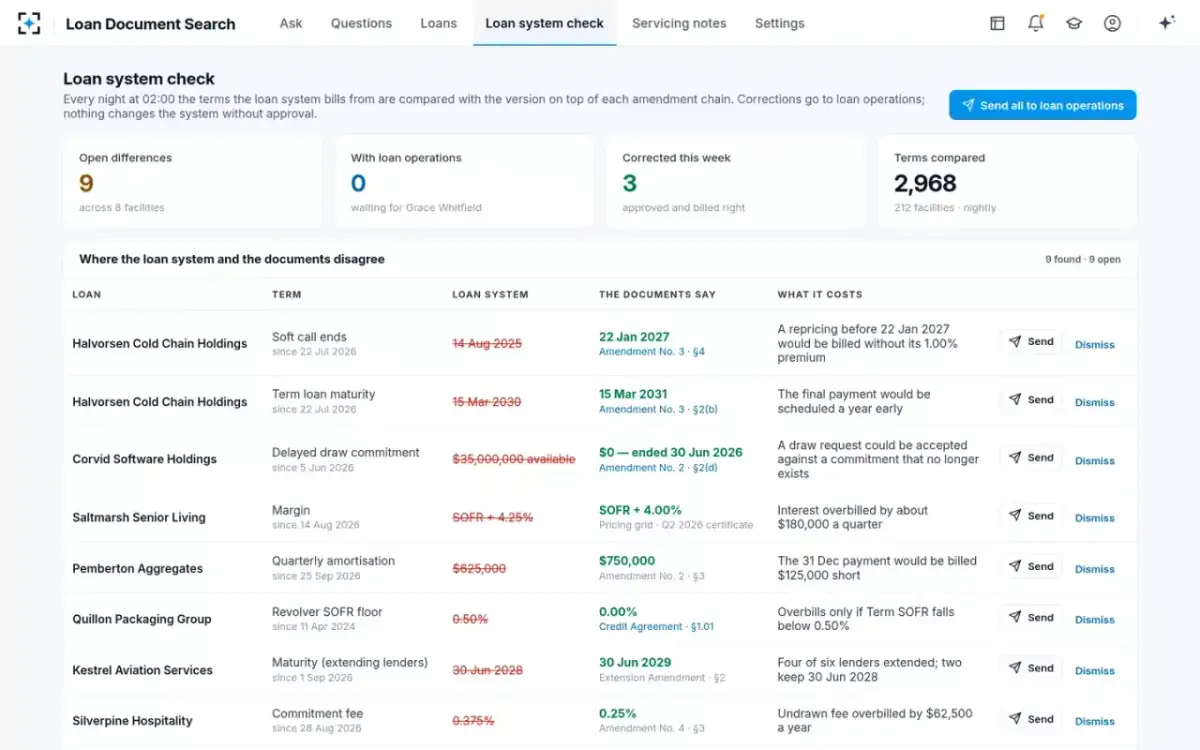
The time argument is the easy half. The harder half, and the one a finance committee tends to ask about, is what goes wrong when the billing system and the documents disagree — because that cost is not a saving, it is a loss already happening. On the sample book a nightly comparison of 2,968 terms across 212 facilities found nine open differences on eight facilities. Three of them show the three distinct shapes of the failure.
Nine differences, three kinds of damage
| Facility | What the system bills | What the documents say | What it costs |
|---|---|---|---|
| Saltmarsh Senior Living | A margin of SOFR + 4.25%, since 14 Aug 2026 | SOFR + 4.00%, under the pricing grid and the Q2 2026 certificate | Interest overbilled by about $180,000 a quarter. The borrower is being charged for a rate it has already earned its way out of. |
| Pemberton Aggregates | Quarterly amortisation of $625,000, since 25 Sep 2026 | $750,000, under Amendment No. 2 §3 | The 31 December payment would be billed $125,000 short — an underbilling that quietly extends the loan. |
| Corvid Software Holdings | A delayed draw commitment of $35,000,000 still available, since 5 Jun 2026 | $0 — the commitment ended 30 Jun 2026 under Amendment No. 2 §2(d) | A draw request could be accepted against a commitment that no longer exists, which is not a billing error at all. |
The regulatory framing of the third case is worth keeping, because it is the one that persuades a risk committee. The OCC’s handbook notes that credit administration exceptions “can occur at any time (e.g., at underwriting, shortly after closing, or any other time during the life of the loan)” and that exceptions “that weaken the bank’s ability to protect its interest in a loan are critical”. A commitment the system believes is live, three months after the documents ended it, is that kind of exception.
Where the loan system and the documents disagree, with what each one costs
Build, buy, or ask the documents: three options over three years
Most committees will want three options costed over three years, and the lines are more useful than the totals, because the totals depend on a book’s size and a vendor’s proposal. The table below is a worksheet rather than an answer: it names the lines a finance committee will ask about and where each number should come from.
The three-year lines, and where each number comes from
| Line | What it covers | Where your number comes from |
|---|---|---|
| Licences and subscription | Platform and per-seat fees, modules, annual uplift. | The proposals in front of you. Insist on the three-year figure with uplift included, not the first-year price. |
| Implementation and loading | Loading executed documents, splitting them into sections, and checking a sample by hand. | Document count × a loading rate you have tested on your own files. The sample book carries 4,906 executed documents across 212 facilities. |
| The desk’s time | Hours spent getting from a question to a citable answer, at a defensible rate. | Your own split of the week × the BLS median for the seats that answer, or your own fully loaded rate if you have one. |
| Correction effort | Finding, approving and applying differences between the billing system and the documents. | Differences found per month × the hours each takes to investigate today. Count the investigation, not just the keying. |
| The cost of a wrong answer | Interest over- or underbilled, a date given and withdrawn, a commitment honoured that had ended. | Your last four quarters of corrections. The sample book’s $180,000 a quarter on one margin is the shape; your own log is the number. |
| What you keep running | The repository, the billing system and the mailbox you are not replacing. | Unchanged — and say so explicitly, because a committee will assume a replacement unless told otherwise. |
Staffing trends belong in the paper too, because they change which option ages well. The Bureau of Labor Statistics projects employment of loan officers to “grow 1 percent from 2025 to 2035” ( BLS, Loan Officers), and overall employment of financial clerks to “decline 4 percent from 2025 to 2035” ( BLS, Financial Clerks). A plan that depends on hiring more people to absorb a growing book is planning against the direction of its own labour market.
Eight questions for a business case that survives the finance committee
- How many questions does the desk actually answer, and how long does each take?
Log two weeks before writing anything. Every figure in the paper is a multiple of these two numbers, and both are usually guessed.
- What share of those questions needs a term as amended rather than as signed?
This is the share a repository cannot help with. On a book with regular amendments it is most of them.
- What does a wrong answer cost us today?
Pull the last four quarters of billing corrections and withdrawn replies. If nobody logs them, that absence is itself a finding to report.
- Which systems are we keeping?
Name them. A paper that does not say the repository and the billing system stay will be read as a replacement proposal and priced as one.
- Who approves a correction to the billing system, and does that change?
If the answer is “it stays with the supervisor”, say so. Automation of the finding is a different proposition from automation of the change.
- How will we know it worked?
Pick measures before you buy: time from question to citable answer, share of answer sentences carrying a clause and page, differences found and closed per month.
- What happens when an amendment arrives?
Ask each option what it does on the day a new executed amendment lands. Rebuilding the affected chains and re-checking saved answers is a different answer from filing it.
- What is the three-year number, with uplift and the desk’s time in it?
A one-year licence comparison flatters whichever option has the lowest entry price and tells the committee nothing about the fourth year.
How Loan Document Search fits beside the systems you keep
It is not a repository and not a contract system. It reads the executed documents in the agency book and keeps every section as amended, answers questions from them with the clause and page behind each sentence, works the dates and the amounts, and compares the billing system with the documents every night. It reads the loan system; it never writes to it. Corrections go to a named loan operations supervisor who approves every change.
The connections are deliberately modest. Credit agreements and amendments come in with their pages. Notes, fee letters and side letters are searched and shown only to the loan’s own agency team. The billing system is read-only. Questions arrive through the agency mailbox and replies go out from the officer’s own mailbox, not from an agent. The servicing procedures manual is used for how the desk works, never for what a loan says.
The agency book: 212 facilities, and which ones the billing system disagrees with
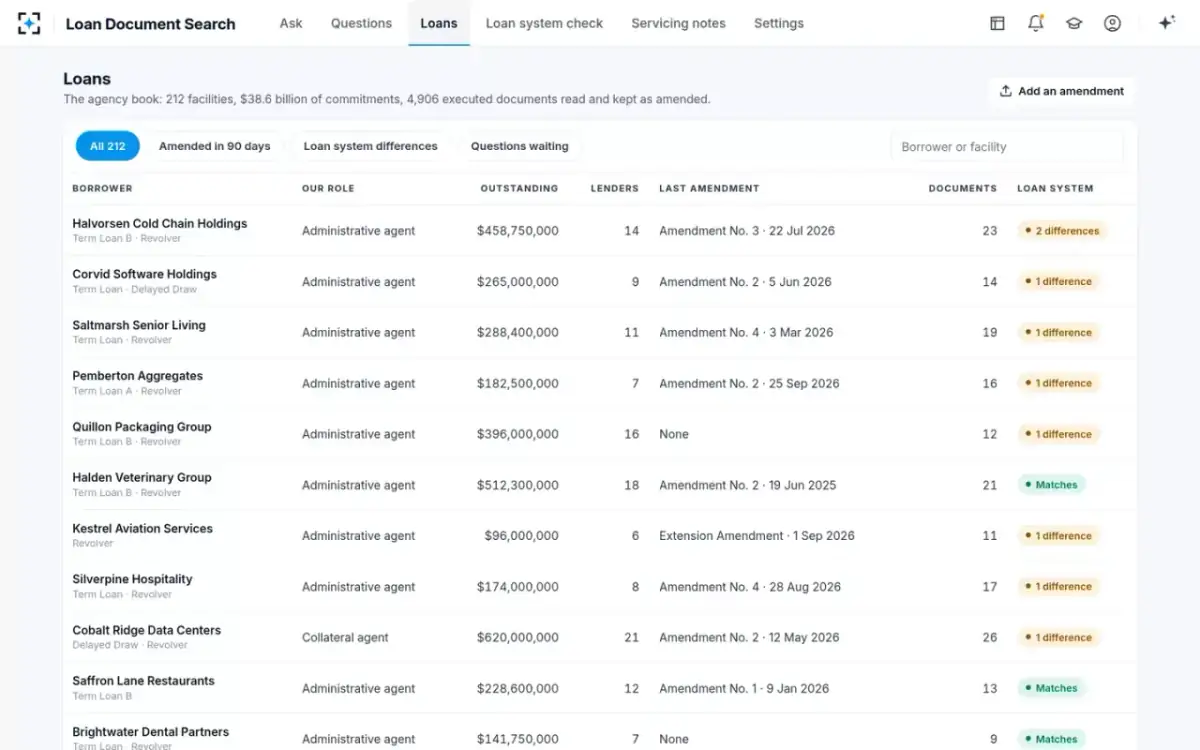
What the desk sees first is a queue rather than a search box. Every question that reaches agency services arrives with an answer already drafted from the loan documents and its sources attached, and the officer opens it to check the clauses rather than to start. On the sample book that drafting takes fourteen seconds for a prepayment question with nine citations; the time that matters afterwards is the officer’s, and the target the desk works to is a reply the same business day.
Six questions waiting, each already answered from the documents
The place to start a business case is not a demonstration but your own queue: two weeks of logged questions, the time each took, and how many needed a term as amended rather than as signed. The mechanics behind those answers are set out in which version of a credit agreement governs today and in the two calendars a loan runs on. To see the queue, the differences and the citations on a loan file, start from Loan Document Search.
Questions people ask
Does CLM software work for loan agreements?
For the path to signature, yes — drafting, negotiation, approvals and execution are the same work on a credit agreement as on any other contract. For the years afterwards it does what it was built to do and no more: it returns documents and the fields someone tagged. It does not rebuild a section as amended, answer as of a date, or compare the billing system with the documents.
What is the difference between contract management and contract search?
Contract management is a workflow: getting a document agreed, signed and filed, with reminders attached. Contract search is retrieval over what has been filed. Neither is a reading of the agreement. The question a servicing desk is asked — what does this section say today, and what does it cost on Friday — needs the reading, which is why finding the document quickly so often leaves the half hour untouched.
What should a loan document system do after closing?
Five things: keep every executed document split into sections with pages and defined terms; rebuild each section as amended, with the versions it replaced still visible; answer as of any date; carry a clause and page on every sentence of an answer; and compare the terms the billing system uses with the documents, routing differences to a person who approves them.
Can contract software answer a question about a clause?
It can return the clause, and increasingly it can summarise one. What it generally cannot do is tell you which version of that clause is in force, because that requires following every amendment’s effective date and the defined terms the clause depends on. An answer drawn from the original text of an amended section is confidently and completely wrong.
How do you build a business case for loan document software?
Log two weeks of questions and the minutes each takes, work out what share needs a term as amended, price the time at a defensible wage, and add the correction effort and the cost of wrong answers from your own last four quarters. Then cost three years with uplift, and name the systems you are keeping. The first two numbers decide the paper; everything else is negotiation.
How much does contract lifecycle management software cost?
Published pricing comes from the vendors, so it is not a figure this guide will put in front of a committee. The shape is consistent: a platform fee plus per-seat charges, modules priced separately, a one-off implementation and an annual uplift. The number you can compute independently is the desk’s time, from public wage data — about $36.87 an hour at the Bureau of Labor Statistics median for loan officers, before benefits and overhead.