A US Government Securities Business Day is any day that is not a Saturday, not a Sunday, and not a day on which the Securities Industry and Financial Markets Association recommends that its members’ fixed income departments close for the entire day for trading in United States government securities. That definition is why a term loan priced off SOFR counts its notice periods on one calendar while the payment on the same loan is made on another, and why the two calendars disagree on a small, entirely predictable set of days each year. Counting on the wrong one produces a deadline that is wrong by exactly one business day — the cheapest mistake on a servicing desk to make and one of the harder ones to take back. Botminds’ Loan Document Search counts on the calendar the clause names and prints the days it counted.
The worked examples use fictional sample data from the solution: Halvorsen Cold Chain Holdings, a Term SOFR term loan whose notice periods run on US Government Securities Business Days and whose payments run on New York banking days. The 2026 dates come from the published schedules, linked where they appear.
What is a US Government Securities Business Day?
It is a trading-day calendar, not a banking calendar. The question it asks is whether the government securities market is open, because that is the market SOFR is produced from: “SOFR is published for the business days that the Treasury repo market is open on, which are generally U.S. government securities secondary-market trading days as determined by SIFMA” ( ARRC, An Updated User’s Guide to SOFR). A rate that is not published on a day cannot be fixed on it, so a loan that depends on that rate counts its days on the days the rate exists.
The practical reading is a short list of exclusions, and the important word in it is “entire”. A recommended early close — a day on which the market shuts at noon or at two o’clock — is not an exclusion. The day still counts.
Where the definition comes from, word for word
The wording in most credit agreements is taken from the Alternative Reference Rates Committee’s recommended language, which is hosted by the Federal Reserve Bank of New York and is the nearest thing to an official text.
U.S. Government Securities Business Day: Any day except for (i) a Saturday, (ii) a Sunday or (iii) a day on which the Securities Industry and Financial Markets Association recommends that the fixed income departments of its members be closed for the entire day for purposes of trading in United States government securities.
ARRC, An Updated User’s Guide to SOFR, February 2021
Three features of that sentence do the work. It is defined by a recommendation, not by a statute, so the authority is a published schedule rather than a list of federal holidays. The recommendation must be for the entire day. And it is specific to trading in United States government securities, which is why the same body’s recommendations for other markets do not move this calendar. The companion paper on syndicated loans puts the same point in one line: “SOFR is published on all SIFMA government securities market business days (‘business days’)” ( ARRC, SOFR “In Arrears” Conventions for Syndicated Business Loans).
Is Good Friday a US Government Securities Business Day?
In 2026, yes — and the reason is the one word most readings skip. SIFMA’s 2026 recommendation for Good Friday is an “Early Close (12:00 p.m. Eastern Time): Friday, April 3, 2026”, not a full close ( SIFMA, Holiday Schedule). The definition excludes only a day recommended closed “for the entire day”, so 3 April 2026 is a US Government Securities Business Day despite the market being shut by lunchtime.
It is also a day on which Federal Reserve Banks are open, because Good Friday is not a federal holiday. So on the one day of the year that most people in a bank assume is a holiday, both calendars count — and a notice period counted as if it were a holiday is a day early, which is the harmless direction to be wrong in but still produces a deadline the borrower was not given.
Friday 3 July 2026: open for banking, closed for securities
The reverse case is the expensive one, and in 2026 it falls on a single day. Independence Day falls on Saturday 4 July. SIFMA recommends a full close on “Friday, July 3, 2026” for the observed holiday, with an early close the day before. The Federal Reserve observes the holiday differently: its published schedule notes that for a holiday falling on a Saturday, “the Federal Reserve Banks are open, but the Board of Governors is closed on July 3, 2026” ( Federal Reserve, Holidays Observed — K.8). One day, two opposite answers, on the same loan.
The 2026 recommendations where the two calendars could part
| 2026 day | SIFMA recommendation | Federal Reserve Banks | Securities business day? | Banking day? |
|---|---|---|---|---|
| Good Friday, Fri 3 Apr | Early close, 12:00 p.m. Eastern | Open — not a federal holiday | Yes — the close is not for the entire day | Yes |
| Juneteenth, Fri 19 Jun | Full close | Closed | No | No |
| Thu 2 Jul | Early close, 2:00 p.m. Eastern | Open | Yes | Yes |
| Independence Day observed, Fri 3 Jul | Full close | Open — the holiday falls on Saturday 4 July | No | Yes |
| Columbus Day, Mon 12 Oct | Full close | Closed | No | No |
| Day after Thanksgiving, Fri 27 Nov | Early close, 2:00 p.m. Eastern | Open | Yes | Yes |
Read down the table and the structure is simple. SIFMA recommends eleven full closes for 2026; the calendars agree on ten of them and part company on one. Good Friday looks like a twelfth holiday and is not an exclusion at all, because its close is early rather than for the entire day. Two days a year that need thought is few enough to forget about and often enough to be caught by.
Counting three business days, twice, on one prepayment
Take a notice period of three business days and a prepayment on Wednesday 8 July 2026, and count it on each calendar. The two counts use the same arithmetic and reach different days, because one of them has to step over Friday 3 July and the other does not.
One notice period, two calendars, one day apart
- Wed 1 Jul
- Thu 2 Jul3 of 3
- Fri 3 Julclosed
- Sat 4
- Sun 5
- Mon 6 Jul2 of 3
- Tue 7 Jul1 of 3
- Wed 8 Julprepay
- Wed 1 Jul
- Thu 2 Jul
- Fri 3 Jul3 of 3
- Sat 4
- Sun 5
- Mon 6 Jul2 of 3
- Tue 7 Jul1 of 3
- Wed 8 Julprepay
The failure here is quiet. Nobody misreads the clause, nobody miscounts, and the person counting is not careless — they simply count on the calendar in front of them. The deadline that results is wrong by one business day, in the direction that costs the borrower its date.
Most weeks of the year the two calendars give the same answer, which is what makes the habit of using either one feel safe. On the sample loan, a prepayment on Friday 30 October 2026 gives a notice deadline of Tuesday 27 October at 12:00 noon on both calendars, because October 2026 carries no recommended holiday after Columbus Day. The same count in the first week of July would have split.
Which calendar applies to which obligation
A single agreement commonly uses two definitions and applies them to different things. Rate-setting and the notices tied to it follow the securities calendar, because that is where the rate comes from. Payments follow a banking calendar, because that is where the money moves.
Two definitions in one agreement, and what each governs
US Government Securities Business Day: Saturdays, Sundays, and days recommended closed for the entire day for trading in United States government securities.
Business day or banking day: Saturdays, Sundays, and days on which banks in a named place are authorised or required to close.
US Government Securities Business Day: SIFMA, as a recommendation to its members, for the U.S., U.K. and Japan markets separately.
Business day or banking day: The Federal Reserve’s K.8 schedule for its own offices, plus whatever the named jurisdiction’s law provides.
US Government Securities Business Day: Rate setting, interest period elections, the lookback, and the notices tied to them — including the prepayment notice on a Term SOFR loan.
Business day or banking day: Payment dates, funding, base rate loans, and most of the agreement’s other date mechanics.
US Government Securities Business Day: A recommended full close on a day banks are open: the day exists for payments and not for notices.
Business day or banking day: A bank holiday that is not a market holiday: the money cannot move on a day the rate is published.
Reading a clause for its calendar is therefore two steps, not one. First find which defined term the clause uses — many agreements write “Business Day” in the body and define it to mean the securities calendar only when the obligation relates to a SOFR loan. Then check whether the agreement’s own definition has been amended, because a transition amendment is exactly the sort of document that changes it.
Modified following, and the payment date that moves
Calendars also move dates that are already fixed. The ARRC recommends the convention most agreements use: “payments that should be paid on a day that falls on a non-Business Day will be adjusted to the next succeeding business day, unless that business day falls in the next succeeding calendar month, in which case the interest payment date will be the preceding business day”.
That rule has a consequence worth stating to a borrower before they notice it themselves: a payment date near a month end can move backwards. An interest payment due on 31 May that falls on a weekend rolls forward to 1 June, which is in the next month, so it rolls back instead to the last business day of May. The interest accrues for a different number of days than the borrower expected, and the figure on the invoice is not the figure in their model.
On a loan priced off daily SOFR rather than Term SOFR, the lookback is the other date mechanic worth knowing about. “Business day lookback with no observation shift is recommended for SOFR loans,” the ARRC paper notes, because “a lookback permits the administrative agent to determine the rate of interest for the interest period before the period ends and the interest payment is due” — again counted in the securities calendar’s business days.
What a one-day miss actually does
A notice given one business day late is usually not a default, and that is precisely why it is costly. The agreement does not make the borrower’s plan unlawful; it simply means the prepayment cannot settle on the day the borrower chose, so the date moves. Where the money came from an asset sale with its own completion date, or where a refinancing is timed to it, moving the date by a business day moves everything downstream.
The second cost is in the reply. An agent that gave a date and then has to correct it has told the borrower twice, and the second message is the one the borrower remembers. On the sample desk, the deadline on the prepayment question was a time as well as a date — 12:00 noon, not end of day — and a notice that arrives in the afternoon of the right day is as late as one that arrives on the wrong day.
Five checks before counting a notice period
- Which calendar does the clause name?
Not which calendar the loan generally uses — which defined term this clause uses, in the version in force today. An agreement can use both.
- Is the recommendation a full close or an early close?
Only a recommended close for the entire day removes a securities business day. An early close at noon or two o’clock leaves the day counting.
- Does the Federal Reserve observe it, and on which day?
A holiday falling on a Saturday is observed by Federal Reserve Banks differently from one falling on a Sunday. The K.8 schedule states which offices are open on which date.
- Does the deadline have a time as well as a date?
Most prepayment, borrowing and interest-election notices carry a cut-off time in a named time zone. A reply that gives only the date has answered half the question.
- Is the period in business days or calendar days?
The two produce the same answer most weeks and diverge around every holiday. Quote the clause’s own words back in the reply so the borrower can check the count.
How Loan Document Search counts the days and shows the working
The calendars are settings on the loan rather than an assumption inside an answer. On the sample facility one setting names U.S. Government Securities Business Days for Term SOFR loans and a separate setting names New York banking days for payments and base rate loans, so the same agent answering two questions about one loan counts on two different calendars without being told which.
The calendars as settings, beside the rules for how an answer is made
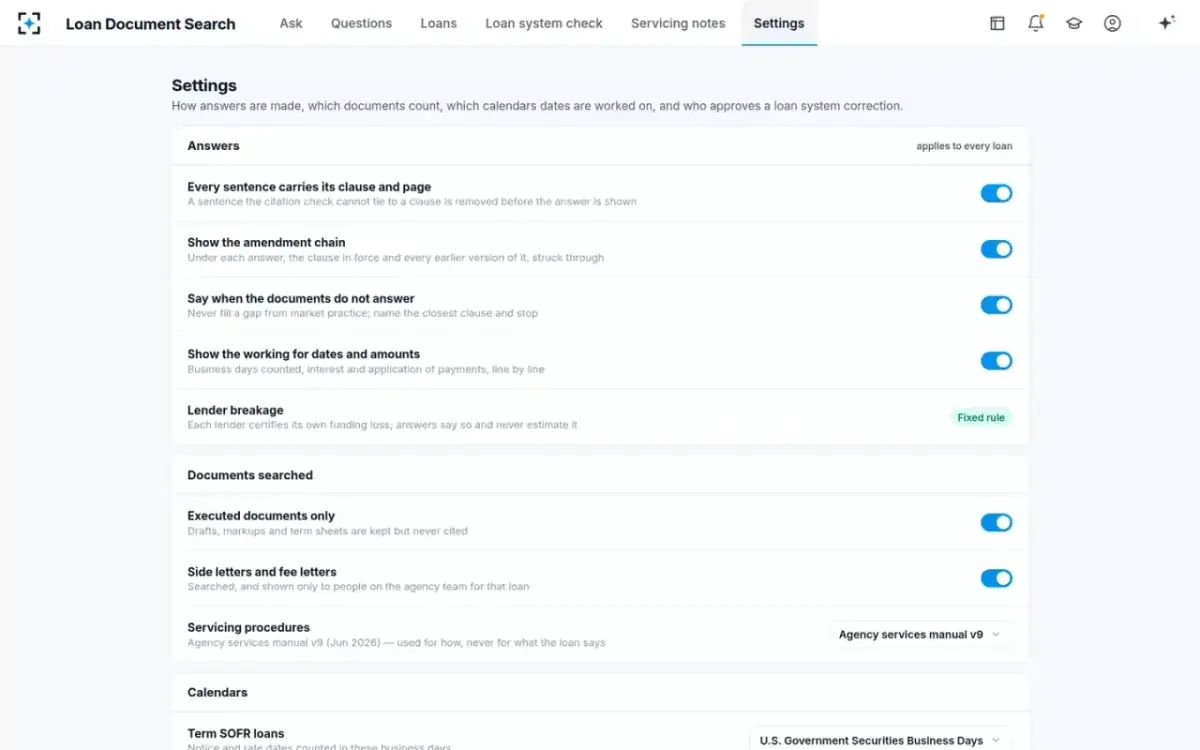
What the agents produce is a count, not a date. The dates and amounts calculator counts the business days on the facility’s calendar and shows each one, so a reviewer can see the days that were counted and the day that was skipped rather than taking a deadline on trust. On the sample prepayment the line reads: Friday 30 October less three U.S. Government Securities Business Days — Thursday 29, Wednesday 28, Tuesday 27 — giving Tuesday 27 October at 12:00.
Three days counted, and the three days named
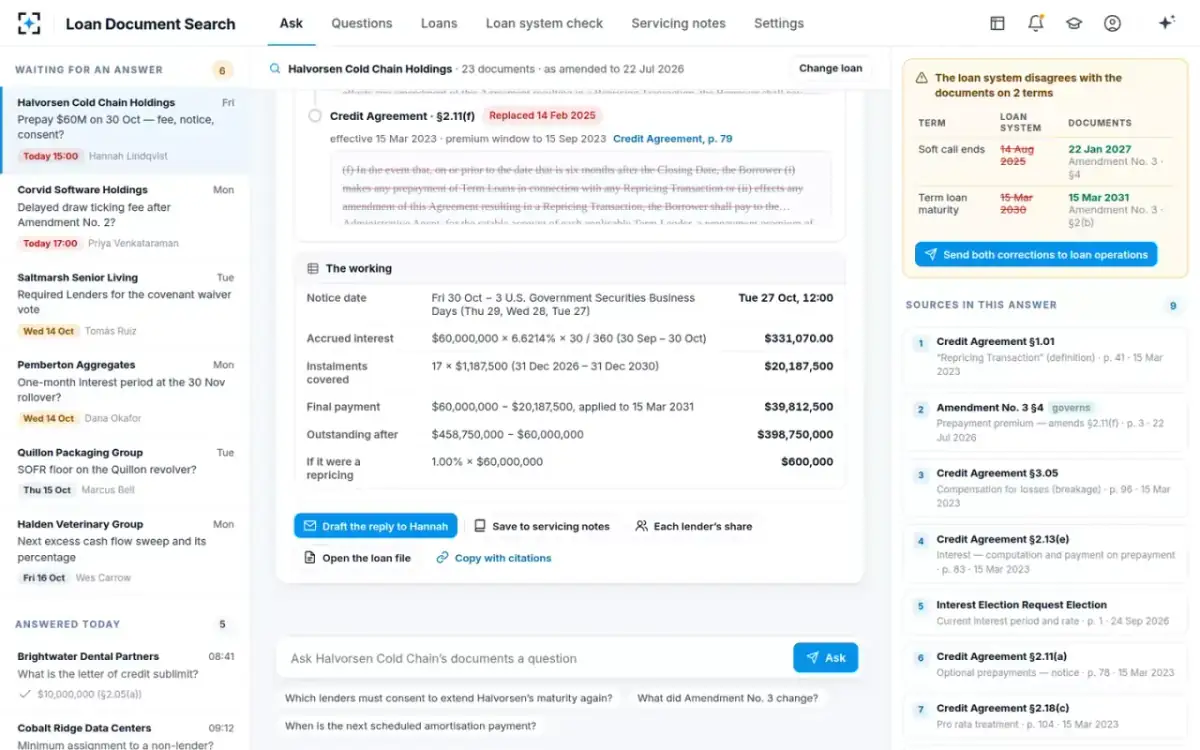
A date is only as good as the clause it came from, which is why every sentence in an answer carries its section and page, and why a saved answer is re-checked when a later amendment moves the clause underneath it. The notice period itself usually sits in the optional prepayments clause — the same clause examined in when a credit agreement actually charges a prepayment premium. To see the calendars, the count and the citations together, start from Loan Document Search.
Questions people ask
What is a US Government Securities Business Day?
Any day other than a Saturday, a Sunday, or a day on which SIFMA recommends that the fixed income departments of its members close for the entire day for trading in United States government securities. It is a market-trading calendar, used because SOFR is published only on days the Treasury repo market is open.
Is Good Friday a US Government Securities Business Day?
In 2026 it is. SIFMA’s recommendation for Friday 3 April 2026 is an early close at 12:00 p.m. Eastern, and the definition excludes only a day recommended closed for the entire day. Good Friday is also not a federal holiday, so Federal Reserve Banks are open. The recommendation is published each year and should be read for the year in question.
What is the difference between a business day and a banking day?
A banking day asks whether banks in a named place are open; a US Government Securities Business Day asks whether the government securities market is open. They coincide most of the year and part company when a market holiday is not a bank holiday, or the reverse. In 2026 the one divergence is Friday 3 July, when the market is recommended closed and Federal Reserve Banks are open.
Which calendar do SOFR loans use?
The securities calendar, for anything that depends on the rate: rate setting, the lookback, interest period elections and the notices tied to them. Payments on the same loan usually follow a banking calendar. Which clause uses which definition is set in each agreement, so the only reliable answer for a particular loan is the one read from its own definitions as amended.
How do you count business days for a prepayment notice?
Count backwards from the prepayment date, skipping every day the named calendar excludes, until you have the number of business days the clause requires; then apply the cut-off time the clause sets. Write down the days you counted. A count that shows its days can be checked by the borrower and by a reviewer; a bare date cannot.
What happens if a notice is one day late?
Usually the transaction moves rather than fails: the prepayment, borrowing or election cannot take effect on the day requested, so it settles on a later one. The cost is in what was timed around it — a sale completion, a refinancing, a rate election — and in having to correct a date already given to a borrower.