A prepayment premium is a fee a borrower owes for repaying early, and in a syndicated term loan it is almost never owed simply because money came back early. It is owed because of an event the agreement names — usually a repricing within a protected window, sometimes an acceleration after a default — and a voluntary prepayment from the borrower’s own cash often falls outside every one of them. That is why “is there a prepayment premium?” is the wrong first question. The right one is what event the repayment amounts to, because the answer to that decides whether the premium clause is engaged at all. Botminds’ Loan Document Search works the trigger first, from the clause as amended, then the notice and the money, with the working shown line by line.
The loan worked through below is fictional sample data from the solution: Halvorsen Cold Chain Holdings, a Term Loan B with $458,750,000 outstanding across 14 Term Lenders, whose CFO asks what it costs to prepay $60 million on Friday 30 October. Research figures come from a federal court of appeals, the Alternative Reference Rates Committee and bank regulators, linked where they appear.
One $60 million prepayment, two completely different answers
$0
premium, paid from cash on hand and the proceeds of an asset sale
$600,000
premium on the identical amount, had it come from a cheaper new term loan
3days
notice, by 12:00 noon, counted on the U.S. Government Securities calendar
What is a prepayment premium, and when does it apply?
A prepayment premium compensates lenders for losing a return they expected to keep. The form it takes depends on what kind of return that was. On a floating-rate term loan the lenders’ economics are in the spread, so the protection is against the spread being refinanced away: a flat percentage, typically 1.00%, payable if the loan is repriced within a stated period. On fixed-rate debt the economics are in the coupon, so the protection is a make-whole: the present value of the interest the lender will not now receive.
In both cases the clause starts with a condition, not a calculation. The sample agreement’s §2.11(f), as restated by its third amendment, reads: “In the event that, on or prior to the date that is six months after the Amendment No. 3 Effective Date, the Borrower (i) makes any prepayment of Term Loans in connection with any Repricing Transaction or (ii) effects any amendment of this Agreement resulting in a Repricing Transaction, the Borrower shall pay to the Administrative Agent, for the ratable account of each applicable Term Lender, a prepayment premium of 1.00% of the aggregate principal amount of the Term Loans so prepaid or affected.”
Read it in order and the structure is clear. There is a window — six months from a defined date. There is a trigger — a Repricing Transaction, itself a defined term, which in this agreement means a refinancing with cheaper term loans. And only then is there a number. A prepayment that is inside the window but is not a repricing engages nothing; a repricing outside the window engages nothing either.
Three triggers: soft call, make-whole and the prepayment that costs nothing
Almost every prepayment question on a term loan resolves to one of three cases. Naming which one you are in is most of the work, and it is work done on the definitions rather than on the payment.
What the repayment amounts to, and what it costs
| The event | What usually triggers it | What is typically owed |
|---|---|---|
| A voluntary prepayment from the borrower’s own funds | Cash on hand, operating cash flow, equity, or the proceeds of an asset sale, applied to the loan at the borrower’s election. | Principal, accrued interest to the prepayment date, and any funding loss a lender certifies. No premium, unless the agreement charges one on any voluntary prepayment. |
| A repricing transaction inside the soft call window | A refinancing or an amendment whose effect is to lower the effective yield on the term loans, however it is documented. | The stated percentage — commonly 1.00% — of the principal prepaid or affected, for the rateable account of the lenders. |
| Acceleration after an event of default | The agreement declares the loans due, or they become due automatically. Many agreements treat that as a prepayment for premium purposes. | Whatever the clause says becomes payable on acceleration, which on fixed-rate debt is usually the make-whole and is the case most often litigated. |
The middle row is where the money is, and the drafting reflects it. A repricing trigger is written to catch the economic effect rather than the paperwork — “makes any prepayment … in connection with any Repricing Transaction or … effects any amendment of this Agreement resulting in a Repricing Transaction” — precisely so that doing the repricing as an amendment instead of a refinancing does not avoid the fee.
What is soft call protection, and what resets it?
Soft call protection is the repricing premium with a time limit: for a defined period after a date, a repricing costs the borrower a percentage of the loan; after it, the loan can be repriced freely. The “soft” distinguishes it from hard call protection, which charges for any early repayment whatever its source. Six months at 1.00% is the common shape in the broadly syndicated market, and the premium is paid through the agent for the rateable account of the lenders, not kept by the agent.
What catches people out is the reset. Each repricing amendment typically restates the clause and measures a fresh window from its own effective date, so a loan that has been repriced twice has had three soft call windows, not one. The sample loan shows the pattern exactly: the original agreement ran a window to 15 September 2023, six months from closing; Amendment No. 2 restated the clause on 14 February 2025 with a window to 14 August 2025; Amendment No. 3 restated it again on 22 July 2026, with a window to 22 January 2027. Each version is nearly word-for-word identical to the last, and the only thing that moved is the defined date the six months runs from — which is why reading the version in force rather than the original is not a formality here.
The reset also explains why a loan system drifts on this particular term. A soft call window is entered once at booking and has no event that forces anyone to re-enter it; on the sample facility the system still carries the window that closed on 14 August 2025, while the documents say 22 January 2027. A repricing before that date would be billed without its premium.
How is a make-whole premium calculated?
A make-whole is a present-value calculation rather than a percentage, and it appears mostly in private placements, notes and fixed-rate facilities rather than in floating-rate syndicated term loans. The Fifth Circuit, reviewing one in the Ultra Petroleum appeal, described it in a sentence worth keeping: “The Make-Whole Amount, stripped of the contract’s financial jargon, is simply the value of all future unmatured interest payments on the Notes, expressed in today’s dollars” ( In re Ultra Petroleum Corp.).
A make-whole, as the Fifth Circuit read one note purchase agreement
Called Principal
the principal being repaid early
The amount of the note actually accelerated or prepaid, which is the baseline the premium is measured against.
Defined in the agreement
Remaining Scheduled Payments
every payment the note had left
The interest and principal the holder would have received on the called principal had the note run to maturity.
Defined in the agreement
Discounted Value
those payments, in today’s dollars
The court: “These payments are summed and discounted to their present value using a discount factor 50 basis points over the yield to maturity of Treasury securities comparable in risk profile.”
Fifth Circuit, 2022
The Make-Whole Amount
Discounted Value − Called Principal, if positive
The agreement’s own words: “the excess, if any, of the Discounted Value of the Remaining Scheduled Payments with respect to the Called Principal … over the amount of such Called Principal.”
The agreement, as quoted by the court
The sensitivity of that calculation is the reason it is argued about. Because the remaining payments are discounted at a rate tied to Treasury yields, a make-whole computed when rates are low is very large and the same clause produces almost nothing when rates are high. Nothing in the clause changes; the number does.
Is a prepayment premium enforceable in bankruptcy?
It is the question the clause is most often tested on, and the answer turns on how the agreement is drafted at least as much as on the law. The Ultra Petroleum agreement made the link explicit: “Among the Events of Default that trigger principal acceleration and the Make-Whole provision is the filing of a petition for bankruptcy.” A clause drafted that way asks a court to treat an acceleration caused by the filing as the event that earns the premium.
For a servicing desk, the practical position is narrower than the legal one and worth stating plainly in a reply. Whether a premium survives a bankruptcy is a question for counsel and the court, and it depends on the particular clause, the solvency of the estate and the applicable law. What the documents can answer is what the clause says becomes payable, on what event, and in what amount — and that is the honest limit of a document answer. Where the documents do not settle a question, the better reply names the closest clause and stops, rather than reasoning from what usually happens.
The notice, the money and the order of application
Once the trigger question is settled, three mechanical questions remain, and each has its own clause. How much notice is owed, and by when on the day. What is payable with the principal. And where in the amortisation schedule the money lands.
Twenty-one days from the question to the money, three of them business days
- The CFO’s question arrives, Fri 9 Oct at 16:42 — due Tue 13 Oct18 days
- Notice by 12:00 noon, Tue 27 Oct3 business days
Notice periods on term loan prepayments are short and precise: a number of business days, a cut-off time, and often a minimum amount with a multiple above it. On the sample loan the notice is due by 12:00 noon New York time on Tuesday 27 October, three U.S. Government Securities Business Days before the prepayment, and the minimum is $1,000,000 in multiples of $500,000, which $60,000,000 comfortably meets. The business-day calendar is the part most likely to be counted wrongly; that is the subject of the two calendars a loan runs on.
Application is a clause as well. The sample agreement applies a voluntary prepayment as the borrower directs and otherwise in direct order of maturity, which here means it absorbs all 17 remaining quarterly instalments of $1,187,500 and then $39,812,500 of the final payment due 15 March 2031, leaving $398,750,000 outstanding. A borrower who assumed the money would come off the back end, or be spread rateably across instalments, would have planned a different cash flow for the next four years.
Breakage is certified by each lender, never estimated
Prepaying in the middle of an interest period can cost the lenders money, and the agreement handles that separately from any premium. On the sample loan 30 October falls inside an interest period running to 30 December, so each lender may certify its own funding loss. The convention is deliberate: the loss is a fact about one lender’s funding, not a figure the agent can compute for everyone.
The Alternative Reference Rates Committee noted that the old wording survives the move to overnight rates: “While typical ‘breakage’ language may not be applicable in a Daily Simple SOFR or Daily Compounded SOFR regime, there is recognition that credit agreements may include language that compensates lenders for funding losses, e.g., losses sustained due to an intra-period prepayment” ( ARRC, SOFR “In Arrears” Conventions for Syndicated Business Loans). Many agreements signed in the transition kept a breakage clause whether or not the rate mechanics still produce a loss, so the clause has to be read rather than assumed spent.
Accrued interest is the other amount due with the principal, and the day count convention for it is set by the agreement. The same ARRC paper recommends Actual/360 for SOFR, “which is the standard convention in U.S. money markets”, and recommends on rounding that “interest-rate calculations based on SOFR be rounded (not truncated) to 5 decimal points and dollar amounts be rounded to 2 decimal points … but that calculations not be rounded internally”. That last clause is the useful operating rule: round at the invoice, never in the middle of the arithmetic, because a figure rounded twice on the way through is a figure neither party can reproduce.
Where the answer goes wrong: the source of funds nobody asked about
The expensive mistake in this area is not a miscalculation. It is answering the question that was asked instead of the question that decides the money. A borrower asks “what is the fee to prepay $60 million on 30 October?”, and the fee depends entirely on where the $60 million comes from — a fact the question does not contain.
The same $60,000,000, on the same day, from two sources
From cash on hand and sale proceeds: A voluntary prepayment. The agreement’s premium is tied to a Repricing Transaction, and this is not one.
From a new, cheaper term loan: A refinancing with cheaper term loans — a Repricing Transaction as the agreement defines it, inside the window to 22 Jan 2027.
From cash on hand and sale proceeds: $0.
From a new, cheaper term loan: 1.00% × $60,000,000 = $600,000, for the rateable account of the Term Lenders.
From cash on hand and sale proceeds: Accrued interest to the prepayment date, plus any funding loss each lender certifies for the part period.
From a new, cheaper term loan: The same interest and breakage, plus the premium.
From cash on hand and sale proceeds: No fee — and state the condition, because the borrower may change how it funds the payment before the date.
From a new, cheaper term loan: The fee, the clause that charges it, and the window that will close on 22 Jan 2027.
The same asymmetry shows up across the servicing desk’s other errors, which tend to be operational rather than analytical. The OCC’s handbook lists the ones banks have paid for: losses “due to failures to obtain proper signatures on loan documents, improperly disbursing loan proceeds, or incorrectly perfecting or renewing collateral liens”, and notes that “errors such as these can also result in billing mistakes, payment processing errors, or other customer service issues” ( OCC, Lending and Loan Portfolio Risk Management). Prepayments touch three of those at once: a payoff to process, a schedule to re-apply, and a figure a borrower will check.
How Loan Document Search works a prepayment answer
The order is the point. The agents read the agreement and every amendment, build the premium clause as amended to today, decide what the transaction is against the defined term, and only then compute. The answer that comes back on the sample question is seven sentences with nine citations, each read back against its clause before it is shown: no fee, because the 1.00% premium applies only to a Repricing Transaction and a prepayment from cash on hand and sale proceeds is not one; notice by 12:00 noon on Tuesday 27 October; no lender consent, because a voluntary prepayment is paid to the 14 Term Lenders pro rata. The one condition — that money from a new cheaper term loan would carry $600,000 — is in the answer rather than in a footnote.
The working, line by line, under the cited answer
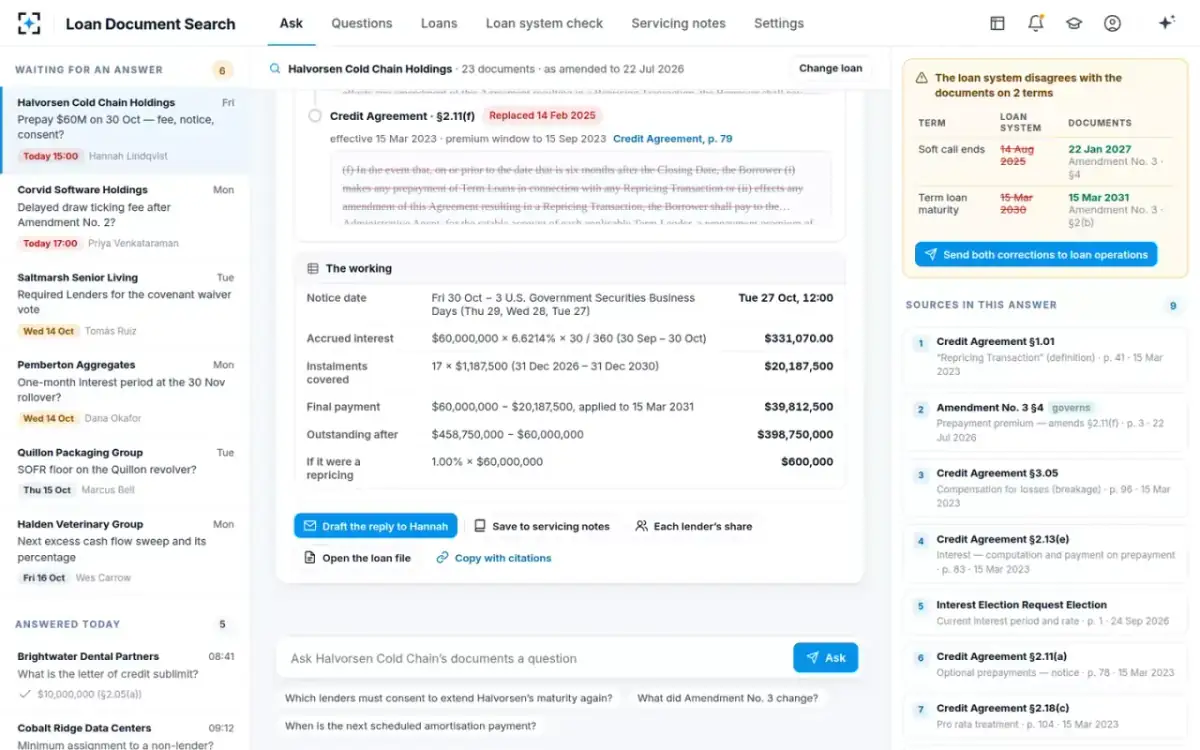
Three limits are set as rules rather than habits. Each lender certifies its own funding loss and the answer says so instead of estimating it. Figures are not rounded part-way through a calculation. And no agent sends anything: the servicing officer reads the clauses and the working, then sends the reply from their own mailbox.
The answer the borrower’s question actually gets
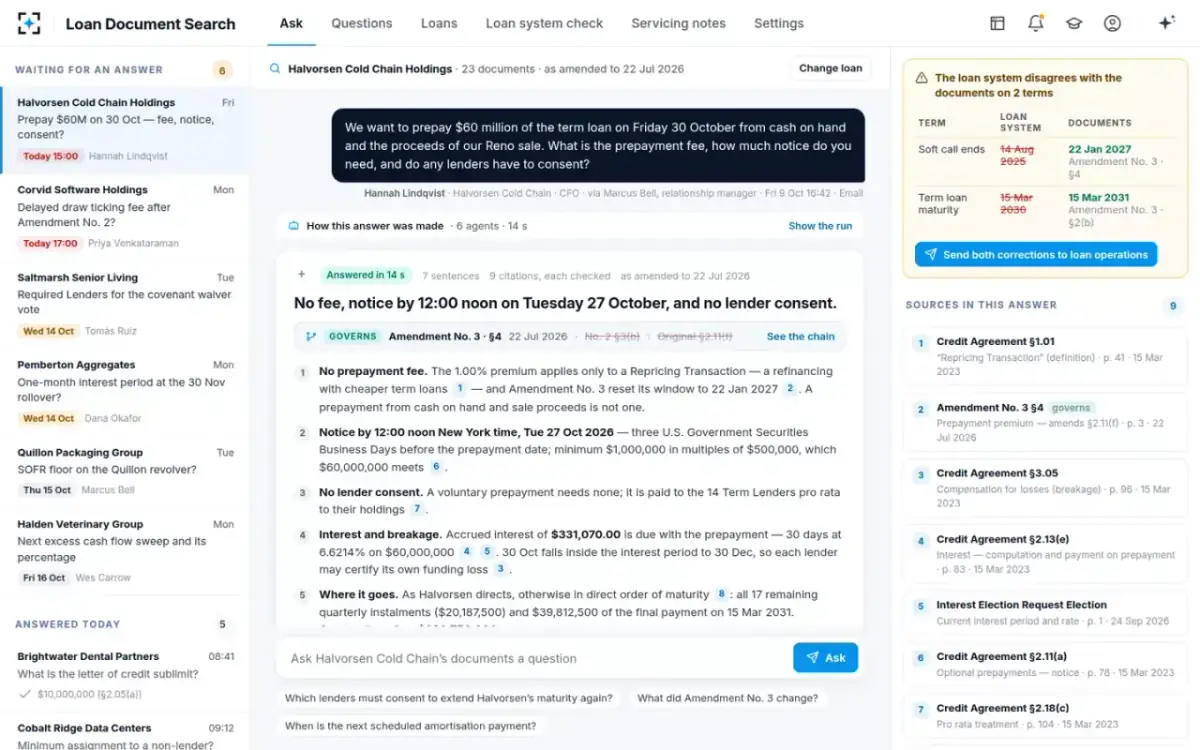
These questions scale with the market they sit in: the 2025 Shared National Credit review found that “nearly half of total SNC commitments are leveraged, and leveraged loans comprise 81 percent of non-pass loans” ( Federal Reserve, FDIC and OCC, January 2026), and leveraged term loans are where soft call protection lives. To see the trigger, the working and the clause together, start from Loan Document Search.
Questions people ask
When does a prepayment premium apply?
When the agreement’s trigger event occurs inside the period the clause protects. On a floating-rate term loan the trigger is usually a repricing — a refinancing or amendment that lowers the effective yield — rather than a repayment as such, so a voluntary prepayment from the borrower’s own cash often costs nothing even inside the window. Read the window and the defined trigger before reading the percentage.
What is soft call protection?
A premium, commonly 1.00%, payable if the term loans are repriced within a defined period, usually six months, from a date the agreement sets. It protects the lenders’ spread rather than their principal, and it expires. Each repricing amendment typically restates the clause and starts a fresh window from its own effective date.
What is a make-whole premium?
The present value of the interest a lender will not now receive, payable on early repayment or acceleration of fixed-rate debt. The Fifth Circuit summarised one as “simply the value of all future unmatured interest payments on the Notes, expressed in today’s dollars”, computed as the excess of the discounted remaining payments over the principal being repaid. It is far more common in notes and private placements than in syndicated floating-rate term loans.
How much notice do you give to prepay a term loan?
Whatever the agreement’s optional prepayment clause requires — typically one to three business days, with a cut-off time on the day and a minimum amount. The business-day calendar the clause names matters as much as the number: on the sample loan, three U.S. Government Securities Business Days before Friday 30 October gives a deadline of 12:00 noon on Tuesday 27 October.
Where does a prepayment go in the amortisation schedule?
Where the agreement says, which is usually as the borrower directs and otherwise in direct order of maturity — that is, against the nearest instalments first. On the sample loan a $60,000,000 prepayment absorbs all 17 remaining quarterly instalments and part of the final payment, so the borrower’s scheduled payments stop rather than shrink. Some agreements instead apply prepayments rateably across the remaining instalments, which produces a very different cash flow.
Is breakage the same as a prepayment premium?
No. A premium is a fee the agreement charges for an event; breakage compensates a lender for a funding loss caused by repayment inside an interest period. They are different clauses, they can both apply, and breakage is normally certified by each lender for its own share rather than calculated centrally.