An ISDA clause library, in the sense that matters after signing, is a catalogue of the clauses in a firm's executed derivatives agreements, such as rating triggers, NAV triggers, cross-default thresholds, set-off, close-out method, notices and collateral re-use, organised so that any one of them can be found and compared across every agreement, as amended. Built from executed documents rather than templates, it answers "what did we sign, and what applies today?" instead of "what should we ask for?". Building one by hand takes months and decays with every amendment. Botminds' Derivatives Documentation Search builds it by reading: its agents read every agreement family, apply amendments and protocols in order, cite each clause to its page and keep the library current as new documents arrive, and a two-week pilot on one dealer group's estate is enough to test whether it works on your files.
The pilot plan below is ours, offered as a starting point; the figures that show what a finished library answers come from the solution's fictional sample estate, Quillfield Capital and the Hollins Brothers Bank group.
A ten-business-day pilot: the agents read in minutes; most of the fortnight is lawyers setting and checking the answers
- Connect sourcesDay 1
- Lawyers write the answer keyDays 2–3
- First full read, intake flagsDay 4
- Fix gapsDay 5
- Run the questions, score each clause typeDays 6–7
- Review flags and conflictsDay 8
- Simulated eventDay 9
- Results, decisionDay 10
What is an ISDA clause library?
Two different things share the name. A drafting clause library is a set of approved precedent wording a negotiator chooses from: it lives before signing and belongs to the people negotiating, the work covered in the ISDA playbook guide. An executed clause library is the record of what was actually signed, agreement by agreement, as amended: it lives after signing and serves the people who must act on the agreements. This guide is about the second, because it is the one a downgrade morning, a reporting correction or an audit question depends on.
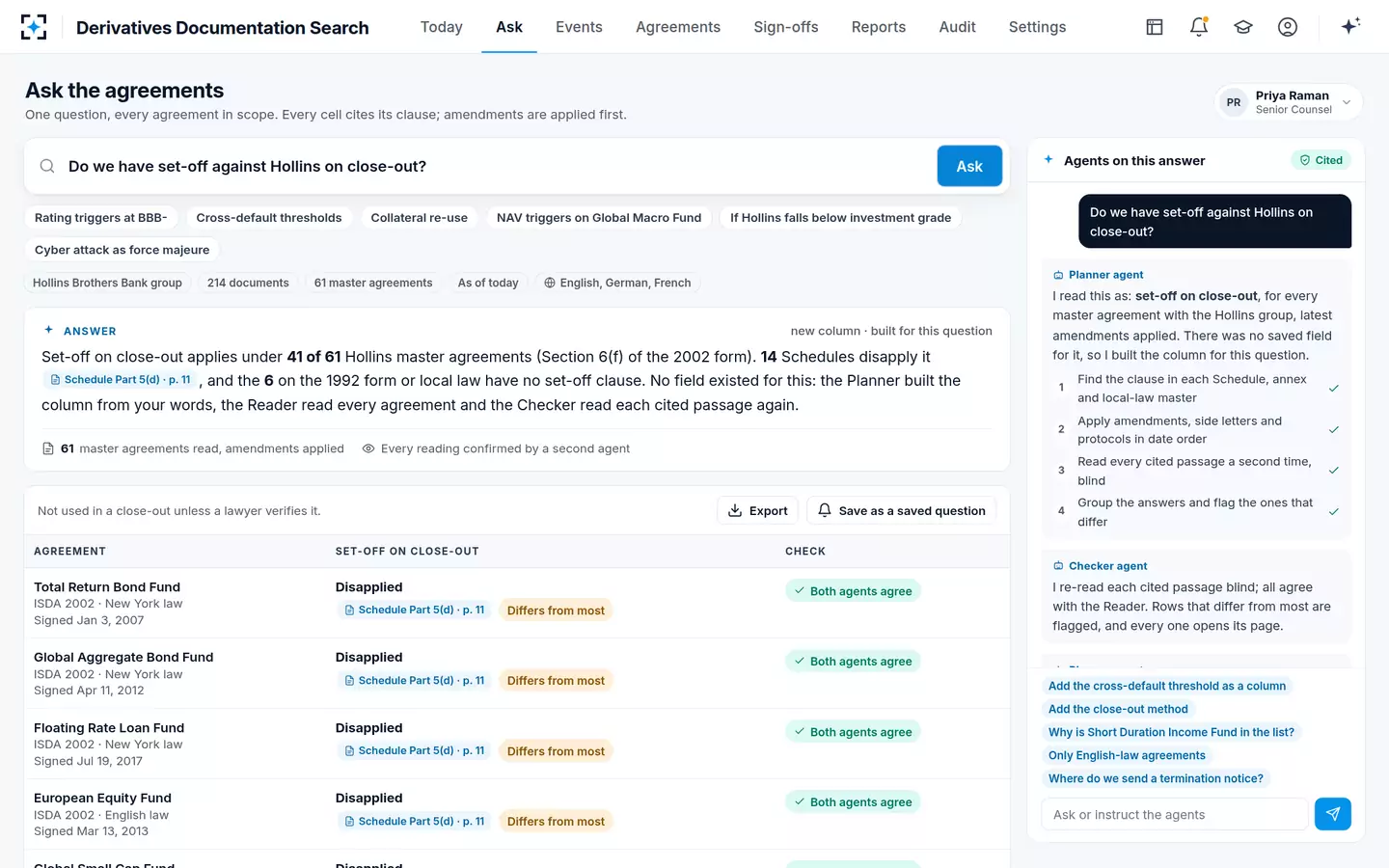
The difference shows in a single question. "What is our standard set-off position?" is a drafting question with one answer. "Do we have set-off against this dealer on close-out?" is an executed question with sixty-one answers, one per agreement family, and in the sample estate they split three ways: Section 6(f) applies under 41, 14 Schedules disapply it, and 6 agreements have no set-off clause.
Can an ISDA clause library be built from executed agreements?
Yes, if the build reads every agreement to the end of its chain and proves execution before applying a change. That is the difference between a library and a stack of abstracts: an abstract records a clause once, at signing; a library built by reading records the clause in force, with the amendment that put it there. EU rules already expect the processes around uncleared derivatives to meet that standard: counterparties must have "formalised processes which are robust, resilient and auditable in order to reconcile portfolios, to manage the associated risk and to identify disputes between parties early and resolve them" (Regulation (EU) No 648/2012, Article 11(1)(b)). A library that cannot show where each value came from is not auditable.
The solution builds the library question by question rather than field by field. A question nobody set up, such as set-off on close-out, becomes a new column: the Planner builds the reading plan from the words, the Reader reads every agreement, and the Checker reads each cited passage again. Saved, the column becomes a permanent part of the library and is re-read when a new document arrives in any family it covers.
A clause nobody set up a field for, answered across every agreement and saved as a column
Which ISDA clauses should a library cover first?
The ones a close-out needs, because those are the ones nobody can afford to look up slowly. On the sample downgrade morning the agents opened the counterparty event by asking the six questions a lawyer asks first: rating triggers, cross-default, set-off, close-out method, notices and collateral re-use. Add NAV-decline triggers if your funds face them and the margin terms operations asks about most, such as minimum transfer amounts, and the first library is complete enough to act on.
A first ISDA clause library: eight clauses, where each lives, and what one sample answer looked like
| Clause | Where it usually lives | Sample answer across Hollins' 61 families |
|---|---|---|
| Rating downgrade trigger | Schedule Part 1, amendments, local-law annexes | 9 terminable at BBB-; 15 more at BB+; 30 with no rating trigger |
| Close-out method | The form (Section 6(e)) and Schedule elections | 55 Close-out Amount; 3 Market Quotation, Second Method; 3 local-law settlement amounts |
| Set-off on close-out | Section 6(f) of the 2002 form; Schedule Part 5 | 41 apply; 14 disapply; 6 have no clause |
| Notices | Section 12; Schedule Part 4; notices amendments | Address from the 2 April 2024 notices amendment; email not permitted for Section 6 notices except under one agreement |
| Collateral re-use | Credit support annex paragraphs | Re-use under 19 New York-law annexes ($61.8M); title transfer under 18 English-law ones |
| Cross-default Threshold Amount | Schedule Part 1 | Example family: 3% of shareholders' equity |
| NAV-decline trigger | Schedule Part 1 | Example family: 25% in one month, 35% in three, 50% in twelve |
| Minimum transfer amount | Credit support annex elections | 8 of 61 agreements above $1 million, all at $2,000,000 |
What do you need for an ISDA clause library pilot?
One dealer group's complete executed estate, the places where documents arrive outside it, and a set of questions your lawyers have already answered by hand. Choose the dealer group the firm would least like to be surprised by: usually the largest, the most amended, or the one with local-law masters.
What to have ready before day one
- The dealer group's executed documents
Masters, Schedules, annexes, GMRAs and prime brokerage terms, amendments, side letters, from the legal document store.
- Access to where documents arrive outside the store
The legal mailboxes' email archive and e-signature records, where countersignatures and side letters often live.
- Entity data
Fund entities and the dealer group's legal entities with LEIs and hierarchy; the protocol adherence list.
- Exposure, if risk is in the pilot
Mark-to-market and collateral per agreement from the collateral system, for the roles entitled to see it.
- Twenty questions with known answers
Questions your lawyers answered by hand in the last year, each with the right answer and page per agreement.
- Two lawyers and an operations lead
One to write and score the answer key, one to act as approver, one to own the gaps the read uncovers.
- Written reading rules
Amendment order, executed copy over drafts, one-sided amendments to a lawyer, and the confidence a close-out answer needs.
How do you check an ISDA clause library against what lawyers know?
With an answer key written before the read, and with errors planted on purpose. The answer key is the CUAD discipline applied to your own estate: experts label the right answer for each agreement, and the system is scored against their labels, not its own confidence (Hendrycks et al., NeurIPS 2021). Planted errors, such as a draft filed beside an executed copy or a deliberately misread value, test whether the checks catch what they should; the solution's own release tests use 64 seeded conflicts and 48 seeded misreadings for the same reason.
The most useful single check is a rehearsal. Bank supervisors expect "hypothetical close-out simulations at least once every two years for one of the banking organization's most complex counterparties" (SR 11-10 guidance). Day 9 of the pilot is that simulation for one dealer group: a hypothetical downgrade, run from the rating feed through the answer, the decisions and draft notices, with the lawyers timing each step and checking every citation.
What counts as success for an ISDA clause library pilot?
Correct answers that a lawyer can verify quickly, flags on everything that needed a person, and a gap list the firm did not have before. Accuracy alone is not enough: an answer that is right but cannot be verified saves no lawyer time, and a pilot that finds no gaps in a decade-old estate probably did not look.
Pilot scorecard: what to measure, and a pass mark to start from
| Measure | How to compute it | Suggested pass mark |
|---|---|---|
| Correct value, as amended | Agreements where the answer matches the lawyer's key, per clause type | Every disagreement explained: either the agent or the key was wrong |
| Citations that open the passage | Values whose citation shows the clause and page | All of them |
| Flags on what needed a person | Planted errors, low scores and one-sided amendments sent to a lawyer | All planted errors caught by the checks or the lawyer |
| Correct "none" | Agreements correctly reported as having no such clause, with places searched | All of them |
| Time to a verified answer | From question to the second lawyer's approval | Inside the morning of a counterparty event |
| Gaps found | Missing signature pages, unfiled amendments, drafts filed as executed, poor scans | A list the firm acts on |
ISDA clause library vs contract abstracts
An abstract is a snapshot; a library built by reading is a view of the documents in force. Abstracts are cheaper to start and decay from the first amendment; a reading library costs a read of the estate and stays current because it is re-read. Most firms keep both for a while, and the pilot is the natural time to compare them clause by clause.
Abstracts or a clause library built by reading: the differences that matter after signing
Contract abstracts: Once, usually at signing, by a person keying fields.
Clause library built by reading: Whenever asked, from the documents in force, by agents with a second reading.
Contract abstracts: Stale until someone re-keys the field.
Clause library built by reading: Applied on the next read; the original shown struck through.
Contract abstracts: Needs a new field and a project to fill it.
Clause library built by reading: A new column, built from the question and saved.
Contract abstracts: The field; the page is in someone's memory.
Clause library built by reading: Every value cited to its document, clause and page.
Contract abstracts: Low to start; rises with every amendment and every new question.
Clause library built by reading: A first full read; then re-reads as documents arrive.
How long does an ISDA clause library take to build?
For one dealer group, the reading takes minutes and the pilot two weeks; for a whole estate, the first full read follows the pilot, and after that the library is maintained, not rebuilt. In the sample the estate holds 1,184 documents across 46 dealer groups, the Intake agent files and links new executed documents as they arrive, and recurring checks, such as a quarterly check of notice addresses for all 46 dealer groups, run with a maker and a checker like any other answer.
What a finished library looks like in the sample
1,184
documents read and current across the estate
46
dealer groups covered by one ask box
37
questions answered in one week
142
answers and decisions approved in one quarter, each with a maker and a different checker
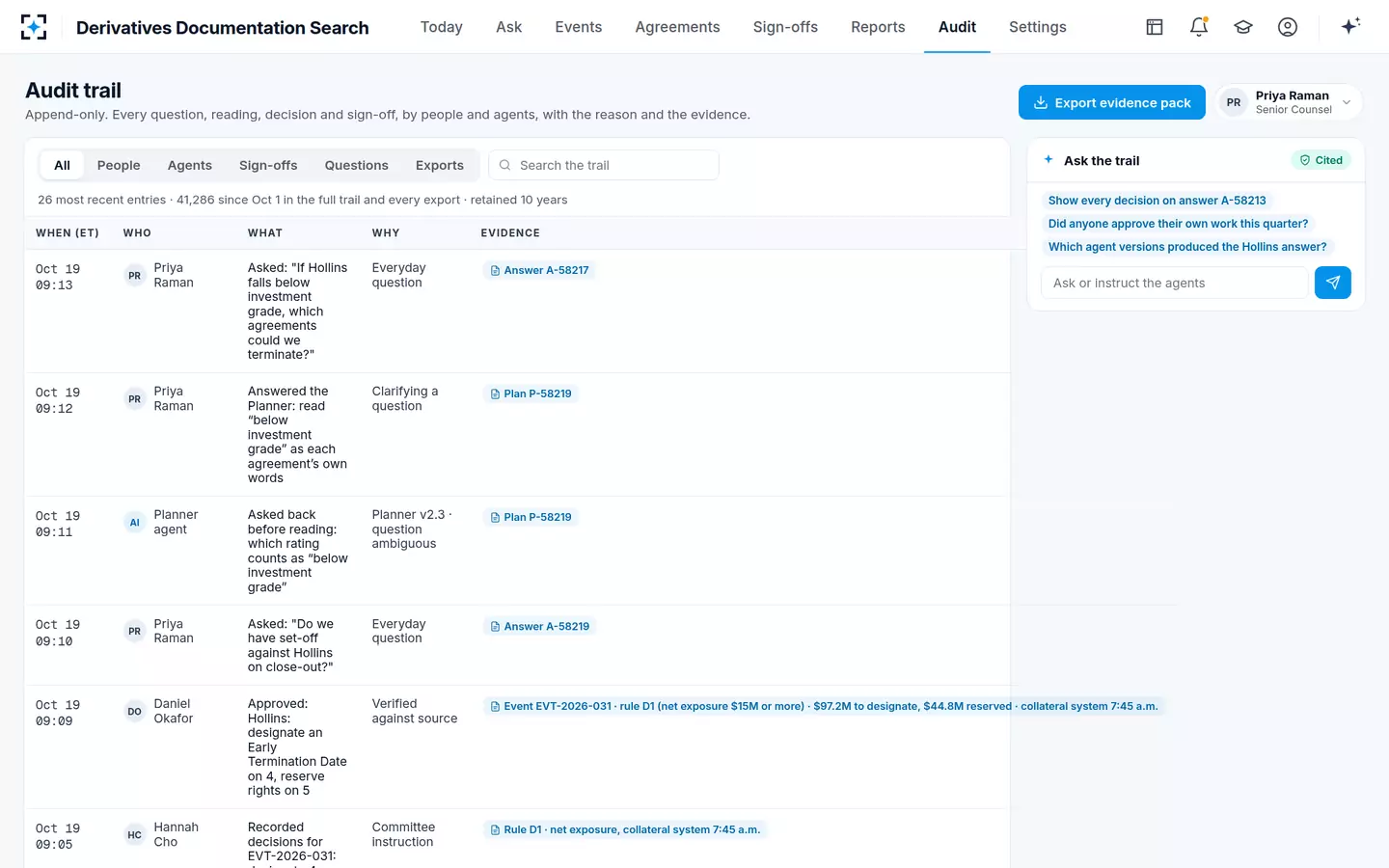
Every question, reading and approval goes on an append-only trail with the agent versions that produced it, which is also the pilot's evidence: at the end of day 10 the trail shows exactly what was asked, what the agents read, what the lawyers changed and why.
The pilot's evidence: every question, reading and decision on one trail
If the pilot passes, the next dealer group starts from a working library rather than a blank page. To set one up on your own agreements, start from Derivatives Documentation Search; for how to score it, see how to measure a legal document search AI tool, and for the amendment rules it depends on, ISDA amendment chains.
Questions people ask
Is an ISDA clause library the same as a playbook?
No. A playbook says what a firm is willing to agree in negotiation; an executed clause library says what it actually agreed, agreement by agreement, as amended. Comparing the two is useful, because the gap shows how often signed terms sit outside the playbook.
Does a clause library need a data model built first?
Not when it is built by reading. Each question defines its own column, and the library grows as questions are asked and saved. Firms usually start with the clauses a close-out needs and add others when someone asks.
Can the library include GMRAs and prime brokerage agreements?
Yes. The same reading covers repo and prime brokerage terms and local-law masters; in the sample, close-out questions about the repo agreements read 14 GMRA 2011 agreements, and re-use questions read every annex.
How is the library kept current after the pilot?
New executed documents are filed into their families as they arrive from the document store, email archive and e-signature records, and saved questions are re-read when their documents change. A changed saved answer appears for review rather than silently replacing the old one.
Who should own an ISDA clause library?
Legal for the meaning of each clause, operations for completeness and filing, and a senior lawyer for the reading rules and thresholds. In the sample, any change to a rule or threshold goes to the Deputy General Counsel for approval.