The close-out amount is the 2002 ISDA Master Agreement's measure of what a terminated transaction is worth on the Early Termination Date: the party making the determination values each terminated transaction in good faith, by procedures that are commercially reasonable and to a result that must be commercially reasonable too, and the results are netted into a single amount payable by one side. The 1992 form measures the same thing by Loss or by Market Quotation. Every term that feeds the calculation, from the right to terminate to set-off and the treatment of collateral, can be changed by a later amendment, so at close-out an unread amendment stops being a filing problem and becomes money. Botminds' Derivatives Documentation Search reads each agreement's close-out terms as amended, cites each to its page, and joins the exposure from the collateral system, so the close-out decision rests on the terms in force.
The worked example uses the solution's fictional sample: Quillfield Capital's 61 agreement families with Hollins Brothers Bank after a cut to BBB-, with net exposure from the collateral system at 7:45 a.m. Statistics, statutes and court decisions are real and linked.
Netting is what makes derivatives exposure manageable, and it works only as written
$846T
notional value of OTC derivatives outstanding worldwide, end-June 2025
$21.8T
their gross market value, with positive and negative contracts with the same counterparty not netted
55of 61
sample agreements that close out by Close-out Amount; the other six use older or local-law methods
14of 61
sample Schedules that switch off set-off on close-out
What a missed amendment costs at close-out: $50.5 million in the sample
In the sample, missing three amendments would leave $50.5 million of net exposure under agreements the fund believes it cannot yet terminate. On 14 March 2023 the Absolute Return Bond Fund, the Multi-Asset Income Fund and the Short Duration Income Fund each moved their rating triggers on Hollins from "below BBB-" to "below BBB". Read with those amendments, all three are terminable at BBB-. Read from the original Schedules, all three wait for the next notch.
Read as amended, 45.6% of Hollins exposure is actionable today; read from the original Schedules, 29.4%
As amended ($311.4M net)
- Terminable at BBB- · 45.6%
- Trigger set lower · 20.5%
- No rating trigger · 33.9%
Original Schedules only
- Terminable at BBB- · 29.4%
- Trigger set lower · 36.7%
- No rating trigger · 33.9%
The cost is not only the $50.5 million. Under the sample firm's own rule, which proposes designating an Early Termination Date wherever net exposure is $15 million or more, the Absolute Return Bond Fund's $24.4 million is a designation, not a watch. A desk reading Schedules would not designate it, would keep $44.0 million of mark-to-market on a downgraded dealer open into the next rating action, and would discover the amendment, if at all, when the next notch made the question moot. The other two amended agreements fall below the rule's line and would get reservation-of-rights letters, which also need the amendment: a letter cannot reserve a right the sender does not know it has.
What is the close-out amount under the ISDA?
It is the 2002 form's measure of what each terminated transaction is worth to the party making the determination on the Early Termination Date, and its definition sets a standard rather than a formula. The High Court in Macquarie Bank v Phelan Energy treated the good-faith and commercial-reasonableness words in the section 14 definition as the limits on the determining party, and tested the bank's figure against them ([2022] EWHC 2616 (Comm), at [40]). How that objective test differs from the 1992 form's Loss is set out in ISDA 1992 vs 2002.
Bank supervisors pushed dealers toward that standard after 2008. Among sound close-out practices, the interagency guidance says "Dealers should consider using the 'close-out amount' approach for early termination upon default in inter-dealer relationships", and notes in a footnote that an industry protocol was published "to aid in the adoption of the close-out amount approach" (SR 11-10 guidance). That protocol is one more document an estate may or may not contain: an older agreement adopts the newer method only between parties that adhered.
How is the ISDA close-out amount calculated?
In outline: value each terminated transaction, add amounts that fell due but were not paid, account for collateral, and net everything into one amount payable by one party. The debt arises on the Early Termination Date, even though it is calculated later; as Gloster LJ put it in Videocon Global v Goldman Sachs International, "the debt obligation to pay the amount due in respect of any Early Termination Date, as calculated under section 6(e), clearly arises on the Early Termination Date" ([2016] EWCA Civ 130, at [64]).
The close-out sum, simplified: four terms, each set by a different part of the documents
Close-out amounts
Value of each terminated transaction on the Early Termination Date
Determined in good faith with commercially reasonable procedures under the 2002 form; Loss or Market Quotation under the 1992 form
Counterparty risk, as determining party
Unpaid amounts
Payments and deliveries already due but not made, in both directions
Read from confirmations and payment records up to the Early Termination Date
Derivatives operations
Collateral
Value of collateral held or posted, as the annex treats it
Title transfer: an obligation to return equivalent collateral that is netted in. Security interest: collateral realised under the pledge
Treasury and collateral
Set-off
Other amounts between the parties set against the result
Only where Section 6(f) applies and the Schedule has not disapplied it
Derivatives legal
Under the 1992 form the first term works differently. The Court of Appeal in Videocon summarised the elections: if Loss applies, the calculating party determines its loss "reasonably and in good faith"; if Market Quotation applies, it "must seek quotations for a replacement transaction and determine a mean of them", with Loss as the fallback "If less than three quotations are received" (at [18]). Under the First Method a positive amount is payable by the defaulting party "but any negative amount is ignored"; under the Second Method a negative amount is paid to the defaulting party (at [19]).
What changes between the 1992 and 2002 ISDA at close-out?
The valuation standard changes from a choice between Loss and Market Quotation to a single Close-out Amount, and the 2002 form adds a set-off section. Which form an agreement uses is easy to read; whether it was later amended to adopt the newer method, by bilateral amendment or by adhering to a protocol, is not. Negotiating which form and which elections to sign is a different job, covered in ISDA 1992 vs 2002: the clauses that changed; this guide is about reading what was signed.
Close-out under the 1992 and 2002 forms, as the courts describe them
1992 ISDA Master Agreement: Loss (determined reasonably and in good faith) or Market Quotation (a mean of replacement quotations), as elected.
2002 ISDA Master Agreement: Close-out Amount: good faith, commercially reasonable procedures, commercially reasonable result.
1992 ISDA Master Agreement: Fewer than three quotations: fall back to Loss.
2002 ISDA Master Agreement: No quotation mechanism to fail; the standard itself governs.
1992 ISDA Master Agreement: First Method ignores a negative amount; Second Method pays it.
2002 ISDA Master Agreement: One net amount payable by whichever party owes it.
1992 ISDA Master Agreement: Not a section of the printed form; any right comes from the Schedule or other documents.
2002 ISDA Master Agreement: Section 6(f), unless the Schedule disapplies it.
1992 ISDA Master Agreement: 3 agreements on the 1992 form, using Market Quotation, Second Method.
2002 ISDA Master Agreement: 55 agreements use Close-out Amount; 3 local-law masters use their own settlement amount.
What is close-out netting?
Close-out netting is the mechanism that turns many terminated transactions into one net payment. EU law defines a close-out netting provision as one under which, on an enforcement event, the parties' obligations "are accelerated so as to be immediately due and expressed as an obligation to pay an amount representing their estimated current value", and "a net sum equal to the balance of the account is payable by the party from whom the larger amount is due to the other party" (Financial Collateral Directive 2002/47/EC, Article 2(1)(n)). Member States must let such a provision "take effect in accordance with its terms" notwithstanding winding-up proceedings (Article 7).
The scale explains why regulators protect it. At end-June 2025 the notional value of OTC derivatives outstanding was $846 trillion and their gross market value $21.8 trillion (BIS, December 2025). "Gross" there means, in the BIS's own definition, that "contracts with positive and negative values with the same counterparty are not netted"; its separate measure of credit exposure "takes into account legally enforceable netting sets" (BIS, Introduction to the BIS derivatives statistics). Netting is what turns a gross number into a manageable one, and it does so only for transactions under the same agreement, as that agreement is written.
Is close-out netting enforceable in bankruptcy?
In the United States, for swap agreements, largely yes: the Bankruptcy Code protects the right to terminate and net. "The exercise of any contractual right of any swap participant or financial participant to cause the liquidation, termination, or acceleration of one or more swap agreements ... or to offset or net out any termination values or payment amounts" arising from it "shall not be stayed, avoided, or otherwise limited" by the Code or by a court order in a case under it (11 U.S.C. 560). Bank resolution regimes, such as an FDIC receivership, work differently, which is why stay protocols matter when a dealer fails.
Bank capital rules show what "enforceable" demands in practice. A qualifying master netting agreement must be "a written, legally enforceable agreement" that creates "a single legal obligation for all individual transactions covered by the agreement upon an event of default" and gives the right "to accelerate, terminate, and close-out on a net basis all transactions under the agreement and to liquidate or set-off collateral promptly" (12 CFR 217.2). Each phrase points at a document: the master agreement, the annex, and every amendment that touches either.
What is set-off under the ISDA?
Set-off lets the non-defaulting or non-affected party reduce the net close-out amount by other amounts owed between the parties, for instance under a different agreement. Netting works inside one agreement; set-off reaches across agreements and other obligations, so it is where an estate's structure matters most. The 2002 form provides for it in Section 6(f); Schedules can and do switch it off, and agreements on the 1992 form or local-law masters may have no set-off clause at all.
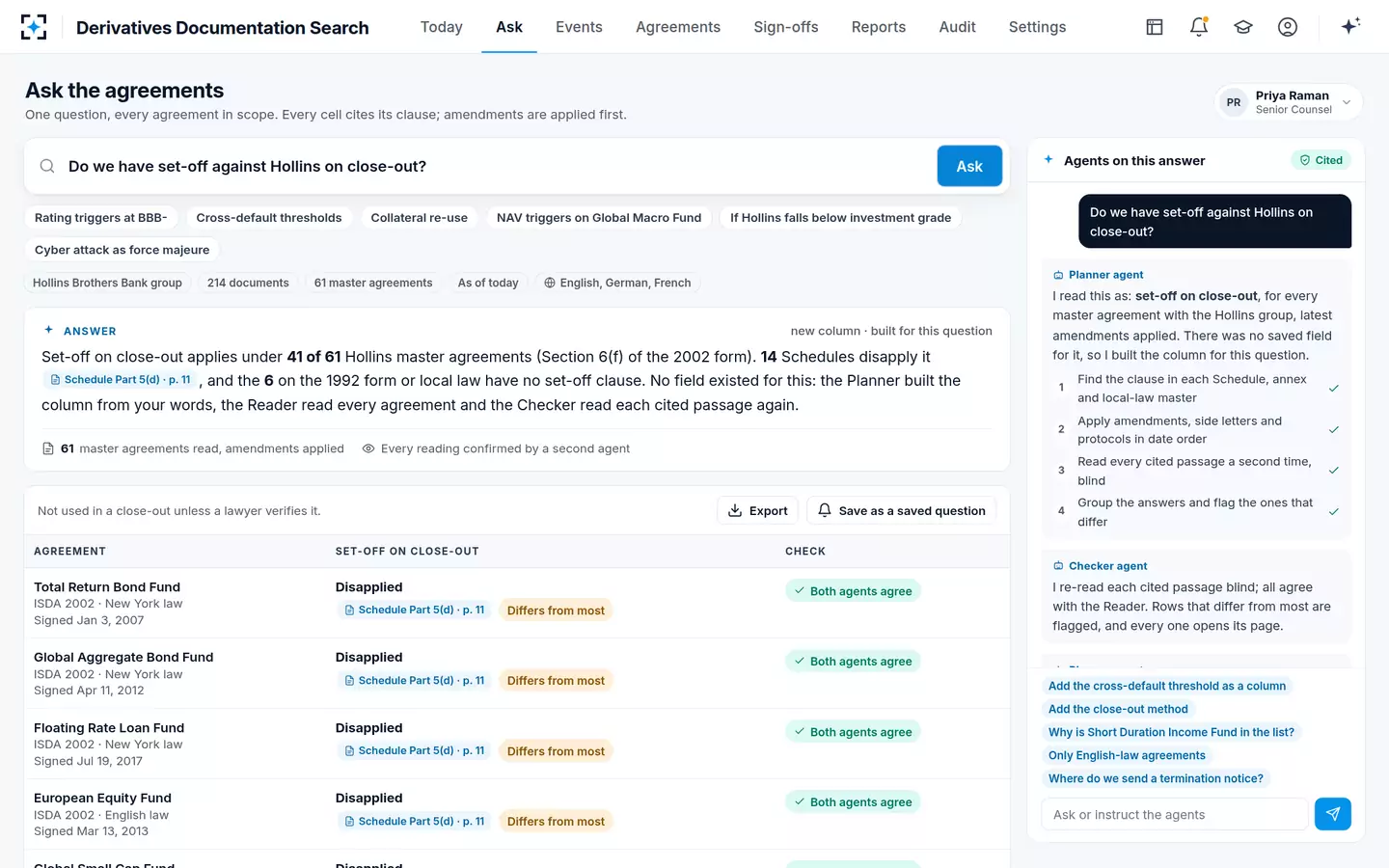
The sample shows how uneven an estate can be. Asked "Do we have set-off against Hollins on close-out?", a question nobody had set up a field for, the solution read every Hollins master agreement: Section 6(f) applies under 41 of 61, 14 Schedules disapply it in Part 5(d), and the 6 on the 1992 form or local law have no set-off clause. Any close-out plan that nets one fund's gain against another agreement's loss with Hollins needs that column first.
Set-off on close-out, read across every agreement in minutes, with the outliers flagged
What happens at close-out if collateral terms are wrong?
The collateral term decides whether collateral is netted as a debt or realised as a pledge, and getting it wrong changes both the number and the steps. Under a title-transfer annex, typical of English-law credit support, collateral passes outright and the receiver owes back equivalent collateral; EU law lets that obligation "be the subject of a close-out netting provision" (Directive 2002/47/EC, Article 6(2)). Under a security-interest annex, typical of New York law, the poster keeps ownership and the receiver enforces a pledge, possibly after re-using it. In the sample estate the dealer may re-use what Quillfield posted under 19 New York-law annexes, $61.8 million, and holds it by title transfer under 18 English-law ones.
"The accessibility and accuracy of legal terms is particularly critical in close-outs, when there is limited time to review the collateral and netting agreements."
Interagency Supervisory Guidance on Counterparty Credit Risk Management (SR 11-10)
Five unread changes, and what each does to the close-out
| The change nobody read | Where it was written | What it does at close-out |
|---|---|---|
| A rating trigger moved one notch | Amendment agreement | A termination right exists but is not used; exposure stays open into the next rating action ($50.5M in the sample) |
| A threshold or minimum transfer amount lowered | Amendment to the credit support annex | Collateral called on the old figures leaves a shortfall the close-out then has to absorb |
| Set-off disapplied | Schedule Part 5 | A plan that nets across agreements assumes a right the contract does not give |
| Close-out method updated | Bilateral amendment or protocol adherence | The calculation uses the wrong valuation standard, and the statement is open to challenge |
| A new annex for new trades | A later credit support annex | Collateral is treated under the wrong annex: netted where it should be realised, or the reverse |
The solution reads all five from the documents rather than from abstracts, and shows the original value struck through beside the term in force. The exposure it joins from the collateral system is shown only to the roles entitled to see it: derivatives legal, counterparty risk and treasury. How each termination right is identified in the first place is covered in where additional termination events hide; to see the close-out terms of the sample estate, start from Derivatives Documentation Search.
Questions people ask
Who calculates the close-out amount?
The determining party, usually the non-defaulting party after an event of default, or the non-affected party after a termination event. It must then deliver a statement of its calculation, and the amount becomes payable when notice of it is effective. Courts can review a determination that misses the good-faith and commercially-reasonable standard.
What is the close-out amount protocol?
It is an industry protocol that let parties to 1992-form agreements adopt the close-out amount approach without renegotiating each agreement. US bank supervisors' counterparty guidance mentions it as an aid to adopting that approach. Like every protocol, it changed only agreements between parties that both adhered.
Is close-out netting the same as set-off?
No. Netting combines the terminated transactions under one agreement into a single amount; set-off reduces that amount by other obligations between the parties, often under other agreements. The sample estate shows the difference: every agreement nets, but only 41 of 61 have set-off on close-out.
When is the close-out amount payable?
The debt arises on the Early Termination Date, and the payment date runs from when notice of the amount payable is effective under the notices section. The Court of Appeal in Videocon held that a late or imperfect statement does not stop the debt from ever becoming payable.
Does a downgrade itself change the close-out amount?
Not directly. A downgrade can give the right to terminate or change collateral calls; the close-out amount is measured only once an Early Termination Date is designated. What the downgrade changes is which agreements can be closed out today, and therefore which exposures can be crystallised.