The 2016 VM CSA under English law is the credit support annex written for regulatory variation margin between parties whose ISDA Master Agreement is governed by English law, and its full title says how it works: "Bilateral Form--Transfer". Collateral delivered under it passes outright to the receiver, which owes back equivalent assets, not the same ones, rather than holding them under a security interest. For a fund with UK or EU dealers this decides what the fund owns on any day, whether a reuse election means anything, what interest and distributions it is owed, and how its collateral is counted if either side defaults. An extraction that reads the threshold and the minimum transfer amount correctly but ignores the mechanism gets those other terms wrong. Botminds' ISDA and CSA Data Extraction identifies the form, the governing law and the transfer mechanism of each annex first, then reads the elections where that form keeps them.
What a fund owns, and what it is owed, under each kind of collateral arrangement
Title transfer (English VM annex): Belongs to the receiver from delivery; the fund holds a claim for equivalent assets.
Security interest arrangement: Stays the fund’s property, subject to the receiver’s security right.
Title transfer (English VM annex): Nothing to grant: an owner may sell, lend or repledge.
Security interest arrangement: Only if the agreement gives a right of use, which EU law recognises if the terms so provide.
Title transfer (English VM annex): Paid to the receiver as owner; the annex obliges it to pass on equivalent distributions.
Security interest arrangement: The fund’s, as owner, subject to the agreement.
Title transfer (English VM annex): Paid by the receiver at the elected rate; whether a negative rate is owed depends on the wording.
Security interest arrangement: As the agreement provides.
Title transfer (English VM annex): The collateral balance enters the close-out sum as an unpaid amount; the fund’s claim is netted.
Security interest arrangement: The fund looks to its retained ownership and the security terms.
Title transfer (English VM annex): Mechanism flag, equivalence, distributions, interest rate and floor.
Security interest arrangement: Mechanism flag, reuse right, custody and segregation, distributions.
The examples on this page come from a fictional sample firm, Quillfield Capital, whose 2,400 executed agreements include 2016 VM annexes under both New York and English law, as it runs through the solution. The law is quoted from EU legislation, US regulators and English courts, linked where it appears.
What is the English law VM CSA? A transfer annex for daily variation margin
It is the English-law member of a family of annexes published in 2016 for the uncleared margin rules. The protocol text that the Federal Reserve republished in its LIBOR Act rule lists five: New York law, English law, Japanese law, French law and Irish law. The English, French and Irish annexes are each a "Bilateral Form--Transfer"; the New York annex's title names no mechanism; the Japanese one is a "Loan" form (12 CFR part 253, Appendix A, 88 FR 5204). Three of the five could also be entered into through a 2016 protocol rather than as a separately negotiated document.
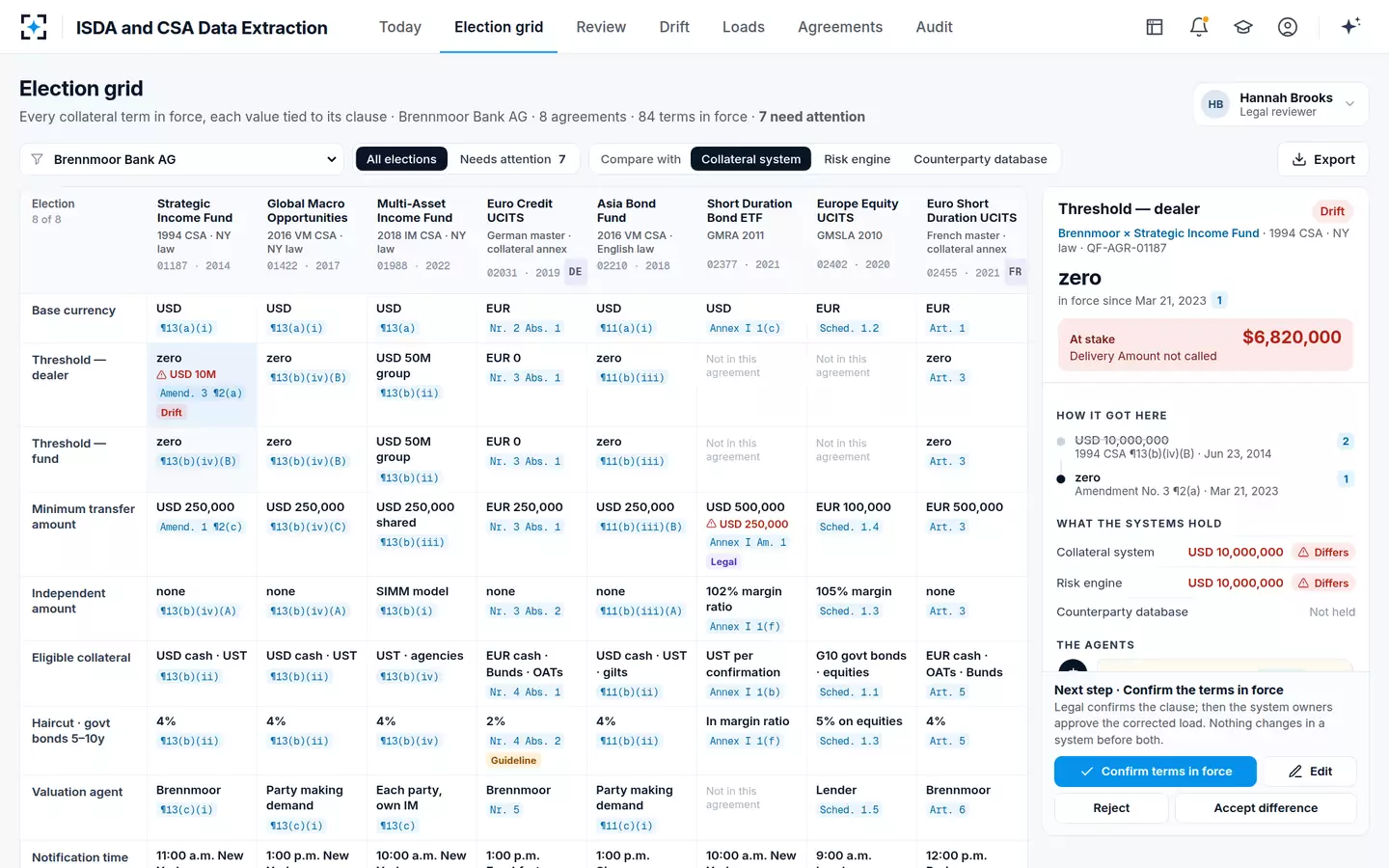
The annex's purpose is regulatory variation margin: exchanged daily, without a threshold, with only the minimum transfer amount to filter small calls. It usually sits beside an older annex that keeps covering legacy trades, a layering explained in credit support annex 1995 vs 1994 vs 2016. In the sample estate, Quillfield's Asia Bond Fund has a 2016 English-law VM annex with Brennmoor Bank AG, signed in 2018, while the same dealer's 1994, 2016 and 2018 annexes with other Quillfield funds are New York-law forms.
How is title transfer different from a security interest?
Under title transfer the receiver becomes the owner; under a security interest the poster stays the owner and the receiver holds a right over the asset. The English annexes put it in their operative clause. In the 1995 transfer annex the Court of Appeal set out, collateral vests in the recipient free of any interest of the party that transferred it, and the annex expressly disclaims creating any mortgage, charge, pledge or other security interest ([2019] EWCA Civ 771, Paragraph 5). The same judgment reads "transfer" in that annex as meaning, "in relation to cash, payment and, in relation to other assets, delivery".
The consequence is that the receiver owes back an obligation, not an asset. When a return is due, the receiver delivers equivalent collateral: securities of the same issue and amount, or cash. Distributions work the same way. The receiver, as owner, collects the coupon and must transfer "cash, securities or other property of the same type, nominal value, description and amount as the relevant Distributions" to the poster, as the court quoted from Paragraph 5(c)(i).
“This Directive seeks to protect the validity of financial collateral arrangements which are based upon the transfer of the full ownership of the financial collateral, such as by eliminating the so-called re-characterisation of such financial collateral arrangements (including repurchase agreements) as security interests.”
Directive 2002/47/EC on financial collateral arrangements, recital 13
What does EU law say about title transfer collateral?
EU law protects it on its own terms. The Financial Collateral Directive requires Member States to let a title transfer arrangement take effect as written, and to let the receiver's obligation to transfer equivalent collateral be netted on close-out (Directive 2002/47/EC, Article 6). Recital 13 states the aim: an outright transfer of ownership is not to be recharacterised as a security interest.
The Directive also regulates the other side. Under a security arrangement, the receiver may use the collateral "as the owner of it" only "in accordance with the terms of the security financial collateral arrangement", and Member States must give effect to that right of use to the extent "that the terms of a security financial collateral arrangement so provide" (Articles 2(1)(m) and 5(1)). A receiver that uses it "thereby incurs an obligation to transfer equivalent collateral". Two routes end in the same obligation; only one of them needs a reuse clause to get there. Whether a VM annex says anything about reuse is therefore a meaningful field under a security arrangement and an empty one under a transfer annex.
Can collateral posted under a VM CSA be reused?
Under an English-law transfer annex, yes: the receiver owns it. The margin rules restrict reuse of initial margin, not of variation margin. The EU rule says the collecting party "shall not rehypothecate, repledge nor otherwise reuse the collateral collected as initial margin" (Delegated Regulation (EU) 2016/2251, Article 20), and the US rule makes the initial margin custodian promise not to rehypothecate or reuse it (17 CFR 23.157(c)). Neither text applies those limits to variation margin.
For a fund that posts variation margin, this has a cost and a record-keeping consequence. The cost is that its posted bonds may be lent or sold by the dealer, and it holds a claim, not the bonds. The record-keeping consequence is that the fund's custody records must show the bonds as delivered away, not as its own assets held elsewhere. US rules for the largest financial companies ask the same question of the dealers: their collateral records carry "Is collateral re-hypothecation allowed?", "Collateral or portfolio segregation status" and "Collateral location" for each item (31 CFR part 148, Appendix A, Table A-4).
Why does initial margin never sit on a transfer annex?
Because the rules require initial margin to stay out of the collector's estate. When the CFTC adopted its margin rule in 2016, commenters asked to be allowed "arrangements involving title transfer and charge back of margin"; the Commission said such alternatives did not "adequately ensure the safety and soundness of the CSE nor adequately offset the risk to the financial system", and required initial margin to be held by a custodian independent of both parties (CFTC, 81 FR 636; 17 CFR 23.157). The EU rule requires initial margin to be "protected from the default or insolvency of the collecting counterparty" by segregation, and bans its reuse (2016/2251, Articles 19(3) and 20).
So a fund's regulatory initial margin is documented separately, with custody agreements, while its variation margin can move under a transfer annex. The two are easy to conflate in a system that has one "CSA" record per counterparty. The extraction has to keep them apart: different documents, different mechanisms, different custody, different reuse.
Variation margin and initial margin under the rules: where the collateral sits
| Question | Variation margin | Regulatory initial margin |
|---|---|---|
| May it move by title transfer? | Yes, under a transfer annex such as the 2016 English-law VM form | No in the US: held by an independent custodian (23.157); in the EU, segregated and protected from the collector’s insolvency (Article 19) |
| May the receiver reuse it? | Not restricted by the margin rules; a transfer annex makes the receiver owner | No: the US custodian may not rehypothecate or reuse it; the EU bans reuse (Article 20) |
| Threshold | None in the regulatory calculation | Up to $50 million (US) or EUR 50 million (EU) across affiliates |
| What the documents must say | Margin requirements, eligible assets and haircuts, valuation and disputes | The same, plus custodial and segregation arrangements (23.504(b)(3)(iv); 2016/2251, Article 3(b)) |
Interest on cash under a transfer annex: who pays whom, and when it goes negative
Under a transfer annex the receiver of cash owns it and pays interest to the poster at the rate the elections set. In the 1995 annex the Netherlands case concerned, the receiver was to pay the Interest Amount monthly, at EONIA minus four basis points, and the court explained why the arrangement was one-directional: the High Court judge had said that positive interest "is a price for having the use of the collateral", while negative interest would be "a potential cost of the collateral being in cash", and the Court of Appeal agreed the annex did not make the poster pay it ([2019] EWCA Civ 771).
For extraction that means the interest election is several fields, not one: the index, the spread, the day count, the payment dates, whether the rate is floored at zero, and any special rate, such as the zero rate that annex applied to cash paid into the wrong account. The answer to "is negative interest owed?" sits in the wording of each annex and any protocol the parties adopted, and the 2016 English annexes must be read for it on their own terms. When the rate index itself changes, as the sample firm's New York annex moved from the Federal Funds rate to SOFR by amendment, every one of those fields has to be re-checked.
What it changes for a fund's custody records and close-out
It changes the asset side of the fund's books and the arithmetic of a default. Under the transfer annex, when an early termination follows a default, the value of the collateral balance becomes an unpaid amount owed to the poster in the close-out calculation (Paragraph 6, as set out in [2019] EWCA Civ 771). If the fund has posted more than its exposure, the excess comes back as part of a net sum, not as its own bonds. How that close-out sum is worked out, and what goes wrong when the collateral terms in it are stale, is covered in the close-out amount and the missed amendment.
For daily operations the effect is narrower but constant. The fund's custodian records, its collateral system and its accounting must all agree that variation margin posted under an English-law VM annex has left the fund, that distributions on it arrive from the dealer rather than the issuer, and that interest on cash is owed at the annex's rate. In the sample firm, Amendment No. 2 to one New York annex moved the cash rate from the Federal Funds rate to SOFR; the same kind of change on an English annex must reach the same three places.
Reading an English VM annex: the elections that trip an extraction
Most of an English VM annex is read like any other: base currency, eligible credit support, valuation percentages, minimum transfer amount, rounding, valuation agent and timing. Three things trip readers. First, the mechanism clause, which is printed rather than elected and so is skipped by readers looking only at the elections. Second, the interaction with a legacy annex: which trades each covers. Third, timing elections written as times in a city, which two careful readers can transcribe differently.
How ISDA and CSA Data Extraction reads an English-law VM annex
Agent
Intake agentClassifies the document by its title line, form year and governing law, and matches it to its Master Agreement and any legacy annex with the same parties.
Never: creates an agreement or a counterparty
Agent
Extraction agentRecords the mechanism, then each election with document, paragraph and page: base currency, eligible credit support, valuation percentages, MTA, rounding, valuation agent, notification time, interest.
Never: resolves a disagreement
Agent
Checker agentReads the same clauses blind with a different method and either agrees or puts both readings side by side.
Never: sees the first reading
A person decides
Documentation analystVerifies agreed terms in one step and reads every disagreement with both passages in front of her.
A person decides
Derivatives lawyerConfirms the terms in force, including the mechanism and which trades the annex covers.
Never: confirms what she verified herself
An English-law VM annex where the two readers disagree
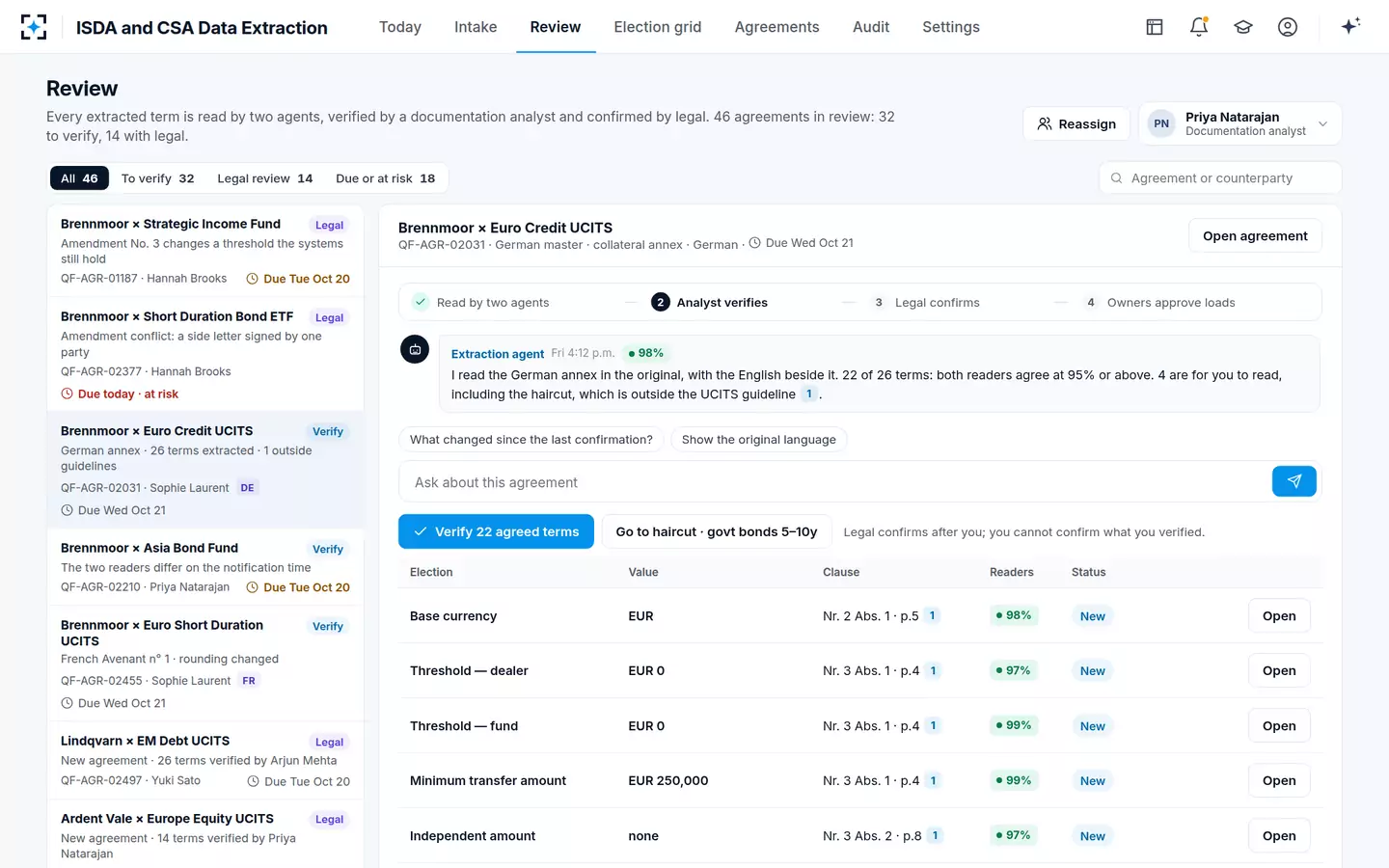
A disagreement on a notification time looks trivial and is not. It decides whether a call made at noon is due today or tomorrow, and under daily variation margin a one-day slip on a large exposure is a one-day uncollateralised gap. The same reading discipline applies to the schedule of assets the annex accepts, covered in the eligible collateral schedule.
One dealer, New York and English annexes side by side
Questions people ask
What is the difference between the 2016 VM CSA under English law and New York law?
The English-law annex is a transfer form: collateral becomes the receiver's property and equivalent assets come back. The New York annex's title names no mechanism, so its grant clause must be read; where a security interest is created, the poster keeps ownership and any reuse right comes from the agreement. The elections also sit in different paragraphs.
Does the English-law VM CSA have a threshold?
For regulatory variation margin the threshold is zero, because the US and EU rules collateralise the full mark-to-market change, filtered only by a minimum transfer amount of at most $500,000 or EUR 500,000. Legacy English annexes covering older trades can still carry positive thresholds.
Can the receiver lend out collateral posted under the English VM CSA?
Yes, as owner. The margin rules ban reuse of initial margin, not variation margin. The poster's protection is its claim for equivalent collateral and the netting of that claim on close-out, which EU law requires Member States to respect.
Can initial margin be posted under an English-law transfer annex?
Not regulatory initial margin. The US rule requires it to be held by an independent custodian that may not reuse it, and the CFTC rejected title transfer alternatives in 2016; the EU rule requires segregation that protects it from the collector's insolvency and bans its reuse.
Who owns the coupons on bonds posted under a transfer annex?
The receiver collects them as owner, and the annex obliges it to pass equivalent distributions to the poster, in the 1995 form "not later than the Settlement Day following each Distributions Date" unless that would create or increase a delivery amount. A fund's income records must reflect that the money comes from the dealer.