The 1995 credit support annex is the English-law form of ISDA's collateral annex, and its defining feature is that collateral passes outright to the receiver: its Paragraph 5 is headed "Transfer of Title, No Security Interest". The 1994 annex is the form for agreements subject to New York law only, and the 2016 Credit Support Annexes for Variation Margin were published in several governing laws once the uncleared margin rules required daily, zero-threshold variation margin. A fund that has traded derivatives for a decade can hold several of these with the same dealer, each covering different trades, as the sample firm in this guide does. The form decides the legal mechanism, the names of the terms and where they sit, so identifying it is the first step of any extraction, not a detail. Botminds' ISDA and CSA Data Extraction reads each executed annex and its amendments in the order they took effect, and records the form beside every term.
Three decades of forms, layered under the margin rules
- 1994 New York and 1995 English annexes1994–2016
- Legacy annexes plus 2016 VM annexes2016 on
- No uncleared margin ruleto Aug 2016
- Phase-in: VM for all from Mar 2017Sep 2016 – Aug 2022
- IM for all in scopeSep 2022 on
The examples on this page come from a fictional sample firm, Quillfield Capital, with 2,400 executed ISDA, CSA, GMRA and GMSLA agreements, as it runs through the solution. The descriptions of the forms come from courts and regulators, quoted and linked where they appear.
What is the 1995 credit support annex? An English-law transfer of title
The 1995 annex is the English-law collateral annex under which the receiver becomes the owner of what it receives. Its Paragraph 5(a), set out by the High Court in 2018, provides that "all right, title and interest in and to any Eligible Credit Support ... which it transfers to the other party under the terms of this Annex shall vest in the recipient free and clear of any liens", and 5(b) that nothing in it "is intended to create or does create in favour of either party any mortgage, charge, lien, pledge, encumbrance or other security interest" (State of the Netherlands v Deutsche Bank AG [2018] EWHC 1935 (Comm)). The receiver owes back equivalent assets, not the same ones.
English practice also offers a security version. The Court of Appeal noted that the users' guide published in 1999 "drew attention to the distinction between the CSA and the Credit Support Deed, which in contrast to the CSA, created a security interest in collateral transferred under it" ([2019] EWCA Civ 771). Two English-law documents, both about collateral, with opposite answers to who owns it. An extraction that records only "English law CSA" has not recorded the most important fact.
The same case shows how long a 1995 form lives. The State and the bank signed in 2001, replaced the elections paragraph in 2010, and were still arguing about it in 2019, when the court had to decide whether the form's interest provisions could carry negative interest. They could not: the 2014 market protocol that would have changed the paragraph had not been adopted by these parties, and the court read the annex as it stood.
How does the 1995 English annex differ from the 1994 New York form?
They differ first in governing law and mechanism, and only then in wording. The 1994 form is, by its own title, for "ISDA Agreements Subject to New York Law Only"; the 1995 annex for English law carries "Transfer" in its title, and the 1995 deed carries "Security Interest" (form titles as listed in 12 CFR part 253, Appendix A). The New York form's title says neither, so the grant clause must be read: a clause under which title vests in the recipient makes the receiver the owner, while a clause creating a security interest leaves ownership with the poster and makes the reuse terms decide what the receiver may do with it.
EU law draws exactly that line. A "title transfer financial collateral arrangement" is one under which the provider "transfers full ownership of, or full entitlement to, financial collateral" to the taker; a "security financial collateral arrangement" is one where "the full or qualified ownership of, or full entitlement to, the financial collateral remains with the collateral provider when the security right is established" (Directive 2002/47/EC, Article 2(1)(b) and (c), as amended).
Layout differs too. The 1995 English annex keeps its elections in Paragraph 11: the court quoted the independent amount, threshold, minimum transfer amount and rounding at 11(b)(iii)(A) to (D), and the interest rate at 11(f)(i). The sample firm's 1994 New York annexes keep theirs in Paragraph 13, with the threshold at 13(b)(iv)(B) and rounding at 13(b)(iv)(D). An extraction that hunts for "Paragraph 11" in a New York annex will find the wrong paragraph.
One US regulation lists the collateral forms a market protocol had to reach
17
credit support forms named, from the 1994 New York annex to five 2016 VM annexes
5
governing laws among the 2016 VM annexes: New York, English, Japanese, French, Irish
3
2016 VM annexes the list says may have been entered into through a protocol
What is the 2016 VM CSA, and why did the margin rules lead to new annexes?
The 2016 VM CSA is the annex written for regulatory variation margin: exchanged daily, without a threshold, in assets the rules allow. Older annexes were not built for that. Describing the market before its own rule, the SEC wrote that uncleared swaps were "typically covered by agreements outlining the rights of the parties to make margin calls; however, such agreements may not require the contracting parties to exchange variation margin on a daily basis" (SEC, 84 FR 43872, 2019). The US variation margin requirement reached the remaining covered dealers’ new swaps with other swap entities and financial counterparties on 1 March 2017 (17 CFR 23.161(a)(2)).
Rather than rewrite every legacy annex, the rules let parties ring-fence old trades. The CFTC allowed an agreement to identify separate netting portfolios, and added: "(These separate netting portfolios are commonly covered by separate credit support annexes to the EMNA.)" The rule, it said, "facilitates the ability of the parties to document two separate netting sets, one for uncleared swaps that are subject to the final rule and one for swaps that are not subject to the margin requirements" (CFTC, 81 FR 636, January 2016).
The 2016 forms also arrived by a route that leaves little paper. The protocol list above includes 2016 VM annexes "entered into between the Parties pursuant to the ISDA 2016 Variation Margin Protocol": an annex that came about through each party adhering to a market protocol. An extraction that looks only for bilaterally negotiated annexes, and ignores the adherence letters, can miss it.
Do old and new CSAs coexist for the same counterparty?
Yes, and that is the normal state of a long relationship. The US banking agencies described the arrangement in 2018: separate netting portfolios under one master agreement, and "Typically, this is accomplished by using a separate Credit Support Annex for each netting set, subject to the terms of a single master netting agreement" (OCC, Federal Reserve, FDIC, Farm Credit Administration and FHFA, 83 FR 50805, 2018). A legacy annex with a positive threshold may cover trades from 2014 while a 2016 VM annex covers everything since 2017, and both are in force.
The boundary between them can move. The same agencies warned that "the compliance date provisions of the Swap Margin Rule contain no safe harbor from the rule's application to a legacy swap that is later amended or novated on or after the applicable compliance date". An amendment to an old trade can pull it into the regulatory netting set. A system has to know, for each trade, which annex governs it, and that comes from the documents, not from the trade date alone.
One dealer, eight agreements, five kinds of collateral document
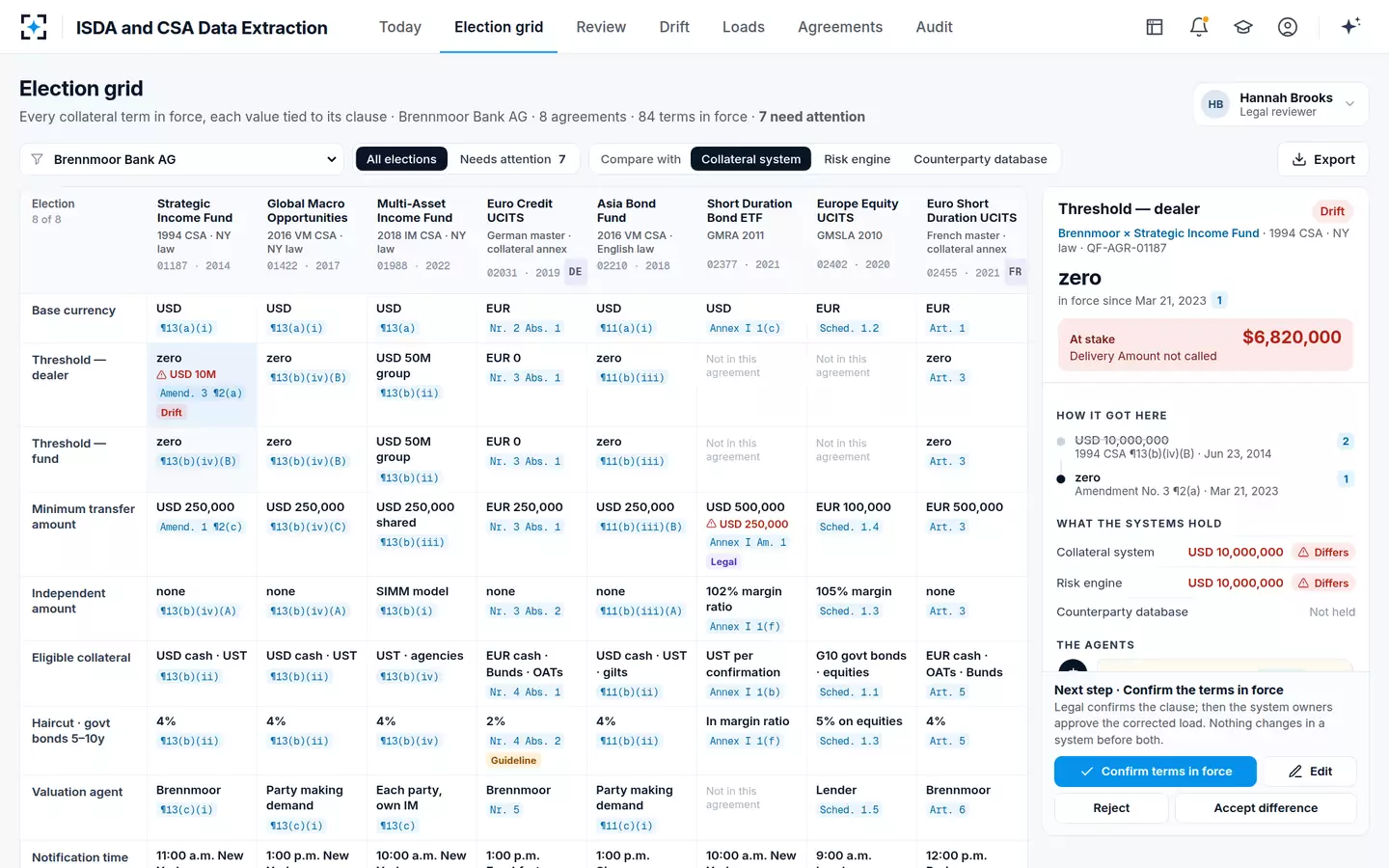
Which version does each of my agreements use? How to tell from the document
Five things identify the form, and all of them are on the page. The title line names the form, the year and the governing law. The grant clause says whether title passes. The execution block shows whether it was signed as a deed. The elections paragraph number and the defined terms differ by form. And the relationship's protocol adherence letters show whether a form was created or amended without a bilateral signature.
How to tell which credit support form you are holding
| Check | What to look for | Why it matters for extraction |
|---|---|---|
| Title line | Year, “Credit Support Annex” or “Deed”, “Transfer” or “Security Interest”, and the governing law, as in the forms listed in 12 CFR part 253, Appendix A | Sets the mechanism and the paragraph map before any term is read |
| Grant clause | Whether title “shall vest in the recipient” or a security interest is created | Decides whether reuse terms, custody terms and distributions are owed, and how collateral is treated on default |
| Execution | Signed as a deed or as an annex to the Schedule | The English deed is a security document; the annex is not |
| Elections paragraph | Paragraph 11 in the 1995 English annex; Paragraph 13 in the sample firm’s 1994 New York annexes | Tells the reader where the threshold, MTA and rounding should be |
| Purpose | “for Variation Margin (VM)” in the title, or a legacy form | A VM annex governs the regulatory netting set; a legacy annex may govern only older trades |
| Protocols | Adherence letters for the 2016 variation margin protocol and later protocols | An annex can exist, or be amended, with no bilateral document in the folder |
Master agreements have versions too, and the annex sits on top of one of them: a 1992 or a 2002 Master Agreement changes close-out and default terms that the annex refers to. That comparison is in ISDA 1992 vs 2002.
What the form changes in an extraction
The form changes which fields exist and what the same field means. Under a transfer annex there is no rehypothecation election to record, because the receiver owns the assets, but there is an obligation to pass back distributions and pay interest on cash. Under a security form the receiver holds the poster's assets, so the reuse and custody terms the US rule asks for, investment and rehypothecation terms among them, become the important fields (17 CFR 23.504(b)(3)).
The same election, read under a transfer annex and under a security form
1995 English transfer annex: The receiver: title vests in the recipient free of liens (Paragraph 5(a)).
A security-interest form: The poster keeps ownership; the receiver holds a security right over it.
1995 English transfer annex: No reuse election needed: the receiver may deal with what it owns, and owes back equivalent assets.
A security-interest form: A reuse or rehypothecation election decides whether the receiver may use it; EU law calls this a right of use.
1995 English transfer annex: The value of the collateral balance becomes an Unpaid Amount in the close-out sum (Paragraph 6).
A security-interest form: The receiver enforces its security over the assets themselves.
1995 English transfer annex: Eligible credit support, valuation percentages, threshold, MTA, rounding, interest and distributions.
A security-interest form: All of those, plus custody, segregation and reuse terms.
1995 English transfer annex: Paragraph 11.
A security-interest form: Depends on the form; the sample firm’s 1994 New York annexes use Paragraph 13.
The 2016 VM annex under English law is a transfer annex, as its title says, and the difference that makes to custody and close-out is the subject of the 2016 VM CSA under English law. Whichever form it is, the dozen terms it carries are the ones described in what a credit support annex means.
Protocols: how a market-wide change reaches an old annex, or does not
A protocol changes old annexes only for parties that adhere to it, and only in the way its text says. The Netherlands case turned on exactly that: a market protocol of May 2014 offered a rewritten interest paragraph for negative rates, the parties never adopted it, and their 2010 wording governed ([2019] EWCA Civ 771). The end of LIBOR worked the other way round in the US. The Federal Reserve's LIBOR Act rule reaches contracts that still referenced LIBOR, and republishes the 2020 fallbacks protocol whose scope covers credit support documents of every form listed above (88 FR 5204, 2023).
For an extraction this means a protocol letter is a document in the chain like any amendment, with an effective date and a scope. The sample firm's Brennmoor chain holds two: a 2018 stay protocol letter and a 2020 fallbacks protocol letter, neither of which changed a collateral election, and a separate 2021 amendment that moved the interest rate on cash collateral from the Federal Funds rate to SOFR. Each had to be read to know which terms it touched, and the rate change was made bilaterally, not by protocol.
How ISDA and CSA Data Extraction handles a layered book
ISDA and CSA Data Extraction starts with the form and the chain, not with the terms. The Intake agent classifies each document, matches it to its agreement by parties, dates and references, and splits bundles by signature page. The Amendment agent orders every amendment and protocol adherence letter by effective date rather than filing date, applies each change and records which document and paragraph set every term in force; when two documents conflict it stops and asks legal. The Extraction and Checker agents then read the elections where that form keeps them.
The amendment chain: seven documents applied by effective date
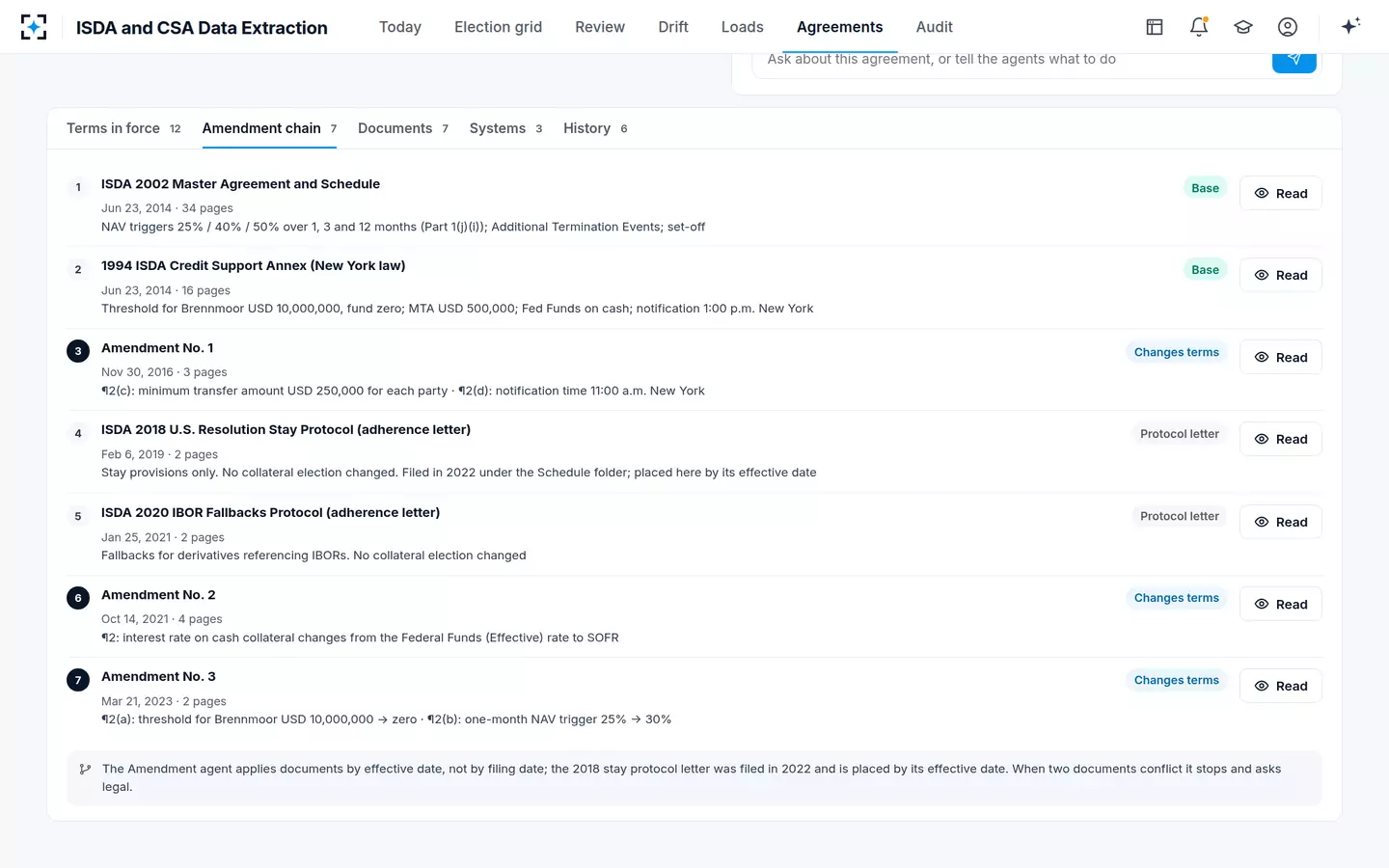
In the sample estate, the last back-catalog batch rebuilt the terms in force for 312 legacy agreements from 1,206 documents, and the Amendment agent stopped on three conflicts for legal to decide. Each of those agreements now carries its form beside its terms, so a reader of any threshold can see which paragraph of which form, as amended by which document, it came from.
Questions people ask
What is the difference between the 1994 CSA and the 1995 CSA?
The 1994 form is for agreements governed by New York law; the 1995 annex is for English law and transfers title to the collateral, with English practice offering a separate 1995 deed for those who want a security interest instead. The elections sit in different paragraphs, and the mechanism decides which reuse and custody terms matter.
Is the 1995 CSA a security agreement?
No. Its Paragraph 5(b) says nothing in it "is intended to create or does create" any security interest; the receiver becomes the owner and owes back equivalent collateral. The 1995 credit support deed is the English security document.
What is the difference between the 1995 CSA and the 2016 VM CSA?
The 2016 annex was written for regulatory variation margin, exchanged daily without a threshold, and usually covers trades after the margin rules took effect while the 1995 annex keeps covering older ones. The English-law version of both is a transfer annex. A 2016 annex may also have been adopted by protocol, so the folder may hold no signed copy.
Why do I have two CSAs with the same bank?
Because the rules let parties keep legacy trades outside the margin regime by putting them in a separate netting set, and the CFTC noted those sets "are commonly covered by separate credit support annexes". Both annexes stay in force, each for its own trades.
Can an old trade move under the new annex?
It can. The US banking agencies said the rules give no safe harbour for a legacy swap that is later amended or novated after the compliance date, so an amendment can bring it within the regulatory netting set and its zero-threshold annex.