An ISDA CSA threshold is the amount of exposure one party agrees to leave uncollateralised before the other may call for collateral: with a USD 10 million threshold, the first USD 10 million of exposure is never called, and only the excess is. Three companion numbers finish the job. The minimum transfer amount (MTA) stops small transfers, the independent amount adds collateral on top of exposure, and rounding sets the final figure. Together they decide whether a margin call happens and how big it is, which is why an error in any of them shows up as a wrong call the next morning. The rules cap two of them: in the US the MTA is $500,000 and the initial margin threshold $50 million, and the EU uses the same figures in euros. Botminds' ISDA and CSA Data Extraction reads these terms from each credit support annex and every amendment, cites them to the clause, and compares them nightly with what the collateral system and risk engine hold.
Four numbers decide whether a call happens and how big it is
- Threshold: the exposure left unsecured
Deducted from exposure before anything is owed. Zero by default if the elections are blank. For regulatory variation margin it is zero; for regulatory initial margin it may be up to $50 million (US) or EUR 50 million (EU). Check: amount, currency, which party, and any rating table that moves it.
- Minimum transfer amount: the smallest transfer
A trigger, not a deduction: once the amount due exceeds it, the whole amount moves. Capped at $500,000 in the US and EUR 500,000 in the EU for regulatory margin. Check: per party, combined or split between initial and variation margin, and which amendment last set it.
- Independent amount: extra collateral on top
Added to exposure in the Credit Support Amount, fixed or triggered by an event such as a downgrade. Not the same as regulatory initial margin. Check: the trigger, the formula, any cap.
- Rounding: the last step
Rounds the delivery and return amounts to an agreed multiple, up, down or to the nearest. Check: the multiple, the direction, and whether delivery and return round the same way.
The examples below come from a fictional sample firm, Quillfield Capital, which holds 2,400 executed ISDA, CSA, GMRA and GMSLA agreements, as it runs through the solution. The rules and the court's reading of a real annex are linked where they appear.
What is a threshold in a CSA? Exposure you agree to leave unsecured
A threshold is unsecured credit, granted in advance. The 1995 English annex that the Court of Appeal read in State of the Netherlands v Deutsche Bank AG [2019] EWCA Civ 771 computes the Credit Support Amount as exposure plus any independent amount, less the poster's threshold, never below zero. A party whose exposure stays under the threshold owes nothing; one whose exposure goes above it owes only the excess. Each party can have its own threshold, which lets a dealer extend more unsecured credit in one direction than in the other.
The threshold is also the term most likely to change after signing. Thresholds can be traded for other concessions, cut to zero when the margin rules arrive, or linked to credit ratings, so a single agreement can carry three different values over its life. The definition adds one trap: the threshold is the amount specified in the elections, and "if no amount is specified, zero". A blank is a value.
What is a minimum transfer amount, and is it deducted from the call?
A minimum transfer amount is the smallest call either party has to meet; it is not deducted. The CFTC said so in plain terms when it adopted the US margin rule in 2016: the MTA changes when margin is collected, not how much. Its example: if the amount due rose from $500,000 to $800,000, the dealer "would be required to collect the entire $800,000" (CFTC, 81 FR 636, January 2016). The EU rule says the same: once the amount due exceeds the MTA, the collecting party "shall collect the full amount of collateral due without deduction of the minimum transfer amount" (2016/2251, Article 25(3)).
A system that treats the MTA as a deductible under-calls every time a call is made, by exactly the MTA. On a $250,000 MTA that is a quarter of a million dollars of exposure left uncovered after each call, and it never shows up as a break, because the system is consistent with itself.
One exposure, five readings of the same annex: the call ranges from nothing to $6.82 million
What is the regulatory minimum transfer amount in the US and the EU?
For margin the rules require, the cap is $500,000 in the US and EUR 500,000 in the EU, applied to initial and variation margin combined. The CFTC's definition reads: "The minimum transfer amount shall be $500,000", with up to $50,000 for each separately managed account where one owner has several (17 CFR 23.151). A dealer "is not required to collect or to post variation margin" until the combined uncollected amount is greater than that figure (23.153(c)). In the EU the MTA "shall not exceed EUR 500 000", and parties may split it between initial and variation margin as long as the two add up to no more (Article 25(1) and (4)).
The cap is a ceiling, not a requirement. In 2016 the CFTC confirmed "that the minimum transfer amount is allowed but not required under the final rule, and parties are free to collect and post margin below that amount." In July 2026 it noted that a dealer and a fund "may agree to have separate minimum transfer amount for IM and VM (to be reflected in the margin documentation)" (CFTC, 91 FR 45134, July 2026). That is a split a system must hold as two numbers, not one.
The four numbers, side by side: what the rules allow and where the agreement decides
| Term | United States | European Union | What the CSA decides |
|---|---|---|---|
| Variation margin threshold | None: variation margin is exchanged without any threshold (CFTC, 2016) | None in the variation margin calculation (Article 10) | Whether the annex for regulatory margin carries a zero; a legacy annex may still carry a positive threshold for older trades |
| Initial margin threshold | Up to $50 million of aggregate credit exposure across affiliates (23.151) | Up to EUR 50 million between different groups; EUR 10 million within one group (Article 29) | The amount used, and how it is shared across the parties’ affiliates |
| Minimum transfer amount | $500,000 combined; up to $50,000 per separately managed account (23.151) | No more than EUR 500,000, combined or split (Article 25) | The amount per party, and whether it is split between initial and variation margin |
| Independent amount | Not a regulatory term; regulatory initial margin is calculated by model or schedule and held by an independent custodian (23.152, 23.157) | Not a regulatory term; initial margin is calculated under Article 11 and segregated | Any contractual add-on, its trigger and its cap |
| Rounding | Not set by the rule | Not set by the rule | The multiple and the direction for delivery and return |
Why do regulatory CSAs have no threshold for variation margin?
Because the rules call for the whole mark-to-market change to be collateralised every business day, with the MTA as the only filter. The CFTC defines the variation margin amount as the cumulative mark-to-market change in value of the swap since it was entered into, less margin already collected and plus margin already posted, and when it set the initial margin thresholds it added that "variation margin will still be exchanged without any threshold" (81 FR 636). The EU formula is the same in substance: the value of all contracts in the netting set, less variation margin previously collected, plus variation margin previously posted (2016/2251, Article 10).
That is why a fund with a legacy annex carrying a positive threshold usually has a second, regulatory annex beside it with zero, each covering a different netting set of trades. The two must never be merged in a system. Which form your agreements use, and why they multiplied after 2016, is set out in credit support annex 1995 vs 1994 vs 2016.
“The minimum transfer amount only affects the timing of margin collection; it does not change the amount of margin that must be collected once the $500,000 threshold is crossed.”
CFTC, adopting the US uncleared margin rule, January 2016
What is an independent amount, and how is it different from initial margin?
An independent amount is a contractual add-on; regulatory initial margin is a calculated requirement with its own custody rules. In the CSA's arithmetic, the independent amount is added to exposure before the threshold is deducted, so it raises every call by a fixed sum or formula. The Netherlands annex shows a triggered one: if two of three rating agencies rated the bank below AA- or Aa3, its independent amount became "one percent (1 %) of the notional amount of the Swap portfolio" for new swaps, and "The overall maximum Independent Amount is set on 75 million euro" ([2019] EWCA Civ 771).
Regulatory initial margin works differently. Under US rules it is calculated by an approved model or a standard table, it must sit with a custodian that is neither party nor an affiliate of either, and the custodian may not rehypothecate it (17 CFR 23.157). An independent amount under a title-transfer annex sits with the receiver. A fund can owe both to the same dealer under different documents, and a system that adds them together, or treats one as the other, misstates both the call and where the collateral is.
Rounding: the smallest term with a daily effect
Rounding decides the last digits of every call, and its direction matters more than its size. The Netherlands annex rounded delivery and return amounts "up or down to the nearest integral multiple of 1000 euro". The sample firm's 1994 New York annex rounds delivery up to the nearest USD 10,000. Rounding the wrong way, or applying the delivery rule to returns, produces a small difference every day, and small daily differences are what portfolio reconciliation flags as breaks.
The court also showed where rounding does not apply. In rejecting the State's reading, it noted that interest amounts were excluded "from both the Minimum Payment Amount of €1 million and the rounding provisions" ([2019] EWCA Civ 771). A field that records rounding without its scope cannot reproduce the agreement's arithmetic.
Rating-linked thresholds: the number that moves with a downgrade
A rating-linked threshold is a table, not a number. In the Netherlands annex the threshold was "the amount determined on the basis of the ratings assigned to Party A"; the court recorded that it varied between €0 and €65 million with the bank's rating and was in practice generally €65 million. The term in force on any day therefore depends on a rating that is not in the agreement at all.
Storing such a threshold as its usual value is the commonest way for a system to look right for years and be wrong on the day it matters. The extraction has to capture the grid, which agencies count, how a split rating is resolved and what happens if a rating is withdrawn, and the system has to read the ratings each day. Downgrade terms in the Schedule raise the same question for termination rights; finding a rating downgrade trigger before the risk call covers that side.
One wrong threshold in the sample estate, sized
The sample shows what a stale threshold costs. Quillfield's Strategic Income Fund signed a 1994 New York annex with Brennmoor Bank AG in June 2014, with a dealer threshold of USD 10,000,000. Amendment No. 3, signed on 21 March 2023, cut it to zero. The collateral system and the risk engine were never updated. At a Friday close the fund's exposure to the dealer was $6,812,400, with no collateral held. Under the agreement in force that is a $6,820,000 delivery amount; the collateral system, still working from USD 10 million, called nothing.
How a drift is sized: exposure, threshold, minimum transfer amount, rounding
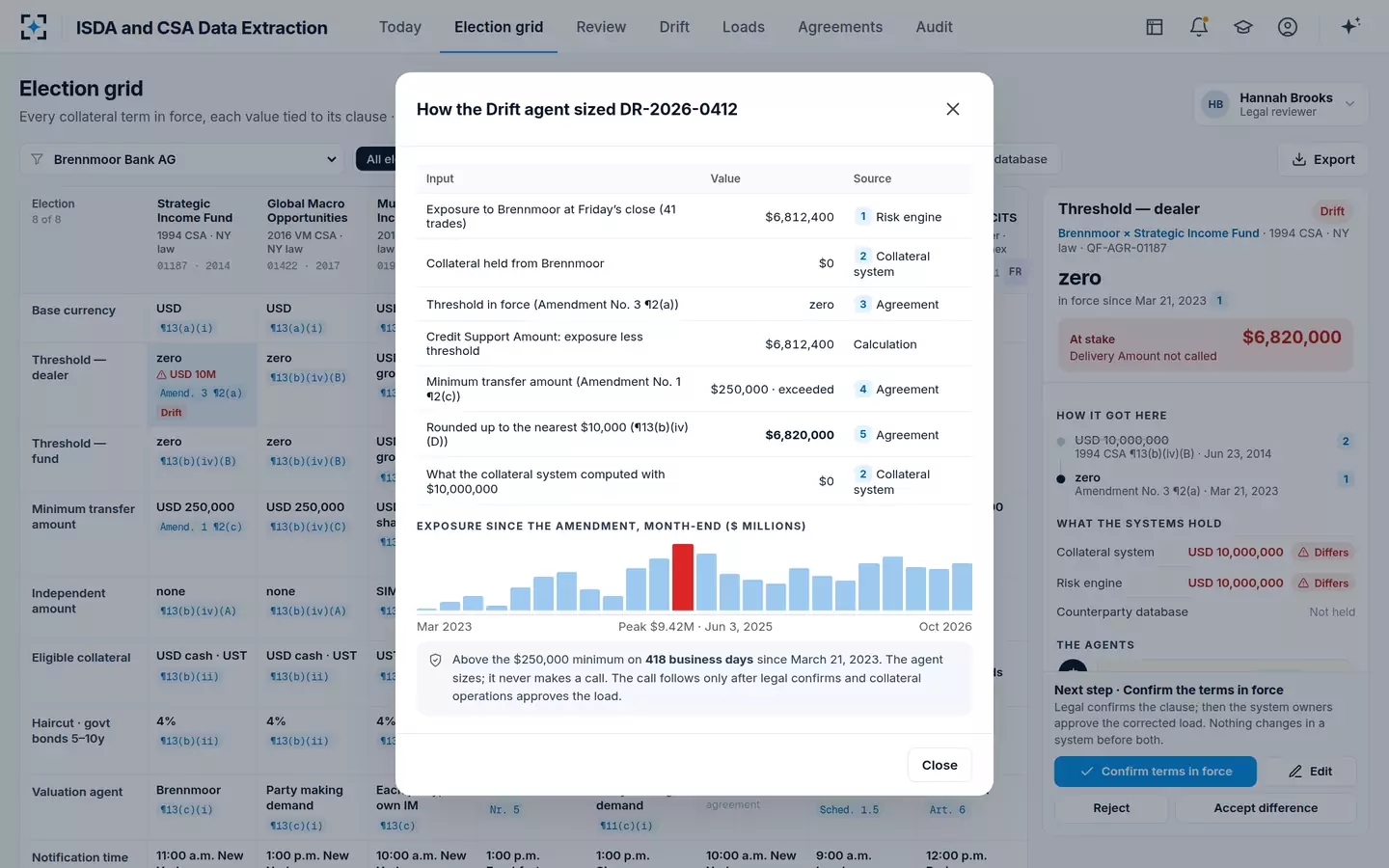
The exposure was above the minimum transfer amount on 418 business days after the amendment, peaking at $9.42 million in June 2025. A dispute would not have caught it, because neither side was calling. Portfolio reconciliation would not have caught it either: US swap dealers must reconcile portfolios with a fund quarterly or annually, by trade count, and that compares the material terms and valuation of each swap, not the collateral annex (17 CFR 23.502). A threshold error is found only by comparing the terms a system holds with the agreement as amended.
How to check the four numbers against the paper
Checking these numbers is a matter of tracing, not reading. For each agreement, collect the annex, the Schedule, every amendment and every protocol adherence letter; order them by effective date; and record, for each of the four numbers and each party, the value in force and the document that set it. Then compare that with every system that holds the number: the collateral system that issues calls, the risk engine that measures exposure, and any counterparty database that feeds limits.
In ISDA and CSA Data Extraction the reading is done twice. An Extraction agent records each term with document, paragraph and page; a Checker agent reads the same clauses blind with a different method; any disagreement goes to a documentation analyst with both passages side by side, and a derivatives lawyer confirms the terms in force. The Drift agent then compares each term with the three systems after the risk engine's end-of-day run and sizes any difference with the latest exposure, threshold, MTA and rounding.
Guided review: terms both readers agree on, and the ones to read first
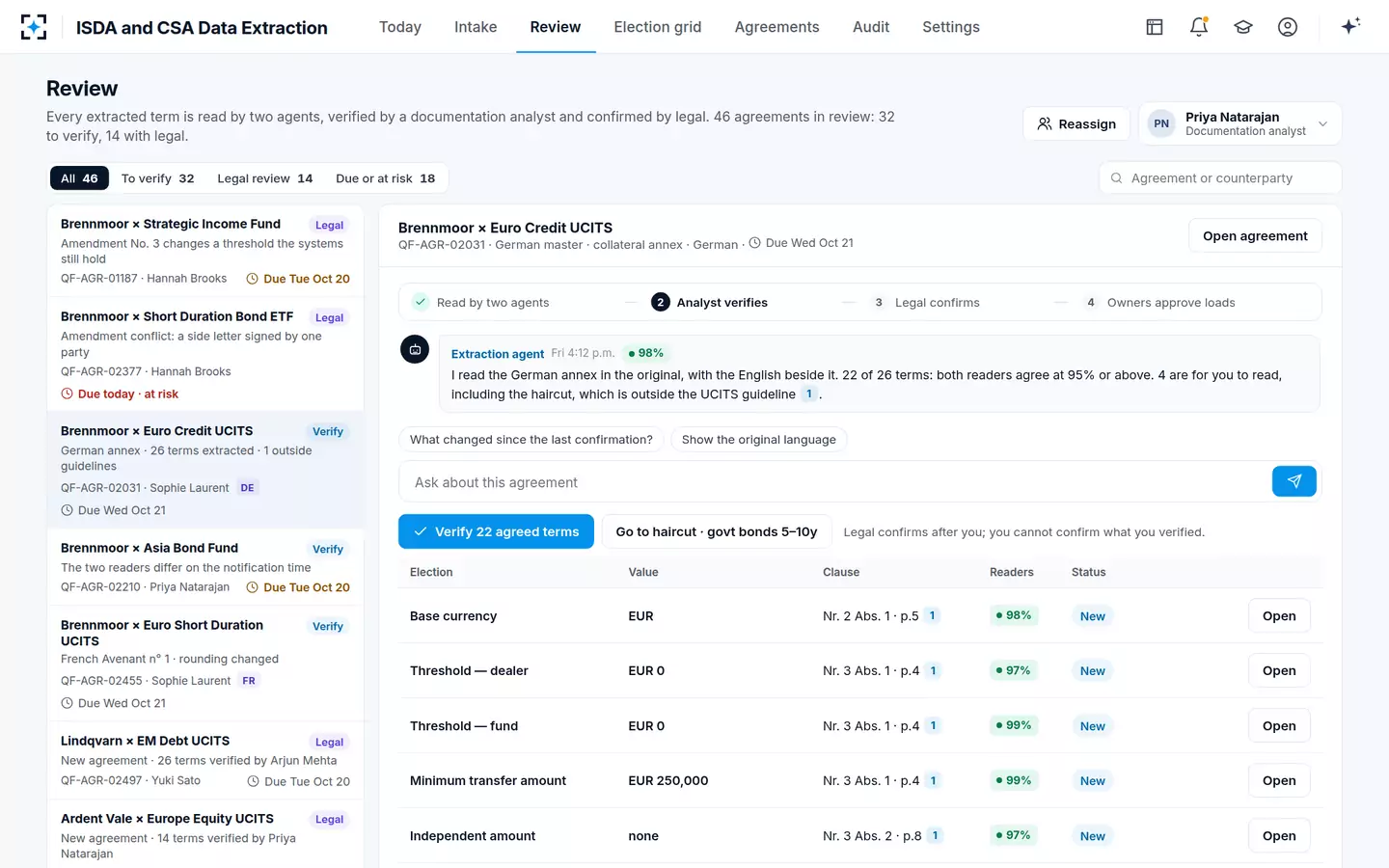
The method matters most where the stakes are invisible. A threshold, an MTA, an independent amount and a rounding rule each look like a single field, and each turns out to depend on a document, a party, a rating or a scope. The eligible collateral and haircuts that decide what the call can be paid in are a table of their own, covered in the eligible collateral schedule.
Questions people ask
What is the difference between a CSA threshold and a minimum transfer amount?
The threshold is deducted from exposure: it is credit left unsecured. The minimum transfer amount is not deducted: it only decides whether a call is big enough to make, and once exceeded the whole amount moves. A $10 million threshold reduces every call by $10 million; a $250,000 MTA reduces none of them.
Can a CSA threshold be zero?
Yes, and for regulatory variation margin it effectively must be, since the CFTC notes that variation margin is exchanged without any threshold. A blank threshold election in the 1995 English annex also means zero, because the definition says so when no amount is specified.
Is the $500,000 minimum transfer amount mandatory?
No. It is the most the US rule lets parties use for regulatory margin; the CFTC confirmed the MTA is "allowed but not required" and that parties may exchange margin below it. An annex can set a lower figure, such as the USD 250,000 in the sample amendment.
What is a high threshold CSA?
An annex whose thresholds are large enough that collateral moves only on big exposures, a term once granted to highly rated counterparties. Since the margin rules, new uncleared trades between a regulated dealer and a fund need a zero-threshold annex for variation margin, so a high-threshold annex now usually governs older trades in a separate netting set.
When do derivatives valuation disputes have to be reported?
US swap dealers notify the CFTC of valuation disputes over $20 million not resolved within three business days with another dealer or five with other counterparties (17 CFR 23.502). EU financial counterparties report disputes over EUR 15 million outstanding for at least 15 business days (Regulation 149/2013, Article 15).
Does the minimum transfer amount apply per fund or per manager?
Per counterparty legal entity, under the US rule, with one relief: where a client owns several separately managed accounts, up to $50,000 may be applied to each. The agreement decides how the MTA is split in practice, and a system must hold it at the level the agreement uses.