Contract data extraction for an ISDA credit support annex means turning the executed agreement and every amendment into the fields a collateral system and risk engine compute with, each tied to the clause it came from. Done by hand, it costs hours per agreement: Botminds' estimate for a sample firm is a median of 3 hours 40 minutes, most of it spent finding documents and working out which amendment governs rather than reading. Yet the wage bill is the smaller part of the cost. The larger part is the expected cost of a wrong number left in a system, because a threshold or eligible collateral term that is wrong produces wrong calls every business day until someone notices. Botminds' ISDA and CSA Data Extraction is built to reduce both: a person's time per agreement to a design target of 12 minutes, and the chance that a wrong term reaches a system to whatever escapes two independent readings, an analyst and a lawyer.
Where one agreement's hours go: most of the time is not reading
By hand: 3 h 40 min (estimate)
- Finding the documents, 30 min · 13.6%
- Abstracting Schedule and collateral elections, 90 min · 40.9%
- Ordering amendments, 45 min · 20.5%
- Legal check, 30 min · 13.6%
- Keying two systems, 25 min · 11.4%
With the solution: 12 min of a person’s time (target)
- Finding, 1 min · 10%
- Verifying the abstract, 3 min · 25%
- Reviewing the chain, 2 min · 15%
- Legal confirmation, 3 min · 25%
- Approving loads, 3 min · 25%
The examples come from that fictional sample firm, Quillfield Capital, with 2,400 executed ISDA, CSA, GMRA and GMSLA agreements and 9,000 amendments and protocol letters across 46 counterparties, as it runs through the solution. Wages are from the Bureau of Labor Statistics; the arithmetic is ours and shown.
What is contract data extraction for a CSA? Clauses into fields, each with its source
It is the step between a signed PDF and a system that can compute a margin call. Each election becomes a field: threshold and minimum transfer amount per party, independent amount and its trigger, rounding and its direction, every row of the eligible collateral schedule with its haircut, the valuation agent, timing, interest on cash, and the mechanism by which collateral moves. For a CSA, extraction is not finished when the base annex is read. The field is only right if it holds the value in force today, which means every amendment and protocol letter has been applied in effective-date order.
That makes a CSA a poor fit for extraction tools built for invoices or forms, which assume one document carries the answer. The answer is spread across a chain, and the unit of work is not a document but an agreement with its history. What the fields are, one by one, is set out in what a credit support annex means.
How long does it take to abstract a CSA by hand?
Hours per agreement, and the range is wide. No regulator or independent study publishes abstraction times for derivatives agreements, so the useful number is your own median. For the sample firm, Botminds estimates 3 hours 40 minutes: 30 minutes finding the executed agreement and every amendment and protocol letter, 90 minutes abstracting the Schedule and collateral elections, 45 minutes ordering amendments and working out the terms in force, 30 minutes of legal checking against the clause, and 25 minutes keying the collateral system and the risk engine. The sample firm's documentation analyst abstracts 30 to 150 fields per agreement by hand, depending on the agreement.
The sample estate by hand, in hours and wages
8,800h
to abstract 2,400 agreements once at 3 h 40 min each (estimate × count)
$151
wages per agreement at BLS mean rates, before benefits and overhead (our arithmetic)
480h
for the same estate at the 12-minute design target
Where does the time go? Finding and ordering the documents
Over a third of the estimated time goes on finding documents and working out their order, not on reading terms. Executed agreements are filed in a document repository, amendments arrive as emailed PDFs, protocol adherence letters sit in a separate folder or none, and some changes come from local-law annexes in German or French. The analyst's first task is to be sure the chain is complete; the second is to put it in effective-date order, which is not filing order.
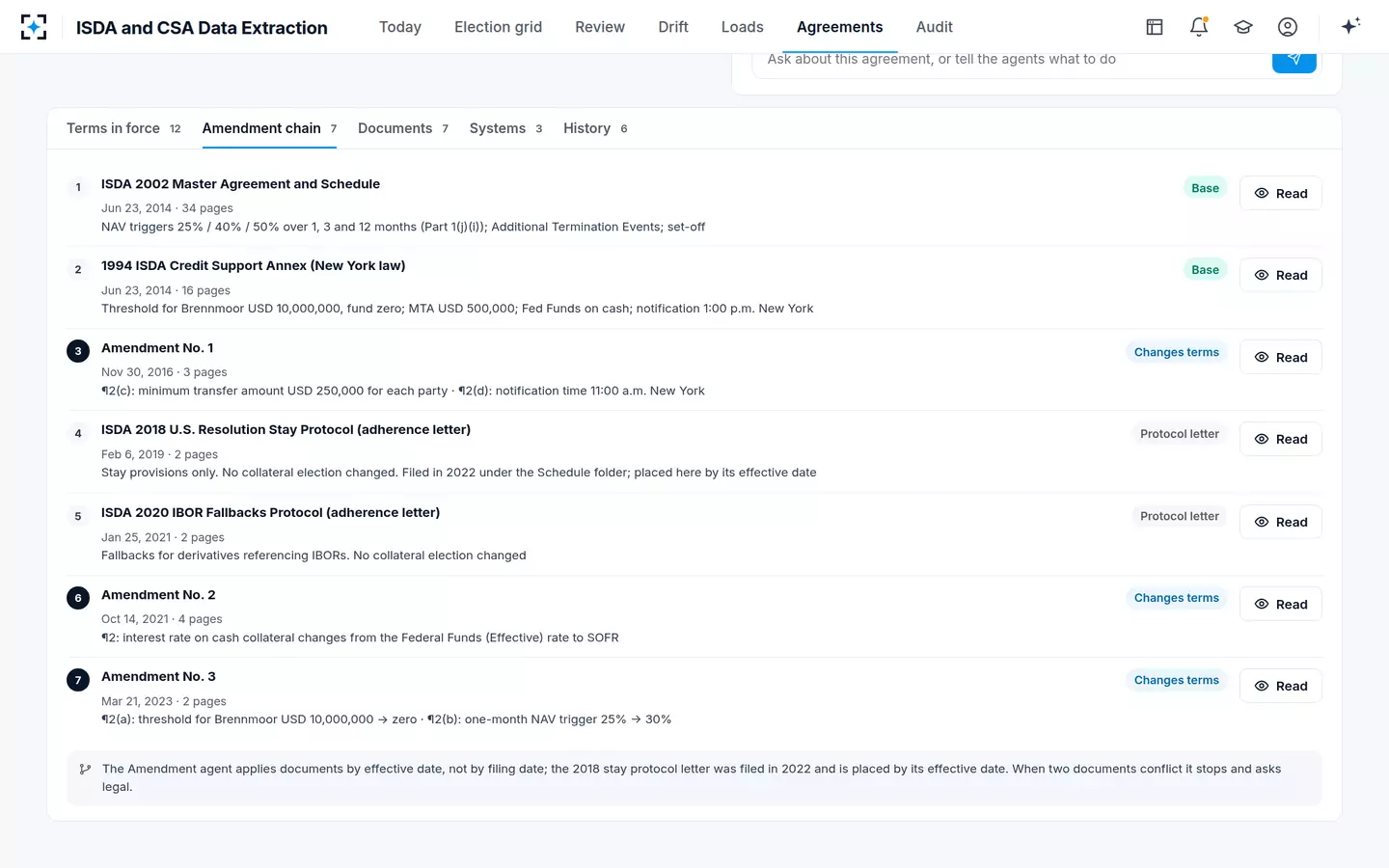
In the sample estate, the Brennmoor agreement for the Strategic Income Fund has seven documents: the 2002 Master Agreement and Schedule, a 1994 New York annex, three amendments and two protocol adherence letters. One of those letters, effective in 2019, was filed three years later under the Schedule folder. An abstract built from the folder's order would apply it last.
Seven documents in one chain, applied by effective date
What does an amendment add?
Each amendment adds the cost of finding it, reading it, deciding where it fits and re-keying what it changed, and some arrive in batches set off by regulation. The US banking agencies' stay rules required covered agreements with the largest banking groups to give up certain default rights tied to an affiliate's insolvency (12 CFR 252.84), and agreements had to be amended to comply; in the sample chain that change arrived as a 2019 stay protocol adherence letter. The end of LIBOR did the same for interest terms: the Federal Reserve's LIBOR Act rule reaches credit support documents that reference LIBOR, and republishes a protocol whose scope lists 17 credit support forms (Federal Reserve, 88 FR 5204, 2023).
An amendment can also change an agreement's regulatory status. The US banking agencies noted that a legacy swap amended or novated after the compliance date can fall under the margin rule, with no safe harbour for having been traded earlier (83 FR 50805, 2018; which form a legacy annex is, and why it matters, is in credit support annex 1995 vs 1994 vs 2016). The sample firm averages close to four amendments and protocol letters per agreement, 9,000 across 2,400; each is a small extraction job that inherits the full cost of getting the chain right.
How do you count agreements and amendments?
Count the unit that carries a set of terms, then the documents that changed it. The table below is the counting method we would use to size any extraction programme, whether done by hand or with agents.
Counting a CSA estate for extraction: the units that drive the work
| Count | What to include | Why it drives cost |
|---|---|---|
| Agreements | Each master agreement with its annex, per fund or account; GMRAs and GMSLAs separately | One set of terms in force per agreement; a fund with several annexes under one master counts each netting set |
| Amendments and side letters | Every executed change, including letters signed by only one party, which must be flagged | Each must be found, ordered and applied; conflicts need legal |
| Protocol adherence letters | Every protocol either party adhered to, linked to the agreements it covers | One letter can amend hundreds of agreements and is often filed nowhere near them |
| Local-law annexes | German, French and other collateral annexes, by language | Reading in the original and checking the translation adds time and a second reader |
| Systems to key | Collateral system, risk engine, counterparty database | Each holds its own copy and drifts on its own |
| Fields per agreement | Core elections, then each variation by party, currency, asset and rating | The sample firm’s analyst abstracts 30 to 150 per agreement |
What does a wrong field cost in calls and disputes?
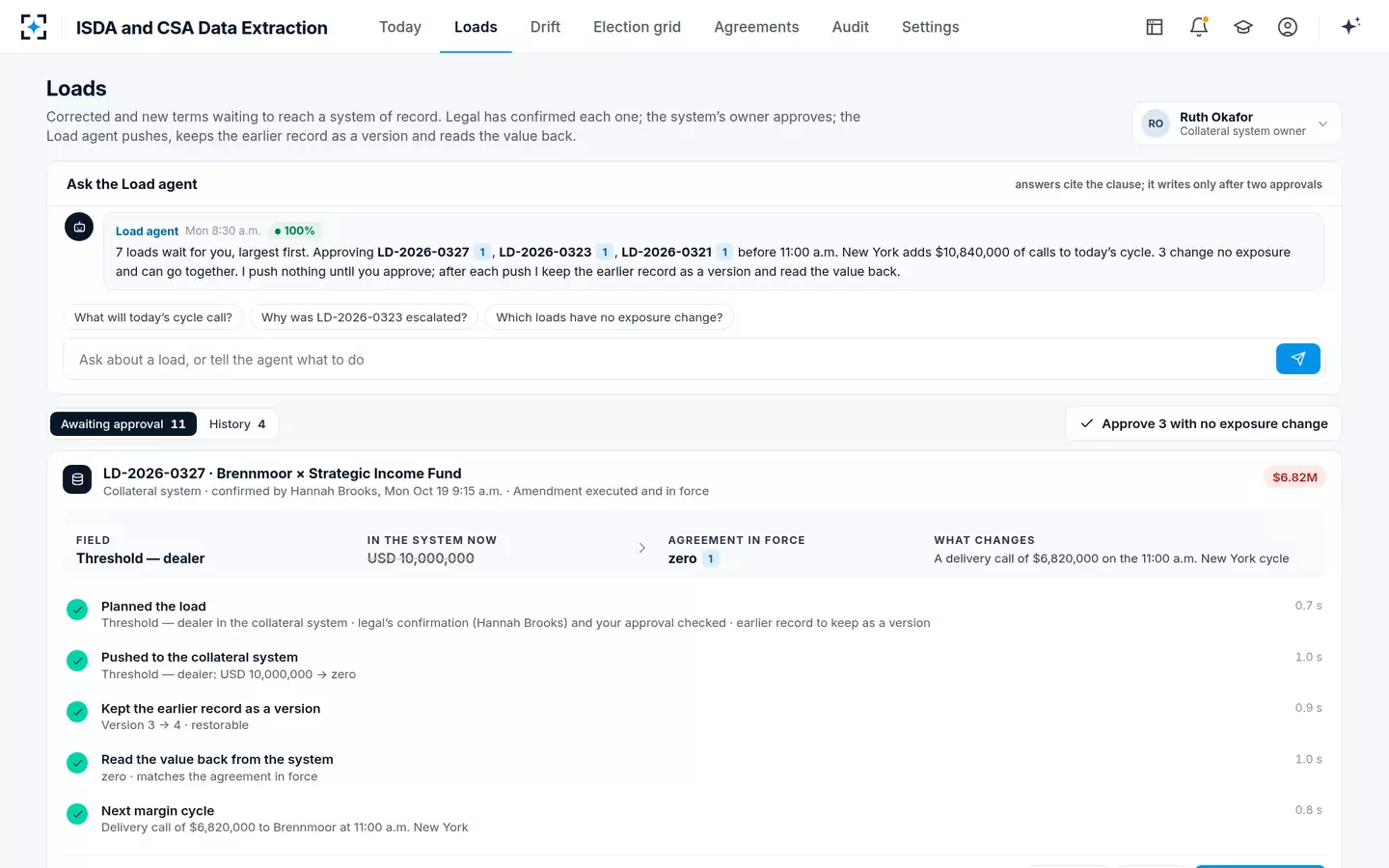
Far more than the hours that would have caught it. In the sample estate, Amendment No. 3 cut a dealer's threshold from USD 10 million to zero in March 2023; the systems kept USD 10 million. On one Friday the result was a $6,820,000 delivery amount the fund never called, and the exposure was above the minimum transfer amount on 418 business days after the amendment. The nightly comparison across the estate found 37 differences between the agreements in force and the firm's systems, worth $41.2 million at stake.
Wrong terms rarely announce themselves. A missed call is never disputed, so it never reaches the reports US swap dealers must make on valuation disputes over $20 million (17 CFR 23.502). Where a dispute does arise over a term, it can be costly in its own right: a single interest election in a 1995 annex, EONIA minus 0.04% on cash collateral, was argued through the High Court and the Court of Appeal before it was settled in the bank's favour ([2019] EWCA Civ 771). Supervisors found that margin disputes mostly concern valuation rather than which collateral is allowed, because the documents settle that clearly (BCBS–IOSCO, January 2025); that protection holds only while the systems hold what the documents say.
The unit cost of one CSA, as a sum
Reading and abstracting
minutes per agreement × loaded hourly cost
Estimate for the sample firm: 220 minutes by hand, about $151 in wages at BLS mean rates before benefits.
Priced by legal operations
Keeping it current
amendments and protocol letters per year × minutes each × loaded cost
The sample firm carries close to four per agreement over its life; the cost recurs as long as the agreement does.
Priced by legal operations
Wrong terms in systems
probability a term is wrong × exposure it misstates × days until found
In the sample, one stale threshold left $6.82 million uncalled on a single day. This is the term that dominates.
Priced by collateral operations and risk
Controls that catch errors
second reader + analyst verification + legal confirmation + owner approval
The cost of not trusting a single reading. It buys down the third term.
Priced by the head of investment operations
What do vendors charge? Vendors don't publish prices, so measure your own
Vendors of contract extraction and collateral data services don't publish prices, and no regulator or independent study collects them, so the honest comparison is your own unit cost against a quoted one. Measure three numbers before any conversation: your median minutes per agreement with amendments, your amendments and protocol letters per agreement per year, and the share of terms your systems hold wrongly, which a replay test on agreements you have already abstracted will show. How to run that test is set out in replaying an AI tool on CSAs you abstracted.
Compare quotes on the same basis. A price per document is not a price per agreement in force, because the chain is where the work is; a price that excludes amendments, protocol letters or local-law annexes excludes the hard part. Ask what is included when two documents conflict: a person, a rule, or the last document read.
Where agents change the unit cost, and where they do not
Agents change the finding, reading, ordering and comparing; people keep the deciding. In ISDA and CSA Data Extraction the Intake agent classifies and matches documents as they arrive, the Extraction and Checker agents read every clause independently, the Amendment agent applies the chain by effective date and stops on conflicts, and the Drift agent compares every term in force with three systems each night. A person still verifies every term, legal still confirms the terms in force, and each system's owner still approves the load, which is why the design target is 12 minutes of a person's time per agreement and not zero. Who those people are is described in who reads an ISDA CSA agreement.
The last step of the unit cost: a load pushed, versioned and read back
Agents do not change the cost of a disagreement that needs a lawyer, and they should not. In the sample estate the Amendment agent rebuilt the terms in force for 312 legacy agreements from 1,206 documents and stopped on three conflicts for legal to decide. Those three are the cases where the old process would have guessed.
Questions people ask
What is contract data extraction?
Turning the terms of a contract into structured fields a system can use, each tied to the clause it came from. For an ISDA credit support annex the fields are the collateral elections, and they must reflect every amendment in force, not just the base document.
How much does it cost to abstract a contract?
It depends on the contract and its amendments; for derivatives agreements no published survey gives a figure. Botminds' estimate for a sample firm is 3 hours 40 minutes per ISDA agreement with its amendments, about $151 in wages at BLS mean rates before benefits; your own median is the number to use.
What are contract data extraction tools?
Software that reads contracts and returns fields. For collateral agreements, look for tools that apply amendments by effective date, cite every value to its page, use a second independent reader, and never write to a system without the owner's approval.
Is it cheaper to outsource CSA abstraction?
Possibly per agreement, but the comparison must include keeping the terms current and catching wrong ones. An outsourced abstract keyed once has the same weakness as an in-house one: nobody compares the systems with the agreement again until a call is disputed.
How many fields are extracted from an ISDA agreement?
The sample firm's analyst abstracted 30 to 150 per agreement by hand, depending on the agreement: the core collateral elections, each per party and currency, the eligible collateral rows, and Schedule terms such as NAV triggers and termination events.