The margin call process for over-the-counter derivatives is the daily cycle in which two counterparties value the trades under one credit support annex, the party that is owed collateral calls for it, the other checks the call, agrees or disputes it, and the agreed amount settles before the custodian's cut-off. For uncleared swaps the rules make it a business-day obligation, and in practice it is still run largely bilaterally, with email, PDF statements and spreadsheets, which is why it fills a collateral team's morning. Botminds' Margin Call Management is built for that morning: its agents compute each call from the signed annex, read the dealers' calls in whatever form they arrive, explain every gap and draft the dispute, while an analyst agrees, a manager approves the large disputes and treasury releases the collateral.
This guide is about derivatives and repo margin, not brokerage margin accounts or the lending sense of collateral management. Where it shows the solution, the figures come from its sample book: Quillfield Capital, a fictional asset manager whose collateral team runs margin for 186 funds and mandates, on Friday 16 October 2026.
The daily margin call process, step by step, with the person who signs each decision
Agent
1 · Value the portfolioPrice every trade under the netting set at the agreed close, from the valuation engine and market data; compute exposure and any initial margin.
Never: Price from a stale curve without saying so
Agent
2 · Compute the callExposure less collateral already held, then the annex's threshold, minimum transfer amount, haircuts and rounding.
Never: Use terms that differ from the signed annex
Agent
3 · Issue and receiveSend our calls before the notification time; read the dealers' calls from the margin network, email, PDF or spreadsheet and match them to our number.
Never: Agree a call outside the published tolerance
Agent
4 · Reconcile the gapCompare both trade populations and valuations trade by trade; price each difference and find the clause behind it.
Never: Dispute on its own
A person decides
5 · Agree or disputeThe analyst agrees calls inside tolerance and prepares disputes; a manager approves the large ones with a reason.
A person decides
6 · Release and settleTreasury releases the movement against verified settlement instructions before the custodian's cut-off; it is never the person who agreed the call.
What is the margin call process for OTC derivatives?
It is a loop of four steps that the Basel Committee and IOSCO set out in their January 2025 report on variation margin: "valuation of the outstanding portfolio of trades between counterparties at the agreed close time"; issuing or receiving the call "representing the relevant profit (or loss) on the portfolio since the last call"; "review and reconciliation of any VM calls, or initiation of any disputes"; and "initiating transfer of VM, either directly, or via a custodian" (BCBS-IOSCO, 2025, section 2.2.2). Initial margin runs beside it on its own calculation, usually a sensitivity model for regulatory initial margin, and is held at a third-party custodian rather than paid across.
The same report is plain about how the loop is run. Outside clearing houses, variation margin is not collected during the day; the daily end-of-day process "typically includes pricing sources (and timing), affirmation, reconciliation and confirmation that are contractually agreed upon on a bilateral basis" (section 2.3.4). Bilateral means every counterparty relationship can run the loop slightly differently: its own notification time, its own valuation agent, its own rounding rule and its own list of eligible collateral, all set in the annex.
Before the loop can run at all, the relationship has to exist. The report lists what comes first: a compliance review, know-your-customer information, the master agreement with its credit support annex or deed, any custodian control agreement, the eligible collateral schedule and the standing settlement instructions. A margin call process is only as clean as those documents and the terms copied from them into the collateral system.
The four regulatory steps, and the two a desk adds
Regulators describe four steps; a working desk runs six, because two jobs sit inside the regulators' steps and are owned by different people. The first is matching: an incoming call must be read and tied to the right fund, annex and valuation date before anyone can review it, and on a busy day that is hundreds of documents in several formats. The second is the split between the decision to pay and the payment itself. An analyst or manager decides what is owed; treasury moves the asset. Keeping them apart is a control, not a formality.
Each step of the margin call process, with its rule and its clock
| Step | What the rule says | The clock | Who owns it |
|---|---|---|---|
| Value the portfolio | US dealers calculate variation margin "Each business day", using methods that rely as far as practicable on recent trades, independent valuations "or other objective criteria" (17 CFR 23.155). | The agreed close of the valuation date | Valuation, collateral analyst |
| Compute and issue the call | EU counterparties calculate variation margin "at least on a daily basis" (Regulation 2016/2251, Art. 9). | Before the annex's notification time | Collateral analyst |
| Receive and match | No rule names the step; the annex sets how and where a demand must be made. | From the notification time | Collateral analyst |
| Reconcile and review | US dealers reconcile portfolios with buy-side counterparties quarterly above 100 swaps, annually at 100 or fewer (17 CFR 23.502(b)); a disputed call needs its own reconciliation that day. | Same morning | Collateral analyst |
| Agree or dispute | In the EU the undisputed part is still delivered on time (Art. 12(3)). | Before the resolution or settlement time | Analyst; manager above a limit |
| Release and settle | EU variation margin is provided "within the same business day of the calculation date", or within two business days under conditions (Art. 12(1)). | The custodian's cut-off | Treasury operations |
Who calls whom, and by when?
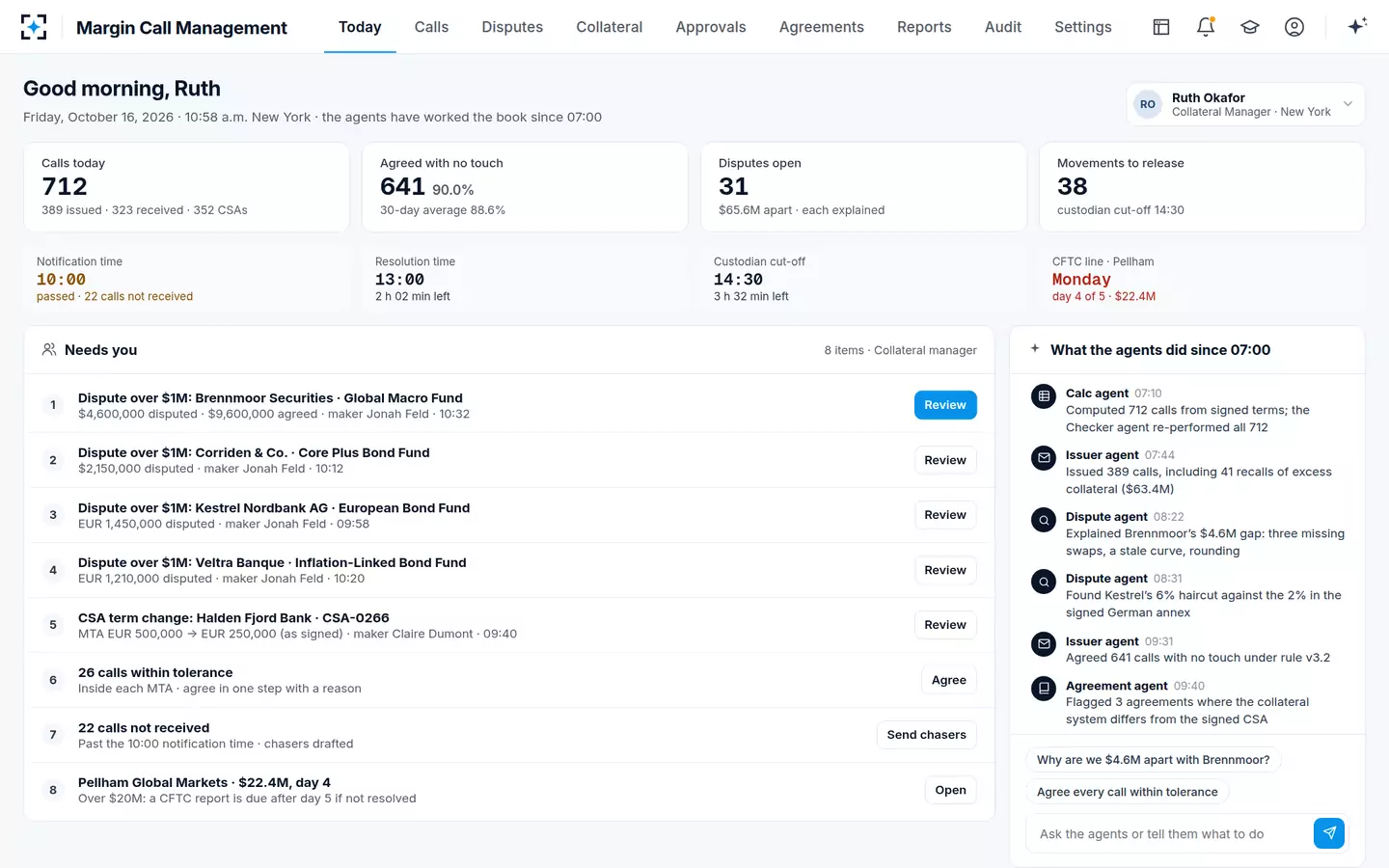
Whoever is owed collateral calls, and the annex sets the deadline. If the fund's swaps have moved in its favour since the last call, the fund calls the dealer for a delivery; if they have moved against it, the dealer calls the fund. Either side can be the calling party on any day, which is why a buy-side team both issues and receives calls every morning. In the sample book, 389 of the day's 712 calls were issued by Quillfield and 323 were received from dealers.
The deadlines come from two layers. The regulations set the frequency and the outer limits: in the US, a swap dealer must collect or post variation margin with a financial end user on or before the business day after a trade is executed and then "each business day until such uncleared swap is terminated or expires" (17 CFR 23.153); in the EU, the posting counterparty provides variation margin within the same business day of the calculation date, or within two business days if extra initial margin or an advance amount covers the gap (Article 12). The annex sets the hours: a notification time by which a demand must arrive to count for that day, a resolution time for disputes, and the settlement day that follows.
One morning's margin call process at the sample firm, by the clock
- Calls computed07:00–08:12
- Calls read and matchedto 10:00 notification
- Approved, releasedto 11:15
- Settlingto the 14:30 cut-off
How often is variation margin exchanged? Every business day
For covered uncleared swaps, daily is the rule, not a market habit. The international framework asks that variation margin be "calculated and exchanged" with "sufficient frequency (eg daily)" (BCBS-IOSCO margin framework, 2020, requirement 3.14), and the US and EU texts make it every business day. Initial margin moves less often: it is recalculated when the portfolio changes and, under the EU text, at least every ten business days, and it sits with a custodian instead of moving between the parties.
Daily does not mean small. In March 2020, average daily gross collateral balances tied to non-centrally cleared variation margin calls rose from $248 billion in February to $384 billion in March, a 55% increase in a month, according to the Basel Committee, CPMI and IOSCO review (Review of margining practices, 2022). Clearing houses called far more, and faster: the peak day of cleared variation margin that month, and the gilt market's record moves of 2022, are set out in historical stress testing. A process that copes on a quiet Tuesday has to cope when every counterparty calls at once.
The clocks inside every margin call process
1day
US: variation margin collected or posted by the business day after execution, then every business day
17 CFR 23.153
T+0
EU: variation margin provided within the same business day of the calculation date
Regulation 2016/2251, Art. 12
5days
US dealer-to-dealer: valuation discrepancies resolved within five business days
17 CFR 23.502(a)(5)
+55%
rise in daily non-cleared variation margin balances, February to March 2020
BCBS-CPMI-IOSCO, 2022
Where the hours go in a manual margin call process
Computing the call is the short part; matching, reconciling and arguing take the day. Basel and IOSCO heard in their outreach about a "lack of automation, especially for mid-sized and smaller firms" and "increased operational pressure during volatility periods due to insufficient automation" (BCBS-IOSCO, 2025, section 2.3.3). The arithmetic of a call is a subtraction and a rounding. What costs time is establishing which trades both sides are pricing, which curve each used, and which version of the annex's terms is the right one.
The split below is Botminds' estimate for one variation margin dispute on one annex, worked by hand in spreadsheets and email, about four working days from the dealer's file request to its corrected call. It is an estimate of a typical case, not a measurement, and it is offered so a team can put its own numbers beside it.
Where one margin call dispute's four working days go when it is worked by hand
By hand · about 4 working days
- Getting the dealer's file · 12.5%
- Reconciling trade by trade · 25%
- Pricing gaps, finding the clause · 18.75%
- Drafting and approving the notice · 12.5%
- Waiting for the dealer's correction · 31.25%
The largest block is waiting, and it is the one a desk controls least. It shrinks only when the dispute notice arrives early and specific enough for the dealer's analyst to fix the file on the first read: the three trade identifiers, the curve date, the clause. That is the argument for doing the reconciliation before anyone is asked to approve anything.
What happens when a margin call is disputed?
The undisputed part still moves, and the rest goes into a dispute process with its own clock. In the EU, "counterparties shall provide, in the same time frame referred to in paragraph 1, at least the part of the variation margin amount that is not being disputed" (Regulation 2016/2251, Article 12(3)). Annexes in common use work the same way: the disputing party transfers the undisputed amount and the parties consult, then recalculate if they cannot agree. A US dealer that cannot collect is not in breach if it has pursued formal dispute resolution in time or begun to terminate (§23.153(e)).
The size of a dispute decides who else hears about it. Large, long valuation disputes must be reported to regulators by US swap dealers and by EU financial counterparties, on two different clocks; the two reporting clocks, and how rarely disputes reach them, are worked through separately. For the process, the lesson is earlier: the Financial Stability Board asks firms to have "clear dispute mechanisms in place and a system to track and manage outstanding collateral disputes" (FSB, Liquidity Preparedness for Margin and Collateral Calls, 2024, Recommendation 6).
It is important to note the increased use of proactive dispute mitigation programmes with accompanying policies and procedures laying out thresholds and corresponding escalation measures.
Basel Committee and IOSCO, Streamlining variation margin processes, January 2025
Settlement: the step of the margin call process that belongs to treasury
Settlement is where a correct call can still fail. The agreed amount has to be delivered in an eligible asset, from the right account, to the counterparty's verified settlement instructions, before the custodian's cut-off for that market. A changed instruction, an asset that is on loan, or a bond reserved for another margin requirement can each turn an agreed call into a fail that rolls to the next day.
The control that matters is who presses the button. The person who agreed the amount should not be the person who releases the asset: that separation is what stops one mistake, or one fraudulent instruction, from leaving the firm unchecked. In Margin Call Management, treasury releases every movement, the release is locked for anyone who agreed or approved the call, and a movement whose settlement instruction changed in the last five days waits for a call-back. The release is one of four signatures on a call, set out in who signs each step of a margin call.
Which steps of the margin call process are manual today, and which an agent can do?
Every step before the decision can be done by software; the decision and the release should stay with named people. Basel and IOSCO recommend that firms weigh standardising and automating their uncleared margin processes, to cut friction and the risk of operational delays and failures (Recommendation 3). Their report also traces frictions to "a dependency of some market participants on bespoke, and manual or outdated operational processes".
The mechanical steps are the ones a margin team spends most of its morning on: re-keying a call from a PDF, chasing a portfolio file, lining up 1,186 trades against 1,189, finding the page that sets the rounding. An agent does those in minutes and shows its sources. What it should not do is send a dispute, agree an amount outside a published tolerance, change a term or move an asset. Those are authority decisions, and where that authority stops in a collateral management system with agents is a question to settle before any agent touches a live call.
Margin Call Management's home screen: the whole margin call process on one page
Margin Call Management on one call: Brennmoor's $4.6 million gap
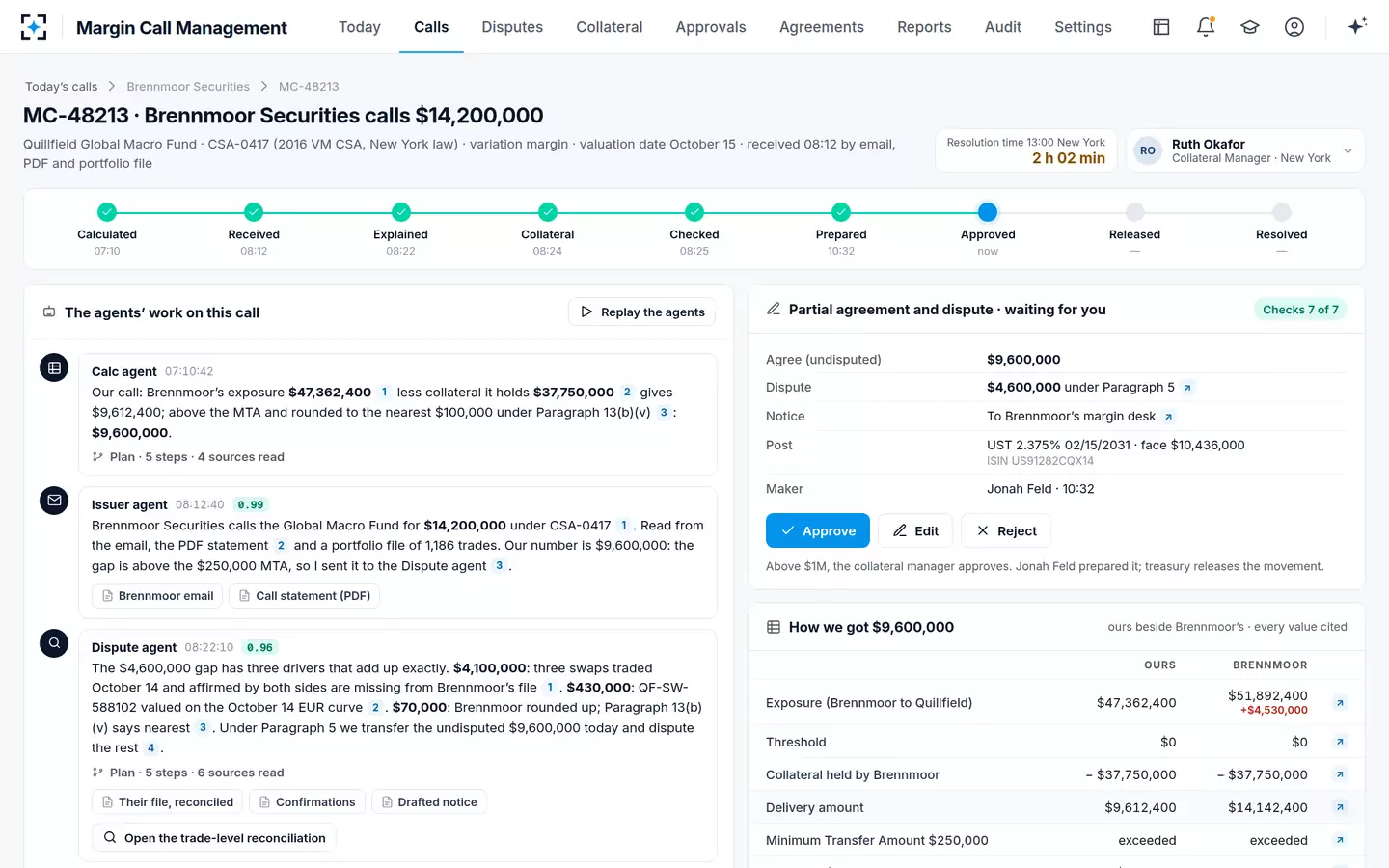
Take one call from the sample book through every step. At 07:10 the Calc agent computed Quillfield's number for its Global Macro Fund under the annex with Brennmoor Securities: exposure of $47,362,400 on Quillfield's valuation, less the $37,750,000 Brennmoor already held, gives $9,612,400, rounded to $9,600,000 under the annex's rounding clause. At 08:12 the Issuer agent read Brennmoor's call for $14,200,000 from its email, PDF statement and a portfolio file of 1,186 trades.
Because the gap was above the annex's $250,000 minimum transfer amount, the call went to the Dispute agent, which by 08:22 had traced the $4,600,000 to three drivers: three swaps traded on 14 October and affirmed by both sides but missing from Brennmoor's file ($4,100,000), one cross-currency swap valued on a stale euro curve ($430,000) and rounding ($70,000). A second agent re-performed the call on a separate model. The analyst prepared a partial agreement of $9,600,000 and a dispute of $4,600,000; because the dispute was above his $1 million limit, the collateral manager approved it at 11:06, and treasury released Treasuries worth $9,600,859 after haircut at 11:15. Brennmoor loaded the swaps and agreed by 12:20. How the call itself is built, input by input, is in variation margin calculation, worked through one annex.
One call in Margin Call Management, every step with its time, agent and evidence
Questions people ask
What is a margin call in derivatives?
It is a demand from one counterparty to the other to deliver collateral because the value of their trades has moved. For uncleared swaps the demand is usually for variation margin, which covers the current mark-to-market exposure, and sometimes for initial margin, which covers potential future exposure and is held by a custodian. US and EU rules require covered firms to exchange variation margin every business day.
What is collateral management in OTC derivatives?
It is the work around margin calls: keeping each annex's terms in the collateral system, calculating and issuing calls, checking incoming ones, resolving disputes, choosing what to deliver, settling, and recalling excess. Basel and IOSCO note that whichever arrangement a firm chooses, in-house or with a provider, it stays accountable for the terms it has agreed with its counterparties.
What is a minimum transfer amount?
It is the amount below which no collateral moves, set in the annex to avoid trivial transfers. US and EU rules cap it at $500,000 and EUR 500,000 combined for initial and variation margin; once the amount due exceeds it, the EU text says the full amount is collected, not the excess over the minimum. The sample annex in this guide uses $250,000.
What is the notification time in a margin call?
It is the hour, set in the annex, by which a demand must be received for the transfer to fall due on the usual settlement day; a later demand pushes the transfer back. It is not set by regulation. On the sample Brennmoor annex it is 10:00 New York, and on the sample day 22 expected calls had not arrived by then.
Is margin called intraday on uncleared swaps?
Rarely. Basel and IOSCO found that non-centrally cleared variation margin is generally not called during the day, unlike cleared markets, where clearing houses can and do make intraday calls. A fund that also clears trades should still know which counterparties can call intraday; the Financial Stability Board asks firms to understand exactly that.
How long does a margin call take to settle?
The rules set the outer limit and the annex sets the day. The EU rule requires delivery within the same business day of the calculation date, or within two business days with extra initial margin or an advance amount; the US rule requires collection or posting every business day. Within that, the custodian's cut-off for the asset is the practical deadline, 14:30 New York in the sample firm.