Variation margin requirements are the rules that make two counterparties to uncleared derivatives collateralise the current value of their trades every business day: in the US, the CFTC's and the prudential regulators' margin rules for swap dealers, which reach funds as their counterparties; in the EU, EMIR and its margin standards, which bind funds directly. They require a daily calculation, a documented valuation method, eligible collateral with haircuts, written dispute procedures and records kept for years after a trade ends. Meeting them is one thing; proving each call met them is another. A defensible call carries its own evidence: the annex terms used, the trades and prices, the collateral and its haircut, the arithmetic and the approver. Botminds' Margin Call Management builds every call that way, so the same file answers a dealer's dispute, an auditor's sample and an examiner's request.
The annotated call on this page is from the solution's sample book, on the fictional Quillfield Capital and its fictional dealer Brennmoor Securities.
One variation margin call, annotated with the evidence behind each line
Parties, fund and annex
What it statesQuillfield Global Macro Fund and Brennmoor Securities; CSA-0417, a 2016-form variation margin annex, New York law, dated 21 February 2017
The evidenceThe signed annex, filed and hashed; the fund's legal entity
Valuation date and time
What it states15 October 2026 close; call made 16 October, before the 10:00 New York notification time
The evidenceValuation run timestamp; the annex's notification time, cited to the page
Exposure
What it statesBrennmoor's exposure to the fund, $47,362,400 on the fund's valuation, across 1,189 trades
The evidenceThe trade population as at the valuation date, the prices and curves used, and their sources
Collateral held
What it states$37,750,000 held by Brennmoor, valued after haircut
The evidenceCustodian and counterparty balances; the haircut schedule in the annex
Threshold and minimum transfer amount
What it statesZero threshold; $250,000 minimum transfer amount, exceeded
The evidenceAnnex terms, each with its paragraph and page
Delivery amount and rounding
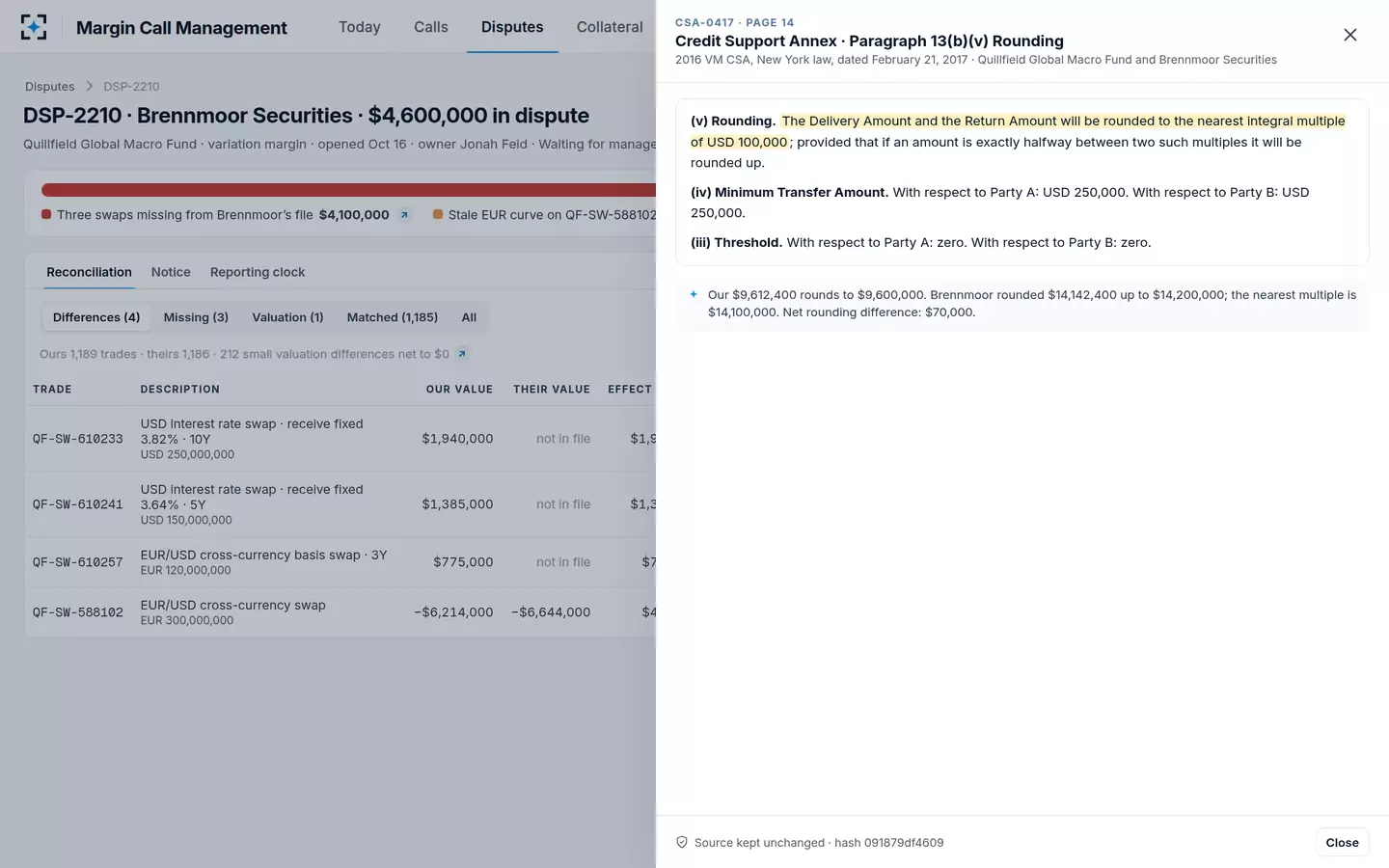
What it states$9,612,400, rounded to the nearest $100,000: $9,600,000
The evidenceThe rounding clause on page 14
Approval and checks
What it statesComputed at 07:10, re-performed by a second model, agreed by the collateral manager with a reason
The evidenceThe audit trail: who, when, why and on what evidence
What are the variation margin requirements in the US?
For a US swap dealer without a prudential regulator, the CFTC's rules require variation margin to be collected or posted with every swap dealer and financial end user counterparty on or before the business day after a trade, and then "as calculated each business day" until the swap ends (17 CFR 23.153). Bank swap dealers follow the prudential regulators' parallel rule. Funds are financial end users, so although the rule is written on the dealer, its requirements arrive at the fund through the dealer's documentation and calls.
The rule asks for more than a number. The dealer must calculate variation margin using methods that rely as far as practicable on objective inputs, keep "alternative methods" when an input fails, and document its methodology well enough for the counterparty to approximate the requirement on its own (§23.155). It must monitor the value and eligibility of collateral and "promptly" collect or post more if value falls (§23.156(c)). And its margin documentation must name the methods, rules, inputs and data sources used to value the swaps for variation margin (§23.158(b)(1)).
What are the EMIR variation margin requirements?
In the EU the duty is on both counterparties, including EU funds. EMIR requires financial counterparties to have "risk-management procedures that require the timely, accurate and appropriately segregated exchange of collateral" (Regulation (EU) No 648/2012, Article 11(3)), and its margin standards turn that into detail: variation margin calculated "at least on a daily basis", provided within the same business day of the calculation date or within two under conditions, the undisputed part delivered even in a dispute, and eligible collateral and haircuts set out in the standard (Delegated Regulation (EU) 2016/2251).
The EU standard also says what the counterparties' written procedures must cover: collateral eligibility, the calculation and collection of margin, segregation, haircuts, the exchange of information and the recording of exceptions, and an exchange of collateral agreement that sets out, among other things, how margin calls are notified, confirmed and settled and who calculates what (Articles 2 and 3). The international standard behind both regimes asks for the whole mark-to-market exposure to be collateralised; the regional rules are how that becomes daily work.
Variation margin requirements, US and EU, side by side
US: CFTC rules for swap dealers: The swap dealer; funds as financial end user counterparties through the dealer's documentation.
EU: EMIR and Delegated Regulation 2016/2251: Both financial counterparties, including UCITS and alternative investment funds, and larger non-financial counterparties.
US: CFTC rules for swap dealers: By the business day after execution, then each business day.
EU: EMIR and Delegated Regulation 2016/2251: Calculated at least daily; provided the same business day, or within two with extra protection.
US: CFTC rules for swap dealers: Objective inputs; alternative methods if an input fails; methodology documented for the counterparty.
EU: EMIR and Delegated Regulation 2016/2251: Values under EMIR's valuation article, aggregated over the netting set, less margin collected, plus margin posted.
US: CFTC rules for swap dealers: Cash, or for financial end users any initial margin-eligible asset, at standardized haircuts.
EU: EMIR and Delegated Regulation 2016/2251: Listed asset classes at standard or own-estimate haircuts.
US: CFTC rules for swap dealers: At most $500,000 combined with initial margin.
EU: EMIR and Delegated Regulation 2016/2251: At most EUR 500,000 combined; above it, the full amount is collected.
US: CFTC rules for swap dealers: Documentation must specify dispute procedures; dealers report large unresolved valuation disputes to the CFTC.
EU: EMIR and Delegated Regulation 2016/2251: Undisputed part delivered on time; written dispute procedures; large, long disputes reported by each financial counterparty.
How do you show a margin call is right?
By keeping, with each call, everything needed for someone else to reproduce it. Variation margin is arithmetic on inputs; a call is right when its inputs are right and the arithmetic is the one the annex prescribes. So the proof is the inputs, each traced to its source, and the arithmetic, line by line. In the sample call, Brennmoor's exposure of $47,362,400 on Quillfield's valuation, less $37,750,000 of collateral Brennmoor already holds, gives $9,612,400, rounded under the annex to $9,600,000. Each of those four numbers links to where it came from.
A call proved this way serves three readers at once. The counterparty, when it disputes, can see which input differs. The auditor sampling calls can re-perform any of them without asking the desk. The examiner asking how the fund knows its collateral is right gets a method, not an assurance. The US rule's own test, that a counterparty can approximate the requirement independently, is a good standard for the fund's evidence too.
Which annex terms must a call cite?
Every term that changes the number: the base currency, the threshold, the minimum transfer amount, the rounding rule, the eligible collateral and its haircuts, the valuation agent, the notification and resolution times, and the interest rate on cash collateral. Citing them to the signed document, not to the collateral system, matters because the two drift apart. In the sample book, one annex was keyed with a EUR 500,000 minimum transfer amount where the signed document says EUR 250,000, and two return calls had gone unissued.
The sample's rounding argument shows the value of a cited term. Brennmoor's call was rounded up; the annex, on page 14, rounds to "the nearest integral multiple of USD 100,000". With the clause on the screen beside the numbers, the $70,000 of rounding in the dispute was settled without an email exchange. The worked variation margin calculation takes the terms one by one.
In Margin Call Management, each annex term is cited to the signed page
What portfolio reconciliation evidence backs a call?
Evidence that both sides were pricing the same trades. A US swap dealer must keep "a record of each swap portfolio reconciliation, including the number of portfolio reconciliation discrepancies and the number of swap valuation disputes (including the time-to-resolution of each valuation dispute and the age of outstanding valuation disputes, categorized by transaction and counterparty)" (17 CFR 23.202(a)(3)(iii)). EU counterparties reconcile on a schedule set by portfolio size, from each business day at 500 or more contracts to quarterly at 50 or fewer, and record disputes (Delegated Regulation (EU) No 149/2013, Articles 13 and 15).
For the fund, the scheduled reconciliation is the baseline and the call-level reconciliation is the evidence that matters on the day. In the sample dispute, the reconciliation of Brennmoor's 1,186 trades against Quillfield's 1,189 found three missing swaps and one valuation on a stale curve, and set aside 212 small valuation differences that net to zero. Kept with the call, that reconciliation is both the dispute's evidence and the scheduled reconciliation's best input. Margin disputes and their reporting clocks covers what a dispute file must record.
How long must margin records be kept?
At least five years after the swap ends under US swap dealer and EU rules, and five or six years for a US adviser's or fund's own books, depending on the record. The periods differ by who keeps the record and why, so a fund manager that trades with US dealers and runs EU funds should keep margin evidence for the longest period that applies to any of them.
How long margin call records are kept, by the rule that applies
| Who keeps it | Rule | Period |
|---|---|---|
| US swap dealer (and other CFTC records entities) | 17 CFR 1.31(b)(1) | From creation until the swap terminates, matures or is transferred, and not less than five years after |
| EU counterparty, including an EU fund | EMIR, Article 9(2) | At least five years after the contract terminates, with any modification |
| US registered fund | Rule 31a-2 | Not less than six years from the end of the fiscal year of the transaction for most transaction records; some records permanently |
| US investment adviser | Rule 204-2(e) | Not less than five years from the end of the fiscal year of the last entry, the first two in an appropriate office |
The record-keeping clocks behind every variation margin call
5 yrs
after the swap ends, for US swap dealers' swap records
17 CFR 1.31
5 yrs
after termination, for EU counterparties' derivative records
EMIR, Art. 9(2)
6 yrs
for most transaction records of a US registered fund
Rule 31a-2
What to keep with every call: an evidence checklist
The list below is what a defensible call file contains. It is longer than most teams keep today, and each item exists because someone, a dealer, an auditor or an examiner, will eventually ask for it. Kept automatically, it costs nothing at the time of the call; rebuilt months later, it costs days.
The evidence file for one variation margin call
- The signed annex and every amendment, unchanged
With the terms used cited to page and paragraph, and a hash so the copy is provably the original.
- The trade population at the valuation date
Trade identifiers and the confirmation behind each; the counterparty's file if it was received.
- Prices, curves and fixings, with their sources and times
The inputs a valuation difference will be argued over.
- Collateral balances and haircuts
What was held, at what value, under which schedule; anything in transit.
- The arithmetic, line by line
Exposure, collateral, threshold, minimum transfer amount, rounding, call; and the counterparty's lines beside them.
- The independent re-performance
A second calculation, by a separate method or person, and its result.
- The approver, time and reason
Including the tolerance rule version for calls agreed without a touch.
- Settlement evidence
The movement, the verified instruction, who released it and the custodian's confirmation.
- Any dispute file
Drivers that add up to the gap, the notice, the counterparty's reply and the resolution.
Margin Call Management: one evidence file per call, exportable
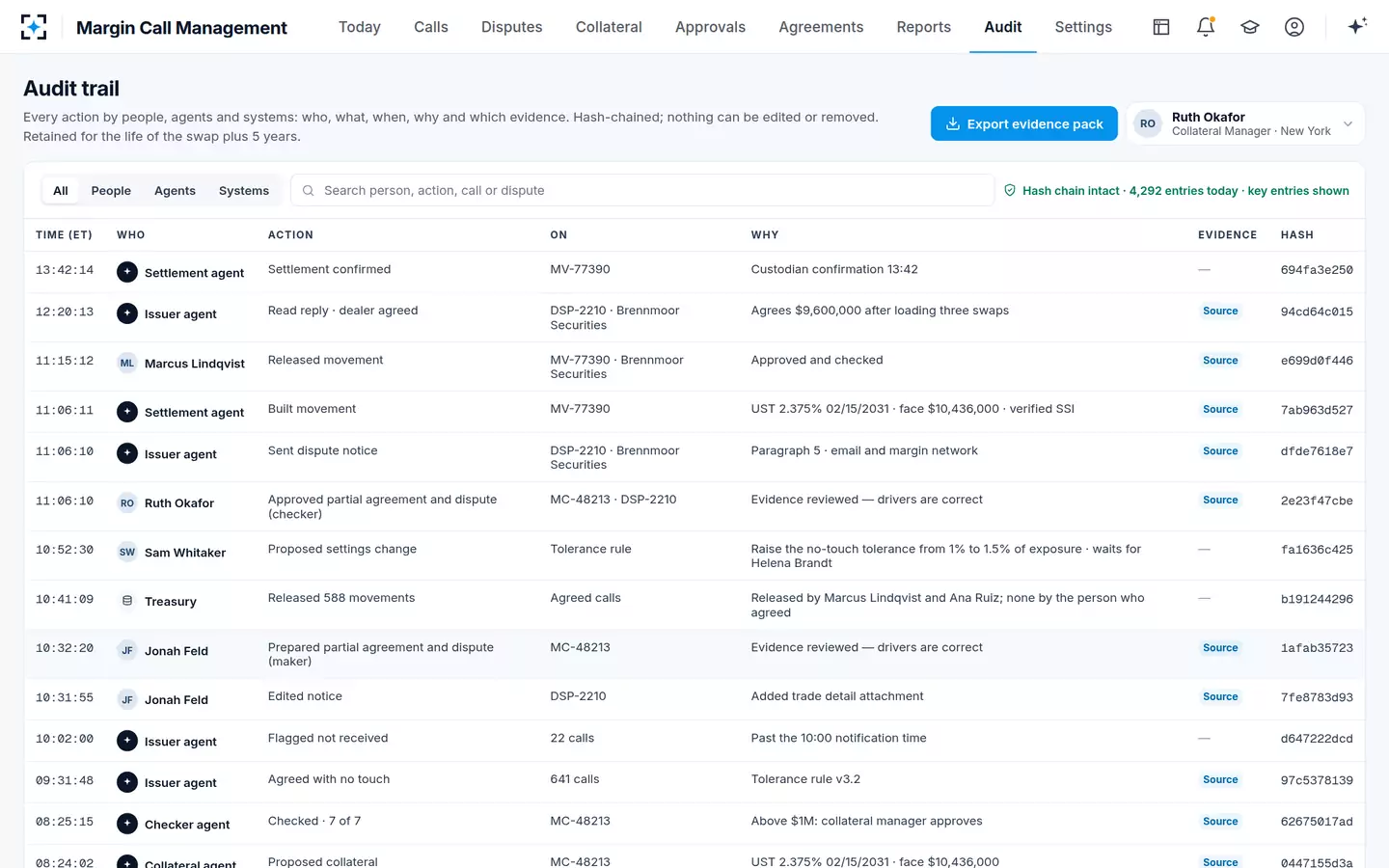
Margin Call Management keeps every number and agent statement linked to the annex page, the valuation, the counterparty's file, the confirmation or the email it came from. Originals are kept unchanged and hashed, with translations beside them. Every action by a person, an agent or a system goes on a hash-chained audit trail with its reason and evidence, retained for the life of the swap plus five years, with legal hold and an evidence file that can be exported per call, dispute, counterparty or period. Internal audit has read-only access.
The point of the design is that proof is a by-product of doing the work, not a project before an audit. On the sample day the trail held 4,292 entries, from the Calc agent's first call at 07:10 to the custodian's settlement confirmation at 13:42. Who signs which entry is covered in who signs each step of a margin call.
The audit trail behind a call in Margin Call Management: who, what, when, why and which evidence
Questions people ask
What does a margin call notice contain?
The parties and the annex, the valuation date, the exposure, the collateral already held, the threshold and minimum transfer amount applied, the amount demanded after rounding, and the settlement details. A well-built notice also states the trade count and links to the portfolio file, so the counterparty can reconcile without asking.
Do variation margin requirements apply to funds?
Yes, directly in the EU, where UCITS and alternative investment funds are financial counterparties under EMIR. In the US the rules are written on swap dealers, but funds are financial end users, so dealers must collect and post variation margin with them daily and fund documentation must support it.
What is the variation margin requirement for non-cleared swaps?
That the full current exposure be collateralised every business day, with no threshold, subject only to a minimum transfer amount of at most $500,000 or EUR 500,000 combined with initial margin. The international standard calls for the full amount needed to collateralise the mark-to-market exposure.
How long should margin call records be kept?
At least five years after the swap ends for US swap dealers and EU counterparties, six years for most US registered fund transaction records, and five years for US advisers' books. Many firms keep margin evidence for the longest period that applies to any of their funds or counterparties.
What do auditors ask for on margin calls?
Typically a sample of calls re-performed from source: the annex terms, trade population, prices, collateral balances and approvals, plus evidence that disputes were tracked and settled collateral matched agreed calls. A call file that already holds those items can be handed over as it is.