The LDI crisis was the week in late September 2022 when a record rise in long-dated UK government bond yields forced liability-driven investment funds, used by defined benefit pension schemes to hedge their liabilities, to meet margin and collateral calls on their swaps and repo faster than their pension scheme investors could send cash, so they sold gilts into a market that could not absorb them. The Bank of England stepped in on Wednesday 28 September with temporary purchases of long-dated gilts. The calls themselves were ordinary variation margin and collateral calls under ordinary agreements; what failed was the time it took to find and move the collateral to meet them. That gap between a call and the cash is the one Botminds' Margin Call Management is designed to close on an ordinary day, so that a desk has hours to spare on an extraordinary one.
The account below uses the Bank of England's own records: Sir Jon Cunliffe's letter to the Treasury Committee of 5 October 2022, the December 2022 Financial Stability Report, a 2023 Quarterly Bulletin case study and the Financial Policy Committee's response. Where the page imagines a collateral desk inside the week, the desk and its manager are fictional, and marked as such.
The LDI crisis in business days: four of spiral, thirteen of backstop
- The spiral22–27 Sep
- Backstop: up to £5bn a day28 Sep–7 Oct
- Limit £10bn; linkers added10–14 Oct
What was the LDI crisis?
It was a run on the collateral of leveraged pension hedges. LDI funds hold long-dated gilts, often index-linked, and add exposure with repo borrowing and interest rate swaps so that a pension scheme's assets move with its liabilities. The Bank's letter put the money in these strategies at "over £1 trillion" in the UK, and described the mechanism: the funds keep a cushion between assets and liabilities, and if losses exceed it the pension scheme investor "is asked to provide additional funds to increase it, a process known as rebalancing" (Cunliffe letter, 5 October 2022).
Rising yields are good news for a pension scheme's funding, because its liabilities fall in value faster than its assets. They are bad news for the cash position of its hedge. As gilt prices fell, the funds owed margin on their swaps and more collateral on their repo, and the letter says they had to rebalance urgently, "either by selling gilts into an illiquid market or by asking their DB pension fund investors to provide more capital". Pooled funds, with many small investors, could not gather capital fast enough.
The LDI crisis in four Bank of England numbers
>£70bn
margin and collateral calls on LDI funds and pension schemes, 23 September to 14 October, a lower bound
£1tn+
invested in LDI strategies in the UK
160bp
rise in the 30-year nominal gilt yield in just a few days
£19.3bn
of gilts the Bank bought between 28 September and 14 October
The LDI crisis timeline, Friday to Wednesday
The days before the intervention are where a collateral desk's lessons sit, because each one added calls to a desk that had not cleared the last. The Bank's letter gives the sequence, and the table below follows it, with what each day meant for a collateral desk at a pooled LDI fund. The desk column is our reading of the mechanics, not a record of any firm.
Day by day: what the gilt market did, and what it meant for an LDI collateral desk
| When | What the Bank recorded | What it meant for a collateral desk |
|---|---|---|
| Thursday 22 September | Monetary policy decision; long-term gilt yields rose by around 20 basis points. | A routine day of swap and repo calls. |
| Friday 23 September | The government's growth plan; long gilt yields up 30 basis points; sterling down around 4% against the dollar; "the first concerns from liability-driven investment (LDI) fund managers". | Larger calls against the funds, due early the next week; first capital requests to pension scheme investors. |
| Monday 26 September | 30-year gilt yields up around 50 basis points, more than 80 above Friday's opening; intelligence implied at least £50 billion of long gilt sales against average daily volumes of about £12 billion. | Calls far above any planning range; collateral buffers used; gilts to sell into a market that could not take them. |
| Tuesday 27 September, morning | A 20 basis point fall in 30-year yields; the Financial Policy Committee briefed in the afternoon. | A moment to catch up on the backlog. |
| Tuesday 27 September, evening | 30-year yields up 67 basis points on the morning; LDI managers warn that multiple funds are likely to fall into negative net asset value. | Funds facing wind-up the next morning; banks that lent to them holding the gilts as collateral. |
| Wednesday 28 September | The Bank announces temporary purchases of long-dated gilts late in the morning; 30-year yields fall more than 100 basis points that day. | Time bought: the funds had until 14 October to rebuild their buffers. |
Tuesday 27 September, hour by hour
The decisive day began with relief. On the morning of Tuesday 27 September, the 30-year gilt yield fell 20 basis points, and the Bank received reports that, if sustained, the level "might allow for a somewhat more orderly liquidation of long-term gilts". The Bank's executive briefed the Financial Policy Committee that afternoon. Then the morning reversed.
The improved conditions of the morning reversed as the day progressed and by that evening 30 year gilt yields had risen by 67 basis points compared to that morning, worsening the situation materially.
Sir Jon Cunliffe, Deputy Governor, Bank of England, letter to the Treasury Committee, 5 October 2022
That evening several LDI managers told the Bank that "at the prevailing yields, multiple LDI funds were likely to fall into negative net asset value", and would have to begin winding up the following morning. In that case, gilts "held as collateral by banks that had lent to these LDI funds" were likely to be sold, driving "a potentially self-reinforcing spiral". Bank staff worked overnight on an intervention, the Financial Policy Committee recommended action the next morning, and the Treasury indemnified it.
Picture the collateral desk at a fictional pooled LDI manager, Hollins Vale, with its collateral manager, Edith Marlowe, at the end of that Tuesday. Every call from the day's repo and swap counterparties is computed and agreed; none is in dispute. The problem is the column next to the calls: eligible gilts already pledged, cash requested from dozens of small pension schemes that need trustee sign-off, and a market where the gilts she could sell would only push yields higher. Nothing in her margin process is wrong. It is simply too slow for a day when a week's calls arrive at once, and the inputs she needs to answer "what can we deliver by when" are in different systems.
Why did LDI funds face collateral calls so large and so fast?
Because the move was outside every range anyone planned for, and leverage turned it into cash calls straight away. The Bank's letter records that in 2018 the Financial Policy Committee had assessed whether the largest derivatives users among pension schemes could cover variation margin calls from "up to a 100 basis point instantaneous" rise in rates, and that other tests and practices "have similarly assumed a maximum of a 100 basis point move in such a short time period". The 30-year yield rose 160 basis points in a few days, and on 28 September its intraday range alone was 127 basis points. The full record of the move, and how it broke historical stress tests, is set out in historical stress testing.
The Bank's stylised example in the same letter shows the arithmetic: an LDI fund holding gilts at two times leverage, half funded by repo borrowing, with a cushion half the size of its gilt holdings, sees the gilts fall about 30% and the cushion "severely" eroded. A further fall would leave the fund with zero net asset value and in default on its repo, at which point "the bank counterparty would take ownership of the gilts". The margin calls are the cushion being drawn on, day by day.
Why were pooled LDI funds hit hardest?
Because their capital came from many small pension schemes, each with its own trustees and processes, and it could not arrive in time. The letter is direct: "In some LDI funds, the speed and scale of the moves in yield and consequent decline in net asset value far outpaced the ability of the DB pension fund investors to provide new capital in the time available. This was a particular problem for pooled LDI funds, given the large number of smaller investors."
Segregated mandates for large schemes could often reach the scheme's own assets directly. Pooled funds had to ask, wait and, where capital did not come, sell. The Bank later found that "operational lags in rebalancing meant that any gilt sales were likely to be concentrated in the final week" of its programme, which is why it doubled the maximum auction size to £10 billion on 10 October (Financial Stability Report, December 2022).
Who sold gilts between 23 September and 14 October 2022, against the calls they faced
What did the Bank of England do?
It bought long-dated gilts, temporarily and at whatever scale was needed, to restore market functioning. The operation, announced late on the morning of 28 September and run as daily auctions until 14 October, was sized at £5 billion a day, later £10 billion, and in the event bought £19.3 billion: £12.1 billion of conventional gilts and £7.2 billion of index-linked gilts, the latter added from 11 October (Quarterly Bulletin, 2023). The gilts were sold back to the market over 12 trading days between 29 November 2022 and 12 January 2023.
The Bank framed it as buying time, not solving the problem: the operation was "intended to give the affected LDI funds time to put their positions on a sustainable footing". By the December report, sterling LDI funds had built an average "yield buffer in the region of 300–400 basis points", the size of a yield rise they could absorb before their liquidity ran out.
What did regulators recommend after the LDI crisis?
A minimum resilience standard for LDI funds, and margin preparedness for everyone. In March 2023 the Financial Policy Committee judged "that LDI funds should be resilient to a yield shock of around 250 basis points, at a minimum, in addition to the resilience required to manage other risks and day-to-day movements in yields", and recommended that The Pensions Regulator specify minimum resilience for the funds and mandates pension trustees invest in (Financial Policy Summary and Record, March 2023). Bank staff calibrated it on five-day stresses, "to align with the FPC's judgement that schemes should be expected to be able to deliver collateral to their LDI vehicles within five days" (Bank staff paper, 2023).
Internationally the episode fed two reports a collateral desk should know. Basel and IOSCO's January 2025 review of variation margin processes described how calls on LDI funds' repo and derivative positions, and the gilt sales they forced, produced "a negative feedback loop of lower prices, additional margin calls and further gilt sales" (BCBS-IOSCO, 2025, section 2.4.2). The Financial Stability Board's December 2024 recommendations on liquidity preparedness for margin and collateral calls drew on the same events and ask for collateral that is "unencumbered, and accessible in the required timeframe", tested under stress (FSB, 2024, Recommendation 6).
What should a collateral desk learn from the LDI crisis?
That the margin call is the easy part and the clock is the hard one. The funds' calls were valid, computed under ordinary agreements; what failed was the time between a call and the collateral to meet it. Five days to deliver collateral is now the Bank's yardstick for pension schemes, and a desk that spends its mornings re-keying calls and reconciling by hand has no slack left when a week's calls arrive in two days.
Collateral desk lessons from the LDI crisis, turned into checks
- Know, every morning, what you can deliver by when
Eligible assets by agreement, unencumbered, at the right custodian, with their haircuts and cut-offs.
- Reserve assets for each requirement
A gilt pledged to repo cannot meet a swap call. Count it once.
- Test calls beyond history
Planning to 100 basis points did not survive a 160 basis point move. Run the calls a larger move would produce.
- Measure the time from call to collateral
Not just the calls' size. Capital from investors, trustee approvals and settlement cut-offs all sit on that clock.
- Clear the routine work early
Calls agreed and explained by mid-morning leave the afternoon for the decisions only people can make.
- Agree flexible collateral before the stress
Basel and IOSCO ask firms to consider accepting a wider set of permitted collateral for variation margin, with haircuts; it has to be in the agreement first.
The same lessons apply to funds that never touched a gilt. Any leveraged derivatives or repo user can face calls larger than its plan in a move larger than its history; reverse stress testing asks at what point a fund breaks, and the collateral desk's question is the operational twin: how many hours do we need, and what slows us down? Repo calls are part of that answer; repo margin under Treasury clearing covers the US version.
What Margin Call Management would and would not have changed
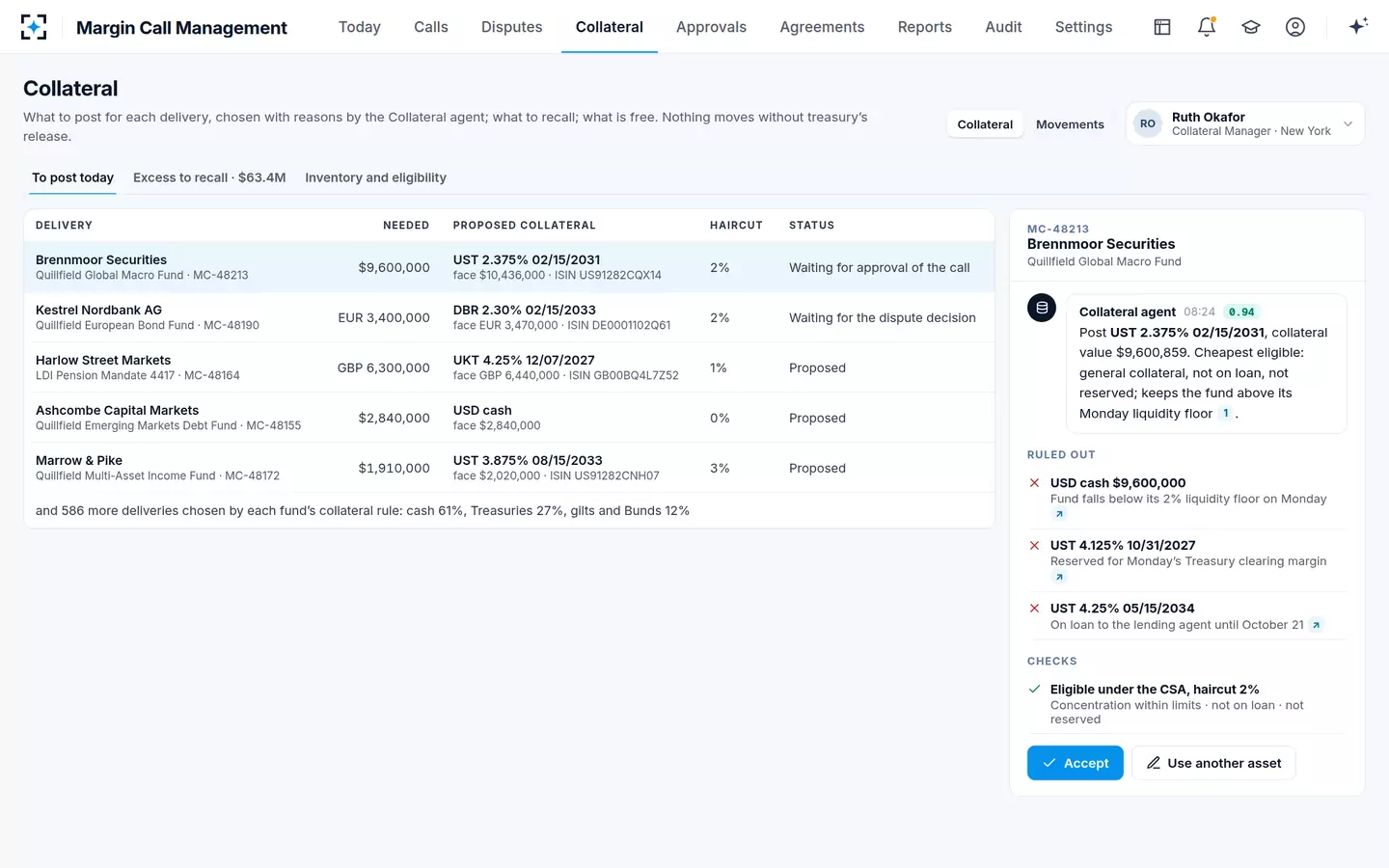
Margin Call Management would not have stopped gilt yields rising, raised capital from pension schemes or sold a gilt. What it does is make the routine part of a margin day fast and explained, so a stressed day starts with the backlog clear. Its agents compute every call from the signed annex, read each counterparty's call, explain the gaps and propose the cheapest eligible collateral, ruling out assets already reserved for other margin, on loan, or needed to keep a fund above its liquidity floor. People approve and release.
On the solution's sample day, 641 of 712 calls were agreed inside tolerance before mid-morning, every dispute was traced to its trades and clause, and the collateral manager's list held eight items. Those are results on fictional sample data, not a promise about a crisis. The relevant point is the one the Bank's staff made with their five-day standard: resilience is partly a buffer of assets and partly the speed of the process that moves them. In the sample book, one of the deliveries proposed on the day is a gilt for an LDI pension mandate, shown on the screen below.
Collateral proposals in Margin Call Management, including a gilt delivery for an LDI pension mandate
Questions people ask
What caused the LDI crisis?
A rapid rise in long-dated gilt yields after the government's 23 September 2022 growth plan, on top of an already rising rate environment, hit leveraged LDI funds with margin and collateral calls they could not meet quickly enough. Their forced gilt sales pushed yields higher still, the self-reinforcing spiral the Bank intervened to stop on 28 September.
When was the LDI crisis?
The acute phase ran from Friday 23 September to Wednesday 28 September 2022, when the Bank of England announced its purchases. The Bank's backstop then ran until 14 October 2022, and 30-year gilt yields peaked that day, more than 270 basis points above their level on 1 August.
How much did the Bank of England spend in the LDI crisis?
It bought £19.3 billion of gilts between 28 September and 14 October 2022, £12.1 billion conventional and £7.2 billion index-linked, against a capacity of £5 billion a day, raised to £10 billion. It sold them back to the market by 12 January 2023. The operation was indemnified by HM Treasury.
Were pension schemes actually at risk of losing money?
The schemes' funding generally improved as yields rose, because their liabilities fell in value faster than their assets. The risk was to the LDI funds: the Bank warned that, without intervention, many pooled funds would have had negative net asset value, leaving the schemes' investments in them worth zero and the funds' gilts sold by their lenders.
What is the 250 basis point LDI buffer?
It is the minimum yield shock the Financial Policy Committee judged in March 2023 that LDI funds should be able to withstand, on top of the resilience needed for day-to-day moves and other risks. Bank staff calibrated it on five-day stresses, consistent with schemes delivering collateral within five days.
Could the LDI crisis happen in the US?
Not in the same form: the UK episode was specific to leveraged LDI funds holding long gilts, but the mechanism, leveraged positions meeting margin calls in a falling market, is general. The Financial Stability Board's 2024 recommendations on margin preparedness drew on March 2020, Archegos, the 2022 commodity turmoil and the LDI episode, and apply to market participants broadly.