Collateral optimization is the choice, for every margin delivery, of the eligible asset that costs the fund least to give up, together with the daily recall of collateral a counterparty holds beyond what it is owed. For a fund trading uncleared derivatives the default is often cash, posted by habit, and cash posted as collateral earns the annex's interest rate instead of the fund's return. Posting eligible securities the fund already owns, at the annex's haircut, keeps the fund invested; recalling excess brings assets home. The saving is measurable as the return on cash not raised and not posted, less the extra face value the haircut takes. Botminds' Margin Call Management proposes the cheapest eligible asset for each delivery, states what it ruled out and why, and finds excess with every counterparty daily; it proposes, and treasury moves the assets.
The sample deliveries below come from the solution's fictional Quillfield Capital book; the cost figures are our illustrative arithmetic, not market levels or a client's results.
What posting cash instead of eligible securities costs a year, on a $100 million requirement
What is collateral optimization?
It is an allocation problem with hard rules and one objective. The rules come from each annex and the margin regulations: which assets are eligible for which counterparty, at what haircut, with what concentration limits, in which currency and at which custodian, by which settlement cut-off. Around them sit the fund's own constraints: its liquidity floor, assets on loan, assets reserved for other margin such as repo or clearing, and its investment restrictions. The objective is to meet every requirement at the lowest cost to the fund.
Two things make it hard in practice. The rules differ annex by annex, so the cheapest asset for one dealer may be ineligible at another. And the inventory moves every day with trading, settlement and lending, so yesterday's answer is wrong today. A team doing it by hand usually falls back on a simple rule, such as cash first, which is easy to operate and expensive to hold.
What can a fund post besides cash?
Quite a lot, against most counterparties. Under the CFTC's rules, a swap dealer may post and collect as variation margin with a financial end user "any asset that is eligible to be posted or collected as initial margin" (17 CFR 23.156(b)(1)(ii)): Treasuries and agency securities, high-grade sovereign debt, certain government-sponsored enterprise debt, publicly traded corporate debt deemed acceptable, equities in major indices, shares of qualifying money market and similar funds, and gold, each at a standardized haircut. Variation margin between two swap dealers, by contrast, must be cash in dollars, another major currency or the settlement currency. The EU standard lists its own eligible asset classes and haircut methods (Regulation 2016/2251, Article 4 and Annex II).
The US list widened in 2026. A CFTC final rule effective 17 August 2026 eliminated a provision that had disqualified shares of money market and similar funds as eligible initial margin collateral when the funds' managers transfer assets through securities lending, repo or similar arrangements, so more assets now qualify, and amended the haircut schedule for those fund shares (CFTC, 91 FR 45134, 17 July 2026; the rule's words and what they do to a signed schedule are in the eligible collateral schedule). Because a financial end user's variation margin may be any initial-margin-eligible asset, the change reaches variation margin too. Whether a given dealer accepts an asset is still a matter for the annex's eligible collateral schedule.
What makes one eligible asset cheaper than another for a margin delivery
| Factor | Cheaper when | Where it is set |
|---|---|---|
| Return forgone | The asset would otherwise earn little: idle cash, or securities held anyway | The fund's portfolio and cash forecast |
| Haircut | Low haircut: short-dated government debt in the swap's currency | 17 CFR 23.156 schedule, EU Annex II, and the annex |
| Currency | Same as the settlement currency, avoiding the 8% additive haircut | 17 CFR 23.156(a)(3)(i)(A) and (b)(2) |
| Interest on cash posted | The annex pays a rate close to the fund's alternative | The annex's interest terms |
| Other uses | Not needed for repo, clearing, lending or the liquidity floor | The fund's own reservations |
| Settlement | At the right custodian and able to settle before the cut-off | Custody and the settlement calendar |
What do haircuts and cash cost a fund?
Each delivery has a cost with two parts, and they can be written down. If the fund posts cash, the cost is the return the fund would have earned on that money, less the interest the annex pays on cash collateral, for as long as the requirement lasts. If it posts securities, the cost is the extra face value the haircut requires, and whatever those securities could otherwise have done, such as being lent or sold. A fund can price each term with its own numbers.
The cost of meeting one margin requirement, term by term
Return forgone on cash
Cash posted × (fund's expected return on the assets sold − annex interest on cash) × years
Zero if the cash was idle anyway; large if assets were sold to raise it.
Portfolio manager, treasury
Haircut on securities
Requirement ÷ (1 − haircut) − requirement
Extra face value encumbered: about $2.04M on $100M at 2%.
Collateral team
Value of encumbrance
Securities posted × what they could earn if free (lending fee, repo, sale)
Often small for Treasuries the fund holds anyway.
Treasury, securities lending
Transaction costs
Costs of selling assets to raise cash, or of moving securities
Larger in stress, when markets are least liquid.
Trading, treasury
The arithmetic is simple and the spread is the variable. In the illustration at the top of this page, a $100 million requirement met with cash raised by selling assets that would have earned one percentage point more than the annex pays costs $1 million a year. The same requirement met with Treasuries the fund holds anyway costs mainly the encumbrance of about $102 million of them at a 2% haircut. The figures are illustrative; the method is the point. A fund should run it on its own requirements, spreads and holdings before deciding the default.
Who benefits from collateral optimization? The fund's investors
The investors, because the cost of posting cash falls on the fund's return. Cash posted is cash not invested, and cash raised by selling holdings carries transaction costs and can force sales at the worst time. The SEC made the point when it adopted its fund derivatives rule: even a fund using derivatives only to hedge currency risk "could still introduce other risks, including counterparty risk and a risk of selling investments to meet margin calls" (SEC, Rule 18f-4 adopting release, 2020). Collateral optimization is one of the ways a fund keeps that risk small. A fund's derivatives risk manager owns the wider programme; Rule 18f-4 in plain words covers who is in scope.
The second source of value is excess collateral. Counterparties often hold more than they are owed, after markets move in the fund's favour or after a dispute closes, and excess stays with them until someone calls it back. In the sample book, the agents found $63.4 million of excess across 41 annexes on one morning and issued the return calls at 07:44.
How do stress periods change the choice?
They raise the requirement and narrow the options at the same time. In March 2020 average daily gross collateral balances tied to non-centrally cleared variation margin rose 55% in a month, from $248 billion to $384 billion, while initial margin balances moved far less, from $47.5 billion to $50.7 billion (BCBS-CPMI-IOSCO, Review of margining practices, 2022). Basel and IOSCO later found that "dealer banks typically prefer cash for VM collateral", while "buy-side firms like pension funds, hedge funds and insurance companies often hold securities but have little cash" (BCBS-IOSCO, January 2025, section 2.3.2). A fund whose annexes accept only cash has to sell securities to meet calls in exactly the market where selling is most expensive.
Collateral also has a risk of its own in stress. The Financial Stability Board warns that where liquidity comes from selling securities, the assets held and the collateral provided should not "exhibit a significant correlation with the value of their collateralised portfolio" in a way that undermines protection (FSB, 2024, Recommendation 7). The September 2022 gilt episode, where the hedge and its collateral fell together, is the case in point; the LDI crisis, hour by hour follows it.
What did regulators say about flexible collateral after 2020?
Both the Basel Committee with IOSCO and the Financial Stability Board encourage firms to widen what they can post and accept, within the rules, before the next stress. Their January 2025 recommendations ask firms to "consider providing flexibility in bilaterally agreed acceptable collateral, from within the set of permissible collateral types per the WGMR Framework and national regulations and doing so with appropriate haircuts", to mitigate liquidity issues "and a subsequent 'dash for cash' during periods of stress" (Recommendation 2).
Market participants should consider the potential for optimising counterparty arrangements (e.g. ISDA CSAs) to be able to deliver non-cash collateral to meet margin and collateral calls, if economically rational and commercially viable.
Financial Stability Board, Liquidity Preparedness for Margin and Collateral Calls, December 2024, Recommendation 7
The regulators are candid about the trade-off. Basel and IOSCO note that wider acceptance "may come at a cost" to dealers, through balance sheet constraints and uncertainty about collateral received, and that amending contracts fully and promptly is costly; they suggest "a targeted and gradual approach". For a fund that means starting with the counterparties that call it most, and the assets it holds most, rather than renegotiating every annex at once.
Collateral optimization in Margin Call Management, one delivery at a time
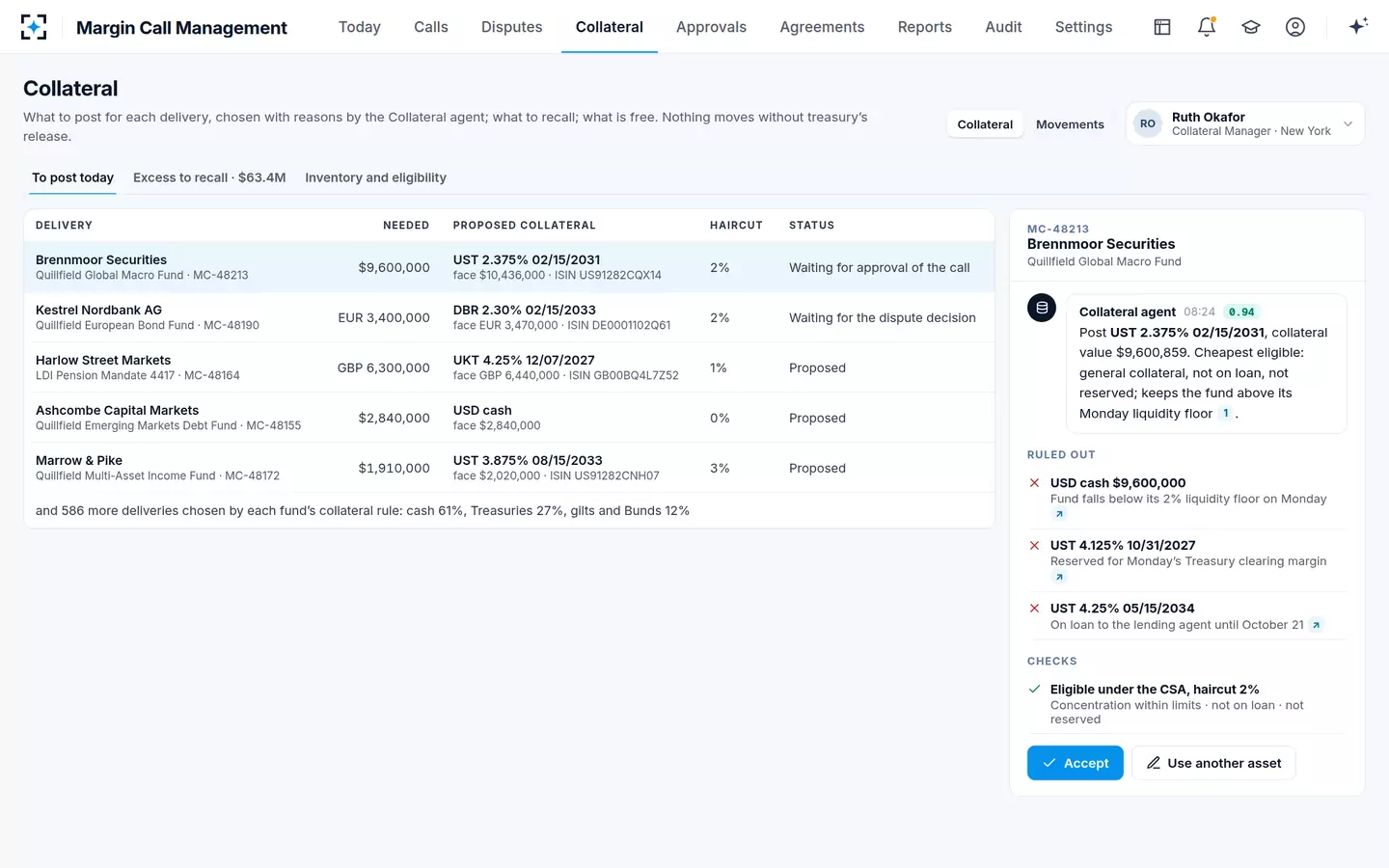
In the solution, the Collateral agent ranks eligible assets for each delivery by what they cost the fund, and rules out assets that would breach the fund's liquidity floor, are on loan, are reserved for repo or other margin, or would breach a concentration limit. It gives its reasons, and the Checker agent re-checks eligibility, haircut and settlement for the asset chosen. The collateral manager can accept or override the proposal with a reason code; treasury moves the asset.
For the fictional Brennmoor delivery of $9,600,000, the agent proposed $10,436,000 face of a Treasury note maturing in February 2031, market value $9,796,795, worth $9,600,859 after the annex's 2% haircut. It ruled out cash, which would have taken the fund below its 2% liquidity floor; a 2027 note reserved for other margin; and a 2034 bond on loan until 21 October. Across the rest of the day's deliveries, each fund's own collateral rule produced a mix of 61% cash, 27% Treasuries and 12% gilts and Bunds.
How the sample book met one day's deliveries, by asset
586 further deliveries, sample day
- Cash · 61%
- Treasuries · 27%
- Gilts and Bunds · 12%
Collateral optimization in Margin Call Management: the cheapest eligible asset, and what was ruled out
What to look for in a collateral optimization solution
A good proposal is explainable, respects every constraint, and leaves the decision with a person. Large firms run optimization engines across triparty agents and thousands of accounts; a fund manager with a few hundred annexes needs something smaller and more transparent. The questions below separate the two needs.
Questions for any collateral optimization solution
- Does it read eligibility from the signed annex?
Not from a schedule keyed years ago. Haircuts and eligible assets differ by counterparty.
- Does it know the fund's own constraints?
Liquidity floors, assets on loan, assets reserved for repo or clearing margin, investment restrictions.
- Does it say what it ruled out, and why?
An unexplained proposal is hard to approve and impossible to audit.
- What cost does it minimise?
Ask to see the cost terms and set them yourself: return forgone, haircut, encumbrance, transaction costs.
- Does it recall excess every day?
Excess with counterparties is often worth more than marginal optimization of new deliveries.
- Who accepts the proposal, and who releases?
A person accepts or overrides with a reason; treasury releases; the system never moves an asset.
- Does it handle settlement realities?
Custodian location, cut-offs and the time to move securities versus cash.
Margin Call Management fits a fund manager that wants each delivery chosen well and explained, inside a margin process it already controls. It does not run triparty allocations, securities lending or a firm-wide inventory engine, and it does not move assets. Whether to build this capability in-house with agents or buy it as a service is covered in collateral management services or in-house.
Questions people ask
What is the difference between collateral optimization and collateral management?
Collateral management is the whole process of agreements, calls, disputes and settlement. Optimization is one decision inside it: which eligible asset to deliver for each requirement, and what to recall. A team can manage collateral well and still post cash by habit; optimization is what changes the habit.
Can a fund post securities as variation margin?
Usually, yes. Under the CFTC's rules a swap dealer may accept any initial-margin-eligible asset as variation margin from a financial end user, at standardized haircuts; only variation margin between swap dealers must be cash. What a particular dealer accepts depends on the eligible collateral schedule in the annex.
What haircut applies to Treasuries posted as collateral?
Under the CFTC's schedule, 0.5% for under one year to maturity, 2% for one to five years and 4% for over five, plus 8% if they are posted against a swap settling in a different currency. Annexes may set higher haircuts. The EU standard has its own schedule.
Can money market fund shares be posted as margin?
Under the CFTC's rules, shares of qualifying money market and similar funds are eligible, and a 2026 final rule, effective 17 August 2026, removed a condition that had excluded funds whose managers use securities lending or repo, and amended the haircuts for these shares. A dealer must still accept them under the annex.
How do you measure the value of collateral optimization?
Compare the cost of the deliveries actually made with the cost of the cheapest eligible alternatives, using four terms: return forgone on cash, extra face value from haircuts, the value of encumbered securities, and transaction costs. Add the value of excess recalled. Run it over a month of real deliveries to see the annual figure.