A margin dispute is a disagreement between two counterparties about how much collateral one owes the other under their credit support annex, almost always because they value the trades differently or are not valuing the same trades. The undisputed part is still delivered, the rest is reconciled and argued, and if the gap is large and lasts, it becomes a regulator's business: a US swap dealer must notify the CFTC of a valuation dispute above $20 million left unresolved for three business days with another dealer or five with anyone else, and EU financial counterparties must report disputes above EUR 15 million outstanding for at least 15 business days. Those lines are rarely reached. Botminds' Margin Call Management treats every dispute as a data problem to close the same day, traced to its trades and clause, with each one shown against both reporting clocks from the hour it opens.
Examples come from the solution's sample book: Quillfield Capital, a fictional manager whose collateral team runs margin for 186 funds and mandates, with fictional dealers, on Friday 16 October 2026.
Two reporting clocks for one margin dispute, in business days
- Resolve3 business days
- Report$20M+
- Resolve5 business days
- Report$20M+
- Resolvefirst 5 days
- Specific process for the unresolveddays 6 to 15
- Report€15M+
What is a margin dispute, and what still moves while it lasts?
A margin dispute is a notified disagreement over the amount of a margin call, or over the value of the collateral posted against it. It is not a refusal to pay. Under the EU rules the posting party must still deliver what it does not dispute: for initial margin, counterparties "shall provide at least the part of the initial margin amount that is not being disputed within the same business day of the calculation date" (Regulation 2016/2251, Article 13(3)), with the same rule for variation margin in Article 12(3). Annexes in common use say the same: the disputing party transfers the undisputed amount, both parties consult, and they recalculate on agreed inputs if consultation fails.
The international framework asks parties to have "rigorous and robust dispute resolution procedures in place with their counterparty before the onset of a transaction" (BCBS-IOSCO margin framework, 2020, requirement 3.15), and the US rules make that contractual: margin documentation must "Specify the procedures by which any disputes concerning the valuation of uncleared swaps, or the valuation of assets collected or posted as initial margin or variation margin may be resolved" (17 CFR 23.158(b)(3)). A swap dealer that keeps pursuing a formal dispute process in good time is not in breach of its duty to collect margin while the dispute runs (§23.153(e)).
When must a swap dealer report a margin dispute to the CFTC?
When a swap valuation dispute is above $20 million, or its equivalent in another currency, and has not been resolved within three business days if the counterparty is another swap dealer or major swap participant, or five business days for any other counterparty. The swap dealer notifies the CFTC and any applicable prudential regulator "promptly" (17 CFR 23.502(c)). The duty sits with the dealer, not the fund, but a fund's dispute is what the dealer reports, with the fund's name on it.
The same section sets the internal clock that comes first. Between dealers, valuation discrepancies must be resolved "as soon as possible, but in any event within five business days", and between a dealer and a buy-side counterparty the dealer must have procedures to resolve them "in a timely fashion"; in both cases "A difference between the lower valuation and the higher valuation of less than 10 percent of the higher valuation need not be deemed a discrepancy" (§23.502(a)(5) and (b)(4)). That 10% tolerance is for portfolio reconciliation, not for margin calls: a 9% valuation gap on a large portfolio is still a large call difference.
The thresholds are often quoted together; the derivatives documentation team's roles page sets them beside the documentation work. For a collateral desk the useful reading is operational: with a dealer counterparty facing a five-day clock, a dispute that is explained on day one and corrected on day two never comes close.
What is the EU's EUR 15 million dispute reporting rule?
It requires financial counterparties to report to their competent authority any dispute about an over-the-counter derivative, its valuation or the exchange of collateral above EUR 15 million that has been outstanding for at least 15 business days (Delegated Regulation (EU) No 149/2013, Article 15(2)). The difference from the US rule matters to a fund: in the EU the duty is the financial counterparty's own, and UCITS and alternative investment funds managed by authorised or registered managers are financial counterparties under EMIR (Regulation (EU) No 648/2012, Article 2(8)), so a UCITS or an EU alternative fund in a long dispute reports it itself.
The same article asks for something earlier than the report. Counterparties must have agreed procedures for "the resolution of disputes in a timely manner with a specific process for those disputes that are not resolved within five business days" (Article 15(1)(b)). In practice, day five is the EU's escalation point and day fifteen its reporting point. In the sample book, a dispute with the fictional Northcote Bank on Quillfield's Euro Liquidity UCITS, EUR 16.1 million, sits on day 9 of 15 and has already been escalated to the dealer by the collateral manager.
How rarely margin disputes reach a reporting line
<2%
of about 30,000 US swap dealer portfolios had a variation margin dispute above $20 million, even in stress
~30k
portfolios covered by US swap dealers' quarterly summary reports, analysed for more than five years
Quarter
disputes were generally resolved within the reporting quarter, "with remarkably few exceptions"
How often do margin disputes happen, and how long do they last?
Large ones are rare and short. Basel and IOSCO analysed more than five years of quarterly summary reports covering US-regulated swap dealers, which track the frequency, size and duration of variation margin disputes above $20 million, and found "that disputes generally represent less than 2% of the approximately 30,000 portfolios, even during periods of stress, and that disputes are generally resolved within the reporting quarter, with remarkably few exceptions" (BCBS-IOSCO, 2025, section 2.4.4). Supervisors in other jurisdictions reported the same pattern.
Two qualifications keep that finding honest. It covers disputes above $20 million; smaller disputes, the ones a collateral desk works every day, are not in the data. And it found that disputes "correlate highly with market volatility metrics": they cluster on exactly the days when a team has the least time. A desk that clears ten small disputes on a quiet day may face forty on a volatile one, with the same staff.
While the use of disputes as strategic delays is possible, the practice is anecdotally very uncommon and generally repudiated by market participants.
Basel Committee and IOSCO, January 2025, section 2.4.4
What causes most margin disputes?
Valuation, far more than anything else. Basel and IOSCO's outreach found that dispute resolutions "primarily concern VM valuation issues" (section 2.4.4). Valuation is a family of causes rather than one: a trade one side has and the other does not, a curve or fixing taken at a different time, a different model for an option, a trade that has matured on one system and not the other. After valuation come the collateral causes: an asset in transit, a haircut keyed differently, an asset one side thinks is ineligible. Then terms: minimum transfer amount, rounding and threshold.
What drives the gaps across one book of open margin disputes
A driver list like this changes how a desk should spend effort. If three-quarters of the money is valuation, the high-value skill is reading a dealer's portfolio file against your own and finding the trades and curves that differ, not drafting the email. The small categories still matter: a haircut or minimum transfer amount keyed wrongly repeats on every call under that annex until someone fixes the term. The worked variation margin calculation shows how each input produces its own kind of gap.
What must a margin dispute procedure record?
At a minimum, how long the dispute has been open, who it is with and how much is disputed. The EU rule makes those three items the floor of the procedure for "the identification, recording, and monitoring" of disputes (Article 15(1)(a)). Under US rules the documentation must also set out how valuation disputes are resolved, or an alternative valuation method, and a record of each portfolio reconciliation must be kept (17 CFR 23.504(b)(4); §23.502(e)).
A margin dispute file: what each item is for
| Item | Why it is kept | Rule or practice |
|---|---|---|
| Counterparty, fund and annex | Who the dispute is with and which terms govern it | EU Article 15(1)(a) |
| Amount disputed, and amount agreed and delivered | The size of the dispute, and proof the undisputed part moved | EU Article 15(1)(a); Regulation 2016/2251, Articles 12(3), 13(3) |
| Opening date and business-day age | The clock for escalation and for each reporting line | EU Article 15(1)(a), (b) and (2); 17 CFR 23.502(c) |
| Drivers, each priced, adding up to the gap | What is actually disputed, trade by trade | Practice; supports the notice and the reconciliation |
| Trade-level reconciliation and the sources used | Both sides' files, curves and confirmations | 17 CFR 23.502(e) record of reconciliation |
| Notice sent, approver and reason | Who decided to dispute, and on what evidence | Firm policy; the annex's notice terms |
| Resolution and any regulatory report | How it closed, and whether a line was crossed | EU Article 15(2); 17 CFR 23.502(c) |
A margin dispute is a data problem: close it the same day
Most disputes end when one side corrects an input, so the fastest route to closure is to hand the other side the exact input to correct. A notice that says "we disagree with your call" starts a conversation; a notice that names three trade identifiers, a curve date and a clause ends one. In the sample book, Brennmoor Securities called Quillfield's Global Macro Fund for $14,200,000 against Quillfield's $9,600,000. By 08:22 the Dispute agent had priced three drivers that add up to the $4,600,000 gap exactly; the notice went out at 11:06 with the trades attached, and at 12:20 Brennmoor loaded the missing swaps, re-priced on the right curve and agreed. The dispute opened and closed on the same day.
The same discipline protects the fund when it is wrong. A $3.2 million initial margin dispute with the fictional Ravensworth Securities traced to 14 equity vega sensitivities missing from Quillfield's own model run for options booked on 9 October. The dealer was right, the solution said so, and the fix was internal. A dispute process that only ever finds the other side's errors is not reconciling, it is arguing.
Every open dispute in Margin Call Management, with its driver, its age and its reporting clock
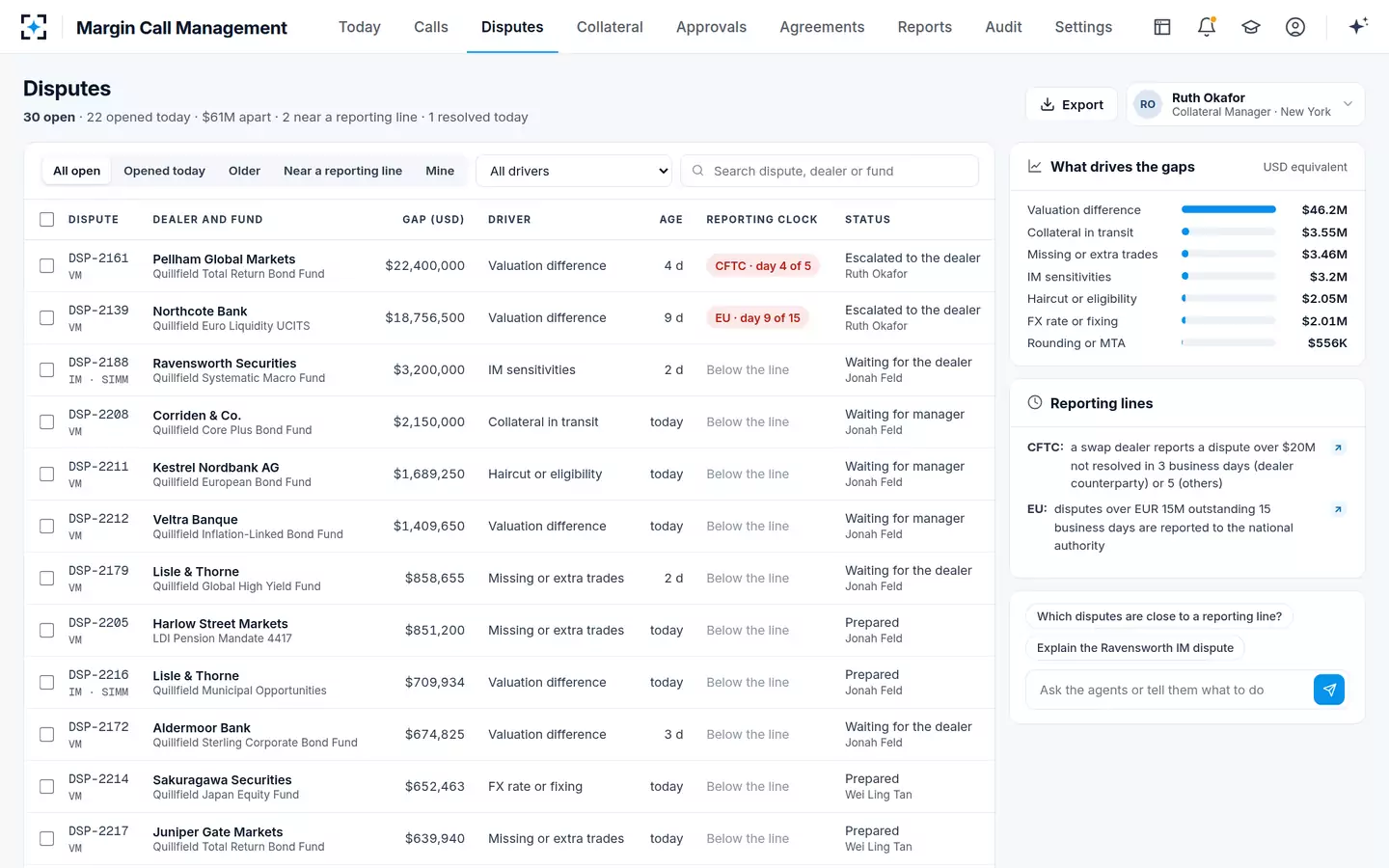
Margin Call Management: each dispute traced, approved and on its clock
The solution's Dispute agent reconciles both portfolios behind any gap above the tolerance rule, prices each driver, cites the clause and drafts the notice in the dealer's language. Its limits are part of the design: the drivers must add up to the gap, below 0.85 confidence it asks a person, and it never sends a notice without a maker and a checker. In the sample firm the analyst can send disputes up to $1 million; above that the collateral manager approves, and above $25 million the head of collateral.
The reporting clocks are tracked, not remembered. Every dispute shows the CFTC or EU line that applies, the business days left, and who owns it, and the head of collateral sees every dispute within two business days of a line. The design target is that no dispute reaches a CFTC or EU reporting line unseen; it is a target, not a result. The trade-level view behind each dispute is the screen an analyst works from.
One dispute in Margin Call Management, traced to its trades before anyone asked
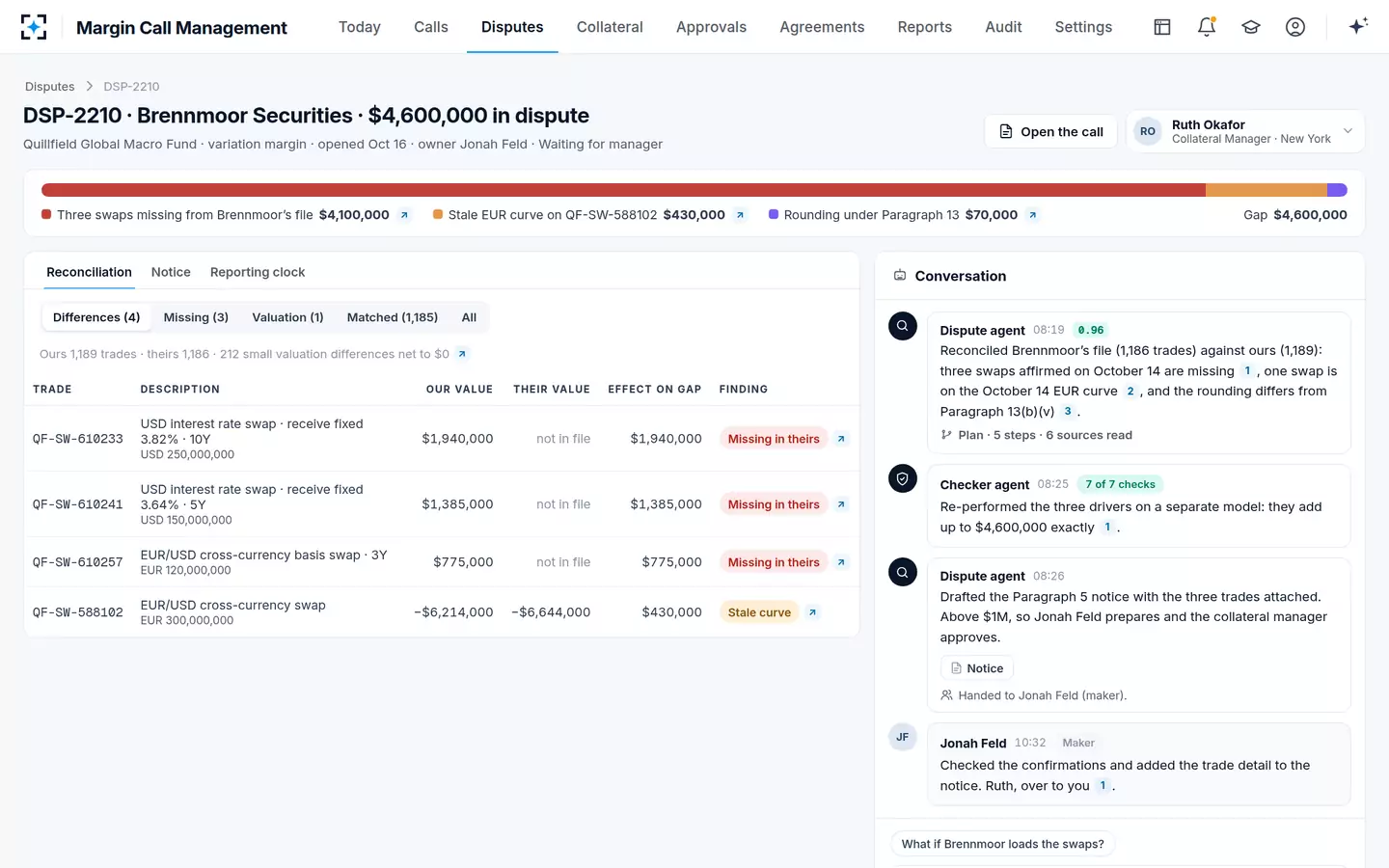
Questions people ask
Who reports a margin dispute, the fund or the dealer?
In the US, the swap dealer: it notifies the CFTC, and any prudential regulator, of valuation disputes above $20 million unresolved after three business days with another dealer or five with anyone else. In the EU the duty falls on each financial counterparty, and EU funds are financial counterparties, so a UCITS or EU alternative fund reports a dispute above EUR 15 million outstanding for 15 business days itself.
Do you have to pay a margin call while it is disputed?
You pay the part you do not dispute, on time. The EU rules require the undisputed portion of variation and initial margin to be provided within the normal deadline, and the standard annexes work the same way. Holding back the whole amount over a partial disagreement leaves the undisputed part late, which is a breach of the delivery deadline rather than a dispute.
What is the difference between a margin dispute and a portfolio reconciliation break?
A reconciliation break is any difference found when two sides compare their trade populations and values, and many are too small to matter: the US rules let a valuation gap under 10% of the higher value go undeemed a discrepancy. A margin dispute is a notified disagreement over a call amount. A dispute usually triggers a reconciliation; most reconciliation breaks never become disputes.
How are margin disputes resolved?
Under the annex's dispute clause, typically by consulting, then recalculating on agreed inputs such as dealer quotations or an agreed valuation method. In practice most end when one side corrects a trade, a curve or a term after seeing a specific trade-level reconciliation. Basel and IOSCO found large disputes were generally resolved within the quarter, with very few exceptions.
Can a margin dispute be about collateral rather than valuation?
Yes, though less often. The value or eligibility of posted collateral can be disputed: a haircut applied at a different rate, a bond one side treats as ineligible, collateral in transit. Both the US documentation rule and the EU dispute rule cover disputes over the valuation of collateral as well as of the trades.
What is a margin dispute resolution process?
It is the written procedure, agreed with each counterparty, for recording, escalating and resolving disputes. The EU rule requires one with a specific process for disputes not resolved within five business days; US rules require the margin documentation to specify how valuation disputes are resolved. A good one also names who may approve a dispute at each size.