A collateral management system for derivatives margin holds each credit support annex's terms, the trades and collateral under it, and the daily calls in and out, and it moves the process from valuation to settlement. Adding AI agents changes how much of that process runs without a person, and so the buying question changes too: not only "what does the system compute?" but "what may it decide?" Agents can read every annex, compute every call, read counterparties' calls in any format, explain every gap and propose collateral. Agreeing amounts outside a published rule, sending a dispute, changing a term and releasing assets are authority decisions that should stay with named people. Botminds' Margin Call Management is built on that line, and this guide sets it out step by step so it can be applied to any system under evaluation.
This page is about derivatives and repo margin. "Collateral management system" also names software for loan collateral, mortgage collateral and central bank collateral pools; those are different products. The sample figures are from Margin Call Management's fictional Quillfield Capital book.
In a collateral management system with agents: what an agent may do, and what a person must
An agent may: Read every signed annex and local-law deed into terms cited to the page, in the original language, and flag where the system differs.
A named person must: Approve any change to a term in the system: legal raises it, the collateral manager checks it.
An agent may: Compute exposure, initial margin and every call from the signed terms; a second agent re-performs each one.
A named person must: Own the tolerance rule that lets calls be agreed without a touch, and every change to it.
An agent may: Read calls from margin platforms, email, PDF and spreadsheets, match them and agree those inside the published rule.
A named person must: Agree anything outside the rule, with a reason.
An agent may: Reconcile both portfolios, price each driver, cite the clause and draft the notice in the dealer's language.
A named person must: Send the dispute: the analyst up to a limit, a manager above it.
An agent may: Propose the cheapest eligible asset, with what was ruled out and why; find excess with counterparties.
A named person must: Accept or override the proposal; treasury releases the movement, never the person who agreed it.
An agent may: Track each dispute against the CFTC and EU reporting clocks and warn before a line.
A named person must: Decide escalation, and own any report to a regulator.
What should a collateral management system do for derivatives margin?
It should run the whole margin day from the signed documents to settled collateral, and prove each step. That means five capabilities: an accurate store of every annex's terms; a daily calculation of every call; a channel for issuing and receiving calls; a dispute workflow with trade-level reconciliation; and collateral inventory, eligibility and settlement. Around them sit reporting, interest on cash collateral and an audit trail that can be handed to an auditor or examiner.
The regulators' own description of the process is the right checklist for coverage. Basel and IOSCO set out valuation at the agreed close, the call, reconciliation or dispute, and transfer, and note that triparty services can add "ensuring collateral eligibility, monitoring of concentration limits, applying haircuts, collateral valuation, optimisation of collateral use, substitutions, and automation of collateral movement" (BCBS-IOSCO, January 2025, section 2.2.2). Their third recommendation asks firms to consider "standardisation and automation" of non-centrally cleared margin processes; a system's job is to make that possible without taking decisions away from the people accountable for them.
Can AI issue margin calls?
Yes, if the call is computed from verified terms and re-performed independently before it goes out. Issuing a call is the application of agreed arithmetic to agreed inputs; there is no judgement in sending the right number on time, and the risk is in the inputs. A US swap dealer's own rule asks for valuation methods that rely on recent trades, independent valuations or other objective criteria, and for "alternative methods" when an input fails (17 CFR 23.155). An agent issuing calls for a fund should meet the same standard: cite the valuation, curve and terms behind each number, and hold a call when an input is stale.
In Margin Call Management the Calc agent computes each call from the signed terms and the Checker agent re-performs it on a separate model family before it is issued; a failed check stops the call. In the sample, a late yen curve feed held three calls until the data arrived: "nothing is agreed on stale prices".
Can an agent agree a margin call or a dispute?
It can agree a call inside a published tolerance rule that a person owns; it should never agree or send a dispute. The tolerance rule is the firm's decision, written down and versioned, that a gap below a set size is not worth a person's time. Applying that rule hundreds of times a day is what agents are for. A dispute is different in kind: it is a position taken against a counterparty, it may become a regulatory report, and it should carry the signature of someone accountable for it.
The Bank of England and FCA's survey of UK financial firms, published on 26 October 2026, found the market drawing the same line. 80% of respondents had AI agents in production that recommend actions while humans decide and execute; only 2% had deployed agents with broad autonomy; and even counting plans for the next 12 months, no more than 9% expected agents to initiate, execute or block payments, or to change limits, thresholds and controls (Bank of England and FCA, Artificial intelligence in UK financial services 2026).
Where UK financial firms draw the line on AI agents' authority
80%
of respondents had agents in production that recommend actions, with humans deciding and executing
2%
had deployed agents with broad autonomy
≤9%
expected agents, within 12 months, to initiate, execute or block payments, or change limits and controls
Can an agent move collateral?
It can propose; it should not release. Collateral selection is a good use of an agent: the cheapest eligible asset depends on eligibility schedules, haircuts, concentration limits, settlement cut-offs, assets on loan and assets reserved for other margin, and an agent can check all of them for every delivery and state its reasons. Releasing the asset is the step where an error or a fraudulent instruction becomes a loss, and it belongs to treasury, with the release locked for anyone who agreed the call and a call-back when settlement instructions have changed.
The regulators' framing supports keeping the line there. FINRA's 2026 report describes AI agents as able to "plan, make decisions and take action to achieve specific goals" and lists among the risks agents that act on their own without a person validating and approving, and agents that go beyond their intended scope; its suggested considerations include deciding where to place human oversight (FINRA, 2026 Annual Regulatory Oversight Report). The SEC's fiscal 2027 examination priorities, which use the term "super intelligence (SI)", list policies for monitoring it, including in back-office operations, among the areas to examine (SEC, FY2027 Examination Priorities).
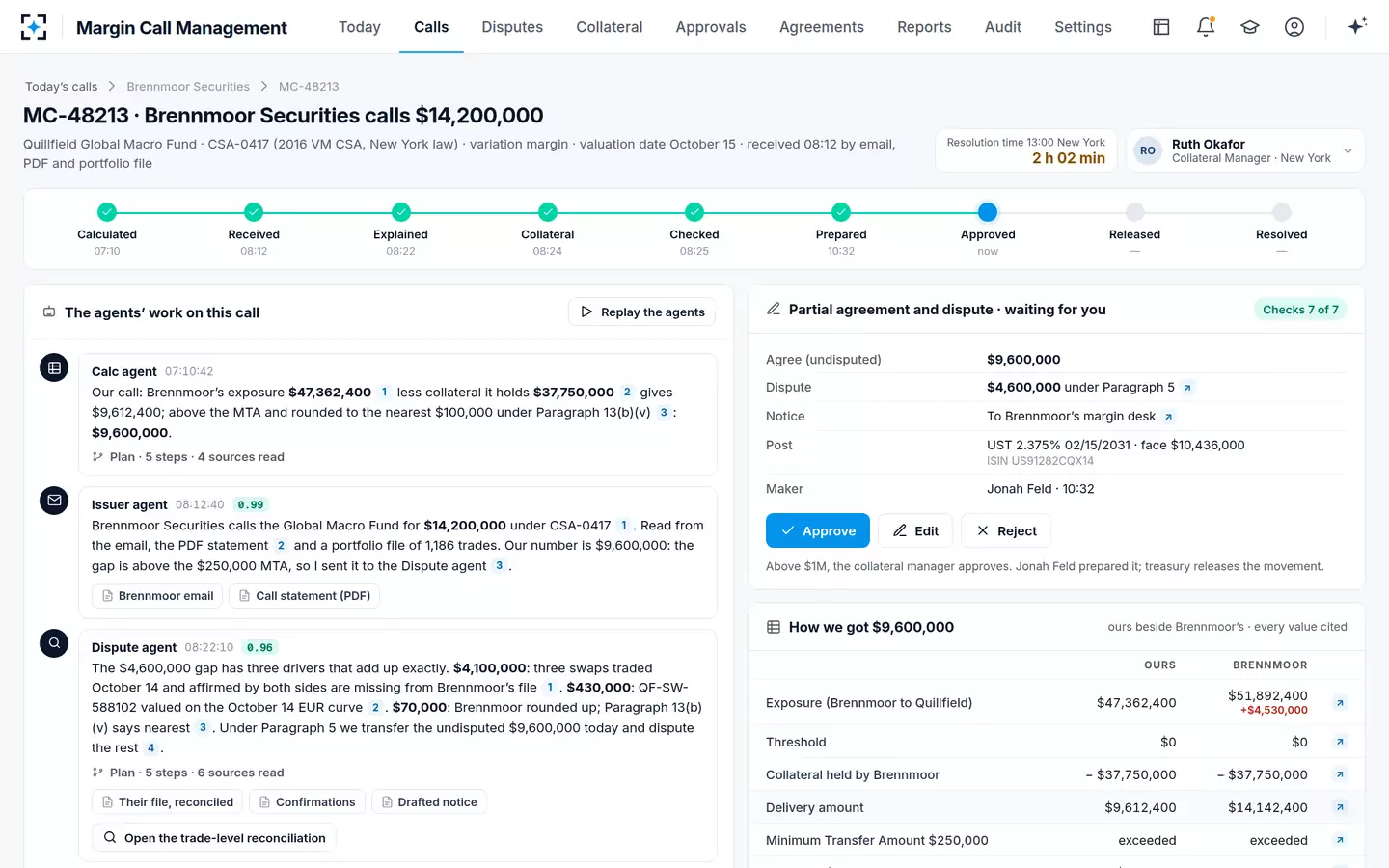
One margin call in Margin Call Management: what each agent did, and the decision left for a person
Can an agent change the terms in the collateral system?
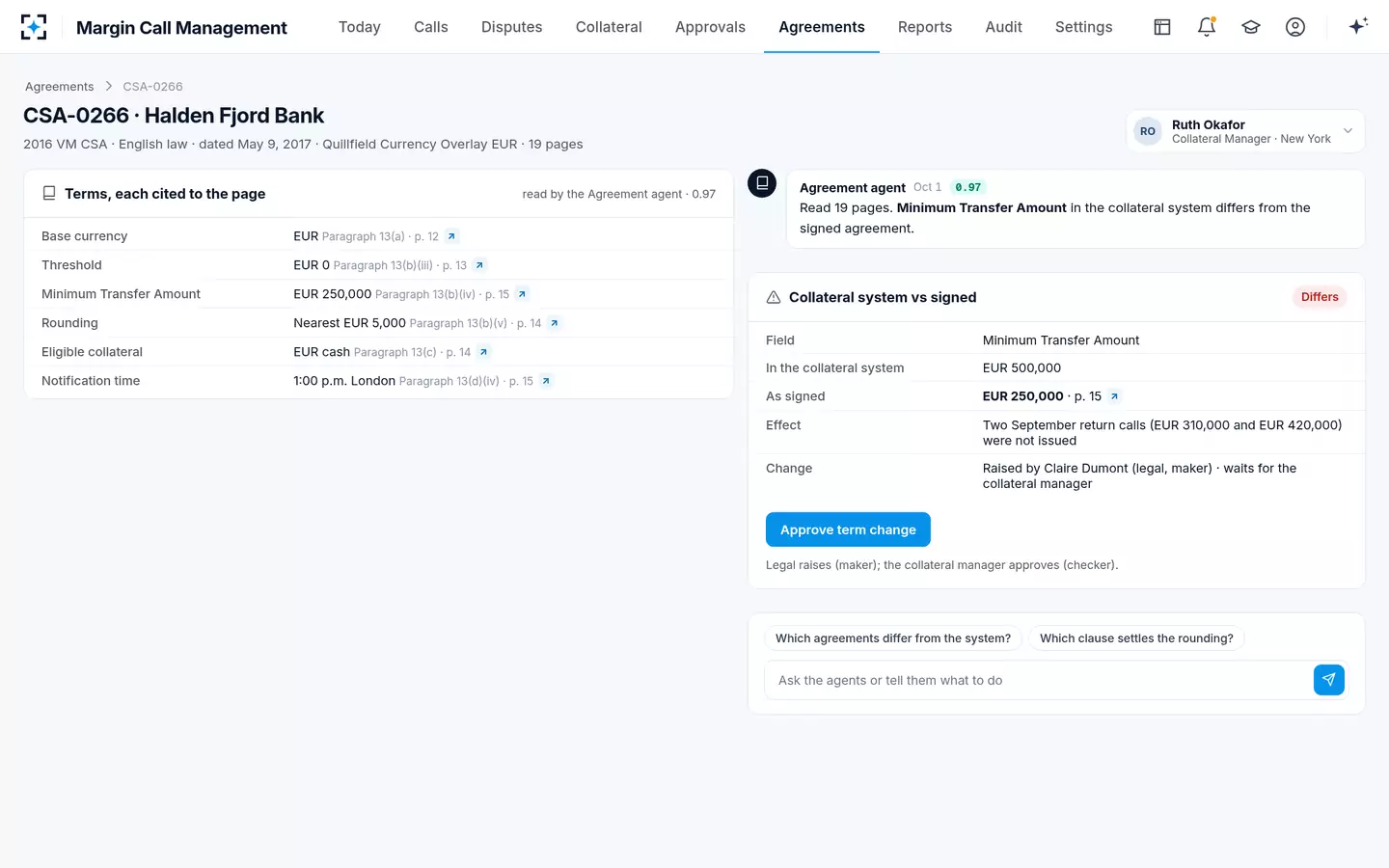
No. It should find the differences and show them; a person changes the term. Terms keyed into a collateral system years ago drift from the signed documents: amendments are missed, a minimum transfer amount is keyed in the wrong currency unit, a haircut schedule is copied from another annex. An agent that reads the signed annex can compare every term with the system every day, which no team does by hand. The fix itself is a change to the basis of every future call and needs a maker and a checker.
In the sample book the Agreement agent flagged three annexes where the system differed from the signed document. One, with the fictional Halden Fjord Bank, held a minimum transfer amount of EUR 500,000 where the signed annex says EUR 250,000 on page 15; two September return calls, of EUR 310,000 and EUR 420,000, had never been issued. Derivatives documentation counsel raised the correction as maker and it waited for the collateral manager to check it.
Margin Call Management compares the signed annex with the collateral system, term by term
How is each agent action logged, and what happens when an agent is unsure?
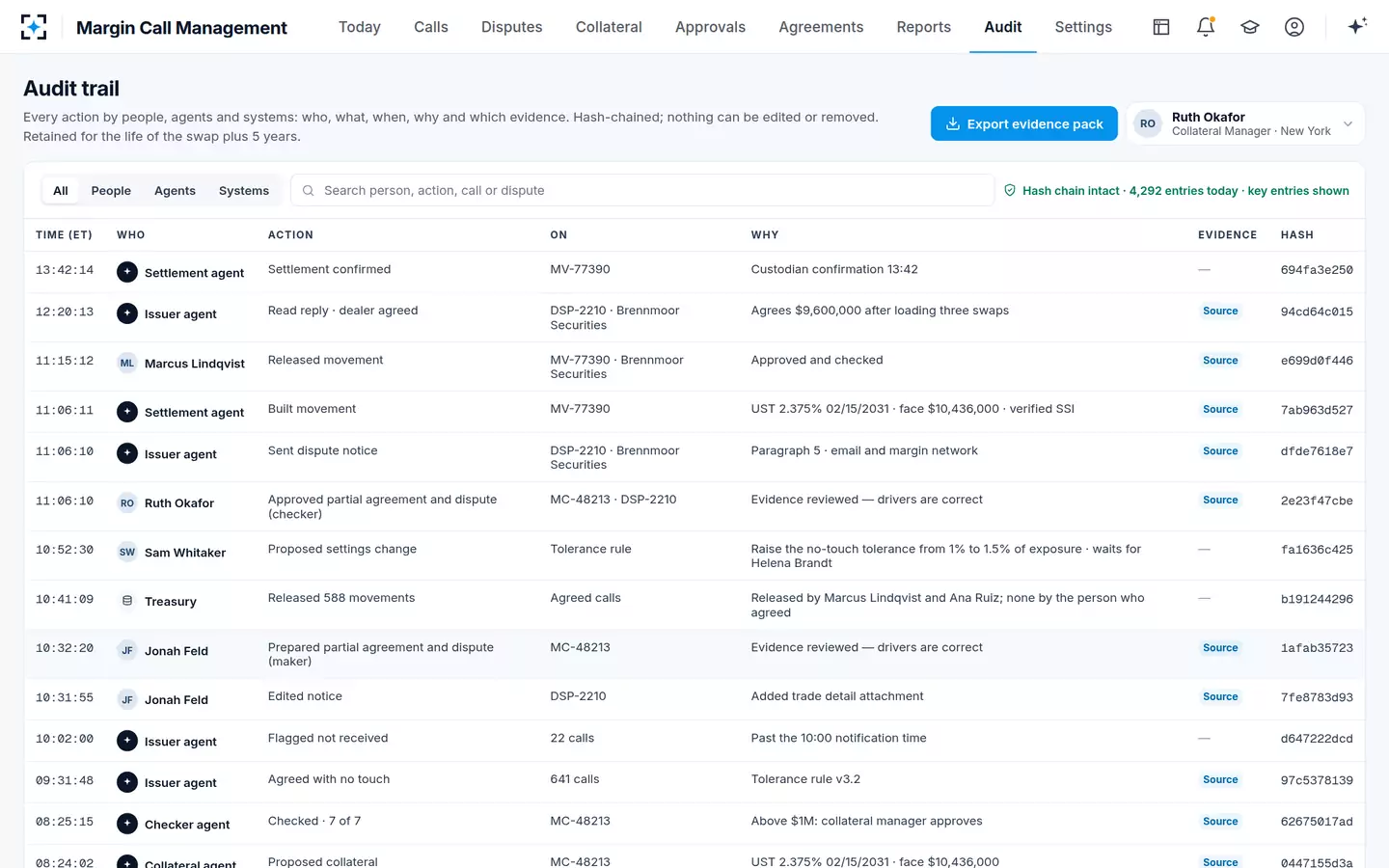
Every action, by an agent or a person, should be logged with who, what, when, why and the evidence, in a record that cannot be edited, and kept as long as the swap records it supports. For a US swap dealer, swap records are kept until the swap ends and "for a period of not less than five years after such date" (17 CFR 1.31(b)(1)); a fund's own retention rules differ, but a margin record that cannot outlive the trade it supports is not much use in a dispute or an examination.
Uncertainty needs an explicit path. In Margin Call Management each agent works to a confidence threshold: the Agreement agent sends an annex for review below 0.90, the Dispute agent asks a person below 0.85, and a call read from a counterparty's document needs at least 0.95 to proceed without an analyst. When the Checker agent disagrees with another agent, the call stops and goes to a person with both arguments, rather than being settled by the agents. Agents, prompts and models are versioned, and the audit trail is hash-chained.
The audit trail in Margin Call Management: people, agents and systems in one record
What to ask any collateral management system vendor about agents
Ask what the system decides, not only what it computes, and ask to see it on your own documents. The questions below are written so that a no or a vague answer is informative. They apply to an established collateral platform adding AI features as much as to a new one.
Questions for a collateral management system with AI agents
- What can an agent do without a person, exactly?
Ask for the list. Agreeing inside a written tolerance rule is reasonable; disputing, changing terms and releasing are not.
- Who owns the tolerance rule, and is it versioned?
Every no-touch agreement should record the rule version that allowed it.
- Is every call re-performed independently?
By a separate model or method, with a failed check stopping the call.
- Does it read the signed annex, or only what was keyed?
Terms cited to the page catch the drift between documents and system.
- Can it read calls in the formats you actually receive?
Margin platforms, email, PDF and spreadsheets, in the languages your counterparties use.
- Do dispute drivers add up to the gap?
An explanation that leaves an unexplained residual is not finished.
- What happens when an agent is unsure?
A confidence threshold and a named person, not a guess.
- Who can release collateral, and who is locked out?
The agreer should be locked out; changed settlement instructions should wait for a call-back.
- Can you export the evidence for one call?
Inputs, terms, approvals and settlement, in a form an auditor can read without the vendor.
Where Margin Call Management fits, and where it does not
Margin Call Management works with the collateral management system a firm already runs, not instead of its core records. It reads the agreements, balances and calls in that system and compares them with the signed annexes; it takes trades and positions from the order management and accounting systems, prices and sensitivities from the firm's valuation engine, calls from the margin platform and mailbox, and balances and settlement instructions from custodians, read-only. Seven agents, Agreement, Calc, Issuer, Dispute, Collateral, Checker and Settlement, do the reading, computing, explaining and proposing.
It does not price derivatives itself, hold assets, clear trades or replace a custodian. A firm whose problem is that it has no collateral records at all needs a system of record first. A firm whose problem is the morning, re-keyed calls, disputes worked in spreadsheets, terms that no longer match the documents, has the problem the solution is built for. The Financial Stability Board's 2024 recommendations add a reason to start before a stress: firms should "consider the advantages of standardisation and automation of their collateral management processes" to reduce operational delays "especially during stress periods" (FSB, 2024, Recommendation 6). Whether to run the desk in-house with agents or buy collateral management services is the next decision, and the inputs a firm must bring are the same either way.
What Margin Call Management connects to, and what each system keeps
| System | What it provides | What stays there |
|---|---|---|
| Collateral management system | Agreements, balances and calls, compared with the signed annex | The firm's records of agreements and balances |
| Order management and portfolio accounting | Trade populations, positions, cash and collateral inventory | The books of record |
| Valuation engine and risk | Prices, exposures and initial margin sensitivities; curves and FX from market data | Pricing models |
| Margin platform and collateral mailbox | Calls in and out, dealer emails, PDF statements, spreadsheets and portfolio files | The messages, kept unchanged |
| Document management | Signed annexes and local-law deeds in English, German, French and Japanese | The signed originals |
| Custodians and settlement instructions | Collateral balances, settlement status and standing instructions, read-only | Custody and the instruction master |
Questions people ask
What is a collateral management system?
Software that holds the terms of each collateral agreement, the exposures and collateral under it, and the calls, disputes and movements between the parties. For derivatives it runs the daily margin cycle under each credit support annex; for loans the same name describes systems that track pledged assets. Most firms with uncleared derivatives use one alongside their trading and accounting systems.
Can AI replace a collateral management team?
No, and it should not try to. Agents can take most of the mechanical work: reading annexes and calls, computing, reconciling and drafting. Disputes, term changes, limits and releases need accountable people; the Bank of England and FCA's 2026 survey found only 2% of UK firms had deployed agents with broad autonomy.
How is an AI agent's margin call checked?
By an independent re-performance before it is issued, a confidence threshold below which a person reviews it, and citations to the terms and valuations it used. In Margin Call Management a Checker agent on a separate model family re-performs every call, dispute driver and collateral proposal, and a failed check stops the call.
Does an agent-based collateral system meet regulatory requirements?
The rules apply to the process and records, not the tool: daily calculation, documented valuation methods, dispute procedures, segregation and record retention. A system helps by doing those steps consistently and logging them. Supervisors expect firms to control what agents may do; FINRA lists agents acting without human approval among the risks to manage.
How long does it take to implement a collateral management system with agents?
The software is the smaller part; reading and checking every annex, connecting the data and running in parallel with the current process take the time. In the solution's sample setup, a 10-business-day parallel run matched 97.8% of calculations at first and 100% after three term fixes, a result on sample data, not a customer's.