A variation margin calculation takes the net mark-to-market exposure of every trade under one credit support annex, subtracts the value of collateral the calling party already holds, and then applies the annex's terms: a threshold, which is zero on regulatory variation margin, a minimum transfer amount below which nothing moves, and a rounding rule. The rules define the core of it the same way on both sides of the Atlantic, so the arithmetic is rarely what two counterparties disagree about. They disagree about the inputs: which trades are in the netting set, which curve priced them, what the collateral is worth after haircut, and what the signed annex actually says about rounding. Botminds' Margin Call Management computes each call from the terms read out of the signed annex, cites every input, and shows the counterparty's figures beside its own so a gap points straight at the input that caused it.
The worked example on this page is one call from the solution's sample book: the fictional Quillfield Global Macro Fund and its fictional dealer, Brennmoor Securities, under a 2016-form variation margin annex governed by New York law, valuation date 15 October 2026.
Variation margin calculation as a chain, from exposure to the call
Agent
ExposureValue every trade in the netting set at the agreed close: Brennmoor's exposure to the fund is $47,362,400 on the fund's own valuation.
Agent
Less collateral heldSubtract the collateral Brennmoor already holds from the fund, valued after any haircut: $37,750,000. Delivery amount: $9,612,400.
Agent
ThresholdZero for both parties under the annex, as the margin rules require for variation margin.
Agent
Minimum transfer amount$9,612,400 is above the $250,000 minimum, so the whole amount is due, not the excess over it.
Agent
RoundingNearest $100,000 under the annex: $9,600,000.
A person decides
Agree or disputeAn analyst agrees a call within tolerance; a gap above it goes to a dispute that a person approves.
How is variation margin calculated? The formula the rules write down
The US and EU rules give the same formula in different words: the cumulative change in value of the trades since they were entered into, less variation margin already collected, plus variation margin already posted. The CFTC's text defines the variation margin amount as "the cumulative mark-to-market change in value" of an uncleared swap, measured from the date it is entered into, "less the value of all variation margin previously collected, plus the value of all variation margin previously posted" (17 CFR 23.151). The EU text aggregates the values of all contracts in the netting set, "minus the value of all variation margin previously collected" and "plus the value of all variation margin previously posted" (Regulation 2016/2251, Article 10).
In a collateral system the same idea is written as a credit support amount: exposure minus the value of collateral held. A positive result is a delivery the calling party can demand; a negative one is a return it owes. The rules then add the frequency, every business day, and the outer limits on the annex's knobs; the annex adds the operating terms. The international framework sets the principle the formula serves: "the full amount necessary to fully collateralise the mark-to-market exposure" must be exchanged (BCBS-IOSCO margin framework, 2020, requirement 3.13).
The inputs to one variation margin calculation, side by side with the dealer's
Exposure
What it isNet mark-to-market value of every trade in the netting set, on the agreed valuation
Quillfield$47,362,400
Brennmoor$51,892,400
Collateral already held
What it isValue, after haircut, of what the calling party already holds
Quillfield$37,750,000
Brennmoor$37,750,000
Threshold
What it isUnsecured exposure the parties allow; zero on regulatory variation margin
Quillfield$0
Brennmoor$0
Minimum transfer amount
What it isBelow it nothing moves; above it the whole amount does
Quillfield$250,000 · exceeded
Brennmoor$250,000 · exceeded
Rounding
What it isHow the delivery amount is rounded, from the signed annex
QuillfieldNearest $100,000
BrennmoorRounded up
The call
What it isDelivery amount after the minimum transfer amount and rounding
Quillfield$9,600,000
Brennmoor$14,200,000
What is the difference between variation margin and initial margin?
Variation margin settles what has already happened; initial margin covers what could happen while a defaulted counterparty's trades are closed out. Variation margin is the exposure today and moves between the parties every business day. Initial margin is an estimate of potential future exposure: for a US swap dealer's model, "the one-tailed 99 percent confidence interval" for an increase in value over "the shorter of ten business days or the maturity of the swap" (17 CFR 23.154), and it is held by a third-party custodian, not paid across.
Variation margin against initial margin, term by term
Variation margin: Current exposure: the change in value since the trade or the last call.
Initial margin: Potential future exposure over a close-out period, at a high confidence level.
Variation margin: Mark-to-market of the netting set, less collateral held.
Initial margin: An approved model, in practice a sensitivity model for almost all firms, or the regulators' standardised schedule.
Variation margin: Every business day under US and EU rules.
Initial margin: When the portfolio changes, and in the EU at least every ten business days.
Variation margin: None: the full exposure is collateralised.
Initial margin: Up to $50 million (US) or EUR 50 million (EU) between two groups may go uncollected.
Variation margin: With the counterparty; cash or eligible securities, title transfer or pledge.
Initial margin: With an independent custodian; no rehypothecation.
Variation margin: All covered counterparties, swap dealers and financial end users.
Initial margin: Only counterparties above the material swaps exposure test ($8 billion US average notional; EUR 8 billion EU).
Both numbers are called the same way and land on the same morning, and the rules combine them in one place: the minimum transfer amount. Under the US rule it is a single amount covering initial and variation margin together, below which no transfer is required (§23.151). A firm that splits it between the two must say how in the documentation, and the parts together must stay within the cap (§23.158(a)).
Exposure: whose valuation counts, and what if an input fails?
The exposure is the input that moves most, and the one most often disputed. The annex names a valuation agent, usually the party making the demand, and the rules ask that the valuation rest as far as practicable on recent trades, independent valuations or other objective criteria. A US swap dealer must also "have in place alternative methods for determining the value of an uncleared swap in the event of the unavailability or other failure of any input" (17 CFR 23.155(a)(2)), and must document its methodology with "sufficient specificity" for the counterparty to calculate "a reasonable approximation of the margin requirement independently" (§23.155(b)(1)).
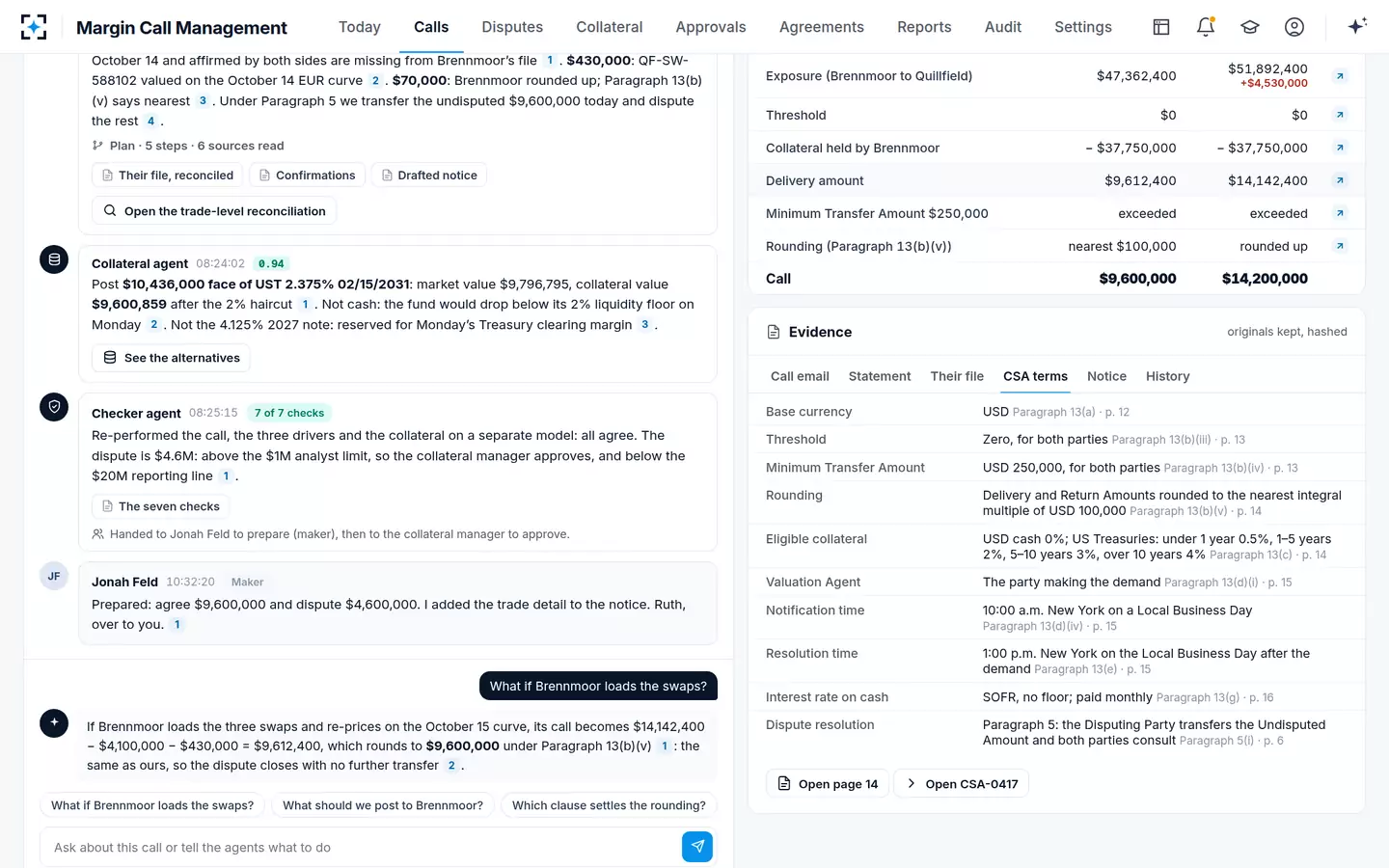
That last requirement is the buy side's lever. A fund that receives a call it cannot reproduce has a regulatory reason to ask for the method. In the sample call the exposure gap is $4,530,000, and it has two parts: three swaps traded on 14 October and affirmed by both sides, which Brennmoor's file did not contain ($4,100,000), and one euro-dollar cross-currency swap that Brennmoor valued on the 14 October euro curve instead of the 15 October close ($430,000). Neither is an arithmetic error. Both are inputs.
Collateral already held, at its value after haircut
Collateral counts at its value after the haircut the annex and the rules apply, not at market value. For uncleared swaps with a financial end user, a US swap dealer may take as variation margin any asset eligible as initial margin, at the regulators' standardised haircuts plus 8% when the collateral's currency differs from the settlement currency, unless it is cash in dollars or another major currency (17 CFR 23.156(b)). The value of each asset is "the product of the cash or market value of the eligible collateral asset times one minus the applicable haircut".
Haircuts that change what posted collateral is worth in a variation margin calculation
| Asset | Haircut | Collateral value of $10 million market value |
|---|---|---|
| Cash in the swap's currency | 0% | $10,000,000 |
| Treasuries and eligible government debt, under one year | 0.5% | $9,950,000 |
| Treasuries and eligible government debt, one to five years | 2% | $9,800,000 |
| Treasuries and eligible government debt, over five years | 4% | $9,600,000 |
| Eligible corporate debt, over five years | 8% | $9,200,000 |
| Equities in the S&P 500 or a related index | 15% | $8,500,000 |
| Any of the above in a currency other than the settlement currency | +8% | A further $800,000 less |
The haircut works on both sides of a call. When the fund delivers, the haircut decides how much face value it must send: in the sample, $10,436,000 face of a Treasury note maturing in February 2031 with a market value of $9,796,795 is worth $9,600,859 after the 2% haircut, just enough to cover a $9,600,000 call. When the fund holds collateral, the same haircut decides how much the dealer's posted bonds count for. A haircut keyed into the collateral system at the wrong rate moves every call on that annex, and on a large bond position a two-point difference in haircut is worth more than most minimum transfer amounts: on $50 million of bonds it is $1 million.
The threshold: zero on regulatory variation margin
A threshold is an amount of exposure a party agrees to leave unsecured, and for variation margin under the margin rules it must be zero. The thresholds in the rules apply to initial margin only: the US initial margin threshold is $50 million of credit exposure between the two groups (§23.151), and the EU allows initial margin collected to be reduced by up to EUR 50 million (Article 29). Variation margin has no such allowance.
Older annexes, signed before the rules or with counterparties outside them, often carry a non-zero threshold, sometimes tied to a credit rating. Those annexes still govern legacy trades, and a firm with both kinds must know which netting set each trade belongs to. Reading which annex applies, and what its threshold says, is the job of an extraction step before the calculation; the calculation's job is to use the right one.
How does the minimum transfer amount change the call?
It decides whether anything moves at all, and once it is exceeded it drops out of the arithmetic. The EU text is explicit: once the amount due is above the minimum transfer amount, the whole amount is collected, with nothing taken off for the minimum (Regulation 2016/2251, Article 25(3); how the threshold, minimum and rounding interact is in ISDA CSA threshold, MTA and rounding). Under both regimes the cap is $500,000 or EUR 500,000 for initial and variation margin combined, and an annex may set less; the sample annex sets $250,000 for each party.
The minimum transfer amount is a switch, not a deduction
A small daily move can therefore leave a gap open for days without any call, then produce one that includes all of it. A desk reconciling its collateral balance should expect differences below the minimum transfer amount to persist, and should not read them as breaks. It should also check that the amount keyed into the collateral system is the signed one: in the sample book, one annex had been keyed with a EUR 500,000 minimum where the signed document says EUR 250,000, and two September return calls of EUR 310,000 and EUR 420,000 were never issued.
Rounding: the clause most often keyed wrong
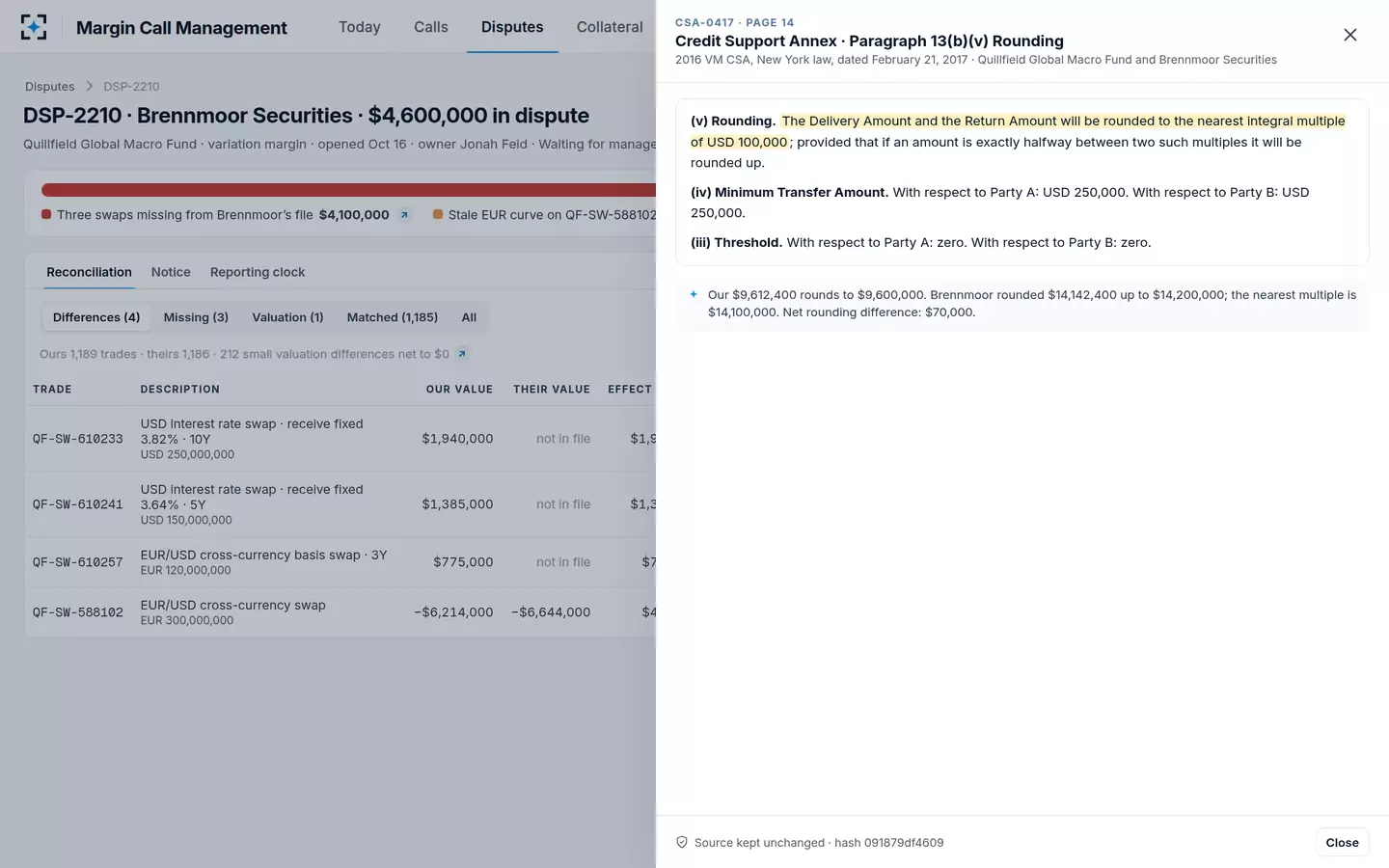
Rounding is the last step and the smallest number, and it still produces disputes because annexes differ in direction and size. The sample annex says the delivery and return amounts "will be rounded to the nearest integral multiple of USD 100,000". Quillfield's $9,612,400 rounds to $9,600,000. Brennmoor's own figure, $14,142,400, rounds to $14,100,000 under that clause; Brennmoor rounded up, to $14,200,000, which the clause does not allow.
Variation margin calculation for the sample call, both sides, line by line
| Line | Quillfield | Brennmoor | Difference |
|---|---|---|---|
| Exposure to the fund | $47,362,400 | $51,892,400 | $4,530,000: three missing swaps and a stale curve |
| Less collateral held by Brennmoor | −$37,750,000 | −$37,750,000 | None |
| Credit support amount (delivery) | $9,612,400 | $14,142,400 | $4,530,000 |
| Above the $250,000 minimum transfer amount? | Yes | Yes | None |
| Rounded | Nearest $100,000: $9,600,000 | Up: $14,200,000 | $70,000: $57,600 from Brennmoor rounding up, $12,400 from Quillfield rounding down |
| The call | $9,600,000 | $14,200,000 | $4,600,000 |
Read down the last column and the dispute writes itself: two input differences, one term difference, no arithmetic. That is the usual shape. Of the $61 million of open gaps on the sample book's disputes screen, valuation differences account for $46.2 million, and rounding or minimum transfer amount differences for $556,000; the analysis of margin disputes and their reporting clocks takes the drivers further.
In Margin Call Management, the calculation sits beside the dealer's, every line cited
Where variation margin calculations go wrong, and how to check one
A calculation goes wrong in one of five places, and each has a check. The trade population: compare both sides' trade lists before comparing values, since a missing or matured trade explains a large gap at once. The valuation: compare curve dates and fixings for the trades with the largest differences. The collateral held: compare balances, including collateral in transit and haircuts. The terms: compare the minimum transfer amount, threshold, rounding and eligible collateral in the system with the signed annex. The arithmetic last.
The order matters because it is the order of likely size. Basel and IOSCO found that disputes turn mainly on valuation rather than on which collateral is allowed, which matches the sample book, where valuation explains three-quarters of open gaps. A second, independent recalculation is the other check: in Margin Call Management a Checker agent re-performs every call, dispute driver and collateral proposal on a separate model family before anything is issued, and a failed check stops the call. A team proving its calls to an auditor or regulator needs the same items kept together; the evidence behind each number in a call lists them.
The rounding clause behind the $70,000, read from the signed annex
Questions people ask
What is the variation margin formula?
Variation margin due equals the current mark-to-market value of all trades in the netting set, less collateral already held by the calling party at its value after haircut. Then apply the annex: no call if the result is at or below the minimum transfer amount, otherwise the full amount, rounded as the annex says. The US and EU rules both define the core as the cumulative change in value less margin collected plus margin posted.
How is variation margin calculated on a futures contract?
On exchange-traded futures the clearing house marks every position to the settlement price each day, and the change in value is paid as variation margin; clearing houses can also call during the day. There is no annex, threshold or minimum transfer amount to negotiate; the clearing house's rules decide. This guide is about uncleared swaps, where each pair of counterparties runs the calculation under its own annex.
Is there a threshold for variation margin?
Not under the margin rules for uncleared swaps. The US $50 million and EU EUR 50 million thresholds apply only to initial margin; variation margin must collateralise the full exposure. Annexes outside the rules, often older ones, can still carry non-zero thresholds for legacy trades.
What haircut applies to Treasuries posted as variation margin?
Under the CFTC's standardized schedule, 0.5% for less than one year to maturity, 2% for one to five years and 4% for more than five, plus 8% if the Treasuries are posted against a swap settling in another currency. Annexes can set higher haircuts. In the sample, a Treasury note with just over four years to run is taken at 2%.
Can the minimum transfer amount be different for initial and variation margin?
Yes. Both the US and EU rules allow separate amounts as long as they add up to no more than the cap of $500,000 or EUR 500,000, and the US rule requires the documentation to say how the amount is split. Once the amount due exceeds the minimum, the full amount is called.
Who calculates variation margin, the fund or the dealer?
Both, in practice. The annex names a valuation agent, usually the party making the demand, but each side computes its own number to check the other's. A US swap dealer must document its method well enough for its counterparty to approximate the requirement independently, which gives a fund grounds to ask how a call it cannot reproduce was built.