Collateral management services, in derivatives and repo, are outside providers that run part of a firm's margin operations: custodians and triparty agents that hold, value and move collateral, and operations providers that calculate, issue and reconcile margin calls on the firm's behalf. (The same words also describe vehicle title services, mortgage collateral services and commodity warehouse monitoring, which this guide does not cover.) The alternative is an in-house collateral desk, now often with AI agents doing the mechanical work. The choice matters less than most buyers expect for one reason: under either model the firm remains accountable for its agreements, and go-live depends on the same four things the firm brings, not on the software or the provider. Those are every annex's terms checked against the signed documents, the list of counterparties and how each sends its calls, the approval limits, and a month of past calls to replay. Botminds' Margin Call Management is the in-house route, and this guide sets out what it needs from a firm and what any service would need too.
Who brings each input to a collateral management go-live
Today
Holds the signed annexes, amendments and local-law deeds, some never reconciled with the collateral system.
With agents
Confirms each annex's terms as read from the signed document, and approves the corrections where the system differs.
Still theirs: Every annex and amendment, checked
Today
Knows which dealers call by platform, which by email, which in German or Japanese, mostly from experience.
With agents
Lists every counterparty, its channel, its contacts, its usual call file and its notification time.
Still theirs: The counterparty and call-channel list
Today
Approval limits live in a policy document and in people's heads.
With agents
Sets limits for agreeing, disputing and releasing as written, versioned settings.
Still theirs: Approval limits and release rules
Today
Has a month of past calls, disputes and settlements spread across spreadsheets and mailboxes.
With agents
Supplies them for replay, so the first live month starts from a known match rate.
Still theirs: A month of past calls to replay
What are collateral management services?
They come in two kinds. Custody-side services hold collateral and, in a triparty arrangement, take on eligibility checks, concentration limits, haircuts, valuation, allocation and substitution of collateral; third-party arrangements provide only "settlement, segregation and reporting services", in Basel and IOSCO's description (BCBS-IOSCO, January 2025, section 2.2.2). Operations services go further into the margin process itself: calculating calls, issuing and answering them, reconciling and handling disputes, under the firm's own agreements.
Regulators accept both and attach the same condition. Basel and IOSCO note that firms must "conduct internal cost assessments to determine whether services can be conducted in-house, or whether a third-party provides a better alternative", and that whichever arrangement is chosen, firms "remain accountable for the terms agreed upon with their counterparties". Their fourth recommendation asks firms to consider whether third-party services would help, "weighing their own firms' capabilities and the need for proper risk management of outsourced services".
Should a fund outsource collateral management or keep it in-house?
Outsource the parts that are about holding and moving assets at scale; keep the parts that are about the firm's own judgement, unless the firm has no way to staff them. Custody, and for initial margin an independent custodian, is not optional: a US swap dealer must require that initial margin it posts or collects be held "by one or more custodians that are not the covered swap entity, the counterparty, or margin affiliates" of either (17 CFR 23.157). Calculation, dispute decisions and release approvals are where the firm's accountability sits, and handing them over still leaves the firm answerable for them.
Collateral management services against an in-house desk with agents
Outsourced operations service: The provider, under the firm's agreements and instructions.
In-house desk with agents: Agents, from the signed terms, re-performed by a second agent before issue.
Outsourced operations service: Typically the firm on the provider's recommendation; terms of the service decide.
In-house desk with agents: Named people at the firm, with limits, maker and checker.
Outsourced operations service: Through the provider's change process.
In-house desk with agents: Settings the firm owns: tolerances, limits and rules, versioned.
Outsourced operations service: In the provider's systems; ask how it is exported.
In-house desk with agents: In the firm's own audit trail, exportable per call.
Outsourced operations service: Depends on the provider's capacity across all its clients at once.
In-house desk with agents: Depends on the firm's agents and staff; agents scale with call volume.
Outsourced operations service: Shared providers concentrate operational risk across the market.
In-house desk with agents: Risk sits with the firm and its software vendor.
The stress row deserves the most weight. The Financial Stability Board asks firms that use providers to include in their liquidity risk management "the operational risks (e.g. inadequate resourcing for heightened manual processing during a stress event) inherent to using third-party services", and to keep "a well-documented assessment of the reliability of their service providers' operational processes and capacities to face stress situations" (FSB, 2024, Recommendations 6 and 8). A provider serving many clients faces every client's calls on the same bad day.
What does a collateral management solution need from us?
Four inputs, whichever route is chosen, and the firm is the only party that can supply them. The table below lists each with who usually owns it and what goes wrong without it. None of them is a software task; all of them decide how fast a go-live goes.
The four inputs a firm brings to any collateral management go-live
| Input | Owner | What goes wrong without it |
|---|---|---|
| Every annex and amendment, with its terms checked against the signed document | Derivatives documentation counsel | Calls computed on keyed terms that drifted: wrong minimum transfer amounts, haircuts, rounding |
| Every counterparty, its call channel, contacts, call file format and notification time | Head of collateral | Calls missed or read late; disputes sent to the wrong desk |
| Approval limits for agreeing, disputing and releasing, and the no-touch tolerance | Treasury and risk, approved by the head of collateral | Agents or providers acting without a written mandate |
| A month of past calls, disputes and settlements | Collateral manager | No baseline: the first live month cannot be judged |
How are the annexes loaded and checked?
By reading the signed documents, not the old data entry. Each credit support annex, initial margin agreement, credit support deed and local-law annex is read into its terms, each cited to its page, and compared with what the collateral system holds. The comparison is the valuable part: terms drift as amendments are missed or values are keyed in the wrong unit. The rules list what the documents must settle, for US swap dealers the margin requirements, eligible assets and haircuts, investment and rehypothecation terms and custody (17 CFR 23.504(b)(3)), and in the EU the terms of the exchange of collateral agreement (Regulation 2016/2251, Article 3), so the read list is fixed by law.
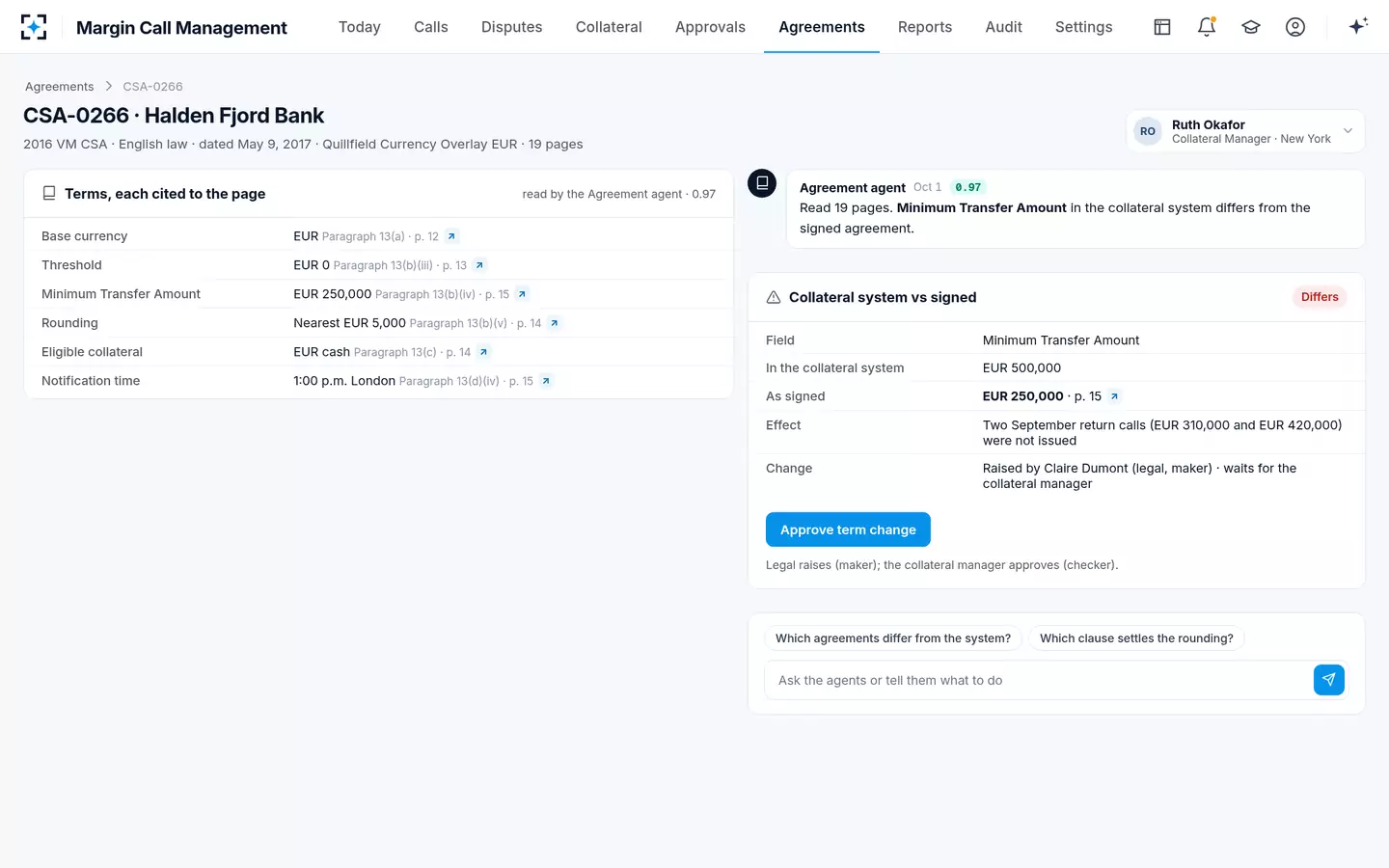
In Margin Call Management the Agreement agent does the reading, in English, German, French or Japanese, keeping the original beside the translation; below 0.90 confidence it sends an agreement for review, and it never changes a term itself. In the sample book it found three annexes where the system differed from the signed document; on one, a minimum transfer amount keyed at EUR 500,000 against EUR 250,000 signed had left two return calls unissued. Counsel raises each correction as maker and the collateral manager checks it.
Loading annexes in Margin Call Management: terms cited to the page, differences with the system flagged
Which counterparties' call files can be read?
The useful answer is all of them, in the form they actually arrive. Some counterparties send calls through margin messaging platforms in a structured format; many still send email with a PDF statement and a spreadsheet portfolio file, in their own language and layout. A service or system that reads only the structured channel leaves the analyst re-keying the rest. Bring a list of every counterparty with a sample of its last few calls, and test the reading on those samples before go-live.
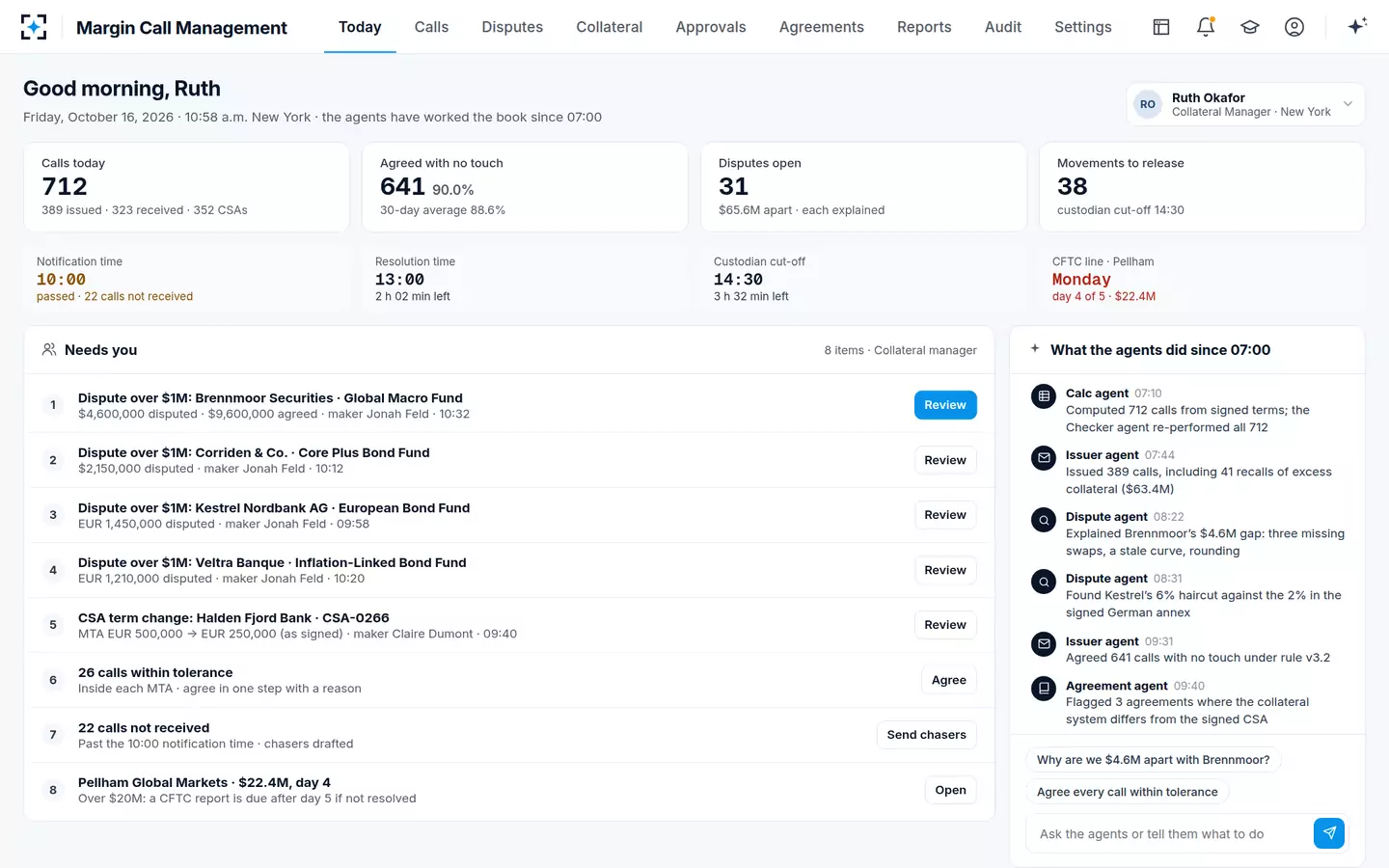
In the solution's sample book, the Issuer agent read 301 incoming calls in four languages on one morning, matched each to the fund's own number, and agreed 641 calls across both directions inside the tolerance rule. A call is read with a confidence score; below 0.95 an analyst confirms it.
What approval limits must be set?
At least four: the tolerance for agreeing a call without a person, the size of dispute an analyst may send, the size above which a manager or head must approve, and the size above which a release needs two people. Add a rule for changed settlement instructions. Write them down as settings with an owner, because a provider or an agent can only act within limits it has been given.
From limits to a live margin day in Margin Call Management
A person decides
Head of collateralApproves the limits: no-touch tolerance, dispute limits, release rules. Every change later needs a reason and the same approval.
Agent
Agreement agentReads every annex into cited terms and flags differences with the collateral system.
Never: Change a term
A person decides
Derivatives documentation counselRaises corrections as maker; the collateral manager checks them.
Agent
Calc, Issuer and Dispute agentsReplay a month of past calls against the firm's own records, then run in parallel with the current process.
A person decides
Collateral managerReviews every difference in the parallel run and signs off the switch.
How do you reconcile the first month?
Replay it before it is live, then run alongside it. A month of past calls, disputes and settlements gives a baseline: for each past call, does the new process produce the same number, and where it differs, which side was right? A parallel run then repeats the test on live days, with the old process still in charge. Differences are almost always terms, trade populations or valuation sources, and each one fixed before go-live is a dispute that will never happen.
In the solution's sample set-up, a 10-business-day parallel run matched 97.8% of calculations at first and 100% after three term fixes. That is a result on sample data, not a customer's measurement; a firm's own number depends on how far its system has drifted from its documents. Evidence of each step should be kept from the first day; the evidence behind each number in a call lists what to keep.
A collateral management go-live checklist, whichever route you choose
- Every annex, amendment and local-law deed collected and read
Including legacy annexes for older trades, which may carry non-zero thresholds.
- Every difference between documents and system resolved
With a maker and a checker, before calls depend on the term.
- Counterparty list with channels, contacts and sample calls
Tested on real files in every format and language you receive.
- Settlement instructions verified
With a call-back rule for changes, owned by the instruction team.
- Approval limits written as settings
Tolerance, dispute limits, release limits, owners, and how they change.
- A month of past calls replayed
Match rate known and every difference explained before the parallel run.
- Parallel run with the current process
Two weeks or more, signed off by the collateral manager.
- Evidence export tested
One call, one dispute and one counterparty month exported and read by someone outside the desk.
- Stress capacity assessed
For a provider: its capacity across clients on a bad day. For in-house: who works the exceptions when calls triple.
Where Margin Call Management fits, and where a service is the better answer
Margin Call Management fits a firm that wants to keep its margin decisions in-house and take the mechanical work off its analysts: seven agents read, compute, explain and propose, and the analyst, manager and treasury decide. It works with the firm's existing collateral management system, accounting, valuation engine, margin platform, document store and custodians. It does not hold assets, act as a custodian or triparty agent, price derivatives or clear trades, so a firm still needs custody, and for initial margin an independent custodian, whatever it chooses for operations.
A service is the better answer for a firm that has no collateral staff and does not want to build a team, or whose volumes are too small to justify one. Even then the four inputs on this page are the firm's to bring, and the accountability stays with it. Before choosing, it is worth seeing where the authority would sit under each model; where agents' authority stops in a collateral management system sets out the line, and the margin call process, step by step shows the work either model has to do.
A live margin day in Margin Call Management: the work the four inputs make possible
Questions people ask
What does collateral management services mean?
In derivatives and repo it means outside providers that hold, value, allocate and move collateral, such as custodians and triparty agents, or that run margin operations, calculating, issuing and reconciling calls, for a firm under its own agreements. The firm remains accountable for its agreements whichever services it uses.
What is the difference between triparty and third-party collateral services?
A third-party custodian provides settlement, segregation and reporting. A triparty agent adds eligibility checks, concentration limits, haircuts, valuation, allocation and substitution of collateral between the two parties. Hybrid models sit between them, as Basel and IOSCO note.
How long does a collateral management go-live take?
It depends mostly on the firm's documents and data: how many annexes there are, how far the system has drifted from them, and how quickly limits are agreed. The solution's set-up includes a 10-business-day parallel run after the agreements are read and the systems connected; replaying a month of history beforehand shortens it.
Does initial margin need a separate custodian?
Yes, for uncleared swaps under the margin rules. A US swap dealer must require initial margin to be held by a custodian that is neither party nor an affiliate of either, under an agreement that bars rehypothecation; the EU rules also require segregation of initial margin. Variation margin usually passes directly between the parties.
Can an outsourced provider make dispute decisions for us?
It can recommend and execute within limits you set, but the firm remains accountable for what is agreed with its counterparties. Most firms keep the decision to dispute large amounts, and the approval of releases, with their own named staff.