Repo margin is the collateral cushion in a repurchase agreement: the difference between the market value of the securities delivered and the cash lent against them, usually stated as a haircut, plus the margin calls either side makes during the trade when the securities' value moves. In bilateral US Treasury repo the haircut is frequently zero, which is why the SEC's Treasury clearing rule is reaching into repo: from 30 June 2027 a direct participant of a Treasury clearing house must submit its eligible repo for clearing, after cash Treasury trades from 31 December 2026, and the clearing house margins every position at least daily. For a fund that borrows or lends in repo, the change arrives as a new daily margin flow through its clearing member, on top of the swap calls a collateral desk already runs. Botminds' Margin Call Management runs those calls and, when it proposes collateral for a swap call, keeps out assets reserved for repo or other margin.
This guide covers Treasury repo margin and haircuts for funds and their collateral teams. The documents a fund must sign to clear are covered in the Treasury clearing mandate's document set; the sample firm in the final section is the solution's fictional Quillfield Capital.
Repo margin bilaterally and under central clearing, side by side
Bilateral repo, today: The two parties, trade by trade or in a master agreement schedule; often zero for a dealer lending to a fund.
Cleared repo, under the mandate: The clearing house sets margin for its member; the member agrees with its client what it collects from the client.
Bilateral repo, today: As the master agreement allows; calls when the exposure passes an agreed amount.
Cleared repo, under the mandate: The clearing house marks positions to market and collects margin at least daily, and monitors intraday exposure.
Bilateral repo, today: One bilateral relationship, one netting set.
Cleared repo, under the mandate: The clearing house must hold margin for a member's own positions separately from margin for its clients' positions.
Bilateral repo, today: Repo and reverse repo with one dealer can be netted, including packages at zero haircut.
Cleared repo, under the mandate: Netting follows the clearing house's and the member's rules for the client account.
Bilateral repo, today: Occasional margin calls under the master agreement.
Cleared repo, under the mandate: A margin requirement passed through by the clearing member, on the member's schedule and terms.
What is repo margin, and what is a repo haircut?
Repo margin is collateral beyond the cash lent; the haircut is that margin expressed as a share of the collateral's value. If a fund borrows $98 million against Treasuries worth $100 million, the haircut is 2%: the lender holds $2 million more in securities than it lent in cash, a cushion against the price falling before it could sell the collateral after a default. Some markets quote the same idea the other way, as a margin ratio of collateral to cash, here about 102%.
The formula is short. Haircut equals collateral market value minus cash lent, divided by collateral market value; cash lent equals collateral value times one minus the haircut. A repo margin call follows when the collateral's value moves during the trade: if those Treasuries fall to $99 million, the cushion has shrunk to $1 million, and the lender can call for more securities or cash to restore it. If they rise, the borrower can call for some back. Those calls are the repo equivalent of variation margin on a swap, and they arrive on the same desk.
How low are repo haircuts in practice? Often zero
In bilateral Treasury repo with dealers, very often nothing at all. The SEC's 2024 adopting release reports that in the Office of Financial Research's 2022 pilot collection of non-centrally cleared bilateral repo, "74% of all volume is transacted at zero haircut", partly because of "netted packages, in which a dealer will conduct both a repo and a reverse repo with the same counterparty and the same tenor but over different pieces of Treasury collateral" (SEC, 89 FR 2714). The SEC described hedge fund repo activity in Treasuries as "often highly leveraged and subject to low or zero haircut".
A Federal Reserve staff note using Form PF data reached the same order of magnitude for hedge funds: at the end of 2022, "about 74 percent of total repo borrowing volume" was "transacted at zero or negative haircuts", on $553 billion of Treasury-backed repo borrowing supported by $9.9 billion of hedge fund capital (Banegas and Monin, FEDS Notes, September 2023). The note estimated that a hypothetical 200 basis point floor on haircuts would require about $12.4 billion of additional capital.
Repo margin in bilateral Treasury repo, by the official numbers
74%
of bilateral repo volume transacted at zero haircut in the OFR's 2022 pilot data
SEC, 2024
$553B
hedge fund repo borrowing backed by Treasuries, end of 2022
Federal Reserve staff, 2023
$9.9B
of hedge fund capital supporting that borrowing
Federal Reserve staff, 2023
$12.4B
extra capital a hypothetical 2% haircut floor would have required
Federal Reserve staff, 2023
Zero is not a mistake in the data; it reflects how dealers price credit and net positions. The same OFR evidence, as the SEC summarised it, shows haircuts reflect "not only the riskiness of the collateral but also the relative credit risk of the counterparties", with haircuts usually zero or negative when dealers lend to hedge funds and zero or positive when they borrow. A zero haircut moves the risk into the margin calls: with no cushion at the start, every move in the collateral's price is a call.
When must eligible repo be centrally cleared?
Under the SEC's rule as extended in March 2025, cash Treasury transactions in scope must be cleared from 31 December 2026 and eligible repo from 30 June 2027 (90 FR 11134); no further extension has been published in the Federal Register since. The obligation is written on clearing houses, which must require their direct participants to submit eligible transactions, and through them it reaches every fund that trades repo with a direct participant.
The scope for repo is wide. An eligible secondary market transaction includes any Treasury-backed repo or reverse repo in which either counterparty is a direct participant (17 CFR 240.17ad-22(a)), with exclusions for central banks, sovereigns, international financial institutions, natural persons, clearing houses, state and local governments and a direct participant's own affiliates. A fund's repo with a dealer that is a clearing member is in scope; repo between two funds, neither a direct participant, is not.
The Treasury clearing dates a fund's repo margin plan has to meet
- AdoptedDec 2023
- Clearing houses' rules2024–26
- Cash trades clearfrom 31 Dec 2026
- Repo clearsfrom 30 Jun 2027
How do margin calls change when repo is cleared?
Three things change: who sets the margin, how often it is marked, and whose account it sits in. The clearing house must run "a risk-based margin system" that, among other things, "Marks participant positions to market and collects margin (including variation margin or equivalent charges if relevant) at least daily" and monitors intraday exposures (17 CFR 240.17ad-22(e)(6)). For Treasury clearing it must also hold margin for a member's own positions "separately and independently" from margin collected for positions of the indirect participants who clear through that member.
What reaches the fund depends on how it clears. The clearing house margins its direct participant; the participant then collects from its client what their agreement says. For registered funds the SEC was careful: the amendments "do not require that registered funds post margin directly to a U.S. Treasury securities CCA", and a commenter told the SEC that under the main clearing house's existing sponsored service registered funds "are not required to post margin" to it (SEC, 89 FR 2714). A fund's own margin obligation therefore sits in the sponsoring or clearing member's agreement, which is why that negotiation matters; what funds must sign, and by when covers it.
For the collateral desk the effect is a new, regular margin line. A bilateral repo at zero haircut that was rarely called becomes a cleared position margined on a set schedule, with requirements that rise when volatility rises, and the member may pass on its own margin calls quickly. In a stress, those calls land on the same day as the swap calls. That combination is what the Financial Stability Board's 2024 recommendations ask firms to plan for: knowing "which counterparties can require intraday margin calls" and having collateral "pre-positioned at the appropriate entities".
Which funds' repo is in scope of the clearing mandate?
Any fund whose Treasury repo counterparty is a direct participant of a Treasury clearing house, whether the fund borrows cash or lends it; the rule looks at the counterparty, not the fund's type. Hedge funds that finance Treasury positions with dealers, registered funds and money market funds that invest cash in repo, and pension and insurance accounts all fall in where the other side is a direct participant. Repo between two parties that are not direct participants stays outside, and so do the excluded counterparties listed in the rule.
That makes the first planning step a counterparty list, not a legal opinion on the fund. A collateral or treasury team that tags each repo counterparty as a direct participant or not knows which of its trades will carry clearing house margin from June 2027 and which will stay bilateral.
Which of a fund's Treasury repo is in scope of the clearing mandate
| Trade | In scope? | Why |
|---|---|---|
| Fund borrows cash from a dealer that is a direct participant, against Treasuries | Yes, from 30 June 2027 | Repo collateralised by Treasuries with a direct participant as one counterparty |
| Money market fund lends cash to a direct participant (reverse repo) | Yes, from 30 June 2027 | The definition covers repurchase and reverse repurchase agreements alike |
| Fund repo with another fund, neither a direct participant | No | Neither counterparty is a direct participant |
| Repo with the Federal Reserve, a sovereign or an international financial institution | No | Excluded counterparties |
| Repo between a direct participant and its own affiliate | No | Affiliate repo is excluded |
| Repo with a state or local government | No | Excluded counterparties |
What repo margin calls did in 2022: the LDI lesson
Repo margin calls, not just swap calls, drove the UK pension fund stress of September 2022. The Bank of England found that as gilt prices fell, liability-driven investment funds had "to post additional collateral on their secured borrowing or pay margin calls on interest rate derivatives positions", and that banks had around £200 billion of outstanding repo lending to these funds (Bank of England, Financial Stability Report, December 2022). Gilt repo is not Treasury repo, and the UK mandate is different, but the mechanics are the same: leverage in repo plus a fast move in the collateral's price equals a margin call that has to be met in hours. The LDI crisis, hour by hour follows those calls through the week.
The lesson for a Treasury repo user is that repo margin should sit in the same liquidity plan as swap margin. The Bank's figures put total margin and collateral calls on LDI funds and pension schemes between 23 September and 14 October 2022 in excess of £70 billion, a figure it describes as a lower bound. A desk that plans for swap variation margin and ignores repo calls is planning for part of the problem.
What does the SEC examine in Treasury clearing?
The SEC's examination priorities for fiscal 2027 put the new Treasury clearing rules on the list for clearing agencies, and the Customer Protection Rule amendments tied to US Treasury clearing on the list for broker-dealers (SEC Division of Examinations, Fiscal Year 2027 Examination Priorities). Across all registrants it also prioritises policies for monitoring "super intelligence (SI)", the SEC's own term, including in back-office operations. None of this puts a fund's repo margin process under a new rule, but the members a fund clears through will be examined on the rules that govern how they handle client positions and margin.
Funds have their own rule in the background. Under Rule 18f-4, reverse repurchase agreements are treated either like bank borrowings for asset coverage or, at the fund's election, like derivatives transactions, and the derivatives rule's risks to manage include liquidity risk. The fund's derivatives programme belongs to its derivatives risk manager; Rule 18f-4 in plain words sets out who is in scope.
A repo margin readiness list for June 2027
- List every Treasury repo counterparty that is a direct participant
Those trades move into clearing; repo with other counterparties does not.
- Know your clearing model and the margin terms in its agreement
The clearing house margins the member; what the member collects from you, how often and in what form is in your agreement with it.
- Model the daily margin on today's repo book
A book run at zero haircut has no history of calls to plan from. Estimate the requirement under normal and stressed volatility.
- Put repo and swap margin in one liquidity forecast
They rise on the same days. Plan cash and eligible securities for both.
- Reserve collateral for each requirement explicitly
An asset pledged for repo margin cannot also meet a swap call; the collateral system must know which is which.
- Decide who approves and who releases
Treat a repo margin call like a swap call: an analyst agrees, a manager approves above a limit, treasury releases.
- Re-check the dates before each milestone
The compliance dates have moved once; confirm them in the Federal Register.
Margin Call Management: one collateral view for swap and repo margin
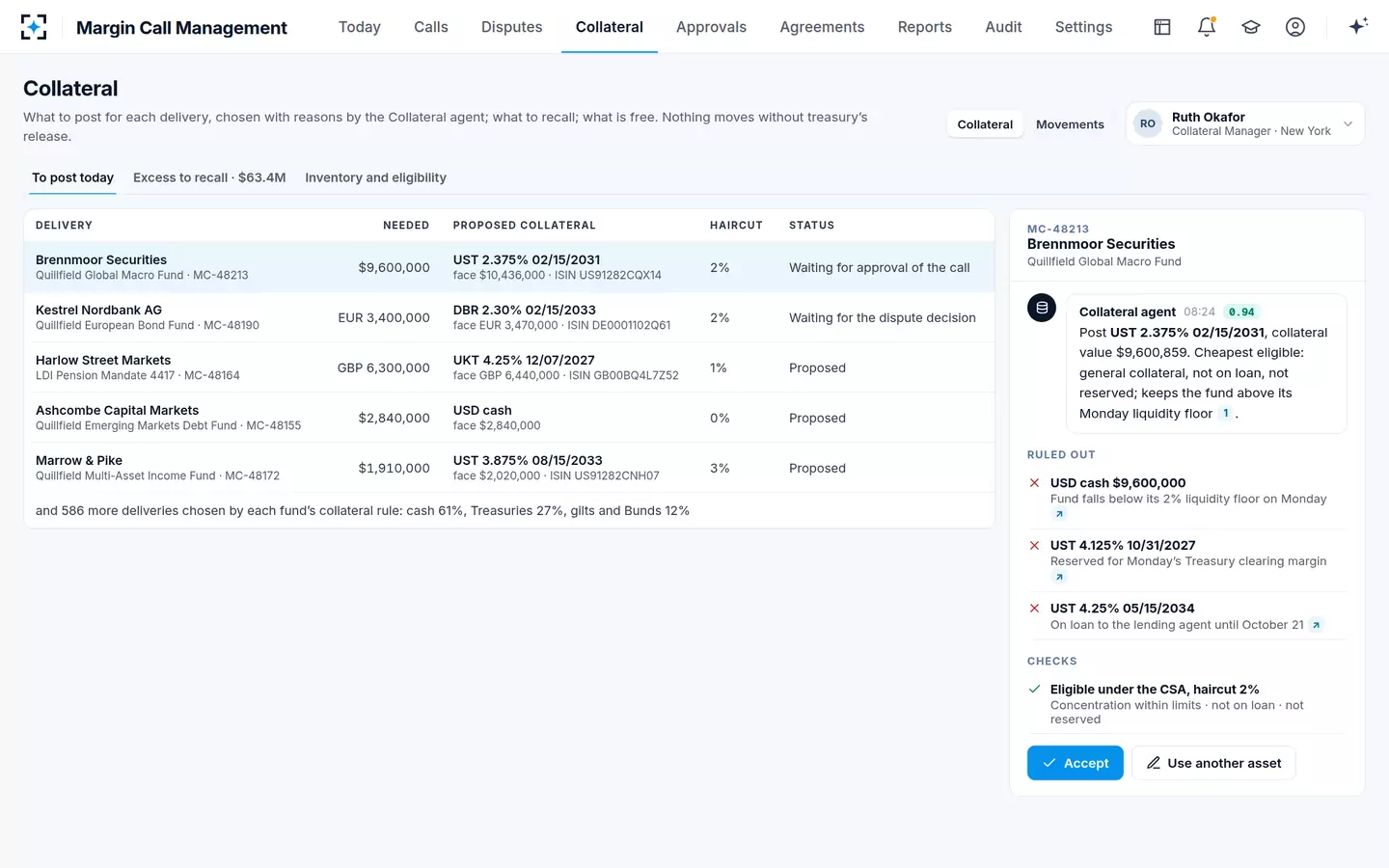
Margin Call Management is built around uncleared swap calls, and its collateral logic already treats other margin as a claim on the same inventory. When the Collateral agent proposes the cheapest eligible asset for a swap delivery, it rules out assets that would breach a fund's liquidity floor, are on loan, or are reserved for repo or Treasury clearing margin, and it gives its reasons. It proposes only; treasury moves the assets.
In the sample book, the agent proposed a Treasury note maturing in February 2031 for the fictional Brennmoor delivery and set out what it had ruled out: cash, because the fund would fall below its 2% liquidity floor; one note, reserved for other margin; and another, on loan until 21 October. Cleared repo margin is one more requirement to reserve against. The fit is narrow and honest: the solution does not clear repo, calculate a clearing house's margin or replace a clearing member's statements; it makes sure the same bond is not promised twice and that each call is approved and released by the right person. How the cheapest eligible asset is chosen is covered on its own.
Collateral proposals in Margin Call Management, with the assets reserved for other margin ruled out
Questions people ask
What is the difference between repo margin and a haircut?
They describe the same cushion from two sides. The haircut is the percentage by which the collateral's value exceeds the cash lent at the start; repo margin is that excess, plus any later margin calls that restore it as prices move. A 2% haircut on $100 million of Treasuries means $98 million of cash and $2 million of margin.
What is a repo margin call?
It is a demand for more collateral, or for collateral back, during the life of a repo because the securities' value has changed. If the collateral falls in value the lender calls for more; if it rises the borrower can call for the excess. Under central clearing the clearing house marks positions at least daily and the member passes requirements on under its agreement with the client.
How is repo margin calculated?
Cash lent equals the collateral's market value times one minus the haircut; the margin is the difference. During the trade, the required collateral is recalculated at current prices, and a call is made for the shortfall or excess, usually above an agreed minimum. Cleared repo uses the clearing house's own margin model for the member's positions.
Does the Treasury clearing mandate apply to registered funds?
Their trades are in scope when the other side is a direct participant of a Treasury clearing house, so a fund's eligible repo with them must be cleared from 30 June 2027. Funds usually clear as sponsored or indirect participants through a member. The SEC noted that its amendments do not require registered funds to post margin directly to a Treasury clearing house.
Why are bilateral repo haircuts often zero?
Partly because dealers net repo and reverse repo with the same client in packages, and partly because haircuts price the counterparty's credit as well as the collateral. The SEC, citing OFR data, reported 74% of bilateral repo volume at zero haircut in 2022. Zero shifts the risk into margin calls during the trade.