A collateral management analyst runs the daily margin call process for a fund manager's or bank's derivatives and repo: computing and issuing calls, reading and matching the calls counterparties send, reconciling portfolios when the numbers differ, preparing disputes, chasing settlement and keeping each agreement's terms right in the collateral system. The job is easy to describe and hard to do on time, because every call has its own annex, counterparty and deadline. It is also only part of the chain of accountability: a margin call passes four decisions, calculation, agreement, dispute and release, and good practice puts them in different hands. Botminds' Margin Call Management gives the analyst agents that do the mechanical part, and enforces who may sign each step: the analyst agrees and prepares, a collateral manager approves large disputes, and treasury releases the collateral, never the person who agreed it.
This guide is about the derivatives margin desk; "collateral analyst" also names a credit role in asset-based lending, which is a different job. The sample figures come from the solution's fictional Quillfield Capital, whose collateral team runs margin for 186 funds and mandates.
Four signatures on one margin call, and what each person attests
Today
Rebuilds each call by hand, re-keys dealers' calls from PDFs and reconciles disputes in spreadsheets before the notification time.
With agents
Opens each gap already priced to its trades, curve and clause; agrees calls inside tolerance in one step and prepares disputes as the maker.
Still theirs: Attests the call is computed from the signed terms; agrees inside tolerance; disputes up to a limit
Today
Owns escalations and large disputes, and has to rebuild the evidence before deciding.
With agents
Sees the drivers, the cited clause and a second agent's checks on one screen, and approves with a reason code.
Still theirs: Attests the dispute is right and its evidence sufficient; approves above the analyst's limit
Today
Releases collateral against standing instructions before the custodian's cut-off, often without seeing who agreed what.
With agents
Releases from one queue that shows who agreed each movement and whether its settlement instructions are verified.
Still theirs: Attests the movement matches an approved call and a verified instruction; never releases what they agreed
Today
Learns a term was keyed wrongly only when a dispute exposes it.
With agents
Sees where the collateral system differs from the signed annex and raises the fix as maker for the manager to check.
Still theirs: Attests the terms the calls rest on are the signed ones
What does a collateral management analyst do?
Every business day the analyst takes a book of annexes through the margin cycle. The morning starts with the firm's own calls, computed from valuations and collateral balances and issued before each annex's notification time; then the counterparties' calls, which arrive by margin messaging platforms, email, PDF statements and spreadsheets, and have to be matched to the firm's number. Calls inside tolerance are agreed; the rest are reconciled trade by trade and either agreed after a correction or prepared as disputes. In the afternoon the analyst follows settlement with treasury and custodians, recalls excess collateral, reconciles interest on cash collateral and fixes the terms that caused the day's breaks.
In the sample firm, one analyst works about 160 of the day's 712 calls. The work is defined less by any single task than by its clocks: the notification time, the resolution time, the settlement cut-off and, for large disputes, the regulators' reporting lines. Basel and IOSCO describe the process as four steps, valuation, the call, review and reconciliation or a dispute, and transfer (BCBS-IOSCO, January 2025); the analyst sits across all four. The margin call process, step by step maps them with their rules.
What does the BLS call a collateral analyst?
Nothing: the US Bureau of Labor Statistics publishes no occupation for collateral analysts, so the work is counted inside broader groups. The closest are brokerage clerks, whose duties include verifying transactions and delivering securities, and financial and investment analysts. Neither is an exact fit; a collateral analyst at a large manager does analysis that clerks' tasks do not cover, and much less forecasting than most investment analysts.
The nearest federal occupations to a collateral management analyst
35,940
brokerage clerks employed in the US, all industries
$65,750
median annual wage for brokerage clerks
361,980
financial and investment analysts employed in the US, all industries
$102,740
median annual wage for financial and investment analysts
Who approves a margin call before it is sent?
For an ordinary call, nobody but the analyst, provided the calculation was checked; for anything outside a set tolerance, a second person. Calls are issued by the hundred and most are right, so firms control them with rules rather than signatures: a call computed from verified terms and inside a tolerance against the counterparty's figure can be agreed in one step. The control is in the rule, which has to be written down, versioned and owned by a senior person, and in a second, independent calculation of the number.
In Margin Call Management the tolerance is a setting: in the sample firm, a gap within the annex's minimum transfer amount and below 1.0% of exposure is agreed with no touch, and every call is first re-performed by a Checker agent on a separate model family. The rule's version is logged with each agreement, and a change to it, such as the proposed widening to 1.5%, waits for the head of collateral. On the sample day 641 of 712 calls were agreed that way, each inside its annex's tolerance.
Who signs at each step of a margin call in Margin Call Management
Agent
Calc agentComputes every call from the signed annex terms.
Never: Issue a call the Checker agent has not re-performed
Agent
Issuer agentIssues calls, reads incoming ones and agrees only those inside the published tolerance rule.
Never: Dispute on its own
A person decides
Collateral analystAgrees calls inside tolerance with a reason; prepares disputes and partial agreements as the maker; may send disputes up to $1M.
A person decides
Collateral managerApproves disputes and partial agreements above $1M as checker, with a reason code; cannot release.
A person decides
Head of collateralApproves disputes above $25M and any change to tolerances or limits.
A person decides
Treasury operationsReleases each movement against verified settlement instructions; a second releaser above $50M; never the person who agreed.
Who may agree a margin dispute?
Someone with authority proportionate to its size, who did not prepare it. A dispute commits the firm to a position with a counterparty and, if it lasts, may reach a regulator: US swap dealers report large unresolved valuation disputes to the CFTC, and EU financial counterparties, including EU funds, report large long ones themselves. That is why the decision to dispute, and the decision to settle a dispute, belong to named people with limits. The Financial Stability Board asks firms for a clear way to raise disputes and a system that tracks every open one until it closes (FSB, 2024, Recommendation 6; where disputes sit in the daily cycle is in the margin call process, step by step).
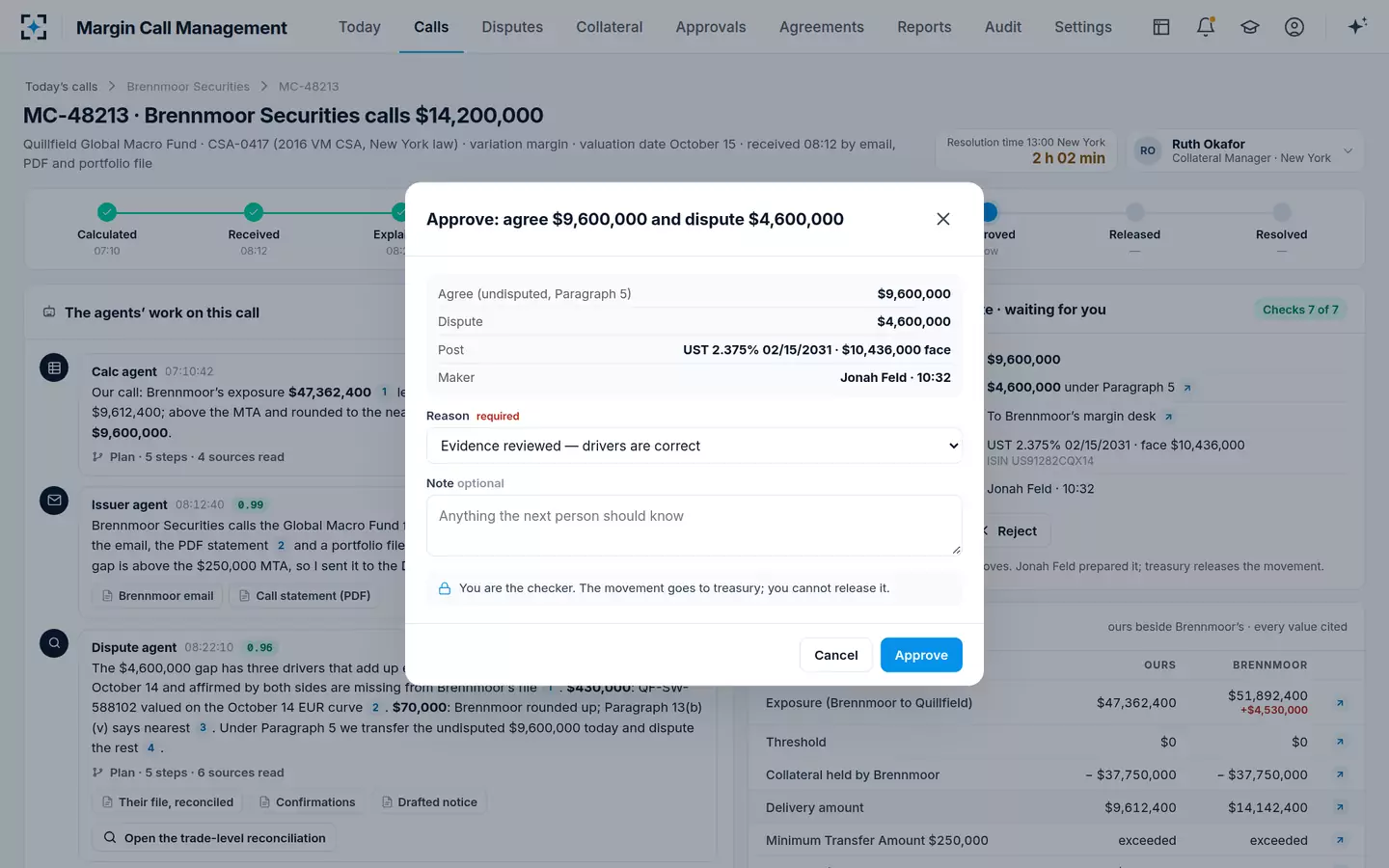
In the sample, the fictional Brennmoor Securities called the Global Macro Fund for $14,200,000 against the fund's $9,600,000. The analyst, Jonah Feld, prepared a partial agreement of the undisputed $9,600,000 and a dispute of $4,600,000 at 10:32, with the three driver trades attached. Because the dispute was above his $1 million limit, it waited for the collateral manager, Ruth Okafor, who approved it at 11:06 with the reason "Evidence reviewed — drivers are correct". Margin disputes and their reporting clocks covers what happens next.
The collateral manager approves as checker in Margin Call Management, with a reason, and cannot release
Who releases the cash or securities?
Treasury, and never the person who agreed or approved the call. The release is the signature that moves money, and it is where separation of duties matters most: a calculation error is caught by the next check, but an asset sent to the wrong account, or to a fraudulent one, may not come back. Settlement instructions are the weak point. A movement to a counterparty whose instructions changed recently should wait for a call-back to a known contact, and above a size, two people should release it.
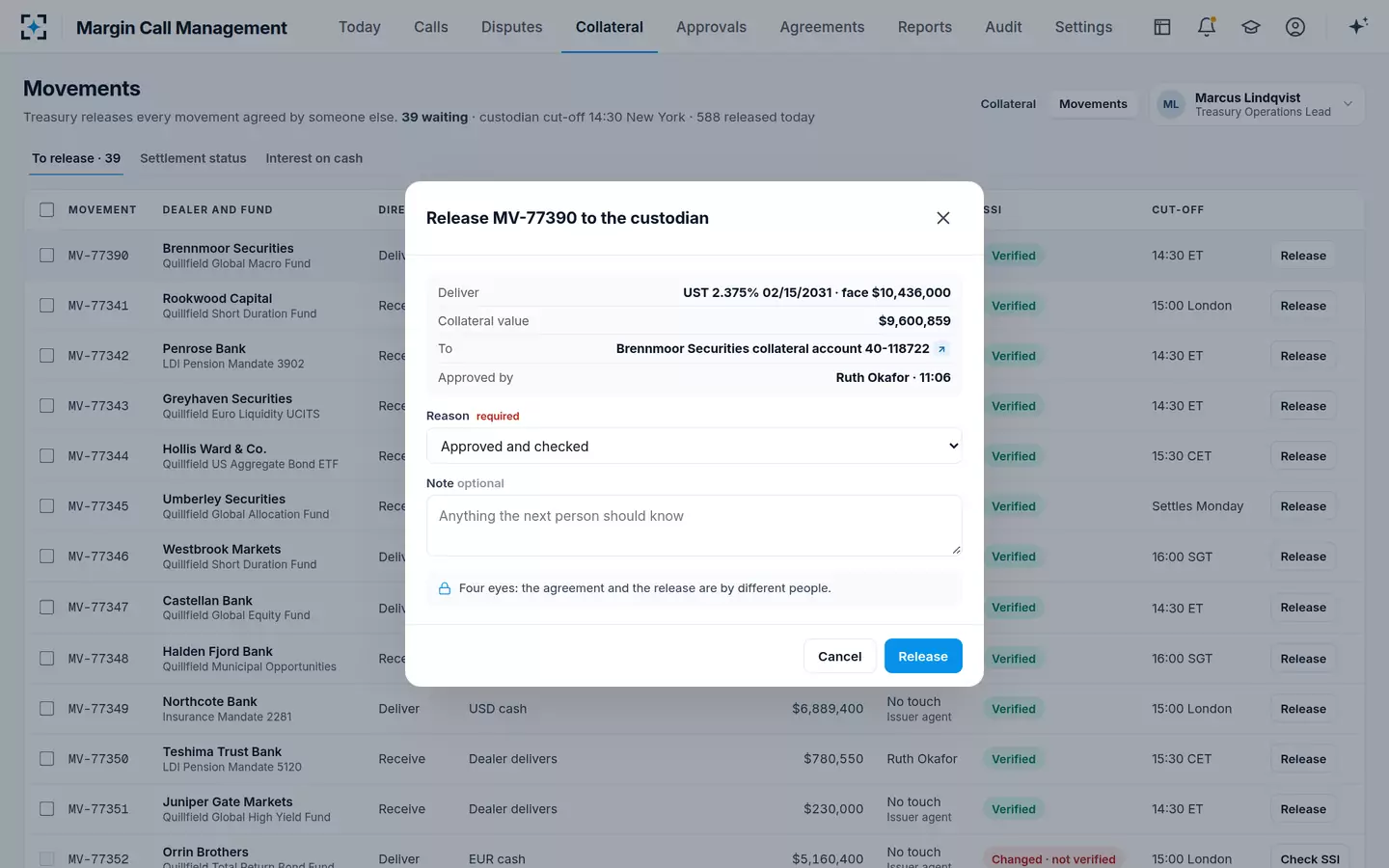
Margin Call Management locks the release button for anyone who agreed or approved the call, requires two treasury releasers above $50 million in the sample settings, and holds any movement whose settlement instruction changed in the last five days until the instruction team has called back. In the sample, Marcus Lindqvist, the treasury operations lead, released the Brennmoor movement at 11:15 with its verified instructions and the approver's name in front of him, well before the 14:30 cut-off.
Treasury's release queue in Margin Call Management: who agreed each movement, and whose instructions are verified
Which approvals scale with the amount?
Disputes, partial agreements and releases scale with size; routine agreement inside tolerance does not. A firm's limits table is the clearest statement of its control design, and it should be short, written and versioned. The table below is the sample firm's; the amounts are settings, not a standard, and a smaller manager might set them lower.
A margin call approval matrix: who signs what, at what size
| Decision | Maker | Checker | Sample limit |
|---|---|---|---|
| Agree a call inside tolerance | Issuer agent under the published rule, or the analyst | Checker agent re-performs the call first | Gap within the annex minimum and under 1.0% of exposure |
| Send a dispute or partial agreement | Collateral analyst | Checker agent must pass | Up to $1,000,000 |
| Approve a dispute or partial agreement | Collateral analyst | Collateral manager | Above $1,000,000 |
| Approve a very large dispute | Collateral analyst | Head of collateral | Above $25,000,000 |
| Release a movement | Settlement agent builds it | Treasury releaser, not the agreer | Two releasers above $50,000,000 |
| Change an annex term in the system | Derivatives documentation counsel | Collateral manager | Every change |
| Change a tolerance or limit | Platform administrator | Head of collateral | Every change |
What does a swap dealer's rule require of its counterparty's process?
More than most buy-side teams assume, because the dealer's obligations need a counterpart on the other side. A US swap dealer must "agree in writing with each of its counterparties on the terms of the portfolio reconciliation" (17 CFR 23.502(b)(1)), and its documentation with financial entities must set out an agreed valuation process, with either alternative valuation methods or a valuation dispute resolution process (§23.504(b)(4)). Its margin documentation must specify the methods and data sources for valuing swaps and the procedures for resolving valuation disputes (§23.158(b)).
Each of those is a process the fund has to run as well: reconciling on the agreed schedule, answering valuation queries, operating the dispute procedure. In the EU the duties fall on the fund directly; EMIR requires financial counterparties to have risk-management procedures for a timely, accurate and properly segregated exchange of collateral (Regulation (EU) No 648/2012, Article 11(3)). The analyst is the person who runs those procedures; the manager is the person who answers for them.
How the analyst's job changes when agents do the mechanical part
The analyst spends less time finding numbers and more time judging them. Basel and IOSCO heard from market participants that thin automation turns volatile days into operational strain, and the Financial Stability Board warns that heavy manual processing in a stress can outrun the people available, including at outside providers (FSB, 2024, Recommendation 8). The answer to both is the same: take the re-keying and reconciling out of the analyst's day so that the analyst's time goes to the calls that need a decision.
The supervisory expectation for the agents themselves is clear. FINRA's 2026 oversight report asks firms using AI agents to consider how they will limit what each agent may do, decide or act on (FINRA, 2026 Annual Regulatory Oversight Report). In a margin desk that means agents that can compute, read, explain and propose, and cannot agree outside the rule, dispute, change a term or release. Where the authority stops in a collateral management system with agents sets that boundary step by step.
Questions people ask
What skills does a collateral management analyst need?
A working knowledge of derivatives valuation and of credit support annex terms, comfort reconciling large trade files, and precision with settlement and deadlines. The analyst must read a counterparty's portfolio file against the firm's own and see which trades and curves differ, then explain it in a dispute notice. Judgement about when to escalate matters as much as speed.
What is the difference between a collateral analyst and a collateral manager?
The analyst computes, agrees within tolerance and prepares disputes; the manager approves disputes above the analyst's limit, owns dealer escalations and answers for the desk's controls. In the sample firm the analyst works about 160 calls a day and may send disputes up to $1 million; the manager approves anything larger.
Why should the person who agrees a margin call not release the collateral?
Because the release moves an asset out of the fund, and one person controlling both the decision and the payment can turn a mistake or a fraudulent instruction into a loss with no second look. Separating them, and requiring a verified settlement instruction before release, is a basic payment control. Large movements often need two releasers.
Is collateral management a front office or back office job?
Usually middle office or operations, sitting between trading, which creates the exposures, and treasury, which moves the cash. In larger firms the collateral team also feeds liquidity planning and collateral optimization, which brings it closer to treasury and the portfolio managers.
How many margin calls does one collateral analyst handle?
No regulator or independent study publishes a standard figure; it depends on the number of annexes, automation and how many calls are disputed. In the solution's sample firm, one analyst works about 160 of 712 daily calls, with most agreed inside tolerance before he sees them. A firm can measure its own by counting calls touched per analyst per day.