An account opening resolution is the written decision of a fund's governing body, its board of directors, general partner or trustee, that authorises the fund to open accounts with brokers, futures commission merchants (FCMs) and banks, and names the people who may sign agreements, place orders and give settlement instructions in its name. Counterparties ask for a certified copy because their own rules make them record who acts for an entity: a FINRA member must record the names of anyone authorised to transact for a legal entity customer, an FCM must record anyone exercising trading control over an account, and a swap dealer must keep information on the authority of anyone acting for its counterparty. A resolution that is missing, too narrow or out of date stops an opening as surely as a missing passport, and it is the document funds most often have to go back to their board for. Botminds' Counterparty Onboarding keeps each fund's current resolution with its approved documents and checks every signer on every form against it before anything is sent.
The clauses below are our model, built from what counterparties' rules require them to know; a fund's own constitution decides who may pass the resolution and how. Examples come from fictional sample data in the solution.
An account opening resolution, clause by clause: what each authorises and why a broker reads it
The fund, identified
Full legal name, registration number, jurisdiction and LEI, exactly as on the certificate and the LEI data.
Why it is read Counterparties match every later document to this line.
Authority to open accounts
With brokers, FCMs, banks and prime brokers, named or by class, for the products the fund trades.
Why it is read A resolution that names one broker has to be redone for the next.
Authority to sign agreements
Terms of business, FCM customer and give-up agreements, the ISDA Master Agreement and Credit Support Annex, GMRA or GMSLA.
Why it is read Each counterparty checks that its own document type is covered.
Who may sign, and how
Named individuals or offices, alone or two together, with any limit by document or amount.
Why it is read Brokers record who may transact for an entity (FINRA Rule 4512).
Who may trade
Delegation of trading authority to the investment manager under its agreement, and who at the manager may place orders.
Why it is read FCMs record anyone exercising trading control (17 CFR 1.37).
Settlement instructions
Who may give or change standing settlement instructions, and the requirement for two signatures.
Why it is read The signer on an SSI letter is checked against this clause.
Tax forms and certifications
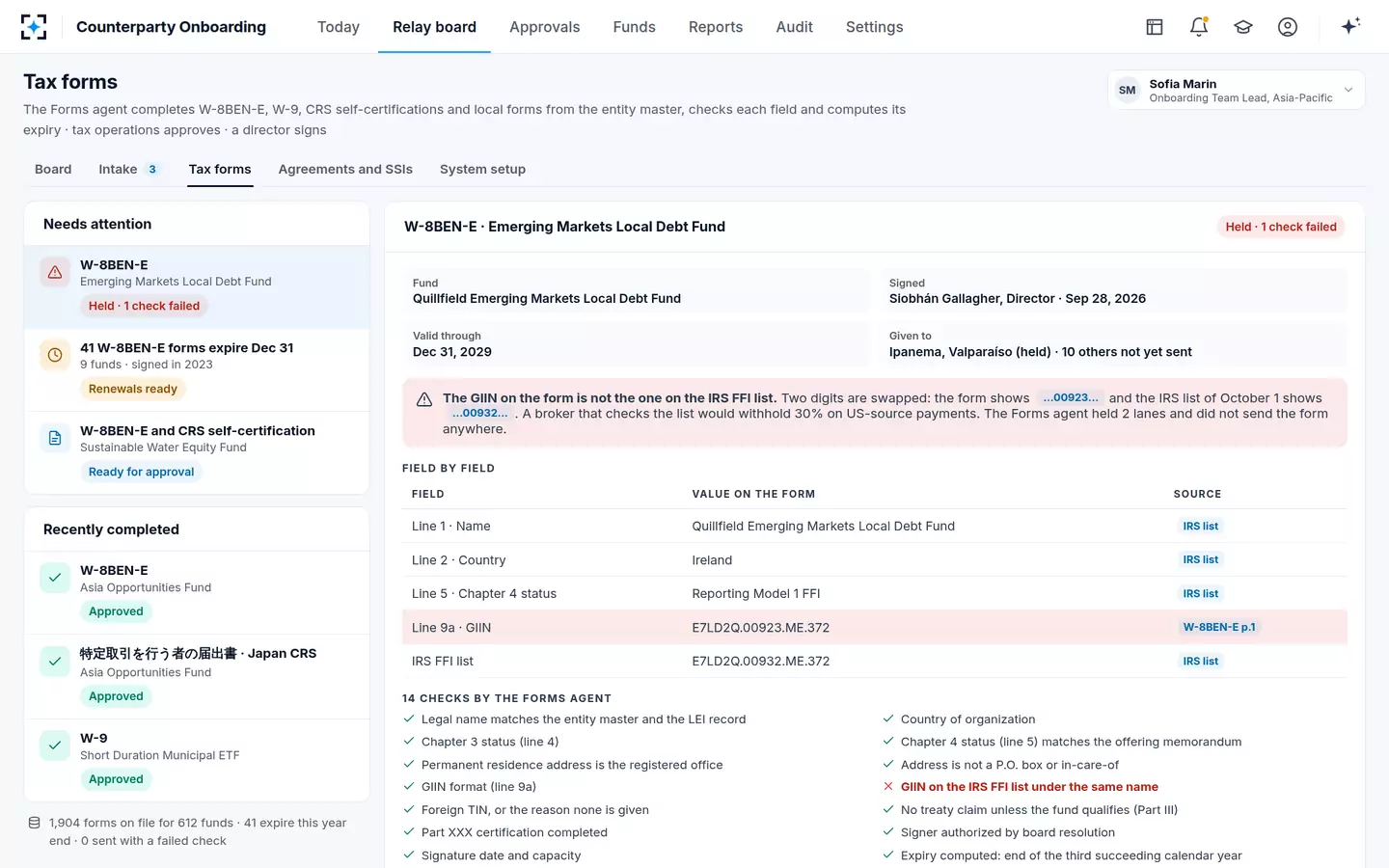
Authority for a director or officer to sign W-8BEN-E, W-9, CRS and beneficial ownership certifications.
Why it is read The IRS requires a W-8BEN-E to be signed by an authorised representative or officer who certifies legal capacity to sign for the entity.
Certification
Certified by the secretary or a director, dated, with specimen signatures and a statement that it remains in force.
Why it is read Counterparties ask for a certified copy, dated within whatever period their own policy sets.
What is an account opening resolution, and how is it different from proof the fund exists?
An account opening resolution proves authority, while the fund's constitutional documents prove existence, and a counterparty needs both. A broker-dealer's customer identification program checks that an entity exists from its constitutional or licensing documents, such as certified articles, a business licence, a partnership agreement or a trust deed (31 CFR 1023.220(a)(2)(ii)(A)). None of those says who may open an account today. The resolution does, and it is the document that changes most often.
The distinction explains why resolutions cause delays. Formation documents are stable and usually ready; authority changes whenever a director leaves, a signatory is added or the fund starts trading a new product. A resolution drafted for the launch, naming one prime broker and two directors, is out of date the first time the fund adds an FCM or replaces a director.
Is a board resolution required to open a brokerage account?
No federal rule names a board resolution as such, but the rules make counterparties record who acts for the fund, and a resolution is how a fund proves it. The table shows where each requirement comes from; each is a reason a counterparty asks.
Which rules make a counterparty ask who may act for the fund
| Counterparty | The rule | What it must know about authority |
|---|---|---|
| FINRA member broker-dealer | FINRA Rule 4512(a)(1)(E) | For a corporation, partnership or other legal entity, "the names of any persons authorized to transact business on behalf of the entity". |
| FCM or introducing broker | 17 CFR 1.37(a) | The name of any person guaranteeing the account or exercising any trading control with respect to it. |
| Swap dealer | 17 CFR 23.402(b)(3) and (c) | Information on the authority of any person acting for the counterparty, and anyone exercising control over its positions. |
| Broker-dealer or FCM, verifying identity | 31 CFR 1023.220(a)(2)(ii)(C); 1026.220 | Where documents and other methods cannot verify the entity, information about the people with authority or control over the account. |
| Any covered US institution, where the rule applies | 31 CFR 1010.230(d)(2) | One individual with significant responsibility to control, manage or direct the entity. |
A swap dealer's essential facts about each counterparty include "Information regarding the authority of any person acting for such counterparty."
17 CFR 23.402(b)(3), Commodity Futures Trading Commission
The swap dealer rule shows why one resolution should serve many counterparties. The dealer may rely on the fund's written representations unless it has information that would make a reasonable person question them, and such representations can be placed in the relationship documentation and cover later swaps, provided the fund undertakes to update material changes in time (17 CFR 23.402(d)). A resolution that the fund keeps current, and re-certifies when it changes, is what makes those representations true.
Who signs an account opening resolution for a fund?
Whoever the fund's constitution gives the power, and the counterparty will check that against the constitution. For a fund organised as a company, that is usually its board of directors, certified by the secretary or a director. For a limited partnership it is the general partner acting for the partnership, which may itself act by its own directors or managing member. For a fund organised as a trust it is the trustee. Many funds delegate trading and some documentation to the investment manager under the investment management agreement; the resolution should record that delegation rather than leave the counterparty to infer it.
The person named as controlling the fund for beneficial ownership purposes, where that rule applies, should be consistent with the resolution. A counterparty that sees one director named as the control person on its form and a different set of signatories on the resolution will ask which is right, and the control prong for a fund explains what that person must be.
What must an account opening resolution authorise? The four acts counterparties check
Four acts matter to a counterparty: opening the account, signing its agreement, placing orders and giving settlement instructions. A resolution that covers the first two but is silent on trading leaves an FCM unable to record who exercises trading control; one silent on instructions leaves the settlement team unable to confirm that the signer of an SSI letter had authority to give it.
Futures add a fifth, often missed. Where the fund executes through several brokers and clears through one FCM, each executing broker signs a give-up agreement with the FCM and the fund, and the CFTC requires the clearing FCM to agree it in advance with each executing firm (17 CFR 1.73(a)(2)(iv)). A resolution that authorises "accounts with brokers" without mentioning give-up agreements invites a query from the FCM's legal team; the give-up agreement explains why the document matters.
A tax form checked against the resolution before any broker receives it
How often should an account opening resolution be updated?
Whenever the facts in it change, and at least whenever the fund adds a new kind of counterparty or product. The triggers are predictable: a director or general partner officer joins or leaves, a signatory is added or removed, the investment manager changes, the fund begins trading futures, swaps or repo, or a counterparty's policy requires a certified copy newer than the one on file.
The cost of a change is not the resolution; it is telling every counterparty that holds the old one. In the sample data, the Japan Value Equity Fund has had a new director since October 16, and six counterparties still hold the old list of directors. The agents can draft each update in that counterparty's own form and language; a person approves each one before it is sent.
A resolution drafted for the launch, and one drafted to be reused
Drafted for the launch: Names the launch prime broker.
Drafted to be reused: Authorises accounts with brokers, FCMs, banks and prime brokers by class, for the products in the offering documents.
Drafted for the launch: "Such agreements as are necessary."
Drafted to be reused: Names the document types: terms of business, FCM and give-up agreements, ISDA and CSA, GMRA, GMSLA.
Drafted for the launch: Two named directors.
Drafted to be reused: Offices and named individuals, with signing mode and any limits.
Drafted for the launch: Silent.
Drafted to be reused: Records the delegation to the investment manager and how authorised traders are notified.
Drafted for the launch: Silent.
Drafted to be reused: Who may give or change SSIs, two signatures required.
Drafted for the launch: Silent.
Drafted to be reused: Who may sign W-8BEN-E, W-9 and CRS forms.
What does a counterparty check the resolution against?
Against the fund's other documents and the public record. The names of directors or general partner officers in the resolution are compared with the register of directors; the fund's name and registration number with the certificate and the LEI data; the traders named with the list the investment manager sends; and the signatories with every signature on the questionnaire, the agreement, the tax forms and the settlement instruction letter.
Each comparison is a place for a mismatch. A director who resigned last month but still appears in the resolution, a trader list that names someone at the manager the resolution does not reach, or a fund name with a missing "Ltd" all produce the same result: a query, and a day lost on the critical path. Checking those matches before the resolution goes out is cheaper than answering for them afterwards.
What delays does a missing or stale resolution cause?
It stops every leg that needs a signature at once. The KYC questionnaire's declaration, the agreement, the tax forms and the SSI letter all need a signer, and a counterparty that doubts the signer's authority will not accept any of them. Unlike a missing document the fund already holds, a new resolution may need a board meeting or a written resolution of all directors, which in a fund with independent directors in several time zones can take longer than the counterparty's whole review.
That is why the resolution belongs in the plan from day one. If the fund's existing resolution does not cover the new counterparty or product, the request to the board should go out the day the counterparty's forms arrive, in parallel with the questionnaire, not after the counterparty asks. The institutional side of the same document, a client's authorised signatory list, is covered in the authorised signatory list template.
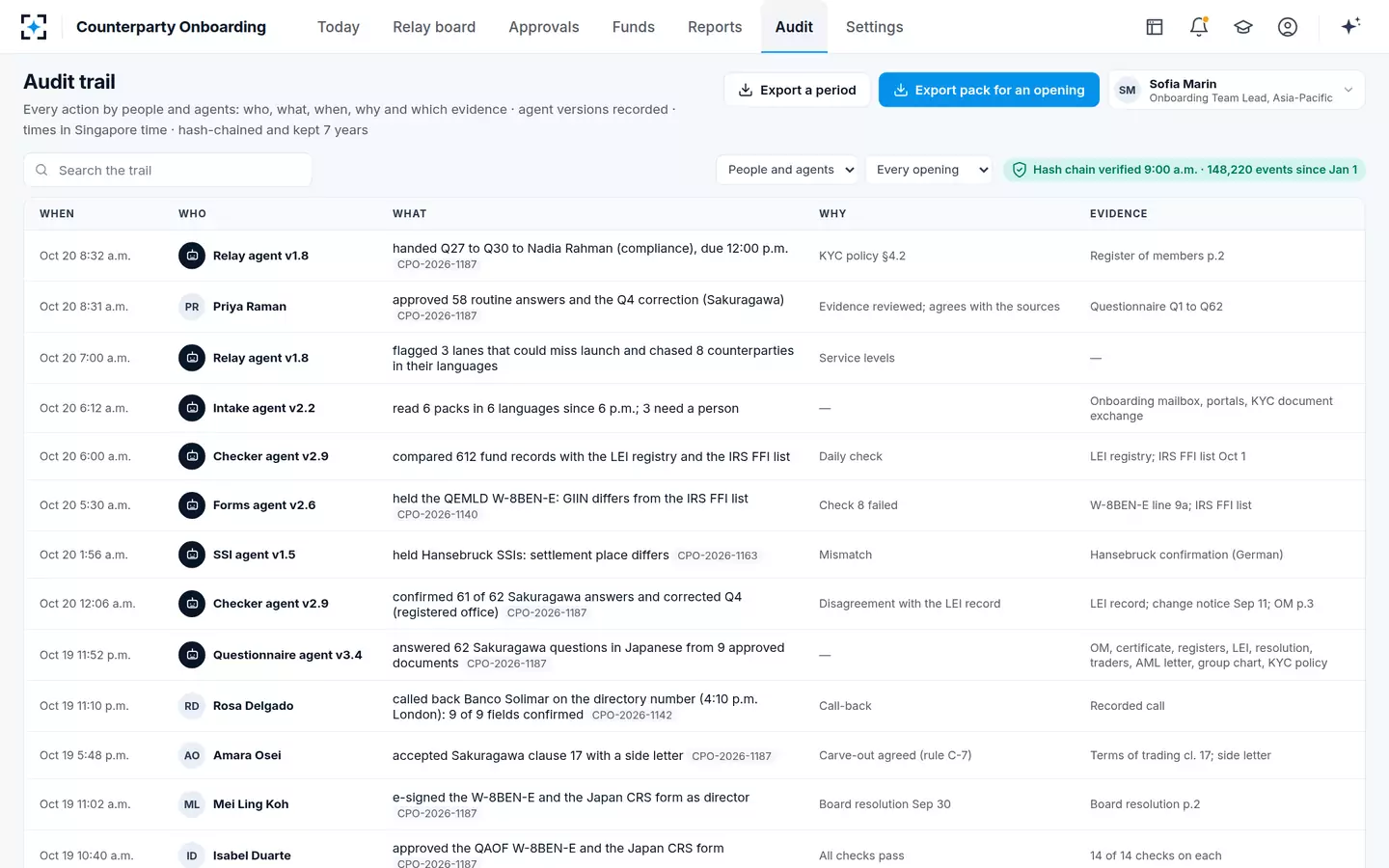
Every signature traced to the resolution that authorised it
How Counterparty Onboarding checks signers against the resolution
Botminds' Counterparty Onboarding treats the resolution as an approved fund document: the agents answer authority questions from it, check every signer on every form against it, and flag a counterparty or product the resolution does not cover before the form goes out. When a director or signatory changes, the agents list every counterparty holding the old information and draft each update; the fund's people approve and send. The agents never sign for the fund and never decide whether a resolution is adequate; Legal does.
Before a resolution goes to a new counterparty
- It names the fund exactly
Name, registration number and LEI as on the certificate and LEI data.
- It covers this counterparty type and product
Broker, FCM, bank or prime broker; futures, swaps, repo, FX.
- It covers this document type
Including give-up agreements and credit support annexes.
- The signers on the forms are in it
With the right signing mode, alone or jointly.
- Trading authority is recorded
The delegation to the investment manager.
- SSI authority is recorded
Two signatures for instructions.
- The certified copy is recent enough
For this counterparty's policy.
- Changes since certification are none
No director, signatory or manager change since it was certified.
Questions people ask
What is an account opening resolution letter?
Usually a certified extract of the resolution: a letter signed by the secretary or a director confirming the resolution was duly passed, quoting its operative clauses, listing authorised signatories with specimen signatures and stating that it remains in force. Counterparties often ask for one in place of board minutes.
Can the investment manager open accounts for the fund?
Only if the fund has given it that authority, usually in the investment management agreement or a resolution. Counterparties will ask to see the delegation, and an FCM records the manager's traders as persons exercising trading control.
Does a registered mutual fund need an account opening resolution?
The fund's board or its delegate must authorise the arrangements, and brokers will still ask who may transact for the fund under FINRA Rule 4512. The form varies with the fund's structure and the delegations its board has made to the adviser.
How recent must a certified resolution be?
No federal rule sets an age; each counterparty's policy does. The safer practice is to re-certify whenever the facts change and to certify a fresh copy for any counterparty whose policy asks for one dated within a set period.
Who should keep the account opening resolution?
The company secretary or Legal keeps the original; onboarding should hold the current certified copy with the fund's approved documents, so every questionnaire and tax form can be checked against it.