A due diligence questionnaire template, for a fund answering a broker, FCM or bank, is a map of the KYC questions counterparties ask, grouped into the nine sections nearly every such form contains: the fund's identity, its regulatory status, ownership and control, the people who act for it, its AML program, the purpose of the account, tax status, settlement data and declarations. Behind most questions sits a rule the counterparty must meet, so the same facts recur across forms in a different order and often a different language; the rest is the counterparty's own policy. A fund that keeps each of those facts as an approved, versioned answer with its source can fill a new questionnaire as a draft to review rather than a form to research. That is the work Botminds' Counterparty Onboarding does: it reads each counterparty's questionnaire in its own language and drafts every answer from the fund's approved documents, cited to the page.
The template below is ours, built from the rules each section answers. The worked example uses fictional sample data from the solution: a 62-question Japanese account application from Sakuragawa Securities to Quillfield Asia Opportunities Fund Ltd.
A due diligence questionnaire template for a fund: nine sections and the rule behind each
Entity identity
Legal name, former names, registration number and jurisdiction, date of formation, registered office, principal place of business, LEI.
Why asked CIP minimum (name, address, identification number); LEI under EU transaction reporting and CFTC swap reporting.
Regulatory status and category
Who regulates the fund and its manager; registration numbers; MiFID category; eligible contract participant status; institutional customer status.
Why asked MiFID II Art. 30 and Annex II; 17 CFR 23.430; 17 CFR 1.55(f).
Ownership and control
Owners above the counterparty's threshold, the controlling individual, listing of any parent, trusts in the chain.
Why asked 31 CFR 1010.230 where it applies; often the counterparty's own, lower threshold.
People who act for the fund
Directors, authorised signatories, traders and anyone with trading control, with specimen signatures and the authority they act under.
Why asked 17 CFR 23.402(b)(3) and 1.37; the counterparty's CIP where it cannot verify by documents alone.
AML program and screening
The manager's AML program, sanctions and PEP screening of investors, the officer responsible, any regulatory findings.
Why asked The counterparty's risk assessment; the adviser AML rule from January 1, 2028.
Purpose and nature of the account
Products and markets, expected volumes, source of the fund's money, connected accounts.
Why asked Ongoing CDD: understanding the nature and purpose of the relationship (31 CFR 1023.210(b)(5)).
Tax status
W-8BEN-E or W-9, chapter 3 and chapter 4 status, GIIN, CRS self-certification and local forms.
Why asked IRS form instructions; local CRS rules.
Settlement and operations
Standing settlement instructions by market, place of settlement, custodian, operational contacts.
Why asked EU: professional clients must supply settlement reference data electronically and keep it current (Delegated Regulation 2026/1536).
Declarations and signature
Accuracy certification, undertaking to notify changes, consent to disclosure, signature of an authorised person.
Why asked The beneficial ownership certification where owed; swap dealers may rely on written representations kept current.
What is in a due diligence questionnaire from a broker?
It contains the counterparty's legally required customer information, its own risk questions and the operational data it needs to settle. The proportions vary by firm, but the regulated core is small. A US broker-dealer must obtain at least a name, an address and an identification number before opening an account and must verify the entity's existence (31 CFR 1023.220). Its anti-money laundering program must include risk-based ongoing due diligence that develops a risk profile from the nature and purpose of each customer relationship (31 CFR 1023.210(b)(5)), which is where the questions about products, volumes and source of money come from.
Derivatives counterparties add their own requirements. A swap dealer must keep the essential facts about each counterparty, including those needed for its credit and operational risk policies and who is authorised to act for the counterparty (17 CFR 23.402(b); the document that proves it is the account opening resolution), and it must verify eligible contract participant status before trading. An FCM decides whether the fund is an institutional customer who can skip the standard risk disclosure (17 CFR 1.55(f)).
What are the KYC questions a broker asks a fund? Ask which are law and which are policy
The useful split is between questions a rule requires and questions the counterparty chooses to ask. Both must be answered accurately, but they are answered differently. A regulated answer should be the same on every form; a policy answer may need a decision, a consent or a reason.
Common questions, and the footing each one stands on
| Question on the form | Required by | How the fund should answer |
|---|---|---|
| Legal name, registered office, identification number | The counterparty's CIP | Identically everywhere, matched to the certificate of incorporation and the LEI data. |
| LEI | EU: Delegated Regulation 2017/590, Art. 13(2); US swaps: 17 CFR 45.6 | The current code, with its status ISSUED and its next renewal date known. |
| Owners at 25% and one controlling individual | 31 CFR 1010.230, where the fund is a legal entity customer | From the fund's FinCEN category: excluded, control prong only, or both prongs. |
| Owners at 10% of economic interest | The counterparty's policy or local law | Drafted from the register; compliance decides and signs, with the investors' consent cited. |
| Eligible contract participant status | 17 CFR 23.430 | Naming the paragraph of the definition the fund meets, so the dealer can rely on it. |
| Expected products and volumes | Ongoing CDD in the counterparty's AML program | From the fund's strategy and the trading desk's plan for this counterparty. |
| Source of the fund's money | The counterparty's risk assessment | Cited to the subscription documents; compliance signs. |
| W-8BEN-E or W-9, CRS status | IRS rules for the counterparty as withholding agent; CRS | The current form, with its expiry; tax operations approves. |
Ownership is where the split matters most. A fund advised by an SEC-registered adviser is not a legal entity customer under FinCEN's rule at all, as which funds owe the beneficial ownership certification explains, so a question asking for its 25% owners is the counterparty's policy, not the rule. The fund may still answer it, but compliance should decide, and the answer should say what it covers.
What is MiFID II client categorisation on a questionnaire?
An EU investment firm must place every client in a category, because the category decides which conduct rules apply to the relationship. Funds and their managers are usually professional clients by default, and many qualify as eligible counterparties, the category with the fewest conduct obligations. Annex II to MiFID II lists "Collective investment schemes and management companies of such schemes" among the entities treated as professional clients (Directive 2014/65/EU, Annex II).
"Member States shall recognise as eligible counterparties for the purposes of this Article investment firms, credit institutions, insurance companies, UCITS and their management companies, pension funds and their management companies, other financial institutions authorised or regulated under Union law or under the national law of a Member State"
Directive 2014/65/EU (MiFID II), Article 30(2)
Two choices sit with the fund. The same article preserves an eligible counterparty's right to ask, generally or trade by trade, to be treated as a client whose business carries the full conduct protections; and for other undertakings a firm must obtain "the express confirmation from the prospective counterparty that it agrees to be treated as an eligible counterparty" (MiFID II, Art. 30(2)–(3)). A questionnaire that asks the fund to accept a category is asking for that decision, which belongs to the manager's compliance function, not to whoever fills in the form. A UK firm applies the FCA's equivalent client categorisation rules.
Who in the fund answers each section, and which answers must compliance sign?
Each section has a natural owner, and the form is finished only when every owner has seen their part. The commonest failure is not a wrong answer but a right answer given by the wrong person: an operations specialist confirming a sanctions position, or a trader's list sent without the authority behind it.
Who answers each section, and who signs
| Section | Drafted from | Signed or approved by |
|---|---|---|
| A. Identity | Certificate, registered office notice, LEI data | Onboarding specialist; a different team lead approves the submission |
| B. Regulatory status and category | Registrations, the fund's eligibility analysis | Compliance |
| C. Ownership and control | Register of members, group chart, KYC policy | Compliance, always |
| D. People who act | Register of directors, authority resolution, trader list | Company secretary or legal; the fund's signatory |
| E. AML and screening | AML policy, screening records | Compliance |
| F. Purpose and nature | Offering memorandum, trading plan | Specialist drafts; compliance signs source of funds |
| G. Tax | Entity master, IRS list of foreign financial institutions | Tax operations; a director signs the form |
| H. Settlement | Custodian's SSI database | Settlement operations; a second person releases |
| I. Declarations | The completed form | An authorised signatory of the fund |
How do you reuse answers across brokers without reusing mistakes?
Reuse facts, not sentences. A counterparty's question about the registered office and another's about the principal place of business may have the same answer or different ones, and a stored sentence copied into both hides the difference. The approach that works keeps each fact once, with its source document, page and approval date, and drafts each new answer from the fact in the counterparty's own wording and language.
On one 62-question form, most questions had been answered before
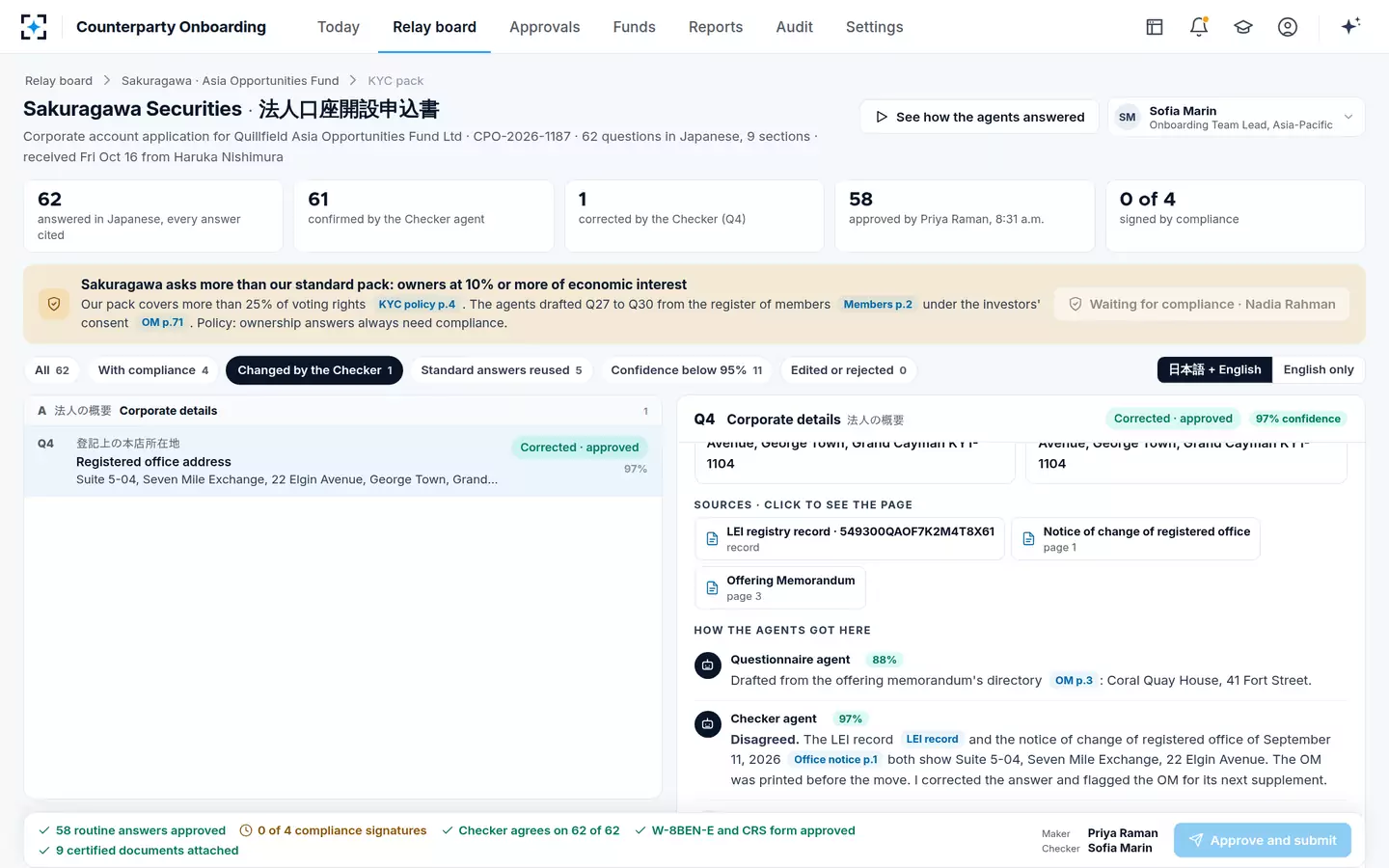
Two numbers in that chart carry the lesson. Forty-nine of 62 questions had been answered before for other brokers, which is why drafting is fast. And one answer that looked routine was wrong: the registered office printed in the offering memorandum had changed on September 11, and only an independent check against the LEI data and the change notice caught it. Reuse makes a questionnaire quick; it does not make it right. Why a complete file is not a correct one sets out how to test for that.
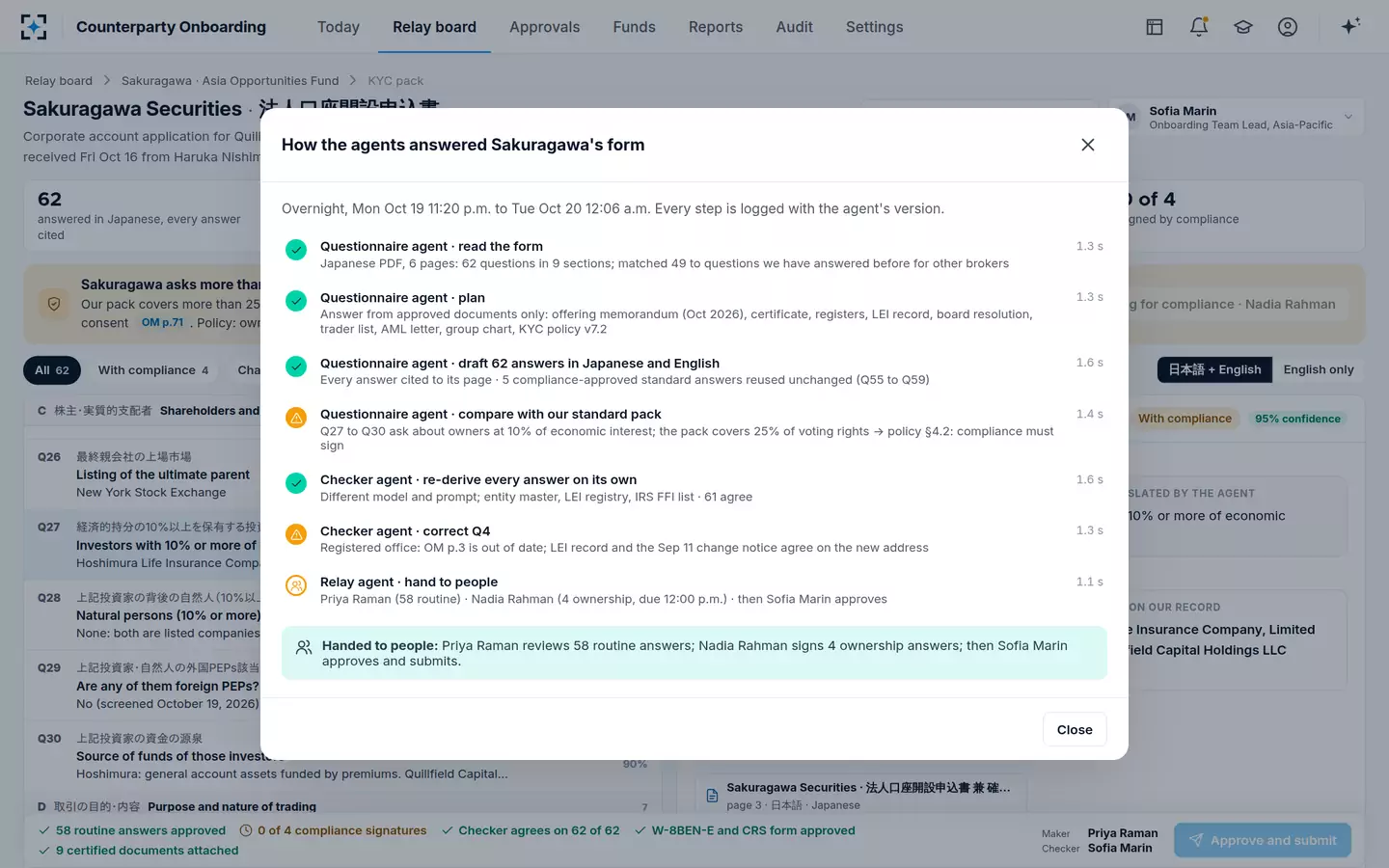
How the agents answered the broker's form, step by step
What makes a questionnaire answer accepted first time?
An answer is accepted first time when it agrees with what the counterparty can check for itself, answers the question asked rather than a similar one, and comes with the document that proves it. Counterparties compare names and addresses with public LEI data, tax forms with the IRS list of foreign financial institutions, and signatories with the authority document. Every mismatch returns the form, and a returned form costs the whole round trip on the critical path.
Eight tests for each answer before the questionnaire goes back
- Same as the public data
Name and address match the LEI record; GIIN matches the IRS list.
- Answers this question
A 10% question is not answered with a 25% standard.
- From a current document
Not a superseded offering memorandum or an old register.
- Cited to the page
So the reviewer, and later an auditor, can see where it came from.
- In the counterparty's language, with an English copy kept
The fund must be able to read what it said.
- Signed by the right person
Ownership, PEP, sanctions and source of funds by compliance.
- Consistent with other counterparties
The same controlling individual and signatories everywhere.
- Settlement data structured
EU firms must require reference data in a structured electronic form from professional clients.
A corrected answer, with both sources shown
Tax status: the section that expires on a date
Most questionnaire answers stay right until something changes; tax forms also expire on the calendar. A W-8BEN-E generally remains valid from the date it is signed until the last day of the third succeeding calendar year, and a change in circumstances that makes any information incorrect must be reported to the withholding agent within 30 days (IRS, Instructions for Form W-8BEN-E). For a manager with many funds, forms signed in the same year expire together, and every counterparty holding one will ask again. In the sample data, 41 W-8BEN-E forms for nine funds expire on one December 31; the detail of validating those forms belongs to FATCA and CRS self-certification.
How Counterparty Onboarding drafts a questionnaire
Botminds' Counterparty Onboarding reads each counterparty's questionnaire in its own language, maps every question to the fund's approved facts, and drafts answers in the counterparty's language and in English, each cited to its page. It flags any question stricter than the firm's standard, sends ownership and AML answers to compliance, and has a second agent re-derive every answer independently before a person reviews it. A specialist prepares, a different team lead approves, and nothing is sent without that approval.
Questions people ask
Is a due diligence questionnaire the same as a KYC questionnaire?
In counterparty onboarding the terms are used for the same document: a broker's or bank's questionnaire to a fund about its identity, ownership, controls and purpose. In investment due diligence, a due diligence questionnaire can also mean an allocator's questions to a manager about its operations, which is a different exercise.
Can a fund refuse to answer a question on a broker's questionnaire?
It can ask why a question is needed, especially one no rule requires, but a counterparty that cannot complete its own procedures may decline to open the account. Questions required by the counterparty's CIP, such as name, address and identification number, have to be answered.
How many questions does a broker's KYC questionnaire have?
It varies by firm and market; the sample Japanese application in this guide had 62 questions in nine sections. No regulator publishes a standard length, so the better measure is how many of a new form's questions the fund has answered before.
Who should sign a broker's KYC questionnaire for a fund?
An authorised signatory of the fund signs the declarations, after compliance has signed the ownership, PEP, sanctions and source-of-funds answers. The person who prepared the answers should not be the one who approves them.
Does a fund need to update a questionnaire after the account opens?
Yes, when facts change. Counterparties ask for undertakings to notify changes, a swap dealer may rely on written representations only if the counterparty undertakes to update material changes in time, and a W-8BEN-E change in circumstances must be reported within 30 days.