Client onboarding solutions for fund managers fall into four approaches: build a workflow in-house, buy a client lifecycle or KYC platform, outsource the work to an administrator or service, or add AI agents over the systems the firm already has. Which fits depends first on direction. Most products sold as client onboarding solutions are built for a firm checking its own customers, verifying identity, screening names and scoring risk. A manager opening its funds' accounts at brokers, futures commission merchants (FCMs) and FX banks is the customer, and needs the reverse: a store of approved, sourced answers about its funds, a way to answer each counterparty's questionnaire from it in that counterparty's language, and a tracker that plans every opening back from the first trade date. Botminds' Counterparty Onboarding is the fourth approach, built for that direction; this guide sets out where it fits and where one of the others is the better choice.
Comparisons are ours, from how each approach handles the work described in this series; vendors do not publish prices, so the cost section gives a method rather than numbers. Product examples come from fictional sample data in the solution.
Four approaches to client onboarding for a fund manager, compared
| What the work needs | Build in-house | Buy a KYC or lifecycle platform | Outsource | Add agents over existing systems |
|---|---|---|---|---|
| Built for which side | Yours, as you design it | Usually the firm onboarding its customers | The provider's process | The fund being onboarded, in this case |
| Answer each counterparty's own questionnaire | By hand, from a shared drive | Rarely; platforms collect answers, not give them | By the provider's staff | Drafted from approved documents, in the counterparty's language, cited |
| Check answers against independent records | Only if someone builds the checks | For customer data, yes | Depends on the contract | A second agent re-derives each answer from the LEI data, the IRS list and the entity master |
| Plan every opening back from the first trade date | A spreadsheet | Case management, usually not by trade date | The provider's service levels | One lane per opening, with a target per leg |
| Enforce who signs what | By policy | Configurable roles | In the provider's controls | Enforced in the software: preparer cannot approve; compliance signs ownership |
| Time to first use | Short to start, long to finish | An integration project first | Contract and transition | A pilot on past questionnaires before any live connection |
| What stays by hand | Almost everything | Answering counterparties | Oversight of the provider | Every signature and decision |
What client onboarding solutions suit a fund manager? Start with the direction of the work
A solution suits a fund manager when it is built for the side of the form the manager is on. For a manager's own investors and institutional clients, the manager is the firm doing the onboarding, and the bank-side tools fit: they verify, screen and record. For the manager's brokers and banks, the fund is the customer, and those tools invert badly: they have fields for the answers a manager must give, not a way to give them.
Onboarding a customer and being onboarded need different software
A firm onboarding its customer: The firm's own, one version.
A fund being onboarded by its counterparties: Each counterparty's, in its own order and often its own language.
A firm onboarding its customer: The firm's CIP and CDD obligations.
A fund being onboarded by its counterparties: The counterparty's obligations, which the fund must satisfy without running them.
A firm onboarding its customer: Collected from the customer and verified.
A fund being onboarded by its counterparties: Held by the fund already: entity master, offering documents, registers, resolutions.
A firm onboarding its customer: Accepting a customer it should not.
A fund being onboarded by its counterparties: Telling a regulated firm something wrong in the fund's name.
A firm onboarding its customer: The firm's service level.
A fund being onboarded by its counterparties: The fund's first trade date.
A firm onboarding its customer: The firm's KYC reviewer and approver.
A fund being onboarded by its counterparties: The fund's compliance, tax, Legal, authorised signatories and trading operations.
For the other direction, see client lifecycle management platforms against onboarding agents on the institutional client side, and investor KYC and AML onboarding for investors in the funds.
Build or buy a client onboarding solution? Four approaches, honestly
Build in-house. A shared drive of approved documents, a library of standard answers and a tracker in a spreadsheet or workflow tool is how most managers start, and for a firm with a handful of funds and counterparties it can be enough. It fails at scale in predictable ways: standard answers drift from the documents they came from, nobody re-checks a fund's LEI or GIIN before each form, and the tracker records that a leg is late, not why.
Buy a KYC or client lifecycle platform. These platforms are strong at what they were built for, a firm's own customer files, and many managers already own one for investor onboarding. Using it for counterparty onboarding means using its case management as a tracker and its document store as an answer library, while the drafting, translation and checking stay manual. It helps the manager's investor side more than its broker side.
Outsource. A fund administrator or onboarding service can take the work, and for a manager without an operations team it may be the right answer. The manager still owns the answers given in its funds' names, so it must oversee the provider: which documents were used, who approved ownership answers, how fast lanes moved. Without a record of each answer and its source, that oversight is a monthly meeting rather than a control.
Add agents over existing systems. Agents read the counterparty's forms, draft answers from the documents the firm already approves, check each answer against independent records, plan and chase each opening, and hand every decision to a named person. It keeps the firm's entity master, document store, screening and order management system in place. It needs the firm to define its approved documents, standard answers and rules first, and a pilot to prove accuracy on the firm's own past questionnaires.
Which approach suits which manager?
Scale and spread decide more than features. A manager with a few funds and a few domestic brokers opens few accounts a year and can run them from a disciplined tracker and a reviewed library of standard answers. A manager without an operations team may be best served by outsourcing, provided it keeps a record of what is said in its funds' names. A manager already running a lifecycle platform for its investors should use it for what it does well and not expect it to answer brokers.
Agents earn their place where the volume and variety are high: many funds, many counterparties, forms in several languages, launches on fixed dates, and an examiner who will ask who approved each answer. In the solution's sample, 186 openings were in flight across 38 funds and 32 counterparties at once, which is the scale at which copying answers by hand stops being a cost and becomes a risk.
What must a client onboarding solution connect to?
To the systems that hold the fund's facts and the counterparty's requests, read-only at first. A fund-side solution needs the entity master (names, LEIs, GIINs, addresses, directors), the approved document store (offering documents, registers, resolutions, AML letters), the public registries a counterparty will check, the firm's screening results, the mailbox, broker portals and e-signature tool where forms arrive and leave, the custodian's settlement instruction database, and the order management and accounting systems for setup requests.
Two of those registries are free and public, and a solution should check them before every form. The Global LEI Foundation publishes every LEI's status and renewal date through a public API (GLEIF). The IRS publishes its list of foreign financial institutions registered under FATCA monthly, searchable by legal name, GIIN or country and downloadable in full (IRS FFI list search and download tool). A tax form whose GIIN is not on that list under the same name will be queried by any counterparty that checks.
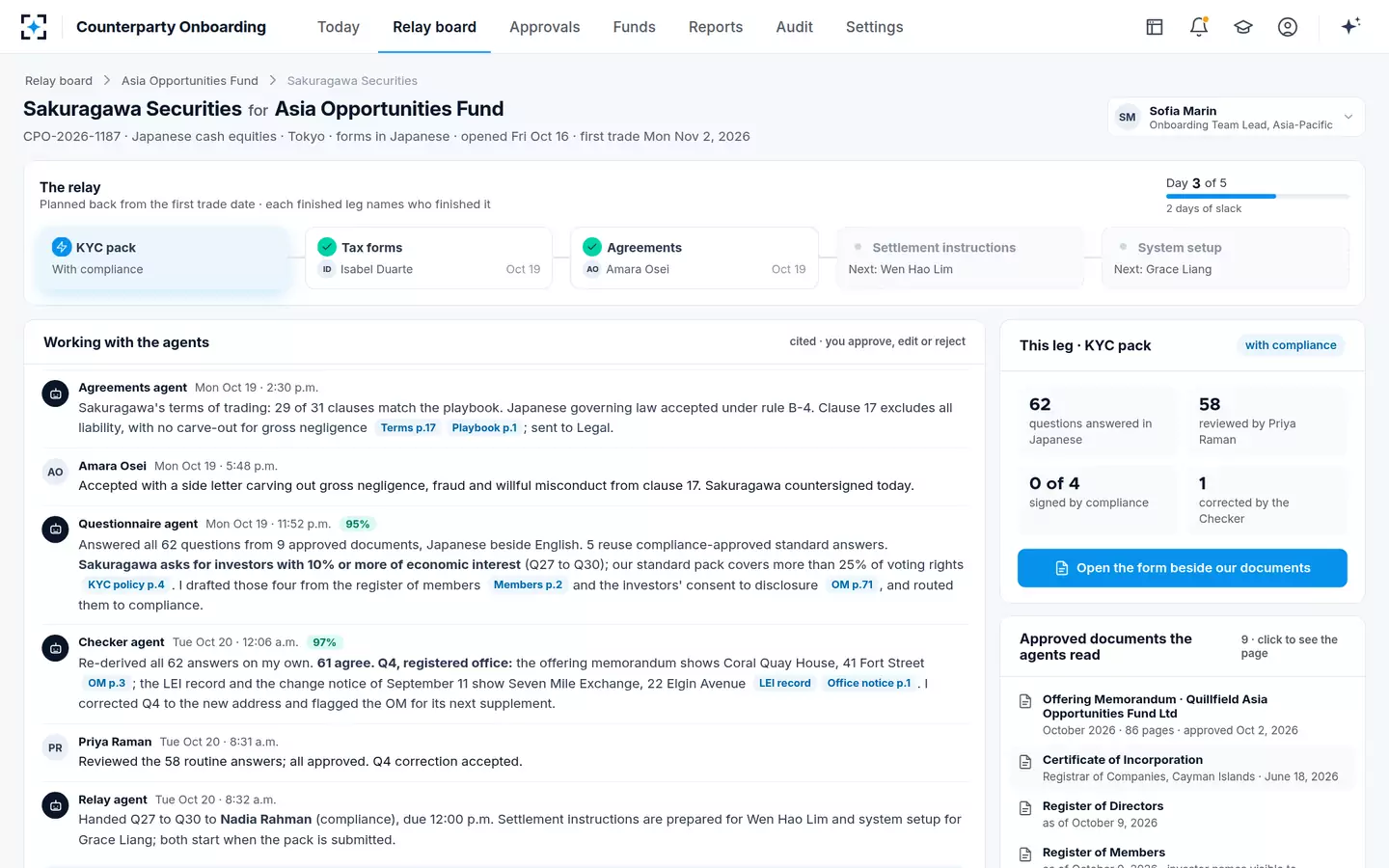
One opening, its five legs, and the approved documents the agents read
How much do client onboarding solutions cost?
Vendors don't publish prices, and the licence is rarely the largest number. Price each approach on the same basis: the annual cost of the software or service, the integration and change work in the first year, the staff hours left for the firm's own people per opening, and the business days per opening to trade-ready. The last converts into money through the cost of a late first trade; the price of a late first trade sets out the method, applied to the days each approach actually removes.
Count only days that disappear. An approach that moves work from operations to compliance, or from the fund to its administrator, has not saved the days; it has moved them. The test is the elapsed time from the counterparty's first request to trade-ready, measured on real openings before and after.
What should a client onboarding pilot test?
Accuracy on your own past work, before speed on new work. A pilot that only demonstrates on the vendor's sample shows that the product works on the vendor's data.
A four-week pilot, from past questionnaires to one live opening (target)
- Approved documents, standard answers and rules as settingswk 1
- Last quarter's questionnaires answered and checkedwk 2
- Scored against what was accepted, by error typewk 3
- One live opening; people approve and send everythingwk 4
What a client onboarding pilot should prove, before any contract
- Answers to your past questionnaires, scored
Every answer compared with the one finally accepted, errors counted by type.
- Questions stricter than your standard, caught
Ownership thresholds, look-through requests, economic versus voting interest.
- Stale documents found
An address, director or identifier that changed after the document was approved.
- Foreign-language forms handled
Answers in the counterparty's language, with an English copy you can review.
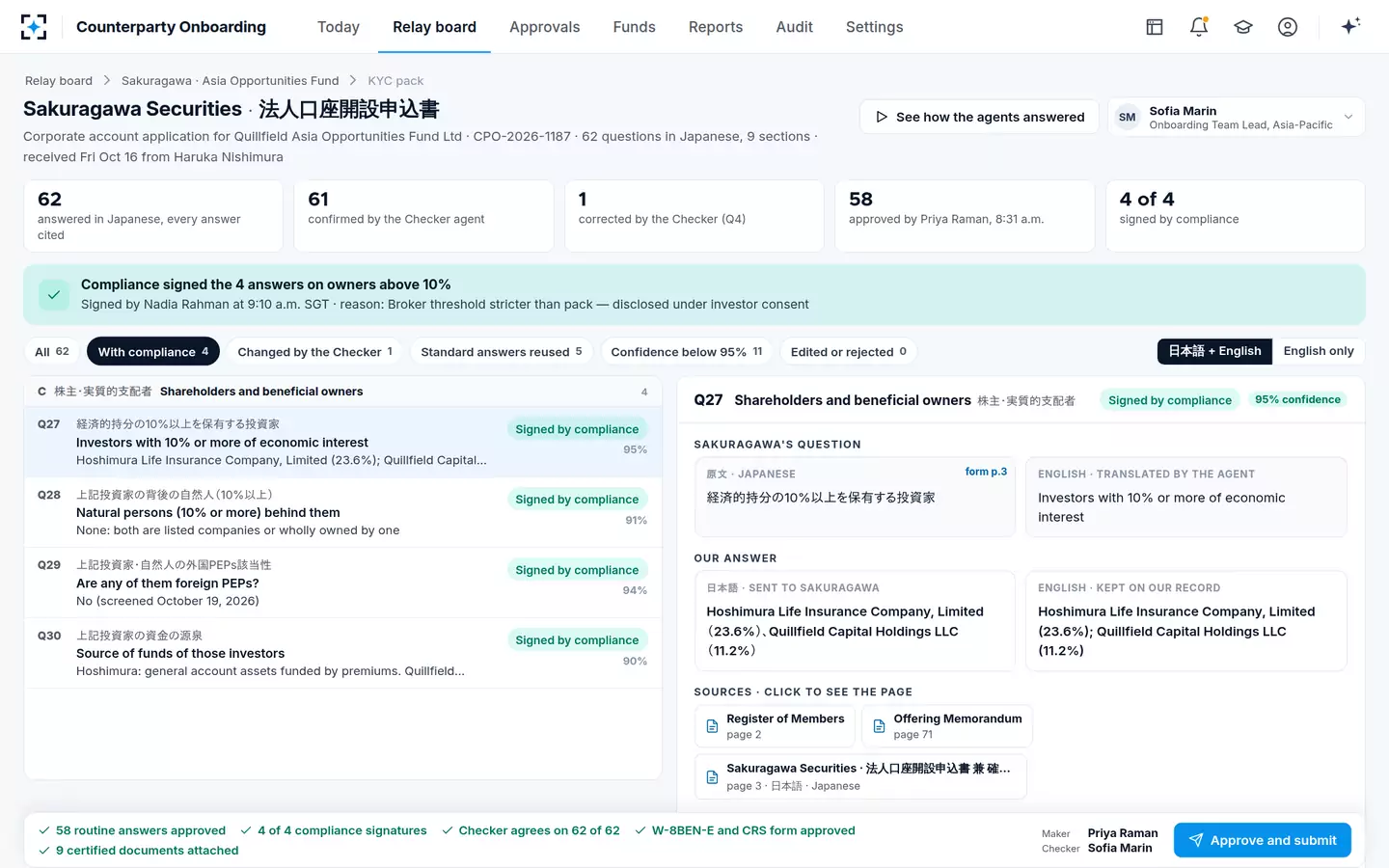
- The preparer cannot approve
Tried and refused by the software.
- Compliance answers cannot bypass compliance
Ownership, PEP, sanctions and source of funds.
- Nothing sent without a person
Including chasers.
- An audit export for one opening
Every answer, source, approval and agent step, in one file.
Approve and submit unlocks only when every condition is met
How do you switch client onboarding solutions without losing what you know?
Move facts, not documents. The value in a manager's onboarding history is the approved answers about each fund, with their sources and approval dates, and the record of what was told to which counterparty. Migrate those first, re-checking each against the current documents and registries on the way in; a standard answer that cannot be traced to a source should be re-approved, not carried over.
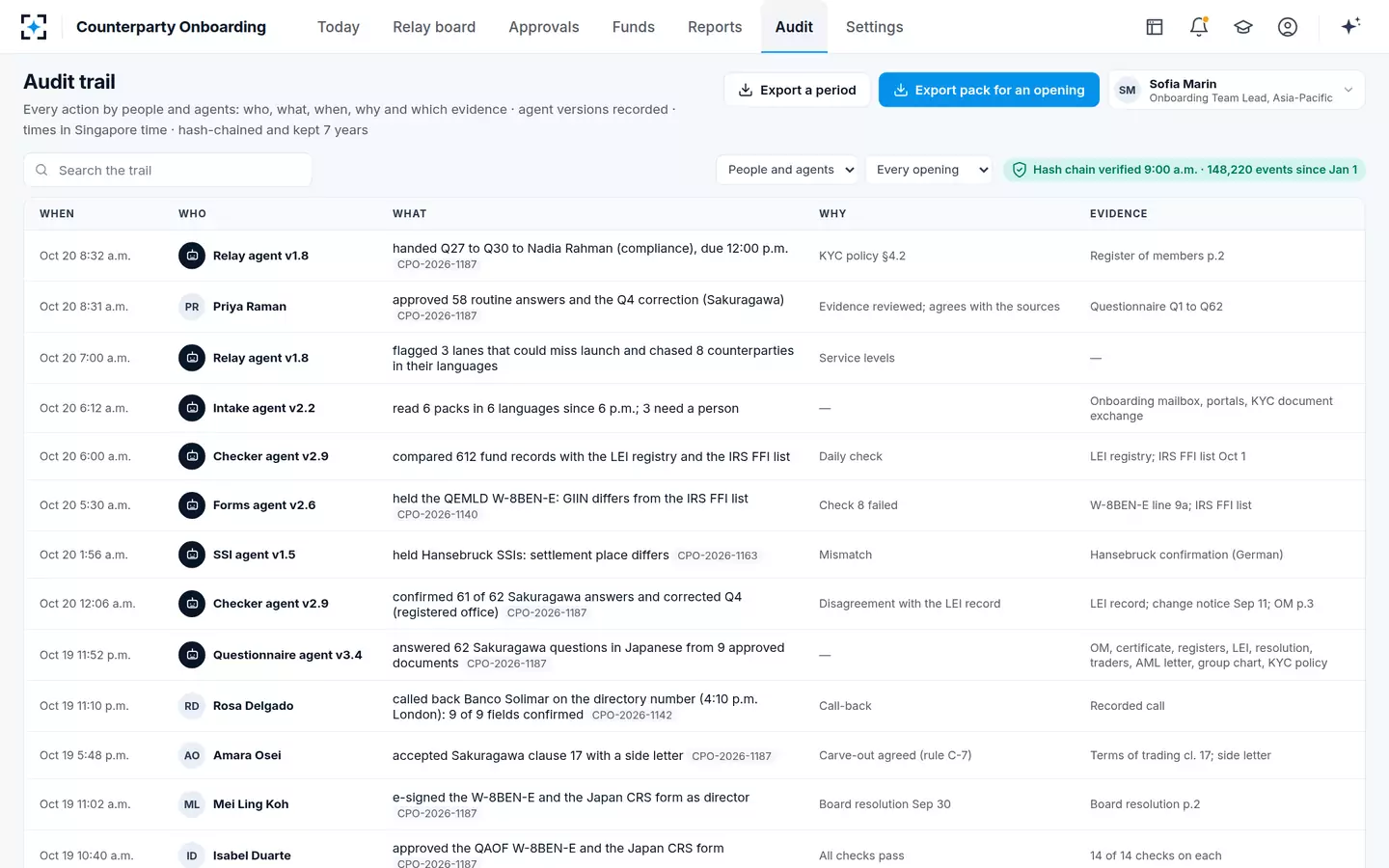
Run the new approach beside the old for a launch, with people approving everything, and keep the old record readable for the period the firm's retention policy requires. Examiners' interest in how firms supervise technology in back-office and AML work is explicit in the SEC's fiscal 2027 priorities (SEC Division of Examinations), and a switch is the moment to make sure the new system's log shows who decided what, from which evidence.
The audit trail a switch has to preserve
Where Counterparty Onboarding fits, and where it does not
Botminds' Counterparty Onboarding fits a manager that opens accounts for several funds at many brokers, FCMs and banks, often abroad, and wants each opening drafted, checked, tracked and evidenced while its own people keep every decision. Eight agents read, answer, check, complete tax forms, compare agreements, build settlement instructions, prepare setup requests and relay each lane; the firm's specialists, compliance, tax, Legal, settlement and trading teams approve and sign.
It is not the right choice for every manager. A firm with two funds and three US brokers may do well with a disciplined in-house tracker. It does not verify investors' identities, run sanctions screening or set credit limits; it uses the firm's screening results and approved limits. And it does not replace Legal in negotiating agreements; it shows Legal the clauses outside the playbook. What an AI agent answering broker KYC should never do sets out those limits in full.
Questions people ask
What is the best client onboarding solution for an asset manager?
The one built for the direction of the work. For onboarding investors and clients, a KYC or lifecycle platform; for opening the funds' accounts at brokers and banks, a solution that answers counterparties from approved documents, checks against independent records and plans to the first trade date.
Can a KYC platform be used for counterparty onboarding?
Partly. Its case management can track openings and its document store can hold approved documents, but drafting each counterparty's answers, translating them and checking them against public registries usually stays manual.
Should a fund manager outsource counterparty onboarding?
It can, especially without an operations team, but it keeps responsibility for what is said in its funds' names. Insist on a record of every answer, its source and its approver, so oversight is evidence-based.
How long does it take to implement a client onboarding solution?
A platform integration takes as long as the systems it must connect; an agent pilot on past questionnaires can be scored in weeks. The Counterparty Onboarding pilot plan targets four weeks from approved documents to one live opening.
What data does a fund-side onboarding solution need?
The entity master, approved fund documents, standard answers and policy, screening results, the custodian's settlement instructions and read access to where counterparty forms arrive. Public LEI data and the IRS FFI list are free to check.