A call back procedures audit tests whether every change to a standard settlement instruction (SSI) was confirmed with the counterparty by phone, on a number the firm already held, before the changed instruction was used, and whether the firm can prove it. The proof is five pieces of evidence for each change: the request exactly as received, the independent source of the number that was called, the call itself with what the counterparty said, the separate verification and approval by two people, and the receipts showing the approved values went live. FINRA has observed firms that "released funds after unsuccessfully attempting to verify emailed instructions by phone" (FINRA Regulatory Notice 12-05); a call-back without that file is, for an auditor, unverified whatever the system says. Botminds' Standard Settlement Instruction Management builds the file as the work happens: the agents book each call-back to the number on the counterparty master, transcribe the recorded call and compare it field by field, and every person's action carries a reason code, a signature and a time.
The examples come from a fictional asset manager, Quillfield Capital, and its fictional counterparties, as they run through the solution. Regulators' guidance is linked where it appears.
The five pieces of evidence a call back procedures audit should find for every SSI change
- 1. The request exactly as it arrived
The email with its headers and attachments, the letter as scanned, the database notice or message. It shows what was asked, by whom, through which channel and when; a retyped summary shows none of that.
- 2. The source of the number that was called
The counterparty master entry the number came from, when it was set up and when it was last re-verified. This is the piece that proves the call did not go to the requester.
- 3. The call itself
Who called, which number, at what time, the recording or transcript, and what the counterparty stated for each changed field. FINRA asks for confirmation “that can be documented”.
- 4. Two people’s decisions
A maker’s verification and a different checker’s approval, each with a reason code and a time. It proves that no single person could make the change.
- 5. What went live, and when
Receipts from each system that took the change, at the effective time, with the version. It proves the approved values, not different ones, reached the SSI master, the custodian and payments.
What is a call-back procedure?
A call-back procedure is a control that requires a change to payment or settlement details to be confirmed by telephone with the counterparty before it is used, by calling a number the firm already holds rather than one supplied with the request. For SSIs it applies to new instructions and to changes of bank, account, intermediary or place of settlement. Its purpose is narrow and important: to prove that the counterparty, not someone pretending to be it, asked for the change.
The procedure is old; what has changed is the evidence expected of it. FINRA's notice on emailed instructions asks firms to "include a method for verifying that the email was in fact sent by the customer" and to have "a means or method of customer confirmation, notification or follow up that can be documented" (FINRA RN 12-05). FinCEN's business email compromise advisory suggests verifying suspicious emailed payment instructions through more than one channel or with others authorised to make the transaction (FinCEN FIN-2019-A005). Both describe a control whose value lies in what it can show afterwards.
Which number should you call back?
A number of known origin: one held on the counterparty master, set up independently of any change request, and re-verified on a schedule. Never a number in the request, in its signature block, or on the letter, because whoever wrote the request chose it. In the sample, the forged Brennmoor email offered a Cyprus number; the call went to the broker's settlements desk in London from the master, last re-verified on 11 February, and the person there denied the change.
Bank wire rooms face the same question from the payment side; wire callback procedures traces it for a single wire. For SSIs the number matters even more, because an accepted change pays every later trade, not one.
Which SSI changes need a call-back?
Every change that moves where money or securities go, and every change that arrives by a channel that proves nothing about its sender. The sample firm's rule requires a call-back for every bank, account or intermediary change, every email or letter, and any request scoring 30 or more on its fraud signals; changes entered by the counterparty itself in an authenticated SSI database and matching its own published data carry less risk and have a longer service level.
T+1 puts pressure on the rule, not an exemption from it. The EU industry task force told ESMA that new or updated SSIs are "subject to fraud prevention policies, requiring validation to be completed before instructions can be utilised" and that, unless SSIs come from an approved repository, "these processes and associated steps, such as call-backs, can be time-consuming" (ESMA consultation paper, February 2025, paragraph 142). The answer is to receive changes earlier and book calls faster, not to skip them.
What evidence should be kept for each change?
The five pieces above, linked to the change and to each other, with times. Taken together they let a reviewer replay the decision without asking anyone. Here is one complete file from the sample, for a genuine change.
One SSI change's evidence file, end to end: Kawabe Securities' new settlement agent
20 Oct, 02:04 London
Signed letter received by post in Singapore and scanned
The letter as received, in Japanese, with each value cited to its line
Intake agent
20 Oct, overnight
Compared with Kawabe’s own entry in the industry SSI database
The same change, entered by Kawabe on 16 October
Source agent
20 Oct, 08:30 London (16:30 Tokyo)
Call-back to +81 3 5550 1294, Misaki Sato, Head of Operations
Number from the counterparty master, re-verified 6 May 2026; recording 1 min 58 s; transcript
Wei Ling Tan, analyst
20 Oct, 08:32
Outcome recorded: CB-01, all three changed fields stated by the counterparty
Field-by-field comparison of the transcript with the request
Wei Ling Tan, checked by the Callback agent
20 Oct, 08:34
Verified as maker, reason code VR-01
Signature, time, the evidence links
Wei Ling Tan
20 Oct, 08:50
Approved as checker, reason code AP-01
Signature by a different person from the maker
Marcus Lee, team lead
26 Oct, 00:01 Tokyo
Live in the SSI master, order management, custodian and payments
A receipt from each system, version 3
Go-live agent
Two details in that file do most of the work. The number called was re-verified in May, months before the request, so it cannot have come from the letter. And the analyst who made the call was not the person who approved the change; in the solution, a team lead who verified a change cannot approve it.
How do you record a call-back for audit?
Record it on a recorded line, from a script that asks the counterparty to state its details, and capture the outcome against each changed field. The script matters: "is the new account in your letter correct?" invites a yes from anyone; "please read me your current USD account details" does not. In the Brennmoor call, the analyst asked for the current details and whether Brennmoor had asked to move its USD settlement; the settlements manager gave the account on file and said "No. We haven't changed our USD instructions, and we sent no such request."
A recorded call-back, transcribed, with the counterparty denying the change
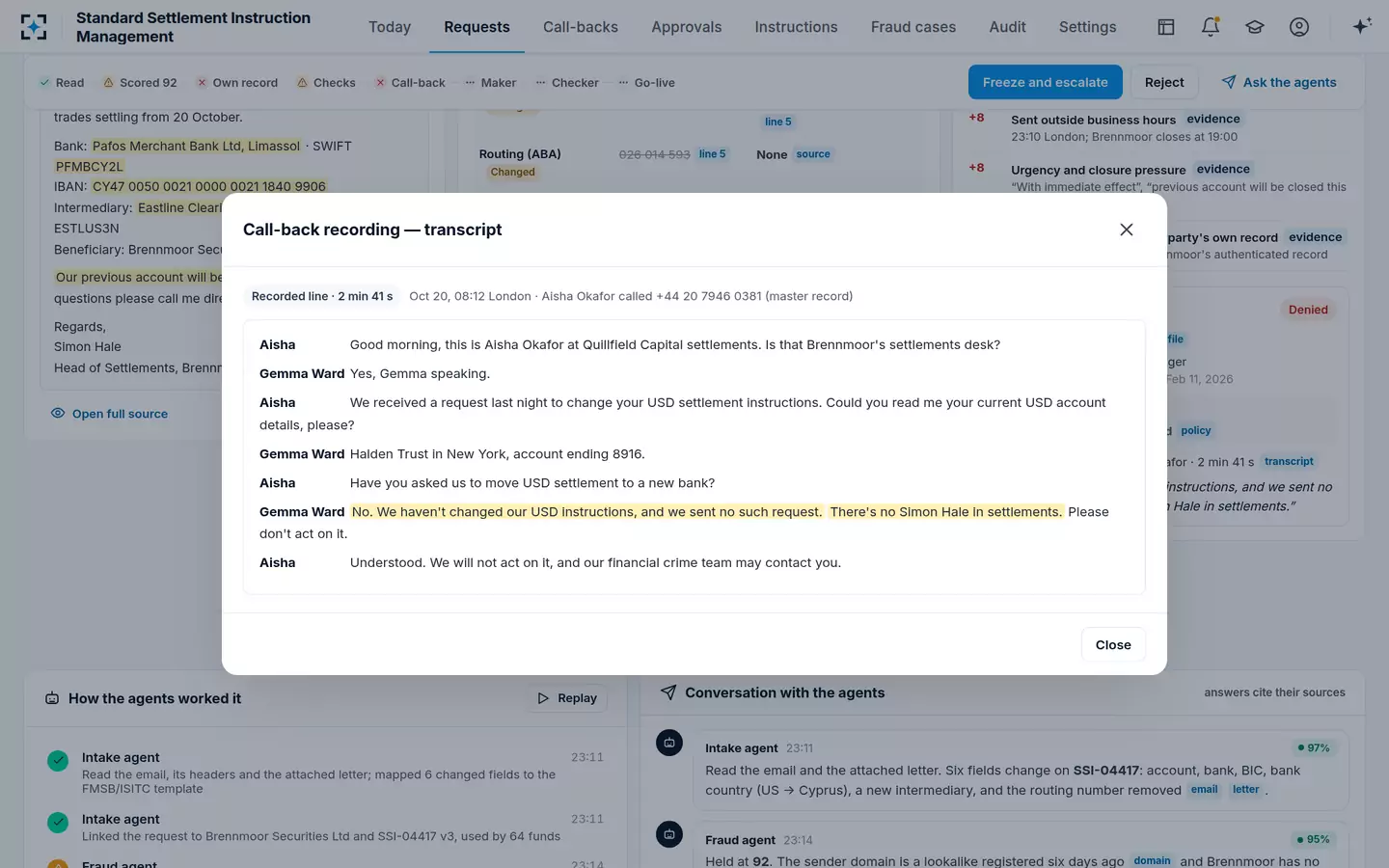
Outcome codes turn calls into data an auditor can sample. The sample firm uses codes such as CB-01, all changed fields stated by the counterparty, and CB-02, denied, and the Callback agent suggests an outcome from the transcript that the caller then decides. Advisers in the US should note what they are keeping: Rule 204-2 requires originals of written communications about receipts and deliveries of funds or securities to be kept at least five years (17 CFR 275.204-2); recordings are not written communications, but the transcript and the outcome usually sit in the same file.
What does an auditor ask for in a call-back procedures audit?
A population, a sample and the evidence for each item. The population is every SSI change in the period, from every channel; the sample is drawn from it, weighted towards bank-country changes, high scores and changes approved near a payment run. For each, the auditor asks for the five pieces of evidence, and then for the exceptions: changes made without a call-back, calls to numbers not on the master, approvals by the verifier, numbers on the master that were changed without their own verification.
Procedures “should also include random sampling and testing of transfers and withdrawals to monitor for compliance.”
FINRA Regulatory Notice 12-05, Verification of Emailed Instructions to Transmit or Withdraw Assets From Customer Accounts, January 2012
Auditors also look at the control around the control. The SEC's report on nine companies that paid fraudsters found they had procedures requiring changes to supplier data to be verified, and still lost nearly $100 million, because staff treated the emails as sufficient on their own (SEC 34-84429). The UK T+1 plan asks every market participant to review and test its reference data policies, processes and systems for T+1 by 31 December 2026 (UK Accelerated Settlement Technical Group), and the FCA has said it will discuss firms' arrangements for standard settlement instructions.
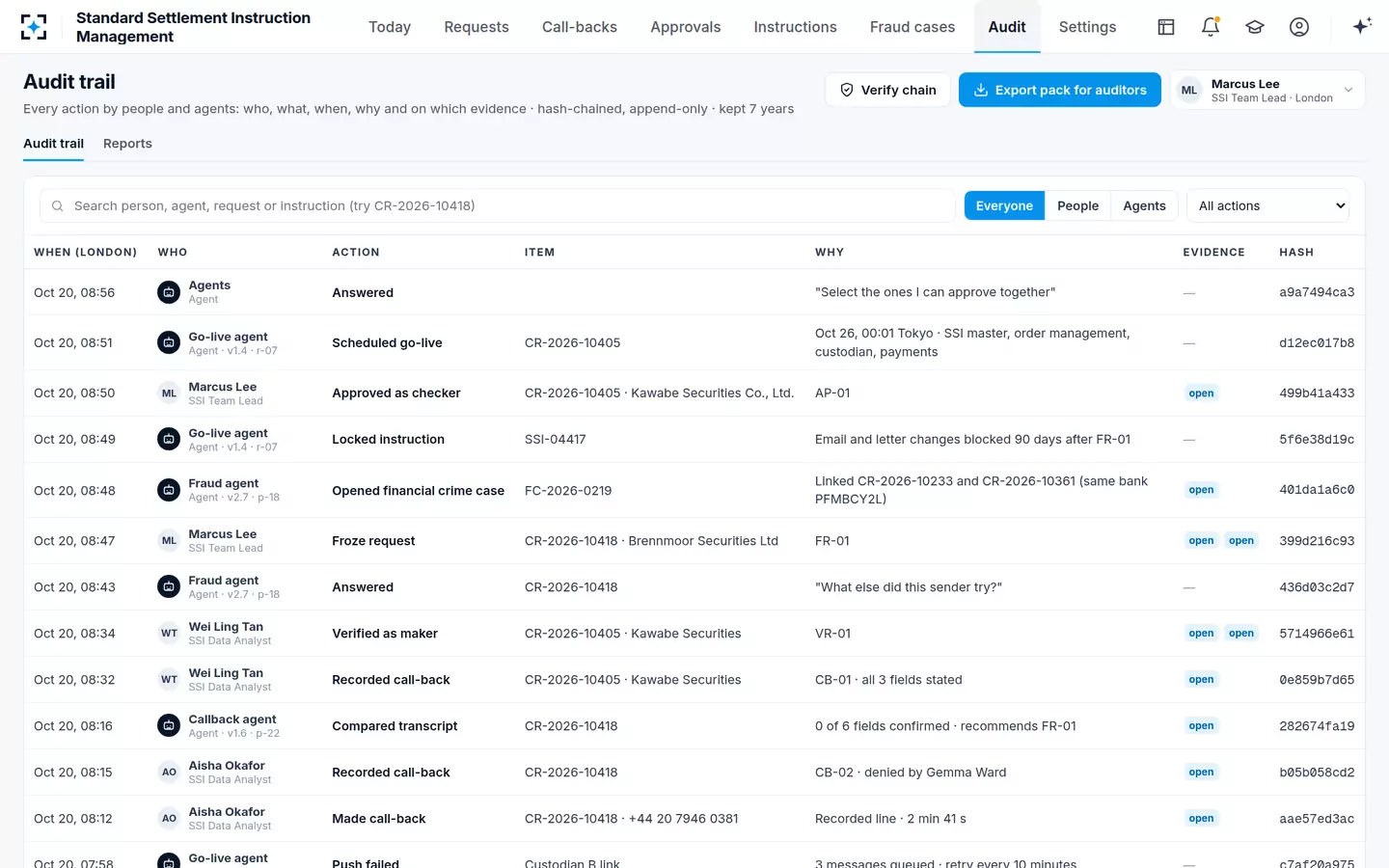
The audit trail in Standard Settlement Instruction Management: who, what, when, why and on which evidence
How do you test that the call-back control works?
Re-perform it on a sample and measure the exceptions, then test it with a request you know is false. A control that has never been shown a forgery has never been tested. The table below is a test plan an internal audit or second-line team can run each quarter.
A quarterly test plan for SSI call-back controls
| Test | How | Passes when |
|---|---|---|
| Coverage | Match every SSI change in the period to a call-back or a documented exemption | Every bank, account, intermediary or place-of-settlement change has a call-back |
| Number of known origin | For each sampled call, trace the number to the counterparty master and its last verification | No number came from a request; every number was verified before the request arrived |
| What was said | Listen to or read the call; compare with the changed fields | The counterparty stated each changed value; none were read to it |
| Separation | Compare maker, checker and payment-release users | No change verified and approved by one person; no approver can release payments |
| What went live | Compare approved values with the SSI master, custodian and payment system at the effective time | Every system holds the approved version, with a receipt |
| Seeded request | Send a realistic false change from a lookalike domain, with its own phone number, with management’s approval | Held, called back to the number on file, denied and frozen |
| Master changes | Sample changes to call-back numbers themselves | Each was verified through a separate channel and approved by two people |
Measure, too, what the call-backs catch. The sample firm's last 30 days show 3 fraud attempts stopped before any payment and 14 genuine changes in which the counterparty corrected a detail on the call that would otherwise have gone live wrong. The second number is the one auditors rarely ask for and the one that shows the control earns its time even when nobody is attacking.
Where time goes on one held request
Most of the elapsed time on a held request is waiting for the counterparty's business day, not working. Booking the call inside the counterparty's hours, and holding the request until then, is part of the control; a call made at midnight to a desk that closed at 19:00 reaches whoever is answering that number at midnight.
From a forged request at 23:10 to a frozen instruction at 08:47: almost all of it is waiting
4 min
to read, score at 92 and hold the request
8 h 58 min
held until the counterparty’s business day; call booked to the number on file
4 min
to make the call and compare it with the six changed fields
31 min
for a team lead to review and freeze with reason code FR-01
The decision that follows a denied call is set out in the FinCEN advisory, read for an SSI desk, and what the agents may and may not do in this file in AI for standard settlement instructions. To see the evidence file built on your own past changes, start from Standard Settlement Instruction Management.
Questions people ask
Is a call-back required by law?
No single rule requires asset managers to call back SSI changes. FINRA's Regulatory Notice 12-05 sets expectations for broker-dealers verifying emailed instructions; FinCEN's advisories describe verification as good practice; and the SEC's 2018 report reminded public companies that internal accounting controls must address changes to payment details. Most firms' auditors treat a call-back to a number on file as the expected control.
What if the counterparty does not answer?
The change waits. Book a retry inside the counterparty's hours and keep the old instruction in force; an unanswered call is not a confirmation. In the sample, a Brazilian bank's first call-back went unanswered and a retry was booked, with the request still held.
Can an email confirmation replace a call-back?
Not if the email goes to an address taken from the request or replies on the same thread, because that reaches whoever sent it. A confirmation through a separate, authenticated channel, such as the counterparty's own entry in an SSI database, is stronger evidence than email, and many firms still call for bank-country changes.
Should call-backs be recorded?
A recording or transcript is the strongest evidence of what the counterparty said, and it lets a second person check the call without repeating it. Check local rules on recording and notice before you do. Without one, keep a contemporaneous note of who was called, on which number, and what they stated for each changed field.
How often should call-back numbers be re-verified?
No regulation sets a period. Re-verify when a number is set up, after any change to it, and on a schedule the firm sets by risk, and treat a change to a call-back number as a change to verify through a separate channel with two approvals. The sample firm records the last verification date beside each number.