A standard settlement instructions template has three parts: who the counterparty is and when the instruction applies, where its securities settle (the depository, the participant code, the custodian or agent and its BIC, the safekeeping account), and where its cash goes (the beneficiary bank, its BIC, the account or IBAN, any intermediary and the local clearing code). A good template is structured data with one value per field, not a letter, because the fields that fail trades are a short list that software can check before the first trade uses them. No regulator prescribes the template itself; the EU's 2026 settlement rules require the reference data behind it to arrive in a structured electronic form, and the UK's T+1 plan asks every firm to adopt the industry's published SSI templates by the end of 2026. Botminds' Standard Settlement Instruction Management reads the templates, emails and letters counterparties actually send, maps them to these fields with a citation for every value, and checks each change before a person approves it.
The filled-in examples use fictional counterparties from the solution's sample data: Kawabe Securities for a Japanese equities instruction and Brennmoor Securities for US dollar cash.
A standard settlement instructions template in eleven fields: what each holds, how it fails a trade, how to check it
Who and when
Counterparty legal name and LEI
ExampleKawabe Securities Co., Ltd. · 20-character LEI
How it fails a tradeAn SSI filed under the wrong entity pays the right bank for the wrong fund or broker.
How to check itThe LEI resolves, is not lapsed, and names this entity.
Scope: asset class, market, currency
ExampleEquities · Japan · JPY
How it fails a tradeA bond trade picks up the equity instruction and goes to the wrong depository.
How to check itOne active instruction per scope; no overlaps, no gaps for traded markets.
Effective date and version
ExampleFrom 26 Oct 2026, 00:01 Tokyo · v3
How it fails a tradeTrades settling before the date use the new details and fail.
How to check itA future date with enough notice; the old version kept until then.
Authorised signatories and contact on file
ExampleHead of Operations · desk number on the master
How it fails a tradeA letter signed by someone with no authority is accepted.
How to check itSigner on the signatory list; the call-back number is never the one in the letter.
Securities leg
Place of settlement (depository)
ExampleJASDEC
How it fails a tradeDelivery instructed at a different depository from the counterparty’s: no match.
How to check itThe depository where this security settles for this counterparty; agreed early.
Participant code at the depository
Example41270
How it fails a tradeThe delivering or receiving participant does not match the counterparty’s instruction.
How to check itFormat for that depository; same participant as the counterparty’s own published SSI.
Settlement agent or custodian, and BIC
ExampleMinato Custody Bank · MNTCJPJT
How it fails a tradeMessages routed to the old agent, who rejects or ignores them.
How to check itBIC exists and belongs to the named bank in that country.
Safekeeping account
Example0081-447120
How it fails a tradeSecurities arrive at an account the counterparty does not use.
How to check itAccount format for the market; matches the counterparty’s own data.
Cash leg
Beneficiary bank and BIC
ExampleHalden Trust Company · HLDNUS33
How it fails a tradeCash leg fails, or is paid to an unintended bank.
How to check itBIC exists, is in the stated country, is not on a sanctions list.
Account or IBAN
Example4410-228-916
How it fails a tradePayment rejected, or credited to someone else.
How to check itIBAN check digits where IBANs apply; account-name check where offered.
Intermediary bank and local clearing code
ExampleNone · ABA 026-014-593
How it fails a tradeCorrespondent missing: the payment is returned or delayed a day.
How to check itRequired for the currency; a new intermediary is a change to call back.
What does a standard settlement instructions template look like?
It looks like a short form with fixed fields, normally one per asset class and market, signed or authenticated by the counterparty. The header identifies the legal entity, ideally by its legal entity identifier, and states the scope and the effective date. The body carries the securities leg, the cash leg or both. The footer carries who authorised it and how to reach them, which matters more than any other line once fraud enters the picture.
The template's job is to make the counterparty's data unambiguous and machine-readable. ESMA described what the UK's endorsed industry standard is for: it "fosters the timely and accurate sharing and authentication of SSIs" by encouraging automated sharing and by "creating templates which facilitate any residual manually shared SSIs to be automatically ingested by receiving counterparties" (ESMA consultation paper on settlement discipline, February 2025). A template that a person must read and retype has already lost half its value.
Which SSI fields are mandatory?
No rule lists mandatory SSI fields, but EU law lists the settlement data every allocation must carry, and that is the practical minimum. From 7 December 2026, written allocations must specify, among other things, "the names and numbers of the securities or cash accounts to be credited or debited", the identifiers of the participants that deliver and receive, and "the place of settlement ('PSET')" (Delegated Regulation (EU) 2026/1536). An SSI that cannot supply those four things cannot produce a compliant allocation.
The same regulation says how the data must travel. Firms must require professional clients "to provide all reference data necessary to settle a trade in a standardised, electronic format", structured so that software can extract it, and to keep it current in advance. Beyond that, markets add their own needs: a local clearing code for many cash currencies, a participant code at the depository, a client or sub-account at the custodian. The UK's action STAT 01 points every market participant to the FMSB Standard for Sharing of SSIs and its templates, to be adopted by 31 December 2026 (UK Accelerated Settlement Technical Group).
“There are currently no pan-European market standards in place to specify in which format SSIs should be structured, stored, and shared in the EEA region.”
EU T+1 industry task force, reported by ESMA, consultation paper of 13 February 2025, paragraph 141
Europe has chosen, for now, not to fill that gap by regulation. In its October 2025 final report ESMA recorded that most respondents wanted the standards for storing and exchanging SSIs left to the industry, while "a non-negligible number of respondents advocated for a baseline regulatory framework", many of them asking that SSIs be exchanged "in an electronic and machine-readable format" (ESMA final report, 13 October 2025).
How do equity, bond, cash and FX SSIs differ?
They differ in what has to be located: a securities SSI must say where the securities move, a cash SSI where the money goes, and a delivery-versus-payment trade needs both to agree. Most of the mistakes that reach the depository come from one asset class's template being used for another, or from a market's local field being left out.
The fields that change from one standard settlement instruction to the next
| Asset | Securities leg | Cash leg | Field most often missing |
|---|---|---|---|
| Equities | Depository and participant code; custodian or sub-custodian and BIC; safekeeping account | Cash correspondent of the custodian, in the trade currency | Place of settlement for securities listed in several markets |
| Bonds | Depository or international depository; participant account; custodian BIC | As for equities, often in a different currency from the investor’s | The right depository when the bond settles in more than one |
| Cash and payments | None | Beneficiary bank, BIC, account or IBAN, intermediary, local clearing code | Intermediary bank for the currency |
| FX | None | One cash SSI per currency the counterparty trades, both legs | A current SSI for the less-traded currency |
FX deserves its own line because a wrong cash SSI on one leg does not stop the other. The CPMI–IOSCO Principles for Financial Market Infrastructures ask systems that settle linked obligations, naming "securities or foreign exchange transactions", to "eliminate principal risk by conditioning the final settlement of one obligation upon the final settlement of the other" (CPSS-IOSCO, Principles for financial market infrastructures, April 2012). Where that protection is not used, an FX SSI error can mean one currency paid and the other sent to the wrong bank.
What is an example of standard settlement instructions?
Here is one, as a counterparty sent it: Kawabe Securities' signed letter, in Japanese, changing its JPY equities settlement agent from Sakuragawa Trust Bank to Minato Custody Bank from 26 October 2026. Three of the seven fields change: the settlement agent, the agent's BIC and the safekeeping account. The depository, JASDEC, and the participant code, 41270, stay the same. The letter is a template in disguise: every value is there, but in prose and in another language.
A standard settlement instruction arrives as a letter in Japanese; the template is read out of it, field by field
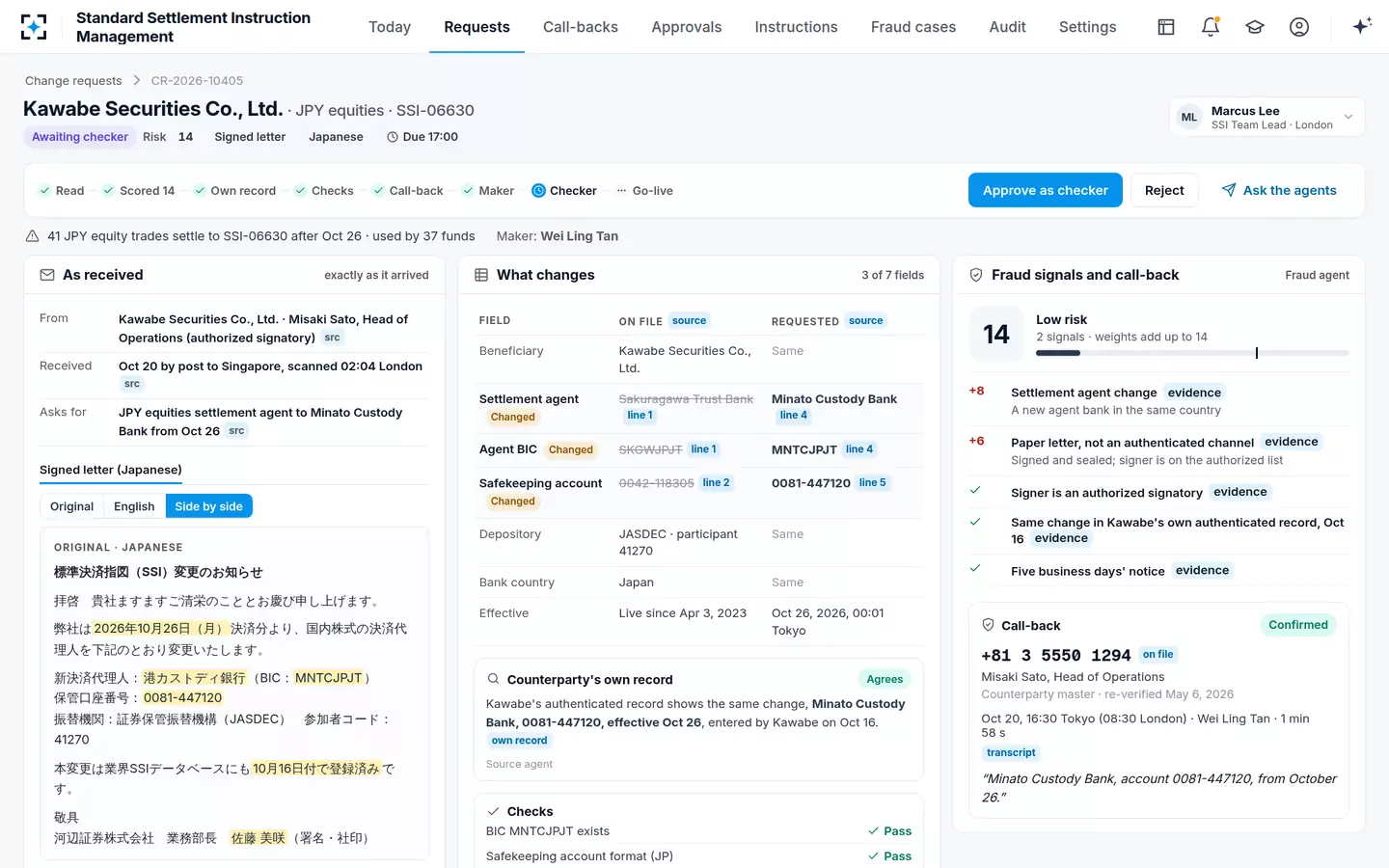
Filled into the template, the change is three lines and an effective date, and that is what an approver should see: the old value struck through, the new value, the line in the letter it came from, and whether the counterparty's own authenticated data says the same. In the sample, the industry SSI database already showed the change, entered by Kawabe on 16 October, and the call-back to the number on file confirmed all three fields.
Should SSIs be sent by letter, email or message?
By a structured, authenticated channel wherever one exists, and by letter or email only as a fallback that is then verified. The UK plan asks for SSI changes to be notified well before they take effect, ideally through a market-standard automated solution, and says that "Where possible, SSIs should be communicated prior to trade execution" (UK Accelerated Settlement Technical Group). The EU's 2026 rules allow unstructured methods for allocations "only" in cases of "temporary technical unavailability or service disruption" (Delegated Regulation (EU) 2026/1536).
In practice four channels coexist: an industry SSI database where counterparties maintain their own data, Swift's MT 670 and MT 671 standing settlement instruction messages, portal uploads, and email or letter. The sample firm's October shows the mix: 171 database notices, 16 Swift messages, 31 portal uploads, 142 emails and 58 signed letters. The emails and letters are the minority that carries most of the risk, because nothing in the channel proves who sent them.
One month of SSI changes at the sample firm, by channel
171
industry SSI database notices, entered by the counterparty itself
200
emails and signed letters, which prove nothing about the sender
47
portal uploads and Swift messages
What checks can an SSI template support?
A structured template lets software test every field before a trade uses it, and those tests catch most honest mistakes: a mistyped account, a BIC that does not exist, a missing intermediary. The CPMI–IOSCO principles make the same case for infrastructures, asking them to use internationally accepted "standardised messaging formats and reference data standards for identifying financial instruments and counterparties" (PFMI, paragraph 3.22.3).
Checks a structured SSI template makes possible, and what each one proves
- The BIC exists, belongs to the named bank and sits in the stated country
Catches typing errors and a bank name that does not match its code. It does not show the account belongs to the counterparty.
- The IBAN check digits are valid, or the account fits the market’s format
Catches a transposed digit. A fraudster’s real account passes too.
- The LEI resolves, is current and names the counterparty
Ties the SSI to one legal entity. In October 2026 GLEIF’s register showed 1,214,439 lapsed LEIs against 1,995,251 issued, so a lapsed code is common and worth a question.
- The depository and participant code fit the security and the market
Catches an instruction pointed at the wrong place of settlement before the trade does.
- Sanctions and watch lists show no hit for the bank, intermediary or country
A new bank on a list is a stop, whatever else the request says.
- The fields are complete for the asset class and currency
A missing intermediary or clearing code is a returned payment tomorrow.
- The change agrees with the counterparty’s own published data
The first check that speaks to authenticity, not format.
The LEI line is the one most often skipped. The nine US agencies' joint data standards under the Financial Data Transparency Act established the LEI as the joint standard for identifying legal entities, effective 1 October 2026, though no agency's reporting changes until that agency acts to adopt it (FDTA joint data standards, 2026; what the rule did and did not adopt is in FIGI vs CUSIP after the FDTA final rule). For an SSI desk its use is simpler: a change that moves a counterparty's cash to a country where its LEI data shows no entity is a question worth asking. Keeping those identifiers current is the work of Security Master Data Management; its guide to LEI renewal shows how often they lapse.
What a template cannot tell you
A template tells you a change is well formed; it cannot tell you the counterparty asked for it. Every check in the list above except the last one passes for a forged request that names a real bank and a real account, and in the solution's sample the forged Brennmoor request passed the BIC, IBAN, intermediary and sanctions checks. The Checker agent's comment on it was six words: "Well formed is not the same as genuine."
The SEC found the same gap in 2018, when it investigated nine public companies that had paid fraudsters. The companies had procedures that required changes to supplier bank details to be verified, yet staff read the compromised emails themselves as enough to make the change (SEC, Report of Investigation 34-84429). The control that closes the gap is not in the template: it is a call-back to a number you already hold, and a call back procedures audit sets out the evidence that proves it was done.
What changes, field by field: the template view of a forged request
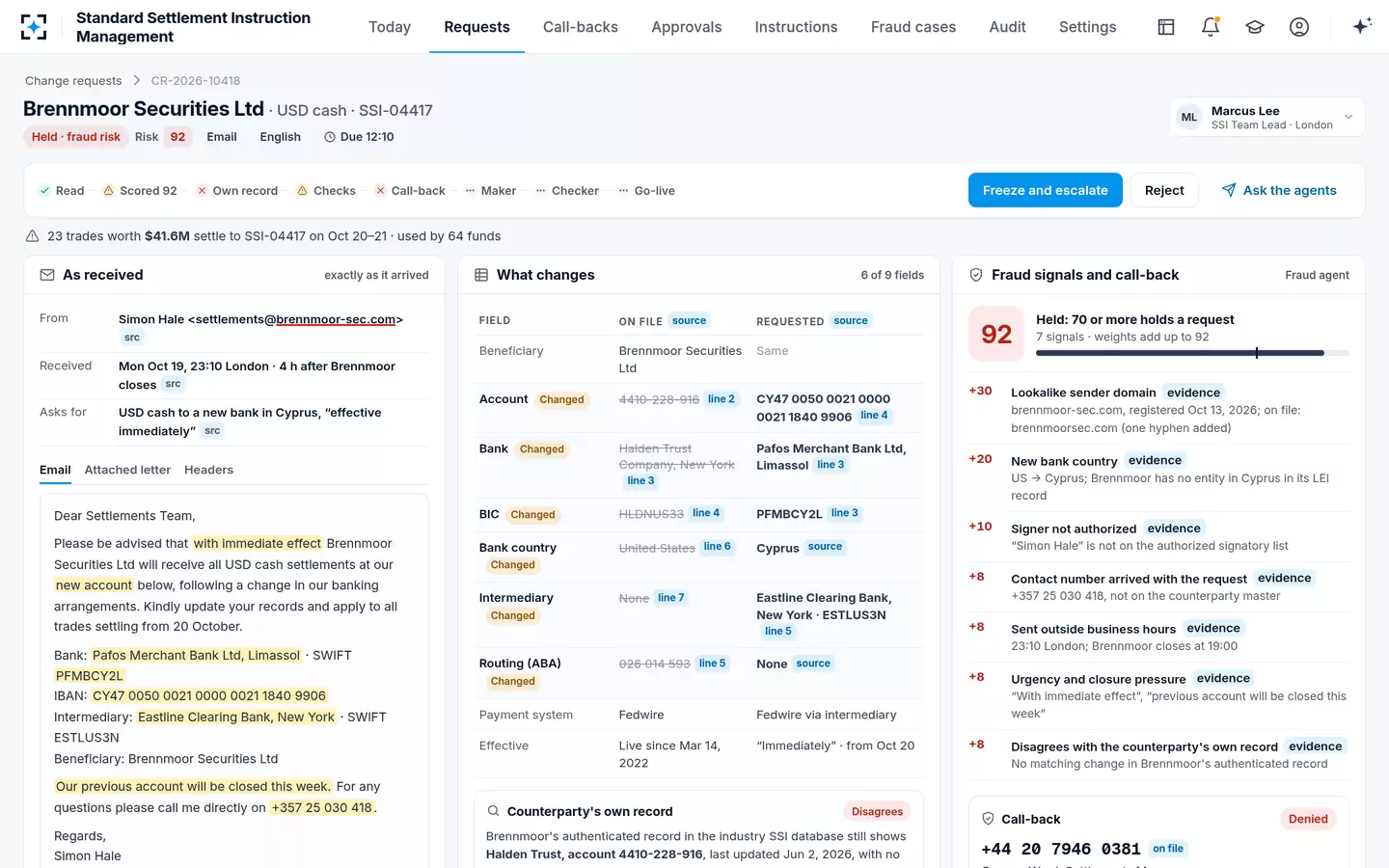
The template is the first of the three things a sound SSI process needs: structure, then authentication, then two people. Who signs a settlement instruction letter covers the people; to see the template view on your own requests, start from Standard Settlement Instruction Management.
Questions people ask
Is a BIC the same as a SWIFT code?
Yes, in everyday use. The business identifier code is defined by the ISO 9362 standard and Swift registers the codes, which is why people call it a SWIFT code. A BIC has eight or eleven characters: the institution, the country, the location and an optional branch. Checking that a BIC exists says nothing about who owns an account at that bank.
What is an SSI form?
An SSI form is the paper or PDF version of the template: the counterparty fills in its accounts and agents and an authorised person signs it. Many firms still send them at onboarding. A form should be read into structured fields, checked, and confirmed with the counterparty on a channel you chose before it is used.
Can one SSI cover several funds?
A broker's SSI usually covers every fund that trades with it in that market, which is why a single wrong broker SSI can fail trades across many funds at once. In the sample, Brennmoor's US dollar cash instruction was used by 64 funds. An asset manager's own SSIs are normally per fund, because each fund has its own custody accounts.
How often should SSIs be re-confirmed?
No regulation sets a period. Common practice is to review instructions that have not been used for a long time, those used in a failed trade and those flagged high risk. The sample firm uses twelve months of non-use as its trigger and reviews every quarter; a dormant SSI should be confirmed or retired before a trade picks it up.
What should never be on an SSI template?
A contact phone number you intend to use for verification. A number that arrives with the instruction belongs to whoever sent it. The call-back number should come from the counterparty master, set up and re-verified separately, so a forged template cannot carry its own confirmation.