AI can read settlement instructions that arrive as PDFs, scanned letters and emails, in any language, and turn them into structured standard settlement instruction (SSI) fields with each value cited to the line it came from; Botminds' Standard Settlement Instruction Management does this with an Intake agent that also links each request to the counterparty and the instruction on file. That is the easy part of a go-live. What decides whether the tool is safe on day one is what the firm brings to it: a counterparty list cleaned of duplicates and lapsed identifiers, an export of the SSI master with its versions, a register of call-back numbers set up and verified independently of any SSI letter, written approval rules, and a month of past change requests to replay before the old spreadsheet is switched off. This guide lists each of those inputs with its owner and when it is needed, for the project lead of an SSI tool, with the EU's 7 December 2026 and the UK's 31 December 2026 SSI deadlines in view.
The examples come from a fictional asset manager, Quillfield Capital, as it runs through the solution. Regulators' dates and figures are linked where they appear.
What to bring before AI reads your settlement instruction PDFs: each input, its owner and when
- The counterparty list, de-duplicated, with legal names and LEIs · settlement operations with onboarding · week 1
Every request is linked to a counterparty; two records for one broker split its history and its call-back number.
- An export of the SSI master, with versions and the funds that use each instruction · SSI team lead · week 1
The tool compares every request with the instruction on file; it needs the current version and what it replaced.
- The call-back register: numbers, contacts, business hours, last verified · SSI team lead with financial crime · weeks 1–3
Built from sources independent of SSI letters and re-verified; the one input the tool must never fill from a request.
- Authorised signatories and known email domains per counterparty · SSI team · week 2
Lets the agents flag a signer who is not on the list and a sender domain that is one character off.
- Your SSI policy and call-back procedure, written · head of settlement operations · week 2
Which changes need a call-back, notice periods, the hold threshold, who may approve; these become settings.
- Roles: makers, checkers, financial crime, payment releasers · head of operations with IT security · week 2
Maker and checker must be different people, and payment releasers cannot approve instructions.
- Connections: changes mailbox, SSI database, Swift, recorded telephony, SSI master, order management, custodians, payments · IT · weeks 2–4
Reading without go-live receipts leaves a gap between approval and the systems that build instructions.
- Last month’s change requests, with what your team decided, and any known frauds · SSI team lead · week 4
The replay set: the only honest test of reading, scoring and holds on your own data.
Can AI read settlement instructions that arrive as PDFs and letters?
Yes, including scans, letters in other languages and emails with the details buried in prose. In the sample, the Intake agent read 31 requests overnight from five channels, letters in Japanese, German, Portuguese, Spanish and Chinese among them, merged two duplicates, and linked each request to the counterparty and the instruction on file. A request it cannot complete goes to a "needs information" queue with a drafted request for the missing fields, addressed to the contact on the counterparty master, not to the sender.
Two things matter more than raw accuracy. The first is the citation: every extracted value points to its line in the original, and the original sits beside the English, so a checker verifies what the counterparty wrote. The second is humility about what reading proves. A perfectly read PDF can be a perfectly forged one; reading is the start of verification, not the end of it. What the agents may and may not decide is drawn out in AI for standard settlement instructions.
What does an SSI tool need from us before go-live?
Data it can trust, rules it can apply, and people it can hand decisions to. The checklist above is the short version; the sections below take the hardest inputs in turn. The order matters: a tool connected to the mailbox before the call-back register is clean will book calls to whatever numbers the register holds, and a register built in a hurry from old onboarding files carries every number a fraudster ever got into them.
Who brings what to an SSI tool's go-live, and what each keeps afterwards
Today
Owns the SSI policy, in a document few people read.
With agents
Turns the policy into settings: thresholds, call-back rules, notice periods; signs the go-live.
Still theirs: Policy and the decision to switch over
Today
Holds the master, the spreadsheet of numbers and the team’s habits.
With agents
Supplies the master export, the call-back register and the replay set; runs the parallel month.
Still theirs: Checker approvals
Today
Hears about attempts once the damage is done.
With agents
Reviews how numbers were verified and what counts as a case; owns the fraud queue.
Still theirs: Case decisions and reporting
Today
Maintains feeds to custodians and payments.
With agents
Connects the mailbox, SSI database, Swift, telephony and the systems that take changes, with receipts.
Still theirs: Connections and access
Today
Samples changes once a year from three sources.
With agents
Agrees the evidence each change must carry and tests the replay.
Still theirs: Independent testing
Which data must be cleaned first?
The counterparty list, because every other check hangs off it. Duplicates split a counterparty's history; a stale legal name hides a merger; a lapsed legal entity identifier means the identity data has not been confirmed for a year or more. Lapses are common. On 28 October 2026 the GLEIF register held 1,995,251 LEIs with issued status and 1,214,439 lapsed, and among funds 153,729 issued and 48,727 lapsed, about one in four (GLEIF public LEI API). Keeping identifiers current is the job of Security Master Data Management, whose guide to LEI renewal covers lapses; the SSI tool needs the result.
Lapsed legal entity identifiers are common enough to check before go-live
37.8%
of issued plus lapsed LEIs were lapsed, all entity types
24.1%
of fund LEIs were lapsed
1,214,439
lapsed LEIs in the register
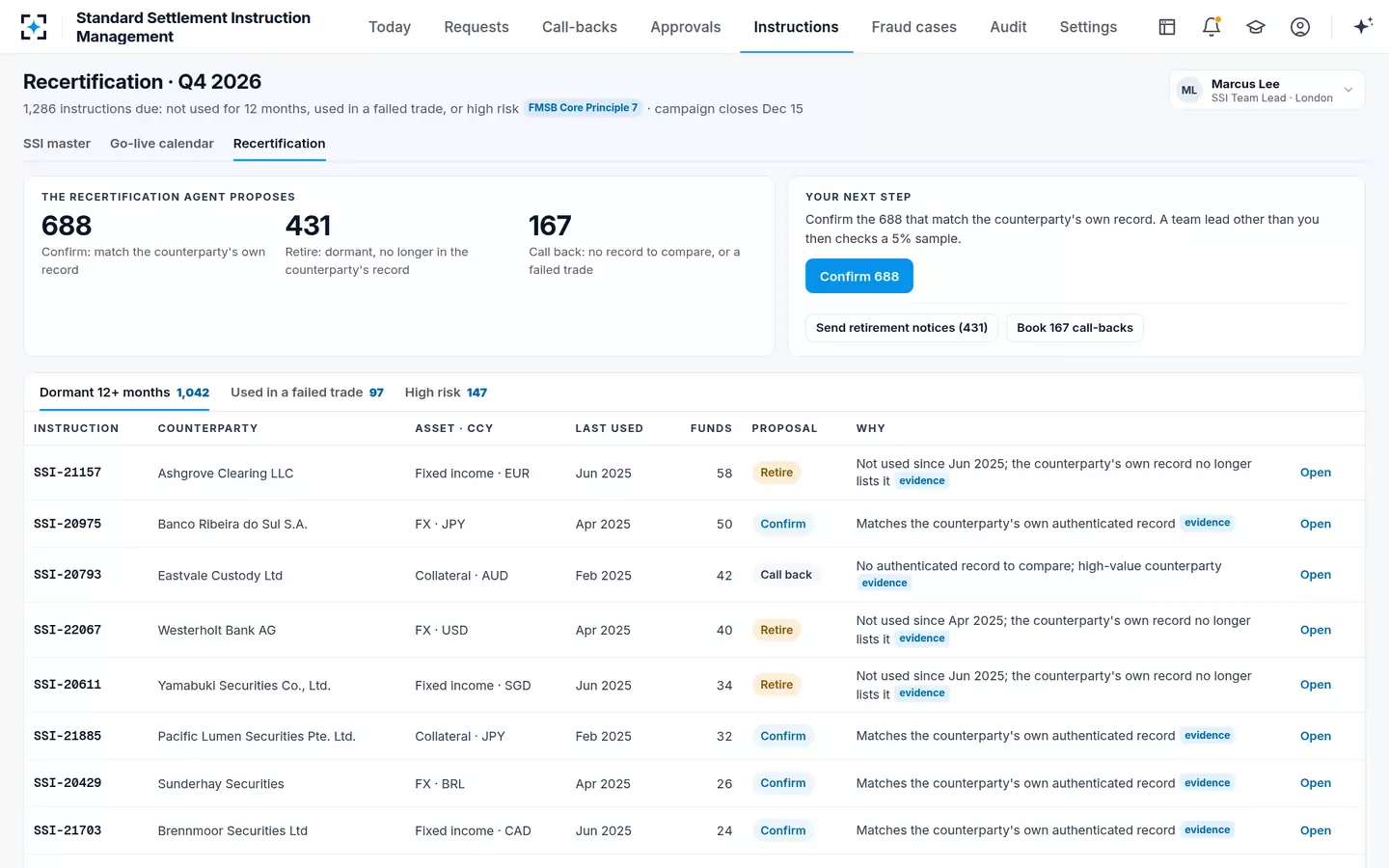
Next comes the SSI master. Each counterparty should have exactly one active instruction per market, asset class and currency it trades, each with an effective date and the funds that use it. Instructions nobody has used for a long time are candidates to confirm or retire before go-live rather than after; the sample firm's first quarterly review covered 1,286 instructions and found 688 that matched the counterparty's own published data, 431 to retire and 167 that needed a call-back.
A first recertification sorts the inherited SSI master into confirm, retire and call back
How do you load counterparties' existing SSIs?
Export them with their history, map them to the template, and compare them with the counterparties' own published data before trusting them. Mapping is mechanical: each field in your master goes to a field in the template, with market-specific fields such as depository participant codes and local clearing codes carried across. The comparison is the valuable step, because it turns an inherited file of unknown quality into three lists: instructions that agree with the counterparty's own data, instructions that disagree, and instructions with nothing to compare against.
Expect the disagreements to be mostly honest. Counterparties change custodians and forget to tell everyone; old instructions survive for markets nobody trades any more. Each disagreement is a change to verify like any other, with a call-back to a number on file, and it is far cheaper to find them before go-live than on a trade-date night under T+1. EU T+1 starts on 11 October 2027 (Regulation (EU) 2025/2075).
Who owns the call-back register?
The SSI team lead, with financial crime reviewing how it was built, and nobody may change it on the strength of an email. The register is the list of numbers, named contacts and business hours the tool will book call-backs to. Every number in it should have a source other than an SSI letter, such as the onboarding file confirmed at the time, a number verified through the counterparty's own published data, or a verified relationship contact, and a date it was last verified. The sample firm records a re-verification date beside each number; the broker number called in its forged-request case had been re-verified eight months earlier.
Treat changes to the register itself as SSI changes: verified through a separate channel and approved by two people. A fraudster who can change the number on file does not need to beat the call-back. Voice is no longer proof of identity either; FINRA's 2026 oversight report describes fraudsters using voice clones to persuade firms to change access to accounts (FINRA, 2026 Annual Regulatory Oversight Report), which makes the number's origin the thing to defend.
What approvals must be configured?
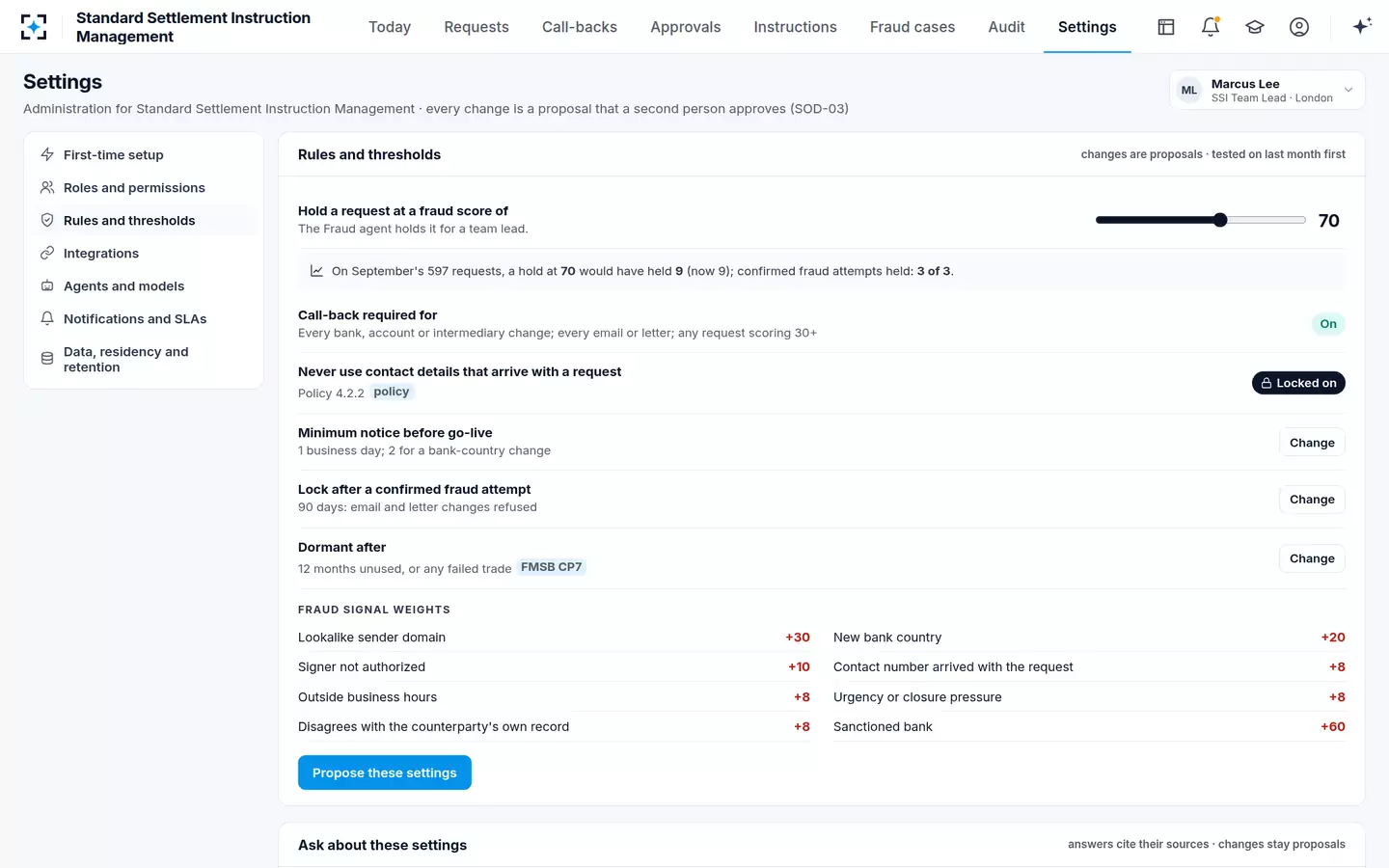
Who may verify, who may approve, and what nobody may do. Configure makers and checkers as separate roles, bar anyone who can release payments from approving instructions, and set what a change needs before it can go live: a call-back for every bank, account or intermediary change and every email or letter, a minimum notice period, and a hold threshold for the fraud score. In the solution these are settings, and every change to a setting is itself a proposal approved by a second person and shown against last month's requests.
Your SSI policy as settings, each tested on last month before it changes
How long does go-live take for an SSI tool?
It depends mostly on the inputs above and on the connections, not on the reading. The plan below is the sequence we suggest, not a promise of dates: clean data first, connections second, a replay of past requests third, then a month in parallel with the existing process before the spreadsheet is retired. Set it against the regulatory dates: EU allocations in a structured electronic form, with the place of settlement, from 7 December 2026 (Delegated Regulation (EU) 2026/1536), and the UK plan's actions to adopt the industry SSI standard and to "review and test" reference data functions by 31 December 2026 (UK Accelerated Settlement Technical Group).
A go-live plan for an SSI tool, in weeks: most of the time is data and testing
- Clean the dataweeks 1–3
- Connect systemsweeks 3–4
- Replayweek 5
- Parallel run with the old processweeks 6–9
- Switchweek 10
What do you test before switching off the spreadsheet?
That the tool reads, holds and records as well as your team on your own data, and that a forgery cannot get through. Replay last month's change requests, including any known frauds, and compare the tool's extractions, scores, holds and booked numbers with what your team did. Then send a seeded false request, agreed with management, from a lookalike domain with its own phone number, and follow it to a freeze. Then run a month in parallel and count the exceptions.
Tests before the spreadsheet is switched off, and what passing looks like
| Test | How | Passes when |
|---|---|---|
| Reading | Replay last month’s requests; compare extracted fields with what the team keyed | Every difference is explained; each field cites its line |
| Holds | Replay at the proposed threshold, including known frauds | All known frauds held; the number held is one the team can work |
| Numbers | Check every booked call-back against the register | No number came from a request |
| Seeded forgery | Send an agreed false change from a lookalike domain with its own number | Held, called back on file, denied, frozen |
| Go-live | Make test changes live; break one connection on purpose | Receipts from every system; the failed push is shown, queued and retried |
| Evidence | Export the file for five changes | Request, number source, call, both signatures, receipts, for each |
| Overrides | Count corrections people make to agents during the parallel month | Falling, and each has a reason code |
ESMA's consultation found most respondents thought a central, market-wide SSI utility "would not be compatible with the T+1 implementation timeline" (ESMA final report, October 2025), so for the next few years firms will keep receiving SSIs by every channel at once, PDFs included. The evidence each change should carry after go-live is in the call back procedures audit, and the case for doing it at all in what one wrong SSI costs. To see the replay on your own past requests, start from Standard Settlement Instruction Management.
Questions people ask
Can AI read handwritten or poor-quality scans of SSI letters?
It can read most scans, but a value it cannot read with confidence should be flagged, not guessed. In the solution, a request with a missing or unclear field goes to a "needs information" queue with a drafted request to the contact on file. A guessed account number is worse than a delayed change.
Do we need an industry SSI database to use an AI tool?
No, but it helps. Counterparties' own entries in an SSI database are the strongest automated evidence that a change is genuine, and the tool compares each request with them. Without one, more changes depend on the call-back, which is the control that matters most anyway.
Where should the AI tool sit relative to the SSI master?
In front of it. The tool reads, checks and holds requests, and only an approved change, signed by a maker and a different checker, is written to the SSI master and the systems that use it, at the agreed time and with a receipt from each. The master stays the single source the trading and payment systems read.
Can we start with one region or asset class?
Yes, and many firms should: start where the volume of emailed and letter changes is highest, or where fraud attempts have come from. Keep the call-back register and approval rules firm-wide from the first day, because a fraudster will aim at whichever channel is still on the old process.
What happens to the old spreadsheet?
Retire it after the parallel run, and archive it with the go-live evidence. Running two sources of SSIs side by side after go-live recreates the inconsistency the project was meant to remove; the SEC described exactly that problem in 2023, when it noted that firms' matching tools often rely on inconsistent SSI data kept on separate databases.